
Sad Goodby to Spain or Was It? Who Lost the Travel Documents?
What an exciting and uneventful day it was going to be. We packed, said goodby to our apartment and Seville and got to the airport with time to spare. We were scared whitless by the RyanAir email we received a few days prior which informed us of all the stringent rules that if not followed to the letter would result either in a huge fee or denial for boarding. We thought we were all ready, and sure enough all went well as we got our stamp at the airline office and pre weighed our bags–I was well within the limits–Kathy barely squeezed by after she ate one of her hidden chocolate bars–she was a pound under weight–at least in the bag:-)–and measured the size of our carryon to make sure it would be allowed. We had time to eat a little something, did, and then to our horror, just moments before we were to check-in for the gate, we realized that our documents were missing.
I did not start it–Kathy insinuated that I had mis-placed them. Imagine us tearing through our suitcases, clothes flying. I replied that I am not in charge of documents, she is, after all, she knows how I lose things. “Yep,” she said, “you lost them.” “No, I remember handing them to you,” said I. “No!” She was adamant that I had brought us to this travesty. I was positive she lost them, but do you know what it is like when your wife’s dander starts to rise–that dander was going off the charts. Then we remembered, we had printed one extra copy of the documents–big sigh of relief. Now to start the process all over again. Of course, this meant we were now at the back of the line and the plane is no seat reservations–first come first served, and that meant we would be middle row rear and I would be stuck between–well, you know.
Sure enough when we got to the gate we waited in a very long line and as they made the announcement to begin boarding they also said, “Passenger Graumann and his wife, please come to the counter.” Ah-oh. As we approached, the attendant handed us our first documents, found somewhere and smiled and pointed for us to go first in line. Amazing! The other passengers wondered who these important people must be. As soon as we cleared the check-in, I turned to Kathy and said, “See how blessed we are because I lost those documents?” HIGH FIVE–SLAM DUNK–I WIN!!!

If It Were a Snake, It Would Have…
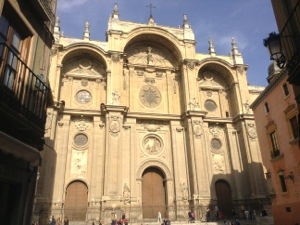
It was right under our nose–an architectural gem–and we had not seen it. How was that possible? We were so comfortable in the historic old town that we no longer took a map on our outings, but somehow we missed this. El Divino Salvador Collegiate Church is considered a masterpiece of the Baroque expression of art and the high point of the Spanish School. It is exquisite in every detail. The realistic beauty and passion of the religious figures depicted throughout were often times breathtaking. We stood quietly in awe as beautiful music filled the space and gave it a majestic serenity. It was here on the masterful Baroque organ that De Arauxo composed “Facultad Organica,” one of the music world’s outstanding organ works. Our last full day in Seville–tomorrow we leave for Italy–and we accidentally left one of Spain’s best for last. WEG
(Please note: Occasionally on the video, I said, “Rococo,” when I should have said “Baroque.”)
Busted
To all of you sending Kathy notes of encouragement about the chocolate, she is hopelessly enamored without it. And, I have caught on to her shenanigans with the so called authentic Spanish hot chocolate, that is really nothing but straight and pure warm chocolate in a cup. Whether it is in solid or liquid form, it still has the same number of calories–one cup (btw–a cup for Kathy is a mug the size of a Texas quart jar) is an entire caloric intake for a day. I can eat 10 pastries and not even come close.
Tonight, we go to Teatro De La Maestranza for the Sinfonica De Sevilla in concert with Ravel, Saint-Saens, Schubert and Mozart on the play list. We have been looking forward to getting to this venue which looks impressive from the outside and is beside the famous Sevilla Maestranze or bull ring. I wanted to attend a fight there, but alas, the season opens after we depart. So, I am posting earlier today than usual. We will get back to our apartment after midnight unless the chocolate con churros shops are closed for the night, then we will get back earlier–I pre-bought some pastries just in case those shops are closed;-) WEG
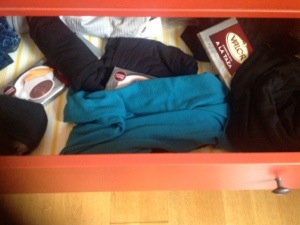
Chocolate is for Lovers
For those of you who, along with me, would prefer hot chocolate to pastries if made to choose, then I have the authentic Spanish recipe for you:
Use the Valor Chocolate A La Taza 10.5 ounce chocolate bar that is made only in Spain, but has been exported to the U.S. The Valor bar is a chocolate intended for consumption after cooking and uses rice flour as the thickening agent. Heat whole milk on the stove. When warm, add 4 oz. of chocolate for each 6 1/2 oz. of milk. Stir constantly over low heat. Just before boiling, remove from heat. Let chocolate settle for a few minutes before pouring into a cup placed on a saucer; then, drink slowly. Be sure to use a spoon to get out the last bit of chocolate! Now, just imagine sipping your drink slowly on a moon-lit evening in an outdoor plaza heated with flaming torches, in the shadow of the ancient cathedral with street musicians providing enchanting tunes, while watching couples, young and elderly, walking arm in arm, relishing the moment. That’s the Spanish experience! And that’s why I say, “Chocolate is for lovers!” Let Wayne have his pastry:-)
Since many of you have inquired, I am also delighted to share with you the story of this traditional hot chocolate drink with which I have fallen in love, like most of the Spanish people ever since Christopher Columbus discovered cacao beans used by native Americans in 1502. It was Hernando Cortez, though, who sent cacao beans back to Spain in 1544. The Spanish explorers liked the drink made from cacao, but added something that the Mayans and Aztecs could not: cane sugar. Though the Spaniards brought cacao back to Spain, they incredibly kept the discovery a secret from the rest of Europe for almost a century! Once the rest of Europe tasted this new drink, it became a fad that swept across the continent. The nobility and elite of Europe were the only ones who could afford to drink chocolate, since it was made from two expensive imports – sugar cane and cacao. Finally, in the 1800s, the technology of the Industrial Revolution helped transform chocolate from liquid form into solid bars; thus, mass production made the delicacy affordable to the rest of the population.
Chocolate drinking establishments in Spain are called chocolaterias where the sweet, rich beverage and cakes and pastries are served. The story is told that the Spanish people were so enamored with the drink that the Pope was asked to change the rules regarding fasting to exclude chocolate! It seems that on every street here in Seville is an establishment that serves the thick, rich chocolate drink “con churros” (hot chocolate with fritters).
Come visit us in our home after our return to Tomball, and we can enjoy the Spanish experience together. I’m going to sneak a few Valor Chocolate A La Taza bars into my suitcase before leaving Seville. Just don’t let Wayne know; I’ve told him he cannot stuff pastries into the suitcase! KG

Pastry Taster
It’s a hard job, but someone needs to do it! And I have volunteered. I have eaten enough pastry in Spain to have been recognized as a pastry taster. It is a self-appointed title, but it works for me and Kathy has to let me taste test now, since it is my job.
So far I have visited ten purely confectionaries, and around 15 or so part pastry, part other food. Multiply all that by, um-m, say three different pastries each and you see why I am the Spanish Pastry King that I am. Here is my take:
The French toast/bread pudding kind of thing is great. Kathy is the baker in our home. She will try to recreate it when we return. If it works, just ask:-)
The pull apart with layered and airy crust topped with apricot cream is really good. It comes in several forms and some are one side chocolate or pistachio. Chocolate is always dark and barely sweet.
The North African nut, spice and baklava kind of thing dripping in honey is a show stopper. Only lack of money stopped me from eating every last one in the store. Kathy has put me on a pastry allowance, in case you didn’t know.
The cheese cake is more ricotta cheesy than ours, the cookies are all very light and fluffy–except the North African ones–they are dense and thick. The gelatin-concocted molds in many flavors and toppings look better than they taste.
The flakey rolls filled with chocolate are delicious.
I need to inform you that while I am eating pastry, my wife is sipping thick, you eat it with a spoon, hot chocolate. She drinks it by the gallon. I have tried to put her on a money allowance like she does me, but, believe me, nothing will come between her and the hot chocolate counter. WEG
Stair Master
Incline up–take a stair step; incline up–take a stair step…not a gym machine, but honest to goodness narrow street stairways that just went up and up and up.
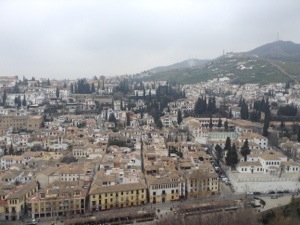
There were obvious advantages to climbing the narrow passageways of the Albaicin quarters, the ancient Moorish area, in Granada rather than using a gym machine. First and foremost are the amazing views along the way! White-washed streets with intersecting alleyways with more steps upward leading in new directions; then a small plaza with little Moroccan restaurants and a quiet wall fountain; more stairways leading in multiple directions (choose one); a long and barely two person wide alley lined with shops selling tea blends we have never seen before or spices of every description open to the air and giving off amazing aromas or North African clothiers and Moroccan restaurants–brightly colored and dark and North African pastry shops with sweets dripping with honey and almond or coconut or apricot cookies; then churches–old with golden altars and painted ceilings and ancient wooden doors and large plazas with jaw-dropping views of snow-covered mountains and the still standing Moorish defensive walls jutting into the hills where gypsy homes are fashioned into the hillside caves, and across the valley, the mighty Alhambra in majestic display–what pleasant views!
Another advantage are the pastry shops–eating fabulous sweets and exercise all rolled into one–what a deal!
Yet another advantage is the open air and flowering trees and chirping birds.
You will never see me on a stair master, but I’ll climb the Albaicine any day.


Granada and Tomball
The amazing Alhambra is a national treasure in Spain and it is easy to see why. High on the mountainside overlooking the fine city of Granada, it has seen centuries pass under its watchful eye of power and prestige as the seat of government for the Moorish empire. This empire passed in 1492 with the coming of King Ferdinand and Queen Isabella who had the goal of ridding Iberia of this foreign invading power (although this invading power lasted over 700 years) and building a united Spain into the premier world power of its day. They succeeded on all counts.
We were thrilled to see Micah Reynolds in Granada today as well. He is full of ambition for his future and enjoying his opportunity to study abroad at the 60,000 student university in Granada, taking courses in Spanish studies that are approved by the University of Texas, Austin. Chris and George Ann have raised a fine young man.
This simply reminded me that people have always looked to the future and what it could bring, whether in ancient Granada or modern Granada. That they leave a legacy for all of us to enjoy is a blessing.



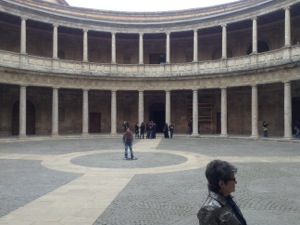

The Monarch’s Catholic
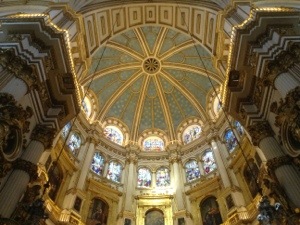
Ferdinand and Isabella, labeled the Catholic Monarchs on most plaques, had a special Royal Chapel built in the city they loved for their burial place. Granada’s significance for the royals was that it was the last bastion of Moorish and Islamic power in Iberia, and it fell before their armies’ might. Having united Spain and allied it with most of the other European nations, they were able to claim Granada as their own and launch Columbus to America from Seville in 1492. They loved the city of Granada above all.
We have now seen the tomb of Christopher Columbus in the grand Seville Cathedral and the tombs of his benefactors in a royal chapel beside the Granada Cathedral. History came alive today for me as I was caught up in the grand sweep of time. WEG

Gas Stations and Locutorios
They have great ways of solving problems in Seville.
Take gas stations. They still have fill up service. I thought, how quaint. No, not quaint, practical. You see, space is so limited in the historic cities like Seville, where the infrastructure was never built for modern conveniences, that inventive ways were necessary to meet modern needs, like filling up the tank with gas. So, very tiny gas stations were put right on the city side walks and you just drive up, usually in a queue, and the attendant quickly gets the gas going. The gas hoses are high power, they fill the tank quickly and you get your card or money ready to pay while the attendant is filling the tank and off you go–no slow gas tank fillers can get in the way of this efficient method.
We found the Locutorio today. They are conveniently located all over the city and one is just a few minutes walk from our apartment. We just did not know what we were looking for or know they existed. When you want to call international, you can use the Locutorio. They are expressly for that service for the international community that lives in Seville. When you enter, you are assigned a compartment that has a telephone and an electronic timer that tells you how much your call is costing you as you speak. We have a European phone for local calls and we will simply switch out the SIM card when we change countries. Using that phone for international calls would be quite expensive. However, the Locutorio is quite inexpensive. We had some banking business to accomplish and the ten minute call was 1,10Euro. Yea!
We are really getting the hang of how to live here. We only have one week left before we move on. That will be a sad departure.
Interesting Things I’ve Learned
Fruits and Vegetables–They come in many more varieties in Spain such as radishes that look like our radishes but also look like carrots and come in lots of colors. You don’t touch them, health rules forbid it. You put on plastic gloves in the super market to pick them up or at the organic section as at the Farmer’s Market, someone picks them out for you, weighs/prices and wraps them for you, wrapped, by the way in a heavy paper rolled into a cone with the top folded in to enclose the package.
Meats–Lots of choices, and if you like ham, the sky is the limit, both in quantity and price. Some of the cured ham, a Spanish specialty, can cost $100 a pound. The cheaper ones are around $30 a pound. You buy it paper thin sliced and it is really good. I bought $4 worth today of one on sale.
Farmer’s Market–Imagine the fresh meat and fish case at Kroger and multiply it 25 times with individual sellers at each case section and you have the Farmer’s Market. It is inside an area under the gigantic Parasols which were built over the ancient Roman ruins. The cases are thematic–all chicken/wild fowl/rabbit, all pork, all fish (eight cases), all fruit/vegetables, all bread/olives/candy, all herbs, all beef and all frozen foods. The meats are all on ice and easy to view and reach, but you do not touch–Spain has high public health standards with signs out. We bought a chicken breast meat and it was walking around clucking only a few hours before–I know, since as a kid we did that kind of thing at our home.
Retail Stores–Lots of specialty shops scattered along streets and byways. We happen upon them by accident as we walk about. Since people are densely packed in apartment living in the core of the city, they simply walk to the store they need in their neighborhood. It’s easy and we have picked it up quickly. Restaurants of all kinds are everywhere. You stop when you are hungry and get a snack or Tapas or pastry and a beer. The evening meal is eaten late and is the main meal of the day. The average people of Seville dress better than the average person at home, by that I mean more formally, even elegantly. If you bring in packages from other retail stores into the supermarket, you place them into a large plastic bag provided by the market and use a hot bar to seal the bag and then you carry it into the market.
I always pay with credit card and they ask to see your passport. At the supermarket, the checker I seek out is used to asking to see my passport in a little game we play. Today, I paid with cash and handed her my passport. She laughed out loud and wagged her finger at me. She now has a story to tell about her crazy American shopper. WEG

 kgraumann
 wgraumann
 gofarther.me