
Home » Uncategorized (Page 18)
Category Archives: Uncategorized
Autumn 2016 Travels in Europe: Lutherland
Friday, October 14, 2016


When we were in Wittenberg three years ago, the entire city was under scaffolding and construction wraps. Today, most of it is gone, as the refurbished city prepares for the 500th anniversary of the Reformation next year, with the posting of the 95 theses (statements) by Martin Luther on the Castle Church door. A beautiful (small) city has emerged. We are astonished.


Much has happened during the past two days. At the Old Latin School, an outreach headquarters for The Lutheran Church–Missouri Synod in Wittenberg, we ran into the International LCMS president, Matt Harrison, who proceeded to give us a personal tour of the Old School. Dating from the 1400s, the School houses a library, chapel, meeting rooms and sleeping quarters for guests. It just so happened that the Old School was hosting a gathering of Lutheran Seminary presidents from around the world, and I was able to visit with Concordia Theological Seminary, Ft. Wayne, Indiana, President Larry Rast. I had served as Chair of the Regents of this seminary for a decade before retirement, and so this was an unexpected pleasure. Mike and Sandra were with Kathy and me, and so they were able to meet and experience along with us. That late afternoon, we attended an English devotional service in the St. Mary’s Town Church (Lutheran) sacristy chapel. In the early evening we were invited to attend the closing Vespers of the International Lutheran Seminaries Leadership Conference in the main church. What more Lutheran experience can there be than singing Luther’s hymn, “A Mighty Fortress,” in the church were Luther preached most of his sermons, with Lutheran leaders from around the world from every tribe and race. A blessing indeed. St. Mary’s is also know as the Cranach Church because there are many paintings by Cranach the Younger in the Church. The altar painting is the most famous and has recently been restored. Art lovers from around the world come to gaze upon it.


We also visited the Castle Church (Lutheran) down the street from the Town Church. The wooden doors where Luther posted his earth-changing 95 theses have been replaced with bronze doors inscribed with the theses. The Castle Church is now beautifully refurbished. It contains the graves of many important historical figures, but none more important than Luther. We enjoyed chilling out in this quaint city, whose inhabitants changed the course of history. WEG


Autumn 2016 Travels in Europe: The Green Vault
Wednesday, October 12, 2016 – Dresden, Germany
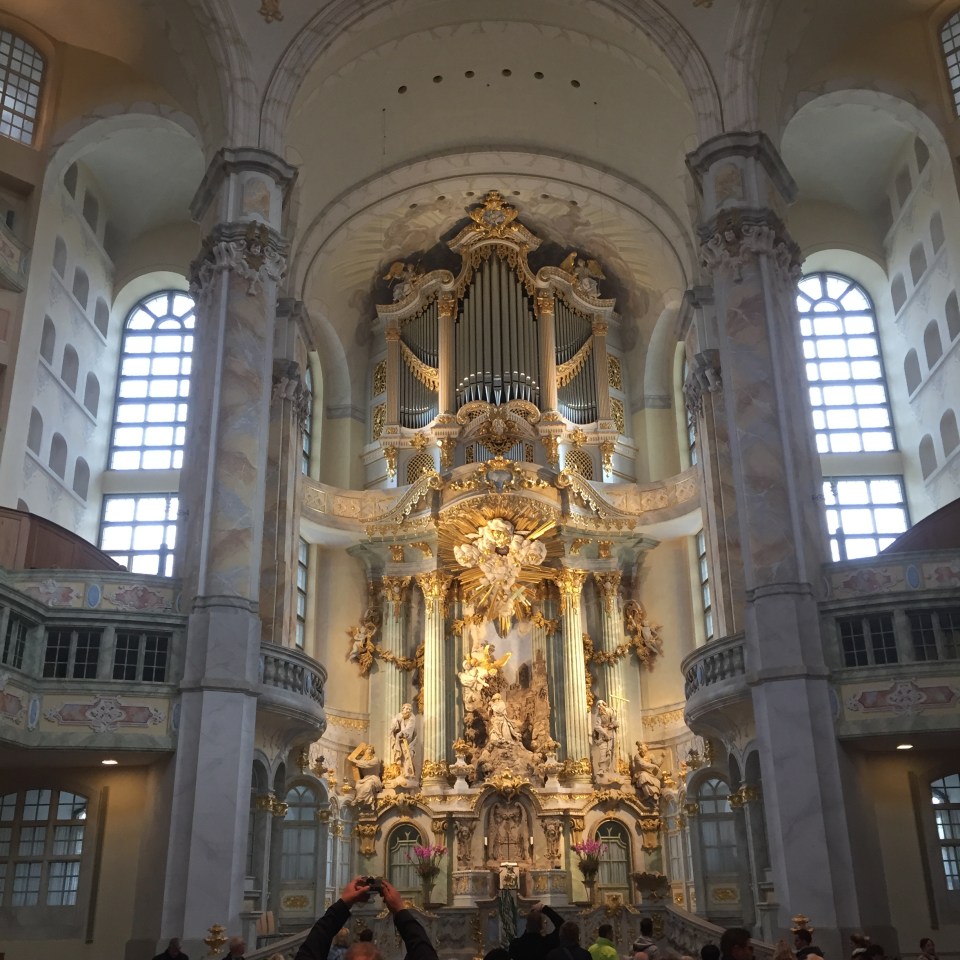
Dresden is famous for one of its historic art collections known as the Green Vault, which is filled with unusual art objects, such as ostrich eggs covered in gold design and a royal jewel collection that is the most complete in Europe. Under ground in marble rooms that turned green with time, the collection was removed prior to the fire bombing of the city in World War II. The vault rooms were heavily damaged, but were rebuilt to former glory and the art reinstated.
Noon time found our group at the magnificent Frauenkirche (Church of Our Lady–Lutheran) for a devotional service. The organ music was wonderful and, although in German, we could make out the psalm reading and the prayers and even recognized the hymn setting. It was a great meditative time seeing the wonderful statuary at the altar, especially Jesus praying at the Garden of Gethsemane, with cherubs flying near and the all-seeing eye of God in a Trinity triangle peering down.
Our group did various activities during the day as each individual determined what was their interest. Kathy and I went to a street fair and walked in the old town. We came upon a stall that made “fried bread,” something my mother made when I was a child and which I had not eaten in like, forever. How good a memory it brought! We also sipped a cup of hot gluwein, a mixture of wine and liquor. It was very good on an unseasonably cold day. It was also rather potent. We walked back to our apartment and took a nap! Rhonda, Allen, and Sherlene went to the Saxon Historical Museum and an outdoor market, and Mike and Sandra went to the Green Vault.
Our evening meal was in a cozy restaurant, and we ate mostly traditional foods. Unfortunately, the waiter did not understand that I only wanted fried spatzle as a side dish without the rest of the featured meal; so he brought each of the foods on the menu that accompanied fried spatzle on separate plates, far more food than one could consume. An English-speaking waiter helped clear up the matter; however, I know it caused them apoplexy. Allen gave me grief over the order, saying, “Next time, just order the whole meal. I’ll even pay for it.” I took that to mean he is paying for all my meals for the rest of the trip :-). WEG


Autumn 2016 Travels in Europe: Masterworks
Tuesday, October 11, 2016 – Dresden, Germany


Raphael, Cranach, Rubens, Durer, Van Dyck, Caravaggio, Tintoretto, Holbein, Cranach the Elder, Cranach the Younger, Titian, Rembrandt, and the works of other great artists make the Old Masters’ Gallery in Dresden an exquisite museum. The collection of art is not overwhelming in number, but it is high quality. Set amidst the grandeur of the Zwinger Palace, the royal home of the Saxon kings, it was a time well spent. We walked through Dresden’s old town and marveled at the splendor of the baroque buildings. It is an appealing atmosphere.


We loved spending part of the day in a shopping mall, marveling at the electronic directory where you simply touched the name of the store you wanted to visit, and the board produced a map from your location to the specific store. We loved people-watching and visiting local stores to compare with our American experience. We noted that the food areas had very little that we would find in our malls, or that it was presented quite differently. You could watch bakers making the breads and pastries. Restrooms are sparkling clean, and you pay 50 cents to enter. There were name brand stores we would know, but also many we would not. Taking this time is one of the reasons we like to arrange our own travels, so that we are not rushed through to simply see the sites.


We loved our evening meal, set in an antique-filled space. Sauerbraten, rouladen, potato and sausage soup, pumpkin soup, red cabbage, potato dumplings, and local Dresden beer and wine combined with laughter and good company made for a delightful evening. WEG

Autumn 2016 Travels in Europe: The Saxon Alps?
Monday, October 10, 2016
Our comfortable train ride from Prague to Dresden took us along the Elbe River and through what is called the Saxon Alps (there are no Alps in Saxony) because of the unusual rock formations that make up the high rolling hills. The ride was smooth and the scenery was pleasant, what more could one ask for?
The baroque beauty of Dresden is uplifting. Sometimes the ambiance of a place hints at a certain character and the fine buildings of Dresden say, “culture.” Walking into the old city, there is the immediate sensation of history, planning and beauty. Wide squares, cobblestone streets, architectural integrity and quality of building are immediately evident. We saw an entire city block under an architectural dig in order to save every brick and stone from past centuries that could be reused in rebuilding the block exactly like it was prior to 1945 when Allied bombing (resulting in a fire storm) completely destroyed the city. Workers with small trowels and whisk brooms were painstakingly uncovering items for future use. Since the fall of the Communist hold on East Germany about 30 years ago, Dresden has been recreating the historic city, block by block.
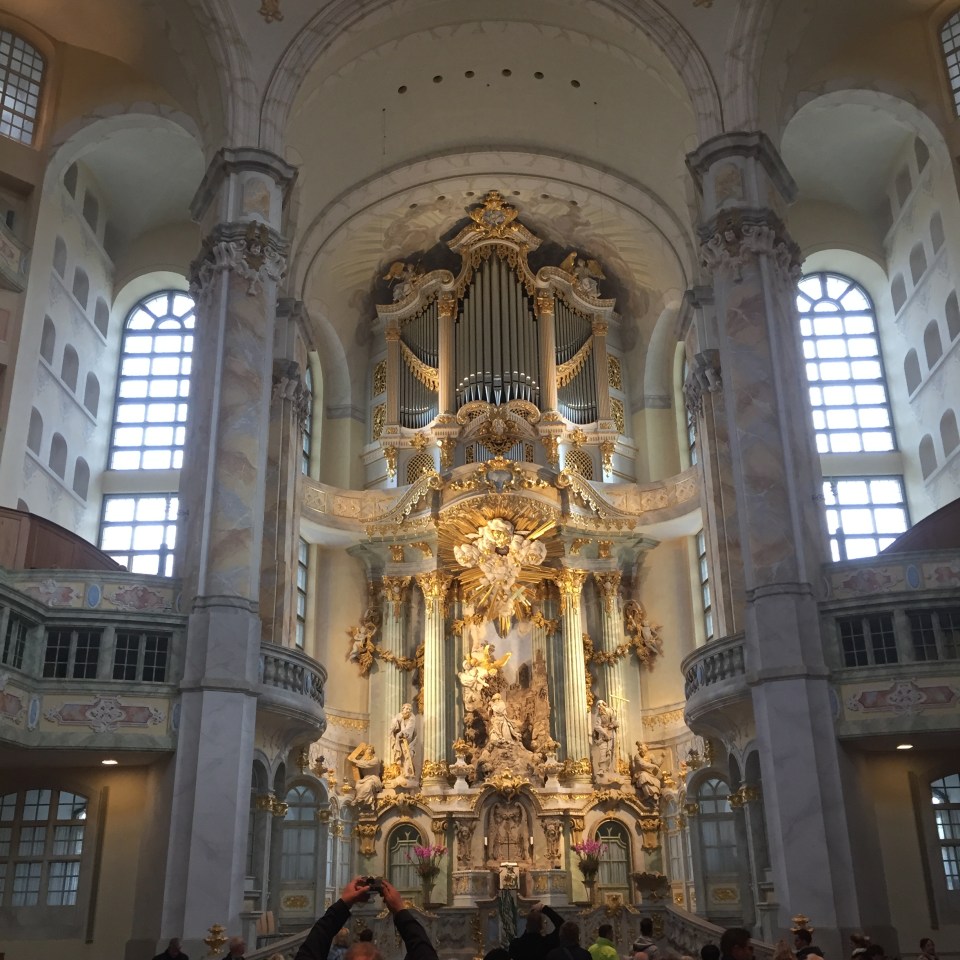
We could not withstand going to the Frauenkirche, the magnificent Lutheran Church that is the icon and emblem of the city. A stunning and worshipful space, the baroque atmosphere is a tranquil mix of pastels. The altar and organ are a brilliant display of statuary in pastels, white and gold. We were able to watch a short film in the media area about the history of the church and the rebuilding efforts that resulted in the church as it stands today. We left the church emotionally moved and inspired.
We ate our evening meal in a wonderfully warm and Saxon-decorated restaurant. The cheese soup was excellent and the roast boar, veal liver, hunters meat loaf and rosti (fried potatoes in a cast iron skillet) with fried eggs were a treat. It was new beer, both dunkle and wheat, both refreshing none the less. We look forward to our days in this glorious city. WEG


Autumn 2016 Travels in Europe: The Largest Castle Complex
Prague, Sunday, October 9, 2016


Going up to the castle high on a hill overlooking the Vltava River and Prague was easy since our tour included the bus ride up. We certainly can testify that this is the largest castle complex in Europe. We walked 3.6 miles on the castle grounds! There is much to see–courtyards and village houses and castle rooms and churches. St. Vitus Cathedral is exceptionally beautiful. The stained glass is bright and inviting. The remains of saints are housed in wonderful sarcophagi; a silver sarcophagus of one of the saints features flying angels and lanterns. St. George (as in the dragon slayer) Basilica was built in 950 AD. Going out the exit of the castle complex on the extreme opposite side as we entered, we expected to find our bus waiting, but, no, it was down, down, down the hill we walked toward the famous Charles Bridge that unites the lower town with the old town Prague.


Then we walked some more as we strolled into the Old Town to watch the astronomical clock strike six o’clock. The clock is at the entrance to a major square where we viewed the ornate and colorful buildings and towers that outline this large space. By the time we got back to our hotel we had added many miles to our daily total, but our minds were filled with the beautiful sights of the day. WEG


Autumn 2016 Travels in Europe: A River Runs Through It

The Blue Danube splits Budapest into two parts, the hilly Buda side with the castles and towering monuments and the flat Pest (Pesht) side with its government, university, civic, cultural and business iconic buildings. Towering church steeples are everywhere. The beautiful bridges that span the Danube link the two sides into one beautiful city.
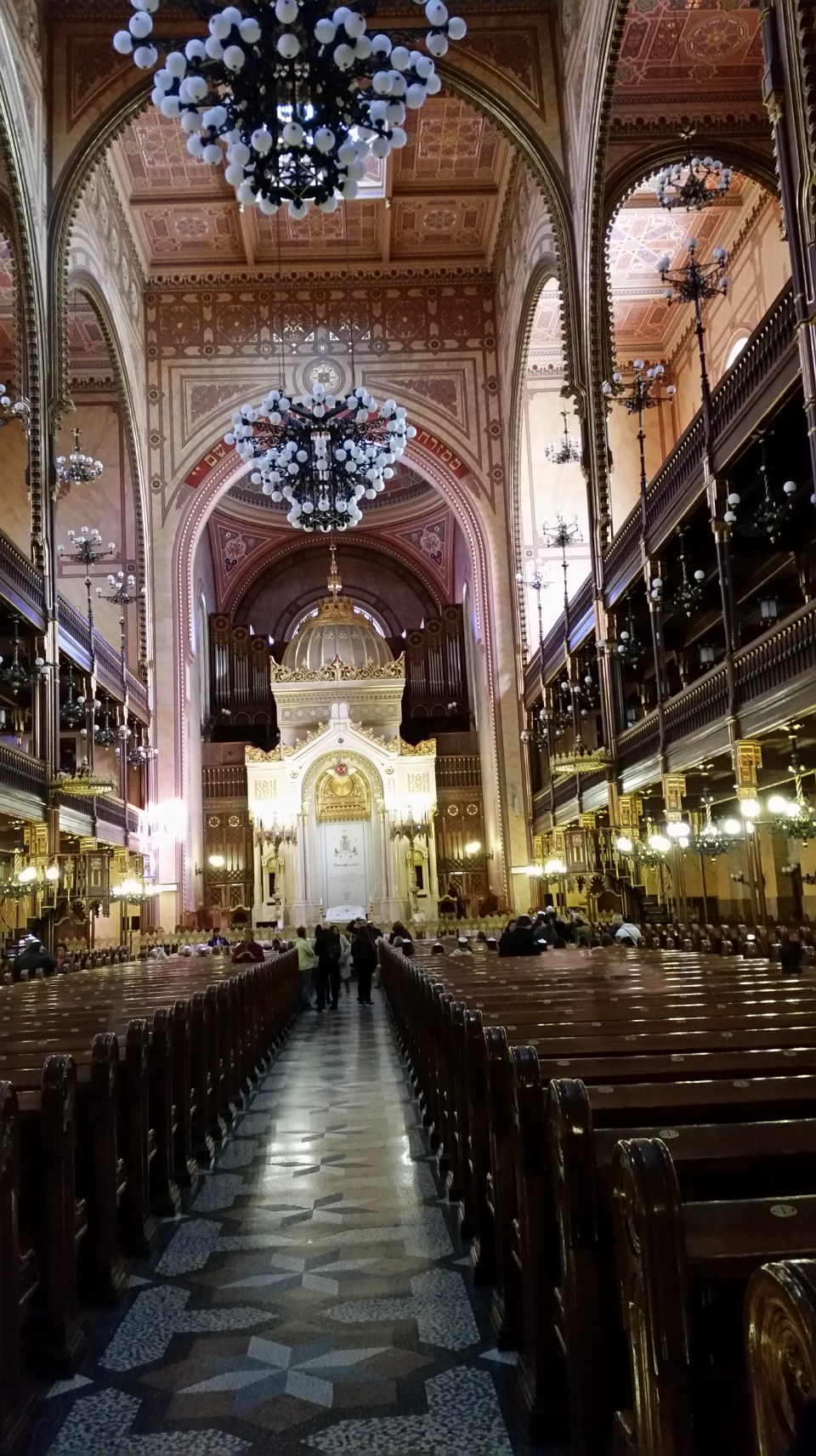
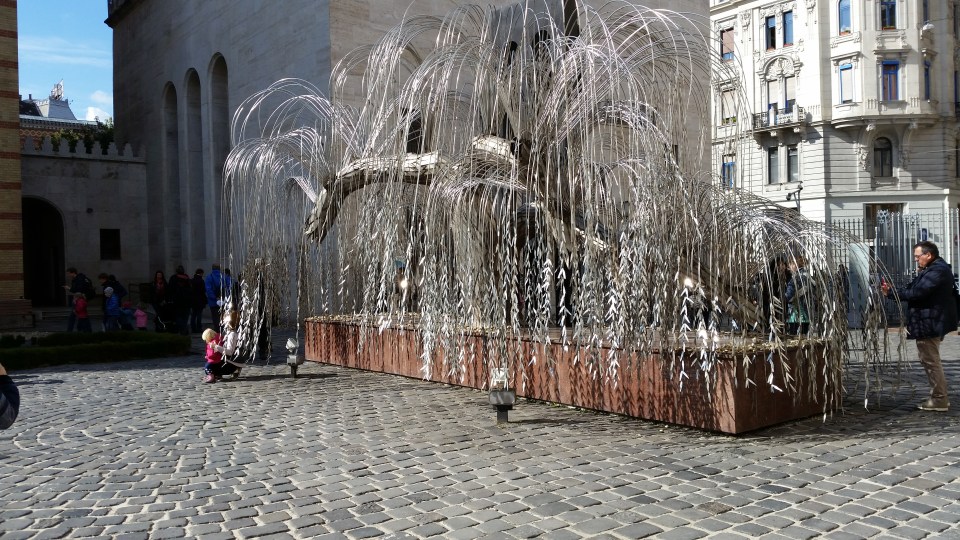
Allen, Rhonda, Sherlene, Mike and Sandra marveled at the Great Synagogue just down from our lovely apartments. It is the second largest in the world and is quite beautiful. Unfortunately, it tells the story of the holocaust that claimed the lives of over 600,000 Hungarian Jews during World War II. The graveyard is left just as the Nazi’s destroyed it. The memorial to the Jews who were murdered is touching yet, at the same time, uplifting. The silver tree with silver leaves that bear the name of a lost friend or relative on each leaf and the memorial stone, “Never forget,” leave a lasting impression. We tried to eat at a highly regarded Hungarian Jewish restaurant, but being the Sabat (evening meal before the Sabbath) it was booked out.
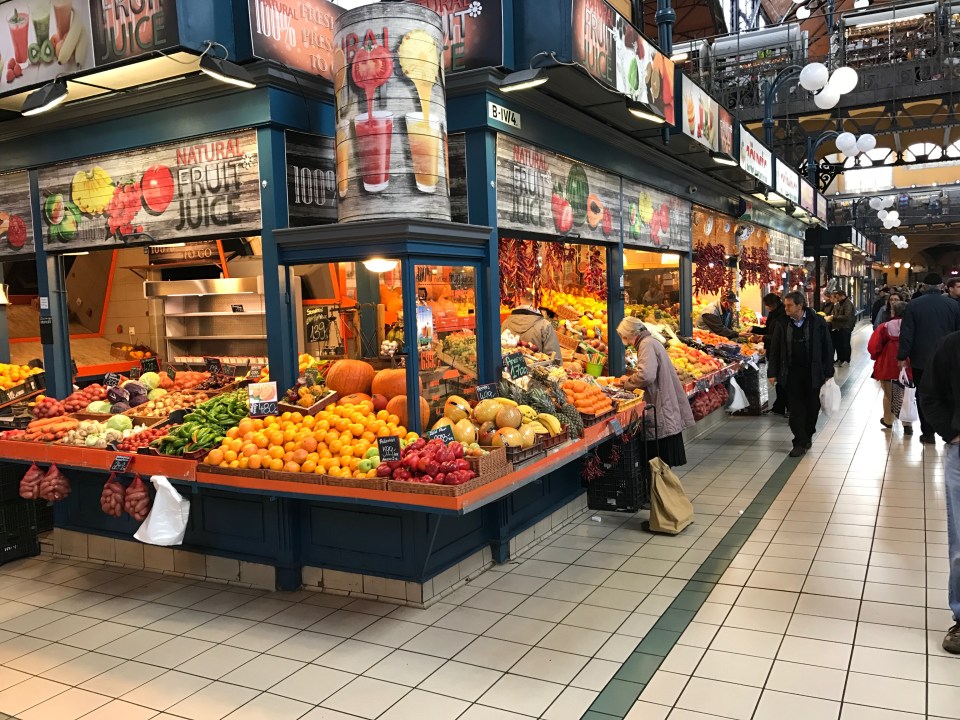
The group also enjoyed the Grand Market. Huge by any measurement, it is filled with foods important to the Hungarian cuisine. It anchors one end of the beautiful pedestrian thoroughfare that winds its way through Pest. In the evening, Mike and Sandra attended a wonderful organ, trumpet and opera concert at the magnificent St. Stephen’s Basilica that featured Mozart’s Requiem. The rest of us watched an artist carve an ice sculpture to music and lights in the Basilica square. We all are in awe of the beauty and gracefulness of this city. WEG
Autumn 2016 Travels in Europe: The Blue Danube

As soon as our dinner cruise on the Danube pulled away from the dock, the string quartet began to play, “The Blue Danube” by Johanne Strauss. We enjoyed a very good buffet meal as we cruised by the bright lights of the Chain Bridge, Buda’s Castle Hill, the Parliament and the city monuments that grace the river. It was a delightful evening!
During the day we rode the “hop on hop off” bus and hopped off by the funicular that ascends to the top of the Buda hills. What an unexpected pleasure to find that soon after our arrival, the palace was conducting the changing of the guard and we had an “up front and personal” view!The guards were precise in their movements and gun maneuvers. Rhonda and I thought that it was better in some ways than the changing of the guard at Buckingham Palace in London. The uniforms were not as colorful, nor were there as many guards, but the maneuvers were excellent.
St. Matthias Church on the hill is such a beautifully painted church on the interior. Every surface is painted with bright colors on gold backgrounds. The views outside the church looking out from the “Fisherman’s Bastian” down onto the Danube and across to Pest are stunning. The huge and iconic Parliament building with its copper red roofs and spires and St. Stephen’s Basilica stand out on the horizon. Budapest is simply a stunningly beautiful city.


Our meals on the trip have been excellent; each country is so different in its native meals. We have enjoyed that variety. We have noted that Hungarian food tends to incorporate a rich variety of ingredients. I ordered hot plum soup and “wow.” Duck is common on the menu. Hungarian goulash is not what your mother made–it is a cubed beef base with a few vegetables in a rich paprika broth. Tortes of cherry or poppy seed or creamed cottage cheese are yummy. We walk enough to eat up the calories, thankfully! WEG
Autumn 2016 Travels in Europe: Up to Heaven
October 3, 2016


Up, up we went in a scaffolding elevator inside the beautiful and tall Karlskirche (St. Charles Church) in Vienna towards the dome painted with scenes of heaven. “We’re going to heaven today,” commented a fellow passenger. Petrified of heights and in an open elevator, I replied, “I just didn’t want to go today.” The scaffolding was in place so that the dome could be repaired and restored. Once we reached the dome level and stepped out onto the scaffolding, I froze, the scaffolding trembling and shaky. I saw a chair and asked Kathy to help me to it, somehow thinking that if I sat I would be safer. That is when I saw the narrow open scaffolding going further heavenward to the copula far above where they were restoring. Kathy said, “Let’s climb.” I said, “No way.” I could not believe they would let you, but they did. She insisted and said she was going. I said, “Go ahead.” She did. I cannot tell you how relieved I was when she returned from 236 feet above ground level, and we descended to the main floor of the beautiful church. What an experience!

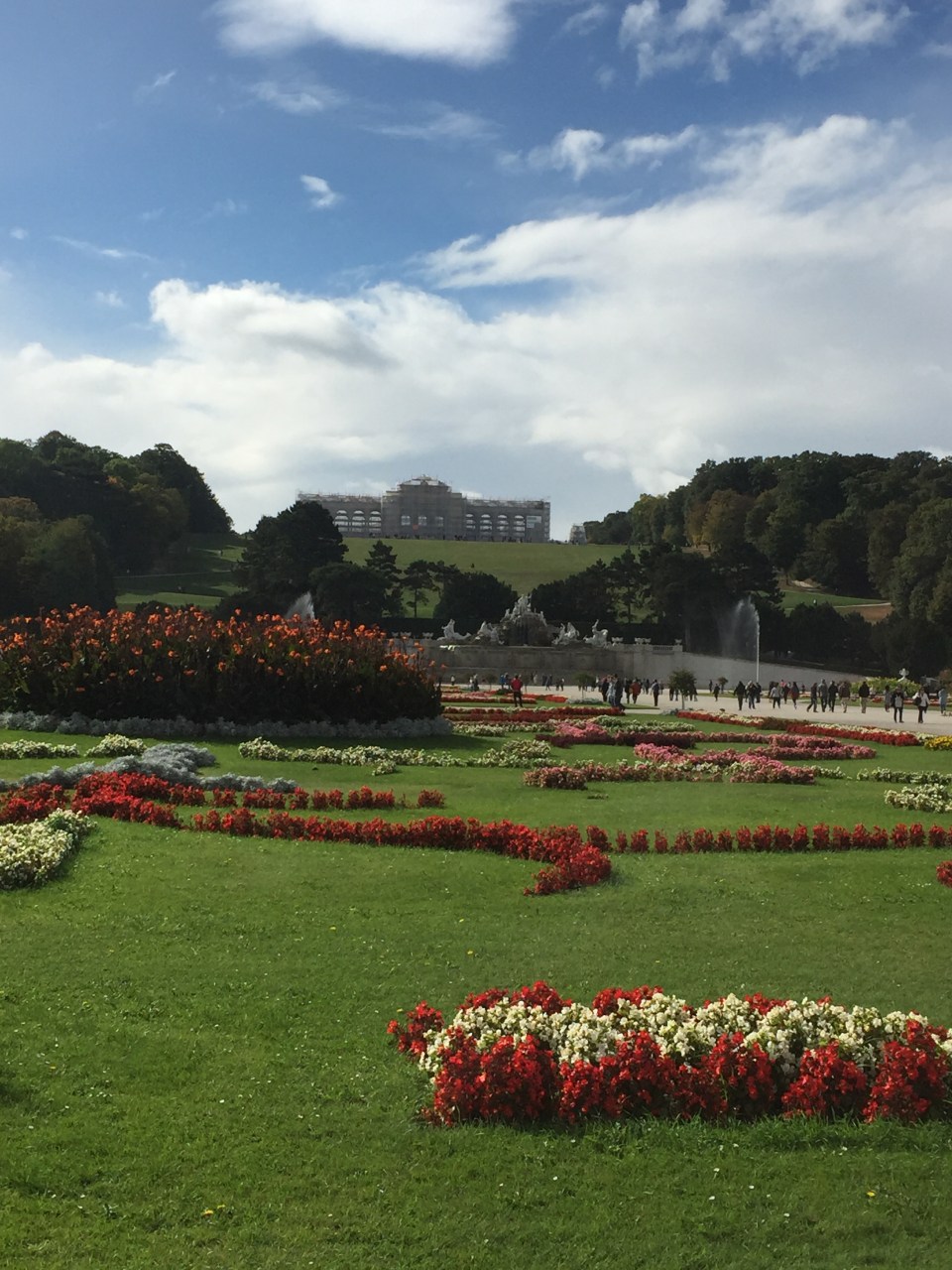
Schoenbrunn Palace was the summer palace of the Habsburg dynasty, of first, the Holy Roman Empire and then the Austrian-Hungarian Empire. Grand it is! Imagine huge crystal chandeliers in gold and white rooms in room after room, and you get an idea of the grandeur. The grounds are also amazing with magnificent gardens and fountains and statuary.
We are staying in apartments in a historic building in Vienna within easy walking distance to the State Opera and other areas of significance. The apartments are wonderful. Wood floors, separate living rooms, one and a half bathrooms, kitchens, separate bedrooms. While each of our apartments is different they all have the same wonderful amenities. Huge and comfortable, we are quite pleased. We had intermittent rain today, but we managed to stay dry and we ate at a highly-rated cafe coffee house nearby. Rhonda and Allen, Sandra and Mike, Sherlene and Kathy and I say “hello” to all our family and friends. WEG
Autumn 2016 Travels in Europe: Baroque Gem
October 1, 2016


We took one last long look at the Tyrolean beauty of Hallstatt, boarded the train and headed for the glory of human creation known as the Melk Abbey. Mike, Sandra, Allen and Rhonda were in awe of this 900 year plus creation. The library, with its intricate wood carvings and leather bound books, is world renowned for having one of the largest holdings of books of antiquity. It is awe-inspiring. The Marble Hall is trompe-l’oeil (an art form that creates an optical illusion) amusement. Most of the marble isn’t, and the ceiling height, while not high, seems quite high. It is the chapel, however, that is the jaw-dropper. Considered one of the finest examples of the Baroque style, it is gold upon gold with angels flying and complementary art. It is overpowering, and it was meant to be. The wonderful abbey with its yellow accent paint and imposing towers and dome looms high over Melk village.
We have a great hotel on the main street in Melk and ate outside in the cool air, with outside heaters providing just the right amount of warmth with the lit abbey on the hill above. What a treat! We had different foods tonight: pumpkin soup (it is the pumpkin oil that makes the difference); pumpkin cheese cakes (wow); battered pork liver and potatoes; pike salad; roasted chicken, to name a few of the culinary items. Sitting on a cobblestone street in the fresh air, with beauty all around and above us, we felt blessed indeed. WEG
Autumn 2016 Travels in Europe: Chilled, Preserved, Displayed


September 30, 2016
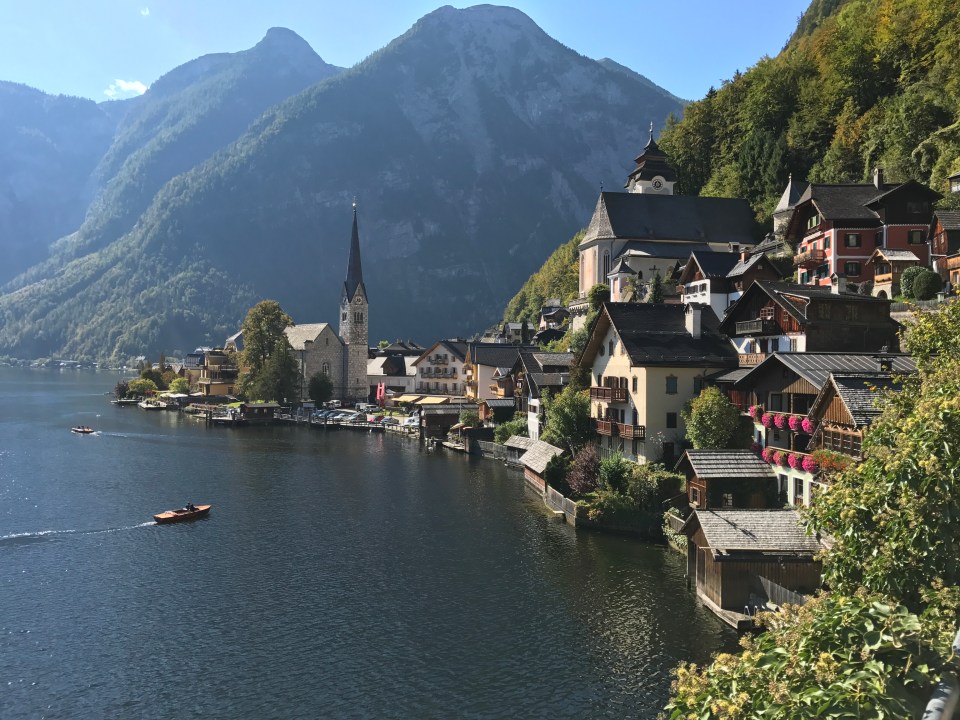
The Tyrolian village of Hallstatt draws one quickly into its charm. The narrow cobblestone streets reveal mountain gingerbread-style houses stacked above each other on the mountainside with the clear and clean lake shimmering on the other side. A waterfall falls in the middle of the city just above the cozy village square. A Lutheran church with a beautiful steeple commands the square, and a Catholic church sits majestically on the hill above. “Picturesque” does not describe the scene adequately enough.
Our group explored the city; yet, other activities also beckoned. Mike and Sandra went to the unique ice caves high above the mountain lake. Not only did they do the remaining strenuous climb after the bus dropped them off, but braved over 500 steps inside the cave to see the ice formations that were like stalactites and stalagmites in regular caves, but made of ice in this cave. Wayne and Kathy took the funicular (a cross between an elevator and cog train) up the mountain to the world’s oldest salt mine. 7,000 years of production have brought wealth through the ages to Hallstatt and still today, 300,000 tons of salt are produced annually. Riding a run-away salt mine train inside the cave and sliding down steep 100 yard slicker slides into the mine depths were exciting parts of the journey. We did not know we had bought tickets for amusement park rides, but in reality, these activities were a part of the miners’ everyday existence. Allen, Rhonda and Sherlene went to the Bone Museum, where they viewed old skulls, displayed with the name of each deceased carefully inscribed for public view. Because usable land is scarce in Hallstatt, those who have been dead the longest are dug up, the bones dried and sculls inscribed, in order to make room for new bodies in the grave site. Sherlene took one look and fled the site. Allen took pictures and Rhonda looked for long lost relatives.
It was a fascinating day in one of the prettiest places on this planet. WEG
 kgraumann
 wgraumann
