
Home » Uncategorized (Page 15)
Category Archives: Uncategorized
Relaxed
Kathy and I arose in the morning rearing to tackle old Cuenca. I had mapped out a route that would take us on an exploratory journey for the day. It was a good decision! The weather today was as near perfect as perfect can be. It was mostly clear and sunny, and somehow the sky here is bluer than we have ever seen. It probably has to do with the altitude and close proximity to the equator. Still, the air is cool and, while you can sunburn easily, I went with a short sleeve shirt all day and was just right.


As we walked, we saw that the city is on the move. Rail tracks are being laid for trolleys/light rail and, for lack of a better word, “gentrification” is happening everywhere. Old colonial buildings are being restored and renewed and there is definitely an air of excitement. The city is already beautiful, but when the restoration projects are completed, the city will have an upscale feel.
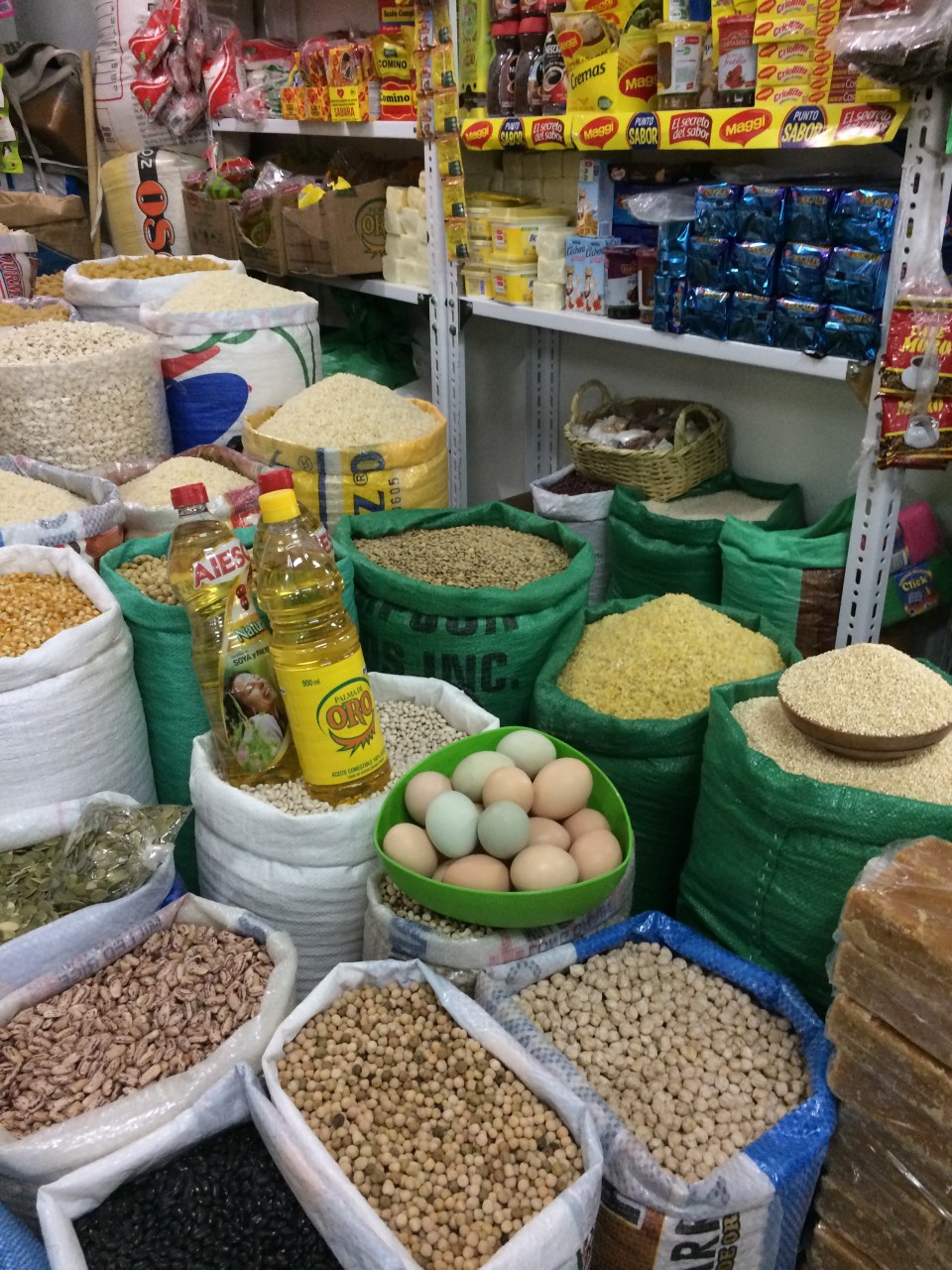
We walked into a large Mercado and spent time perusing the beautifully displayed food items. How, how, how you wish you had these “fresh from the garden” selections at home. It is not just the huge variety, but the endless choices. Take the largest grocery store produce and meat sections you know, quadruple the number of varieties available and double the entire grocery store size and fill it with those vegables/fruits/meats and you have an idea of a neighborhood market. All straight from the farm/garden/ocean/river to you. Not frozen, homogenized, chemical laden–but fresh! We bought some cheese and chocolate to munch on as we walked. When we tried the chocolate, my mouth puckered–this was 100% dark chocolate. Thankfully, we have some fresh honey and milk in our suite kitchen and we will have some great hot chocolate tonight.
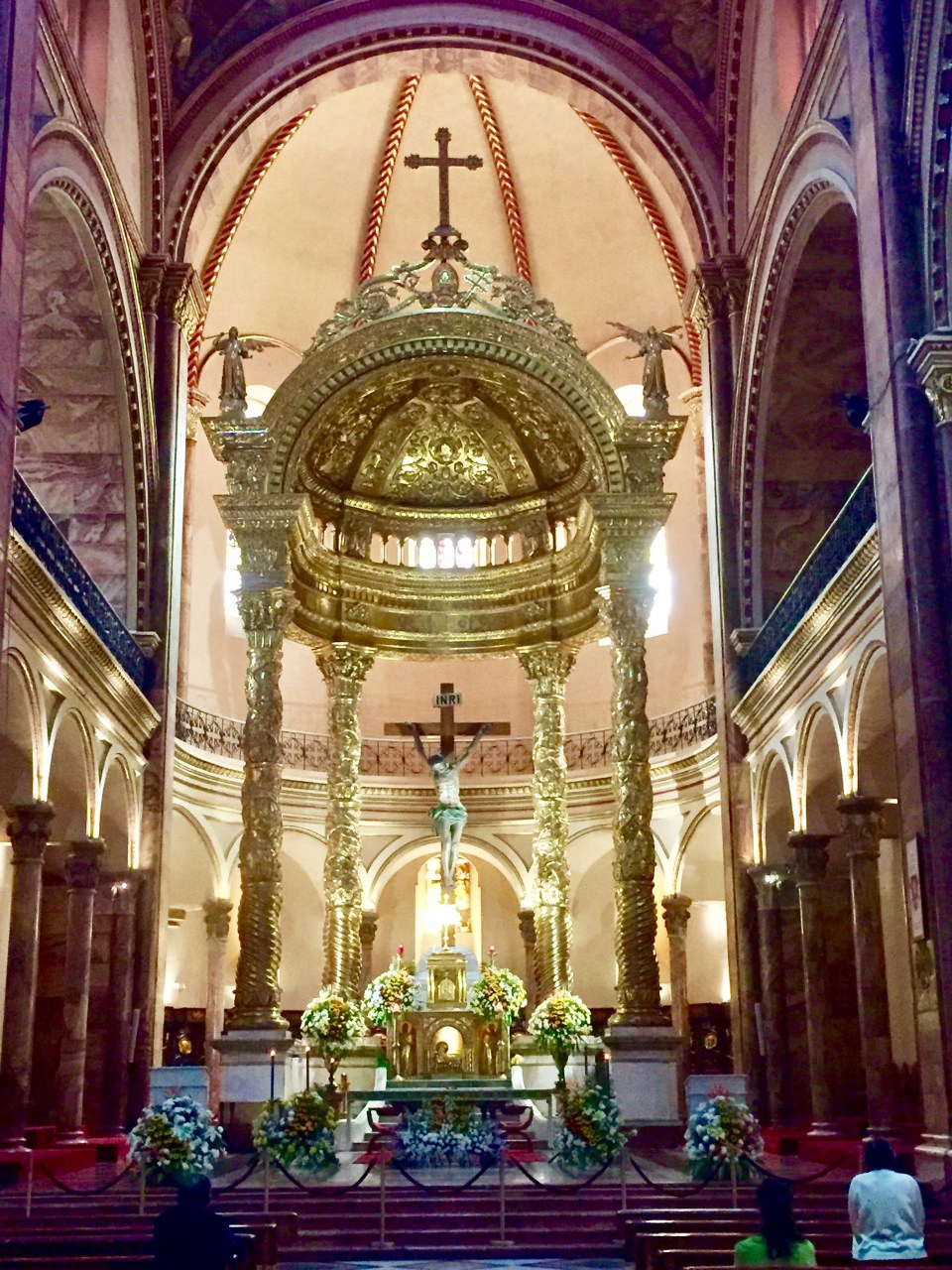
We walked by the “new” and immense cathredral with its three blue mosaic domes. It is quite beautiful with a golden altar. There are spotless restrooms nearby, but you pay about 30 cents to use them. For the money, you also get a small amout of toilet paper to take in with you. I buy extra–I am not sure how it would be possible to make it with the nine one-ply paper sections you are handed. When finished, you wash your hands and as you walk out, the attendant hands you two paper towels to dry your hands.


We ambled down to the Rio (Tomebamba River) that cuts through the heart of the city. It has a magnificent smooth cobblestone walkway along the rushing waters. We walked quite a long way, stopping at a small pub with outdoor seating to share a beer. Refreshing!


We had to climb our way from the river up to the city on a long stairway. With the high altitude, we didn’t dart up. The Andes rose up in the distance and the flowers were blooming, the air was cool and fresh, the city was amazing and the river was relaxing. It was a wonderful day! WEG
Way Cool
I bask in the first cool breezes of fall at home in Texas. You know how it feels when that cool north air hits your face and you breathe in the fresh air. Still, the sun is shining and you get those warm rays at the same time. That was Cuenca, Ecuador, today. At 8200 feet above sea level, the city of 350,000 was clean, fresh and cool on this day when the sun and clouds mixed in the sky.


After arriving in the evening the day before, we slept in at our suite at a remodeled colonial home in the Centre Historico of this charming city. Our accommodations are modern and roomy. The interior courtyard has a fountain and the walls have wonderful art displays and the original wood railings on the floors above the courtyard remain. Cuenca is alternately known as the best preserved “colonial city” in South America and the most European city in Ecuador. The heritage of 16th and 17th century Spanish architecture is everywhere. We were impressed as we walked the cobbled streets to see beautiful plazas with usually white washed churches and colonial buildings. Passage ways through buildings open up into interior courtyards filled with flowers and fountains and shops, restaurants, and small hotels. It is quite inviting.


As we walked, we crossed a street and all of the sudden above us loomed the city’s cathedral with its blue domes. It was an impressive sight and, frankly, overwhelming. We had not expected this imposing or massive building! All around the cathedral, teeming life. Plazas with vendors and gardens and large colonial buildings, restaurants and hotels stretched out in every direction. As we walked in the main plaza, Kathy noted what looked to be an American couple sitting on a park bench beneath trees blooming with beautiful purple flowers. She struck up a conversation with Doug and Barbara that lasted well over an hour. They regaled us with stories of this beautiful city they now call home. Four through ten thousand U.S. expatriates call Cuenca home at any one time during the year. It is easy to see why: impressive weather, natural beauty all around, marvelous colonial city, culture and art and inexpensive. We found out that if you are a senior, health care is quite attainable and quite inexpensive; entrances to all cultural events from opera to sports is free; if there is a line anywhere, you are moved to the front, as seniors are valued, and transportation originating in the country from bus to air is half price automatically, and the list goes on.


I am heading out the door. We had a great lunch today in a beautiful restaurant. Kathy chose the featured entree’–a delicious potato cheese soup and a main of beef and rice and fried plantain–all for $5. I chose the chicken stuffed with shrimp in a palmodoro sauce. So, we are not particularly hungry tonight, having stopped in a pastry shop and eaten sweets around 5pm. I saw an elderly woman last night upon our arrival with a movable charcoal bar-b-que on the street corner with kabobs of chicken and pork situated across from the plaza where our suite hotel is located . Sounds just right to me! WEG

Market Day


Otavalo is a small city about ten miles from Cotacachi, and Saturday is market day in Otavalo. Not any market, mind you, but the world’s largest indigenous market. Folks in native dress flood the city, bringing with them products of every kind. It was a fun and educational experience. We were especially drawn to the food section, where beautiful food products were displayed for sale–fruit, vegetable and meat. I told Kathy that if I lived here I would buy way more than needed, since it all looked so good! Berries in barrels, gizzards in grates, pork in pots, carrots in crates–you get the picture–in row after row after row. Nothing was left unsold. Right beside T-bone steaks were whole cow hearts. Chicken, when purchased, was put in a bag and chicken feet were thrown in for good measure. Potatoes with dirt attached, straight out of the garden, were in huge gunny sacks. We noticed many fruits of which we were not familiar, and we purchased some to take back to the hotel for an evening snack. Want pigs’ feet or cow feet–no problem. Green eggs or brown eggs or bird eggs–your choice. Hamburger was ground right in front of you. Each stall was active, people shelling corn, peas, beans; butchering meat products or scaling/filleting fish. Everything was orderly and nicely displayed. How I wanted to get some of the fresh ground spices, but we are early in our adventure, and I didn’t want the hastle of custom’s checks. All around the market rose the Andes mountains, and the air was cool and fresh.


I purposely did not eat much for breakfast, believing that the market would have food stalls. It did, and I had a hard time deciding which indigenous food to select. I saw a large steaming caldron filled with rice, noodles, potatoes, and vegetables. I decided that this was the one I wanted. The proprietor scooped the ingredients from the top down to the bottom of the cauldron, where it mixed with a seasoned broth, before plating it for me. What I didn’t know was that she was frying an egg which went on top of the concoction. It was a good concoction. Price–$1. The proprietor’s young daughter had fun watching the “gringo” try to eat her mother’s food.


We went to the indigenous clothing section and watched people knit, crochet, sew, and embroider wonderful clothing and shoes. Kathy, on my prompting, purchased two embroidered belts. They will look good on her beautiful self.


We took a taxi rather than the bus to and from the market. Easy peasy, although the taxi cost 10x’s more than the bus. The bus would have been 75 cents for two for the fifteen minute ride. You can do the math–cheap. Almost everything here is about 1/3 the cost of home.


Once back in Cotocachi, we noticed that the Kichwa people were thronging the cathredral. We learned that it was communion day for first time communicants. Beautiful. We then walked the streets and breathed in the fresh mountain air. Priceless! WEG
Guinea Pig Lake


Laguna Cuicocha is a two mile wide, deep blue, 656 feet deep crater lake at 10,650 feet elevation and at the base of the 16,220 foot Volcan Cotacachi. With very steep cliffs surrounding the lake, three small islands in the center and the volcano towering overhead, the scene is impressive. The fresh cool air was refreshing as we took a boat tour of the lake. Along the way, the boat stopped so that we could see the bubbles in the water, signifying that gas was seeping through from the magma below. The volcano is dormant (not extinct) and has been for centuries.
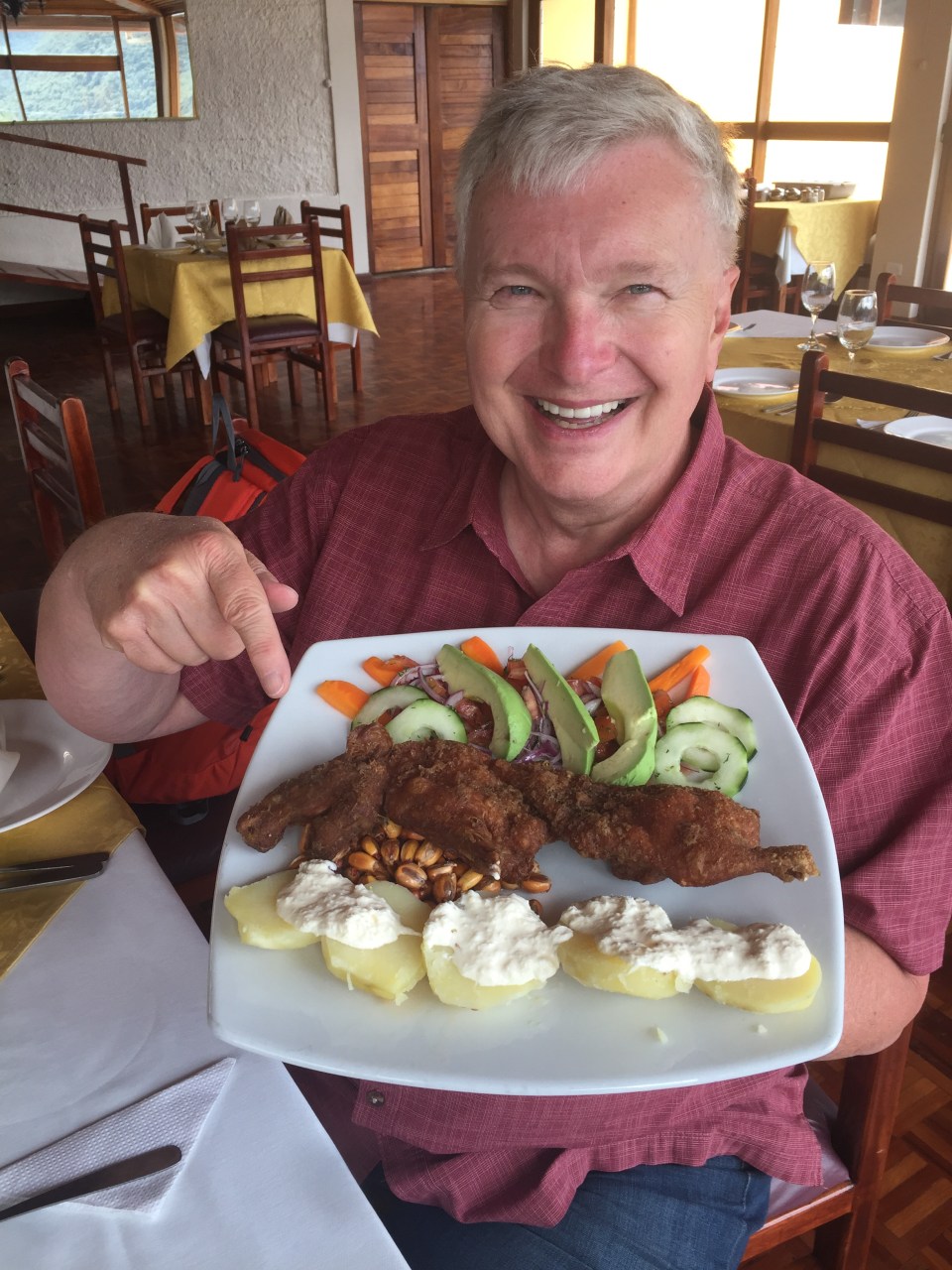
While at the Laguna, we ate lunch in a restaurant with expansive views of the lake. On the menu was cuy, or guinea pig. I took the plunge. It arrived baked, with head and feet attached. I didn’t hesitate but took a bite immediately. The skin was crunchy and the taste was close to pork butt, but it still had a unique flavor all its own. It was good! Guinea pigs in the mountains are not your caged hamster variety. The indigenous Indians raise them because they thrive in the high altitude, require little food, reproduce rapidly, contain high protein value, and they taste good. I am now a fan. The name of Laguna Cuicocha in the Kichwa (native Indian) language translates to “Lake of Guinea Pigs” to honor the place of the guinea pig in the Indian culture.
We took a twenty minute taxi ride to the Laguna. The total round trip cost was ten dollars. When we arrived, we told the cab driver when to pick us up. He was prompt in his return after we had spent three hours at/on the lake. I love how this culture operates. You can drive by a small grocery and shout out the product you need; someone will promptly bring out the item(s) you requested and take payment, and you then drive on. Trucks laden with necessary commodities that everyone uses, such as propane, drive the streets, each commodity truck with a distinct melodious tune. When one hears the tune of the commodity they need, they go to the street and flag down the truck. Simple.

Anita, the attendant at Hotel El Roy, is a native Indian and dresses each day in beautiful native clothing. We found out that she hand makes her exquisite clothing with decorative stitching, embroidery, and lace work, and her hair is in an intricately braided pony-tail. Such beauty! Many of the people in Cotacachi wear traditional clothing and that gives an authenticity to this charming city nestled between two volcanoes. WEG
Bee Stings and Leather
Bees were flying all around the clinic, a simple structure on a hill in Cotacachi, Ecuador. Manuela, our hotel host, told Kathy about bee sting therapy and Kathy was intrigued. The bees were attracted to the flowers around the clinic and with the clinic’s door and windows open, they easily flew inside, just what the therapist intended. It wasn’t just the bee stingers that were important; it was the pollen on the stingers as well. Here is what happened as Kathy told me, “He (the therapist) took a tweezers and captured one of the bees. He took another tweezers and carefully used it to remove the bee stinger. I could see the pollen on the stinger as he removed it from the bee. He then took the stinger and inserted it into my neck. He did this over and over again. My neck and upper back were covered with bee stingers. There was a tingling sensation when the stingers were inserted, but nothing like a bee sting. The stingers remained; he did not remove them–that happened naturally as the day wore on.” I asked Kathy how she felt when it was over and she said, “Relaxed.”

Bee Pollen Acupuncture Therapy
I put my hand on Kathy’s neck as we walked later in the day, and my palm was like a pin cushion. Just kidding. The stingers were gone within an hour of the therapy session. We did go to the “leather street” in Cotacachi in the early afternoon. Cotacachi is the leather center of Ecuador for good reason. We first stopped for lunch and had a wonderful lake trout. I thought the guinea pig would have been too heavy a meal, so that will have to wait for later.


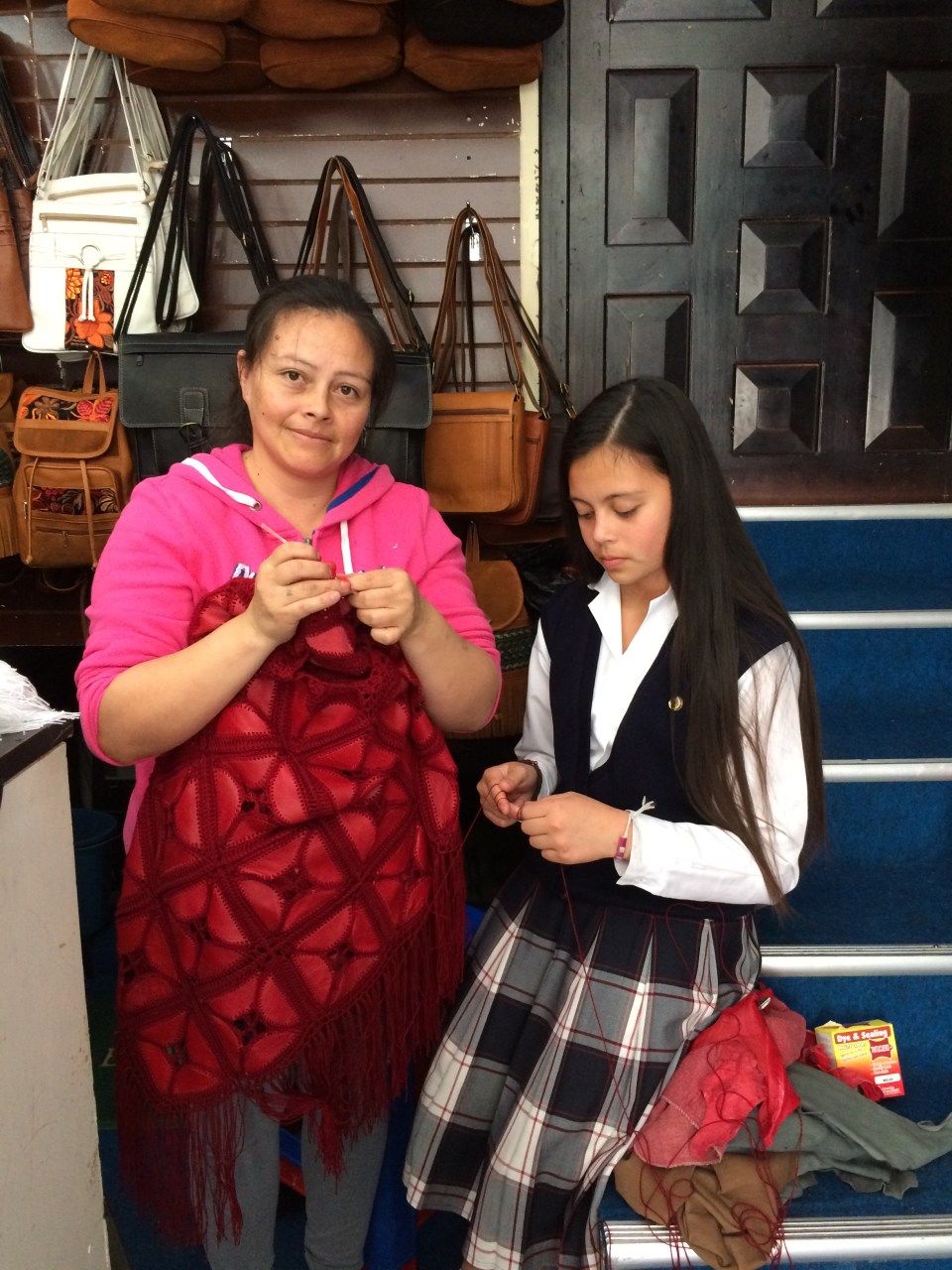
On visiting the leather shops, we were impressed with the high quality of the leather work. Kathy could not resist buying three items: a leather and crocheted shawl (the shop owner tailored it to fit on the spot–it was amazing to watch her skillful, quick hands crochet the needed adjustments); leather gloves; and a leather coat with a matching handmade leather scarf (once again, adjustments were made to fit Kathy’s petite size). I got a belt. Anyone else see any discrepancies here?
Our lunch was a treat beyond the excellent food. An Ecuadorian musician played a guitar and a rondador (a wind instrument that is chorded cane panpipes) at the same time. Wow! We are loving the Ecuadorian culture and its people. WEG

The Serenade


As I type Roman’, the owner of the El Roy Hotel where we are staying in Cotacachi, is serenading Kathy and me with Ecuadorian music while his wife, Manuela, harmonizes and serves us mojitos. It is a magical ending to an amazing day.
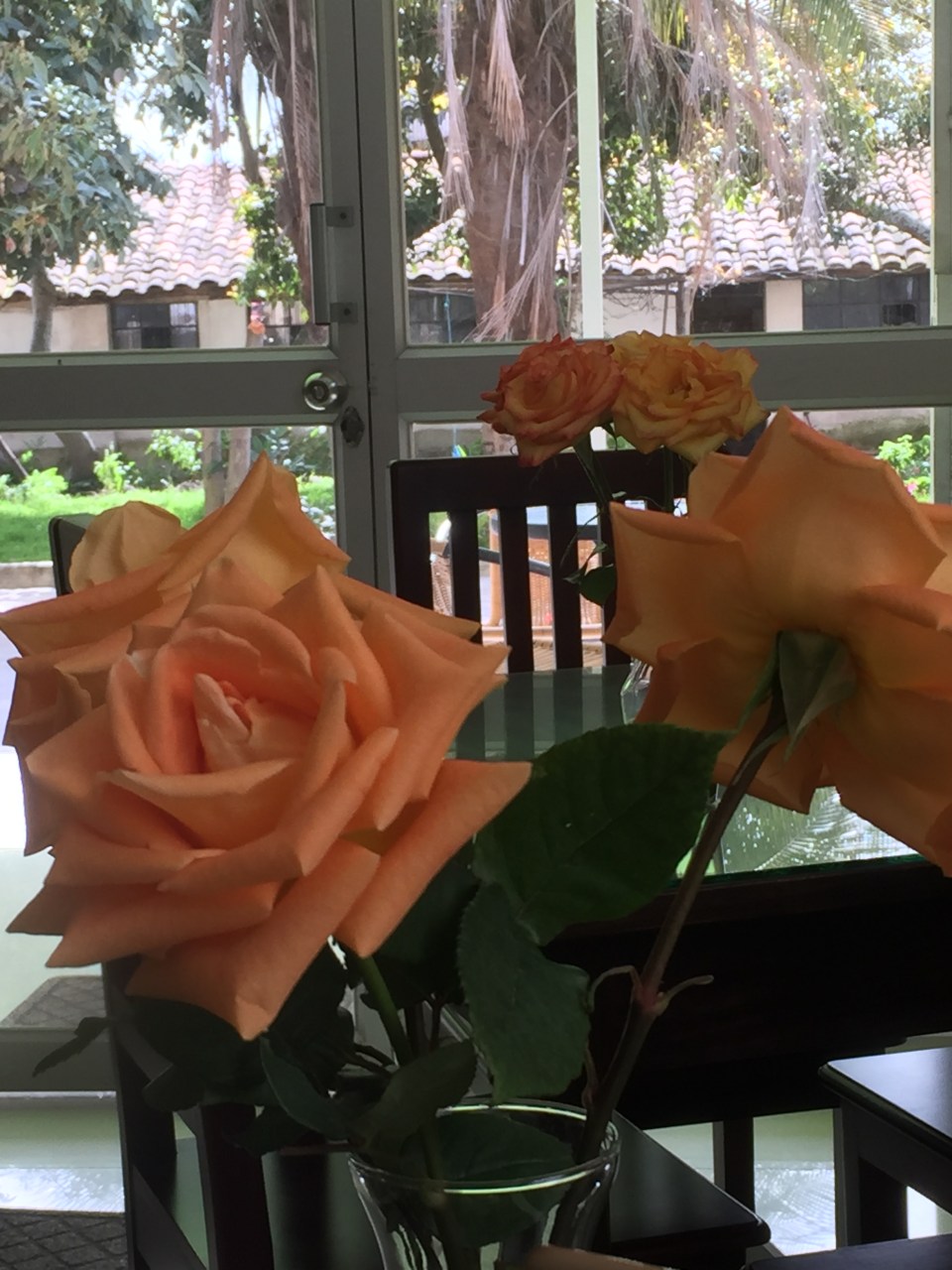
View from our breakfast table at El Roy, Cotacachi, Ecuador
It started wonderfully with a breakfast prepared and served by Anita of the hotel staff, dressed in native costume. Roman’ came into the room and asked if we would like Manuela and him to take us on a tour of the area. “Sure!” We had no idea of the wonders the day would bring. Where, but where, would guests at a hotel receive such royal treatment?


We spent the day getting a cultural immersion. Everywhere we went, the beauty of the mountain setting around us set the tone. We visited the wood carving city of San Antonio and watched people at work in the shops. We saw the beautiful Laguna (Lake) Yahuarcocha surrounded by mountains. It is famous for the Formula One race held there, and we followed along the track. We watched ice cream making in a local shop and tasted the homemade treat. We had never seen ice cream made in a stainless steel pot lodged in ice as it was stirred by human hands with a huge spatula, the ice cream slowly being separated from the cream. Italian gelato, you have a rival. We drove through neighborhoods and cities to see how people lived, with wonderful commentary by our hosts. We toured a neighborhood where expats retiring to Cotacachi congregate and even walked through a beautiful home that was for sale. Everywhere the mountains loomed above. We visited one of the oldest restaurants in Ecuador. The grounds were fabulous. Our new friends, Roman’ and Manuela held their wedding dinner there. Along the way, we learned that Roman’ was a retired Ecuadorian army colonel and Manuela had been an Ecuadorian diplomat to Panama and was also a two term senator to the Ecuadorian Congress.


We felt truly honored and privileged to experience such a day. WEG


TRAVELIN’
Today was an experiential travel day for us because you cannot fly from Quito to Cotacachi, Ecuador, and I had made no prior arrangements for the two plus hours of travel to reach Cotacachi from Quito. The folks at our Quito Hostal (hotel) were more than helpful. They made arrangements for the hotel taxi to take us to a bus station where we could buy tickets to Otavalo, which is a short distance from Cotacachi. Upon arriving in Otavalo, we could board another bus that would take us to Cotacachi, where our lodging for the next six nights was located.
We were impressed with our Quito hotel. It is family owned, and every employee is a family member. They were more than solicitous–we received first class treatment. The colonial home had been remodeled into a small hotel. Everything was modern and tastefully appointed, while retaining the charm of the original colonial home. I will nearly always choose this kind of establishment in an old town area over a modern chain hotel and rarely have I been disappointed.


The hotel taxi was cool–new, with embroidered headrests bearing the hotel name. The ride to the north bus terminal was about 30 minutes and the cost $10. The driver parked and took me to the ticket counter to make sure I purchased the correct ticket. He then took Kathy and me to the bus with our luggage and made sure it was safely packed and we were on the correct bus. Amazing! I gave him a generous tip, and he was overjoyed. The terminal was large, with buses coming in and out continually. Wonderful food stalls and shops lined the walkways. The bus was amazing. I admit, I haven’t been on a public bus in a while, but this bus had beautiful, comfortable seats; a built-in large screen TV showing American movies; a driver, accompanied by a “conductor” who received pre-paid tickets and/or cash for ticket purchases. Along the way, people would flag the bus, and it would make a quick rolling stop to pick them up, and then move on. Several times along the way, people in uniform would come on the bus selling drinks, ice cream, sandwiches, etc. The majestic scenery along the way was mesmerizing; the two hours passed quickly. Up and down the mountain side we traversed. Deep ravines with rushing water deep in the earth caught our attention, sometimes because the road ran right along side these deep cuts in the earth. All along the way the trees and flowers were in beautiful bloom.
We arrived in beautiful Otavalo, impressed with the cleanliness and well kept traditional Ecuadorian homes. Once off the bus, the conductor was waiting for us to give us our luggage, and he pointed me to the Cotacachi bus. We walked up, the luggage was secured below by the conductor, and as we stepped aboard, the bus was on its way. Did I tell you that our combined cost for the first bus tickets was $5.75 for the two-hour trip and our second tickets 75 cents for a thirty minute ride?


Cotacachi is a charming small city nestled, at 8,000 feet, between two volcanoes. It is one of Ecuador’s eternal spring cities. It is 75F by day and 55F at night year round. Palm trees grow in the city’s squares. The streets are pavered, not paved, and the sidewalks are bricked. Our hotel is wonderful–another family-owned establishment–and our lodging comfortable and roomy. The owner already took Kathy to tour the gardens, visible from our room. Many fruit trees, vegetables, and herbs will provide for our morning breakfasts. We ate at a nearby restaurant for dinner, and my T-bone with fried plantain, French fries, avocado and pickled salad was really delicious–all for $11.50. No wonder so many American and German expatriates retire here. WEG

Raw Beauty
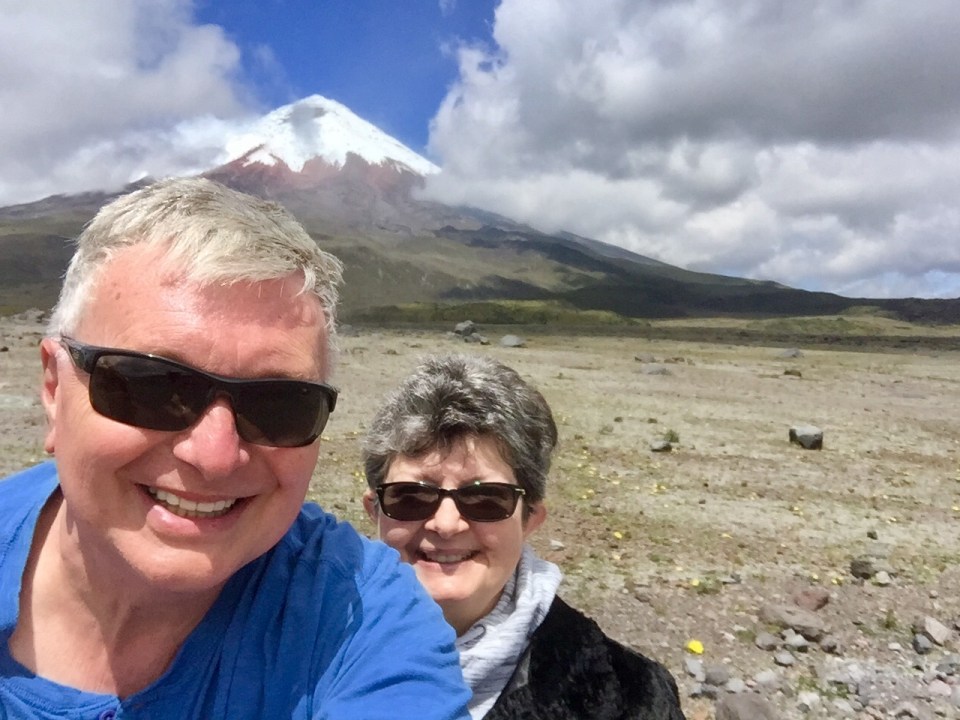
Wayne and Kathy Graumann below Cotopaxi Volcano, Ecuador, May 28, 2017
In all of our world travels, we have not had a day like today. Our long day was spent exploring Cotopaxi National Park. Mighty Cotopaxi, at 19,342 feet, is the second highest active volcano in the world. As such, climbing on the glacier to the top is forbidden. However, we were able to get to about 14,000 feet, close to the base of the ice. Doing so, however, was an ordeal, well worth the energy expended. The drive out of Quito was great with views of the Andes everywhere. It was a bright and clear day. As we began to climb higher towards Cotopaxi, we traversed changing ecological climates. First, were the eucalyptus trees; then, the pine with various pampas grasses; then, succulents and desert-like plants with no trees; then, wind-swept plains with yellow, then purple, and then orange flowers; and finally, nothing but volcanic landscape. The conical snow-covered peak of Cotopaxi was in clear view, a blessing not always available to visitors. As our day tour bus ascended higher, many cars were stalled out and most were turning around. The road consisted of hairpin turns on volcanic sand and rock with gulleys and ruts everywhere. We were told to hold onto our seats or we could be shaken out. Our guide mused that we were receiving a “Cotopaxi massage!” Once we arrived at the final stop up the volcano, we were given the opportunity to climb another 500 feet higher to a look-out point, the Jose Rivas Shelter.

Wildflowers in Cotopaxi National Park, Ecuador
Kathy and I were the seniors on this day tour; most were in their 20’s and 30’s, but we were game. We donned our sock hats and sun glasses, jackets and gloves. But when we stepped out of the bus, the wind was so strong we were almost blown over. Our tour guide said the gusts reached 60 mph. However, never to say never, we trudged upward. The wind was picking up volcanic sand and pebbles and hurling them into our faces. Some people were knocked down. About 1/5 of the way up, we said, “Done!” Going back was harder than going up, since we could not lean into the wind, so small sideways step by step we went down. Some of the younguns eventually came back as well. Once back in the bus, we realized how out of breath we were. Sand was caked to our faces and grit was in our mouths, but we were out of the wind. Yet, mighty Cotopaxi remained in clear view! It is an experience we will never forget!

Kathy Graumann, resting on the ascent to the Cotopaxi Volcano Shelter, May 28, 2017
On this day, we were able to look down the Avenue of the Volcanoes and see four volcanoes in clear view. Our guide said this is almost never to occur. As we stopped on the way down at Limpiopungo Lagoon, a clear mountain lake, we had clear views of the majesty of raw beauty all around us.

Wayne Graumann at Limpiopungo Lagoon, Cotopaxi National Park, Ecuador, May 28, 2017
As we left, we saw herds of wild horses and, amazingly, a large mountain fox, Zorro, trotted close to our bus. As foxes are quite reclusive, our guide declared, “We had a perfect day.” I agreed. Descending further, we entered a mountain climbers’ lodging establishment where we were treated to a delicious mountain trout dinner.


After almost ten hours of exploring, we arrived back at our hotel, content that we are still adventurous and enjoying the adventure, while also eager to relax and clean off the dirt. WEG


Exquisite

The weather is Quito is remarkably wonderful: 65-70F by day and 45-50F by night. Kathy and I stroll the streets past Ecuadorians in native dress and others in modern dress selling all sorts of items: plastic sleeves filled with apples or pears; lima beans in boxes; multi-colored shawls; bowler hats; ice cream and back scratchers, to name a few. The city is alive with people. Cars and buses vie with people in the narrow streets, the sidewalks being packed. El Centro is filled with colonial buildings, most in good repair and many quite handsome. Surprisingly, we do not find pharmacies or banks–which have been a constant presence in every country we have visited over the past several years.

The Church of the Society of Jesus, locally called, “la Compañía,” is our must-see for the day. To say that it is exquisite would be an understatement. Begun in the early 1600s, it is a baroque masterpiece. Considered one of the most beautiful churches in South America, its baroque splendor easily rivals its counterparts in Europe. Intricately carved and gold-leafed from floor to ceiling, with porcelain statuary adorning the altars, the church is a jaw-dropper. The ten side altars blend harmoniously into the whole, leading to the main altar. The gold ceiling reflects the light making a golden hue that gives a heavenly feel. We sit for a least an hour in silent contemplation of the faith that would produce such beauty.

We also amble through the Central Bank Museum, proof that banks do exist somewhere in Ecuador. It tells the story of coin minting, with artifacts, through the centuries in Ecuador.

Our hotel has pure hot water dispensers and anis tea. The tea helps with acclimating to the altitude and it works! Both Kathy and I are feeling good, maybe even exhilarated! Hmm, is it really anis tea? WEG
Autumn 2016 Travels in Europe: One Last Look
November 11, 2016 – From the Cotswolds to London


Over the past two days we have thoroughly enjoyed the Cotswolds of England. It is a land of honey-gold stone buildings with moss-covered slate roofs. Beautiful and quaint villages are around almost every bend. Between villages are rolling hills and valleys where grazing sheep idle the day. Stone walls line the narrow roads between villages, and elegant manor houses are abundant throughout the countryside. Our cottage in Burton-on-the-Water has been lovely and spacious, a moment’s walk into the heart of the village where shops and eateries are abundant.


We drove up to Warwick, with its famous castle, right out of the Middle Ages storybook we read when we were young. One could see in the mind the knights in shining armor riding over the mote into the castle. We watched owls circle above our heads and land on a trainer’s arm. We saw many live peacocks in the peacock garden with its topiaries of peacocks around a spraying fountain. We walked the main rooms of the castle and marveled at the cross bows and the catapults.


We spent another day in the Blenheim Palace, the only non-royal palace in England. It is a marvelous structure and is the home of the Duke of Marlborough, the descendant of the great military general of England who led the armies of England to victory eleven times. As a result, the monarchy granted the first Duke money to build the palace on 5,000 acres that belonged to the monarchy. The only rent payment for the land is the presentation of a French flag to the monarch each year in a regal ceremony in Buckingham Palace in London. That is still the rent price to this day. The palace is stunningly beautiful. So are the grounds of the palace. We took time to enjoy the day with a leisurely stroll on our sunny day.
All throughout our trip, the trees have been in fall mode. This was especially true here in England. Driving through the Cotswolds, we often drove under golden tree archways, in some stretches for quite a length. Allen kept spotting pheasant, sometimes dozens meandered the fields close by. All of this shouted, “Autumn!” We spent the evenings in cozy pubs and quiet time by the roaring fire in our living space.
Our trip now comes to a close. We arrived in London today and fly home tomorrow after a God-blessed trip with wonderful friends. WEG
 kgraumann
 wgraumann
