
Home » Uncategorized (Page 11)
Category Archives: Uncategorized
Betrayest Thou Me With a Kiss

Overlooking Jerusalem
The Mount of Olives is a very beautiful, peaceful place perched on a hillside overlooking the Temple Mount and Jerusalem’s strong stone walls. Jesus was on the Mount of Olives three times during the last week of His life, which we call Passion Week. In the Garden of Gethsemane on the Mt. of Olives, Jesus gathered His disciples and separated Himself to pray as He prepared for the cruel death He knew He must endure because of His love for the people of the world. We had reserved a portion of the Mount for our own personal prayer time amongst the olive trees with Jerusalem spread out beneath us—some of the best prayer time I have had. As we walked in the larger Mount of Olives area, we passed twisted and gnarled olive trees with massive trunks that were well over 2,000 years old. In other words, they were there when Jesus prayed. Touching!

Mount of Olives
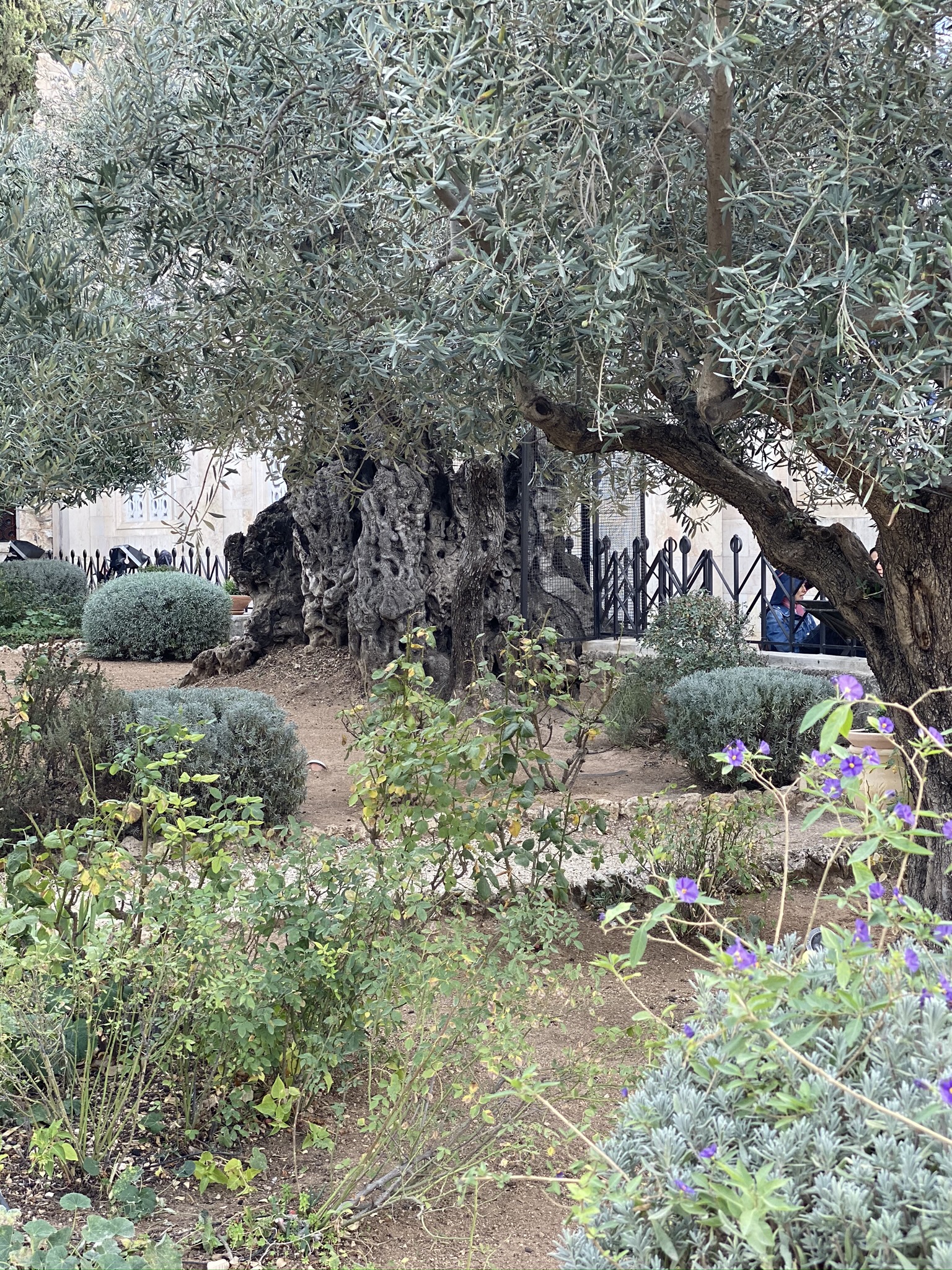
Mount of Olives
Jesus was arrested in the Garden of Gethsemane on the Mount of Olives when one of His disciples, Judas, betrayed Him with a kiss for 30 pieces of silver.

Church of All Nations
The Church of All Nations is particularly striking with its twelve domes and beautiful mosaic work. It commemorates that dark day when Jesus prayed and was arrested. It houses the stone on which some believe Jesus leaned against to pray.

Mosaic, Church of All Nations

Ceiling, Church of All Nations
From there we headed to the Food Market filled with spices and fruits, meat, fish and small restaurants. Fun! Then, we headed for more Jerusalem ambiance at the pedestrian mall—music, outside cafes and shops of all kinds. More fun! And then, just like that, our journey was coming to an end. Our evening banquet was filled with joy and thank you’s, especially for our guide and driver who were both awesome!
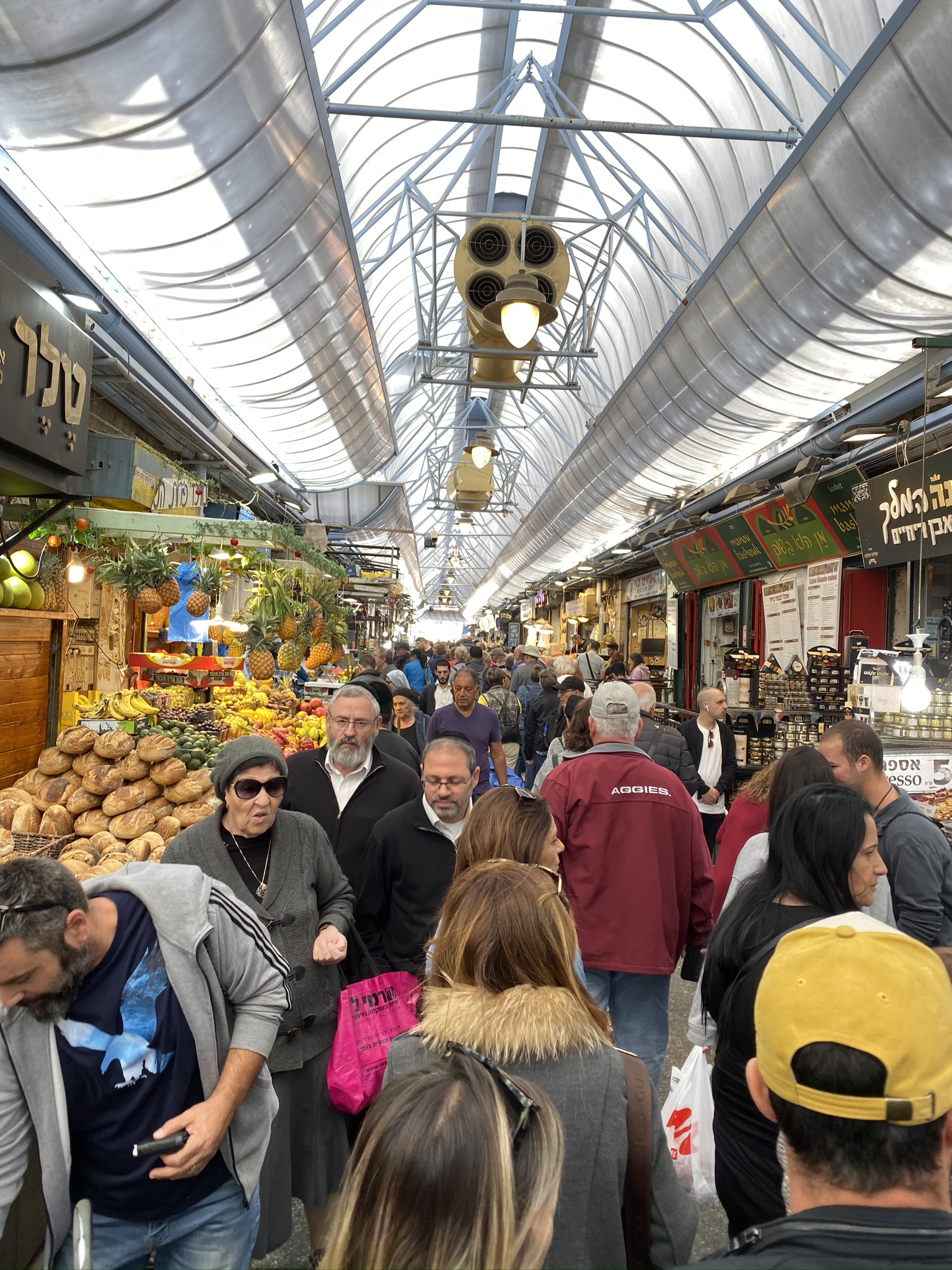
Jerusalem Street Market
In the end, this truly was not a trip or tour, certainly not a vacation. It was a pilgrimage. God was good! WEG
Walking on Water
Hezekiah knew the Assyrian army was marching toward Jerusalem. He had to act quickly to safeguard the city’s water supply. Deploying two huge crews of workers, he instructed one crew to dig from point A to point B and the other crew to dig from point C to point B. Working from opposite directions they met in the middle. When finished they had dug a water channel 300 feet below the surface to connect the Gihon Spring in the Kidron Valley to the Pool of Siloam in the middle of the city. It was a major feat but it guaranteed that Jerusalem would have an adequate and defensible source of water. Today, one could walk the tunnel still flowing with water and, as they say, “Walk on Water.” Those who did not prefer to get wet could walk the “dry tunnel,” dug by the Jebusites over 300 years earlier. This tunnel was found by General Joab who invaded the Jebusite city on the instructions of King David. Overpowering the Jebusite city, King David named the city Jerusalem—the City of David—and began a large building program. We saw remnants of David’s palace and government offices. Recent discoveries of letters with the official signite have contained names and events recorded in the Bible, thus authenticating the Scripture. Remarkable!

Jerusalem
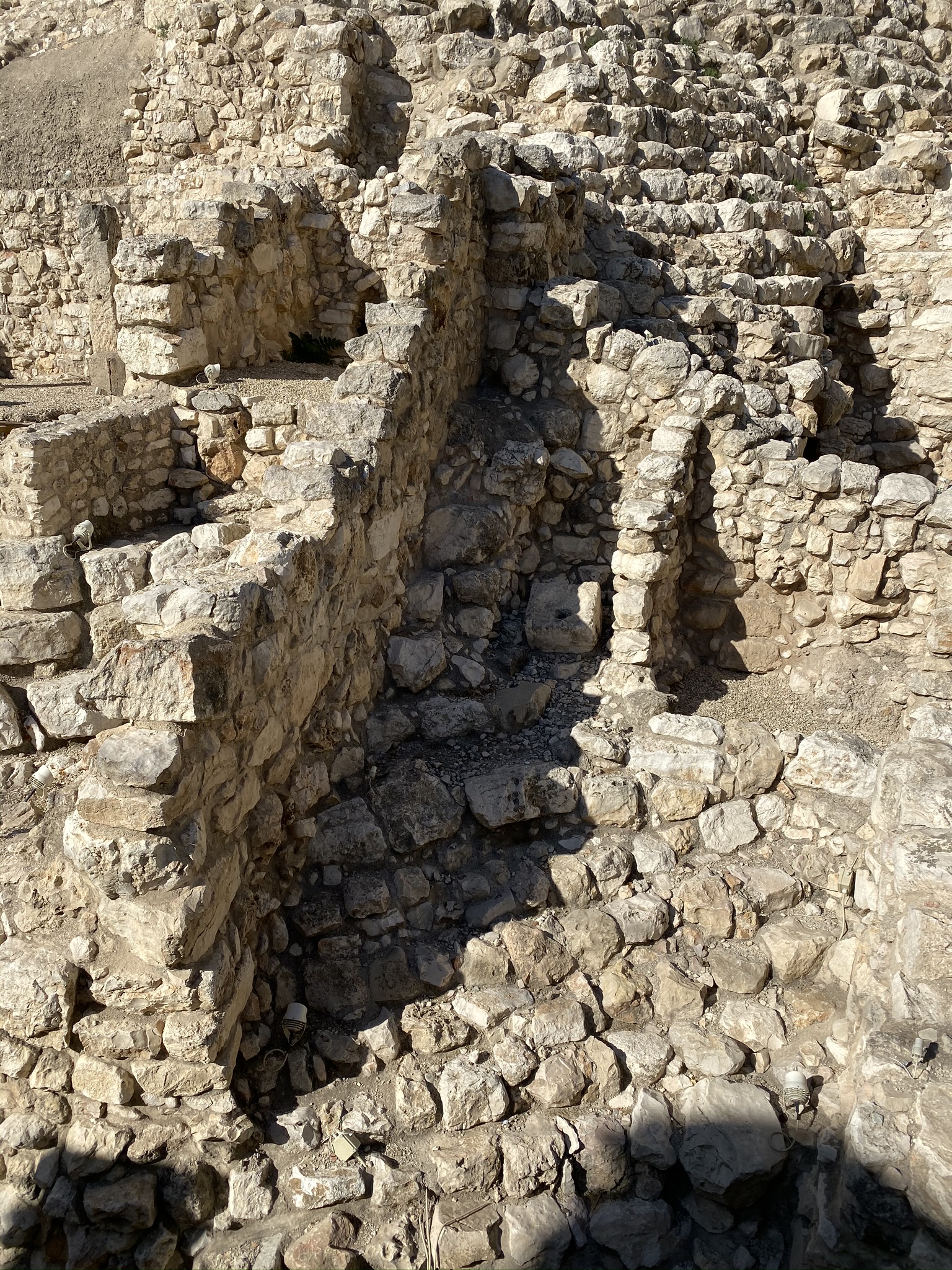
Remnants of King David’s Palace
The Israelis Museum is a marvel, containing among other items, a 1/50 scale model of Jerusalem at the time of Jesus. It was a tremendous visual. So was the view from a special platform of present day Jerusalem. Our guide pointed out the movement of Jesus during Passion Week—arrest, trial, crucifixion, burial and resurrection. It was amazing to see all the Biblical accounts spring to life and realize the close proximity of all these events.

Model of Jerusalem at Jesus’ Time
Visiting the Church of St. Peter in Gallicantu, we stood in the courtyard where Peter denied Jesus. The church was built on the site of the home of temple high priest, Caiphas, where Jesus was tried, mocked and imprisoned. We stood in the jail cell and viewed the steps down toward the city on which Jesus walked after the trial as He made His way to Pontius Pilate who would allow Jesus to be crucified. Touching to say the least.

St. Peter Gallicantu
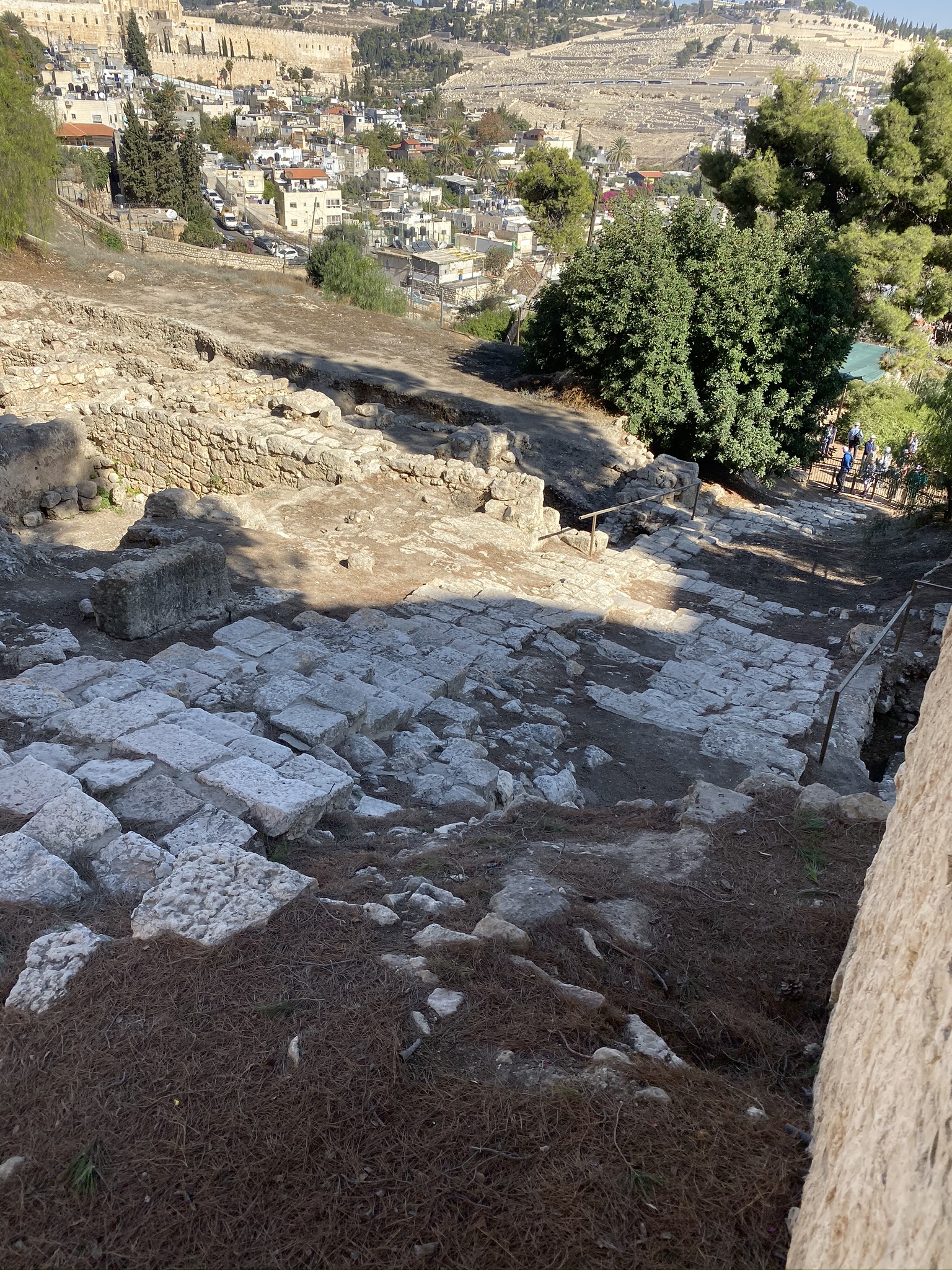
Steps Jesus took going from Caiphas to Pontius Pilate
Our day ended at the the Place of the Skull, where scripture says Jesus was crucified. The rocks in the cliff actually have a formation that looks like a skull, with sunken eyes, no less. Nearby is a cave that served as the grave of a wealthy family. The Bible says that Joseph of Arimathea, a wealthy man, took Jesus’ body and interred it in his burial cave. Scholars debate which of two places is the actually place of crucifixion, but this site seemed so authentic to me. Our group had a very moving communion service in an outdoor chapel in the cool early evening air in a spot between the Place of the Skull and the burial cave. Tears were shed and hearts were touched! He died for me, and He lives for me. WEG

Worship Service with Holy Communion at the Garden Tomb

Garden Tomb
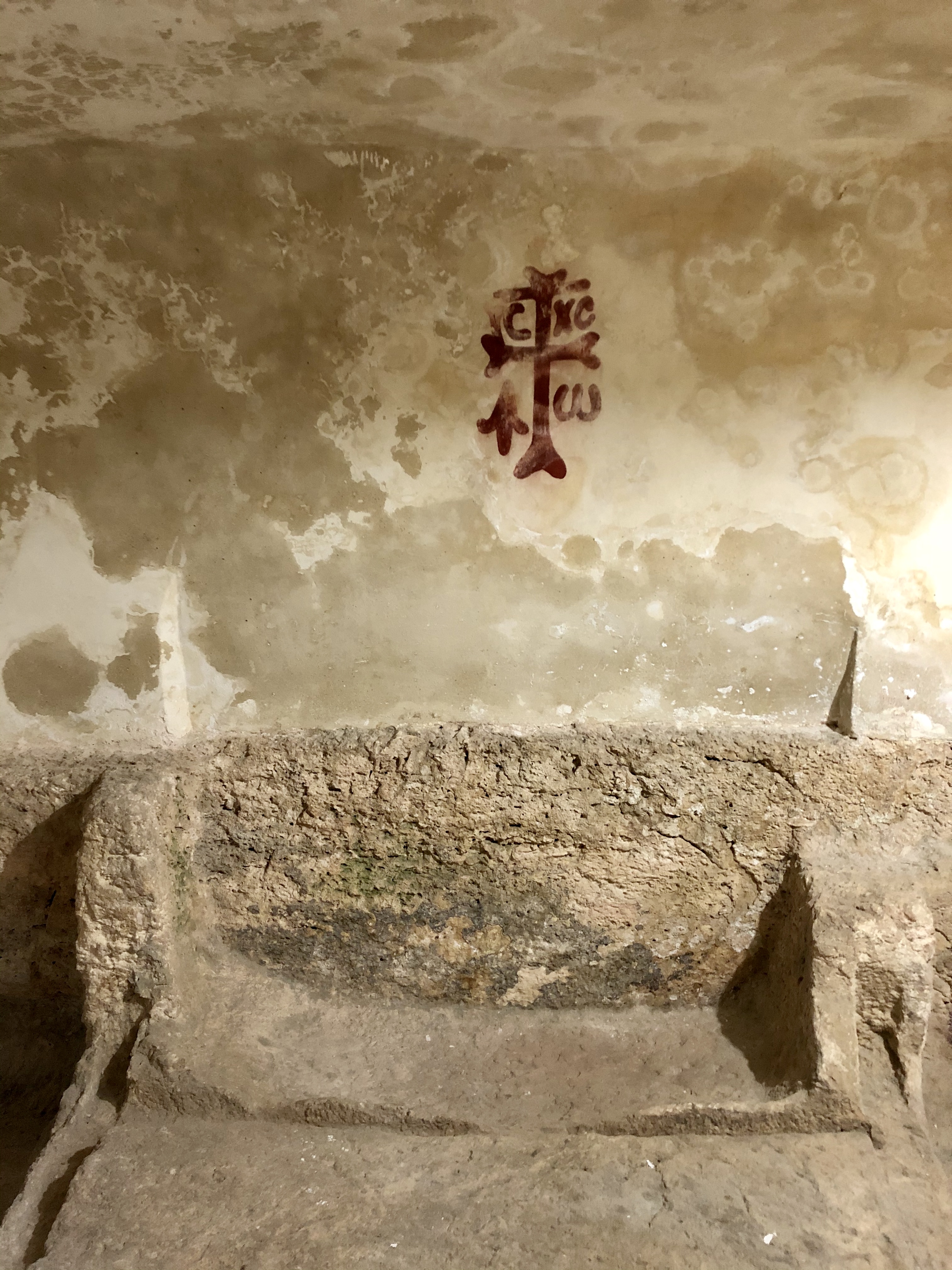
Possible burial site
A Soul-Refreshing Day
Each day of our journey has had a different feel, each unique in a special way. Yesterday was definitely spiritually intense, pilgrimaging to the birth place and death place of Jesus. Today was a soul refresher, an oasis in the desert, the great salt sea at the lowest elevation on planet earth, and an enlightening visit to the cave area where the important ancient scrolls were discovered.
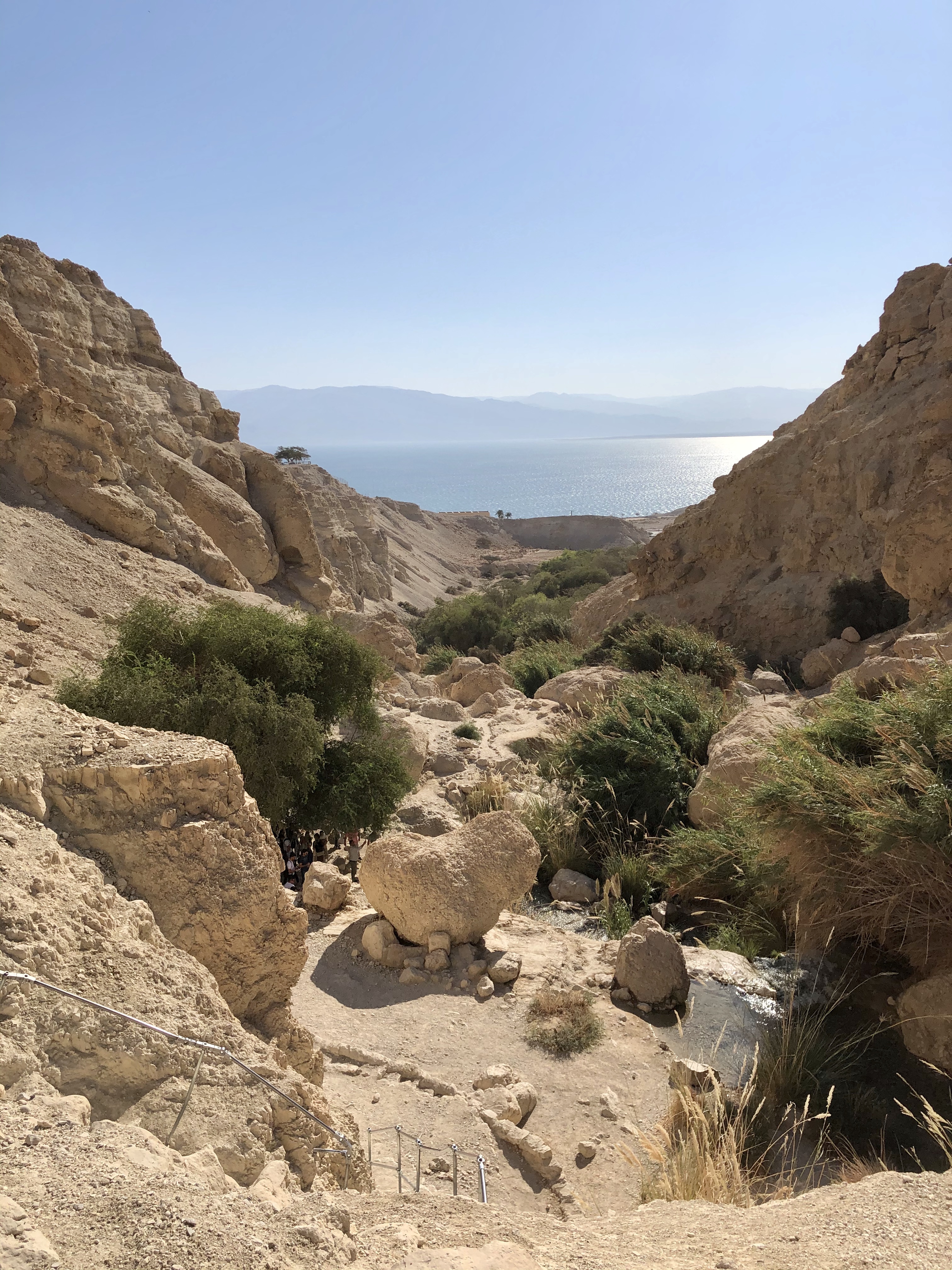
Ein Gedi Desert
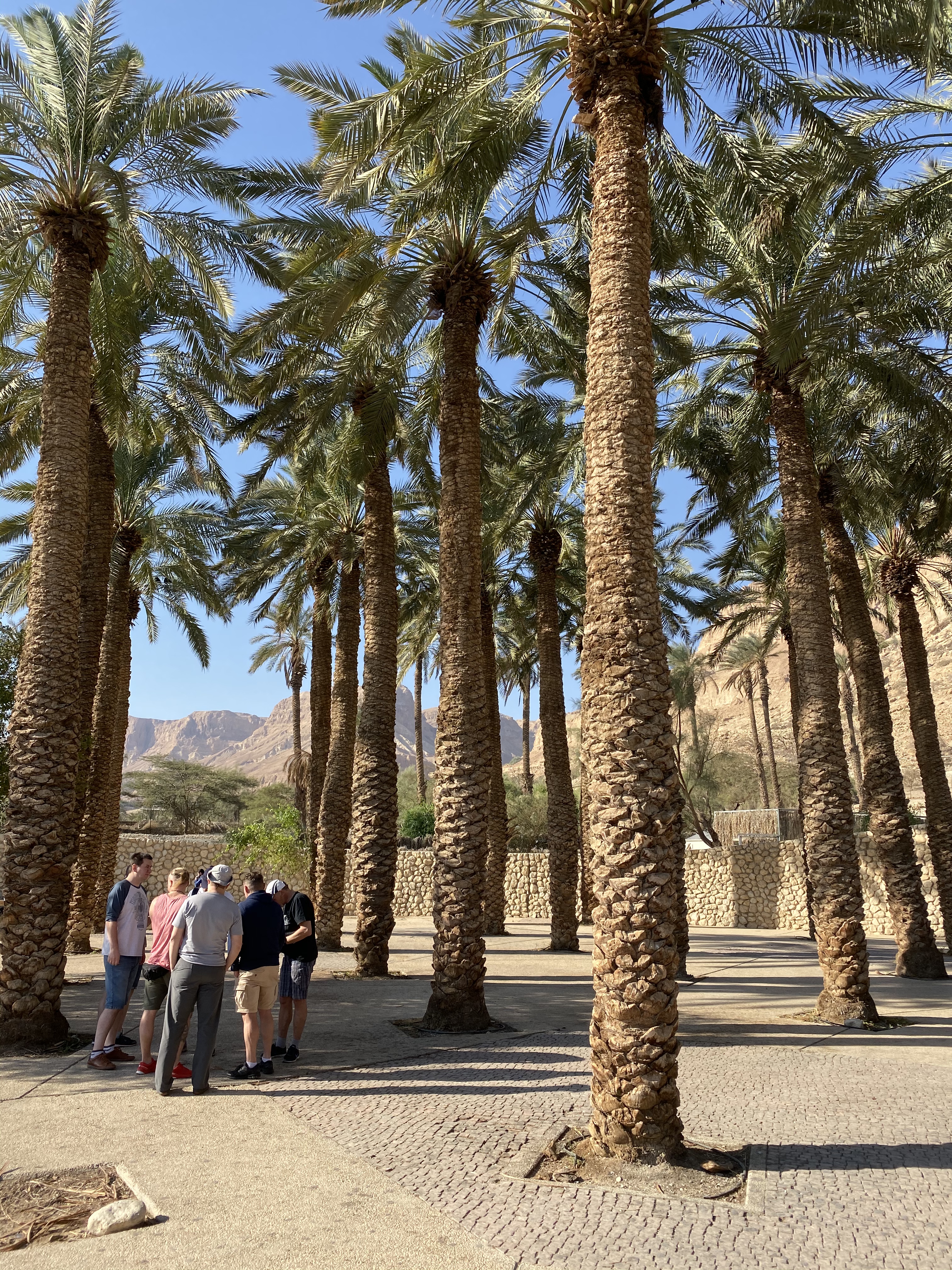
Date palms in Ein Gedi Desert

Waterfall in Ein Gedi
Date palms as far as the eye could see in every direction and a wonderful cool refreshing breeze greeted us at Ein Gedi, the desert oasis south of Jerusalem. Rolling barren, yet hauntingly beautiful, cliff-laden hills suddenly turned to palm trees, scrub brush, low growing trees and beautiful flowers. A rushing stream brought life-giving water to the area. Ein Gedi is the oasis, hidden in the desert, to which young David fled when jealous and suspicious King Saul tried to have him killed. The caves in which he and his men hid in the cliffs are clearly visible from the oasis. Walking the trail, one encountered Ibex, a type of mountain goat, and desert rats. The trail’s upward climb led to rushing water and beautiful waterfalls. For the first time in my life, I understood, experientially, how one feels when you come out of the desert into a refreshing oasis in life. The sound of rushing water, the gentle breeze, trees to shade your path, the calm. Life can be hectic and yet, God provides an oasis to bring us relief. I now have a reassuring mental picture to hold onto.
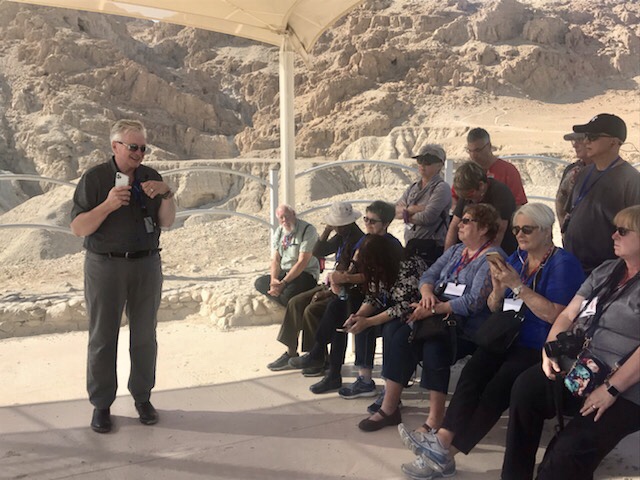
Wayne teaching in Qumran
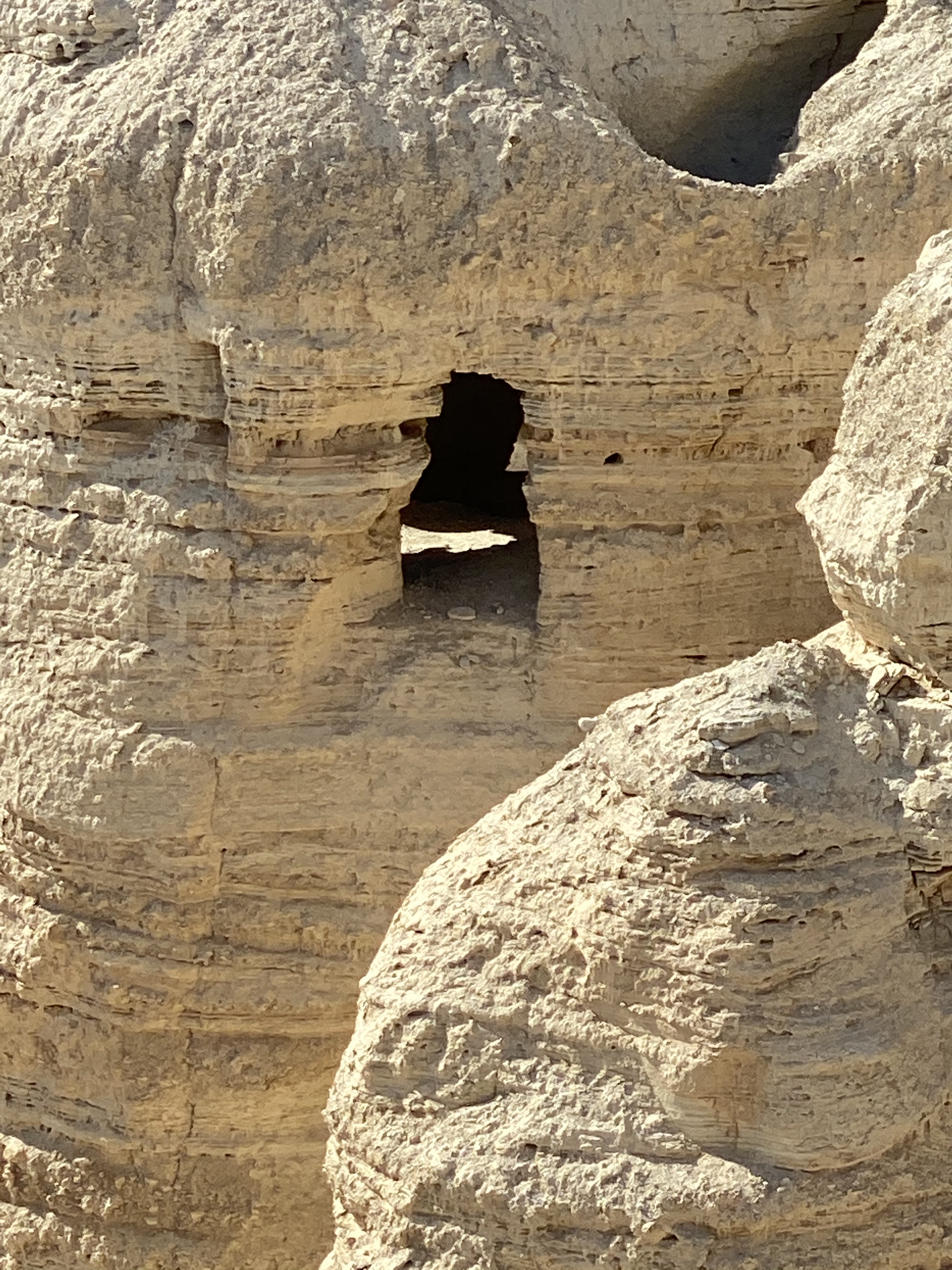
Cave in Qumran
After lunch, we headed over to Qumran, a barren area where, in ancient times, an ascetic sect of Jews founded a community to separate themselves from the wiles of the world and lead a peaceful and communal existence. They built canals to direct flood rains that came from far away Jerusalem and that rushed through the rock canyons nearby into a vast system of cisterns where overflows were directed to their ceremonial ritual baths which they used daily for spiritual purposes. In this way, they had the water necessary to survive in an otherwise uninhabitable place. What makes Qumran so important, however, is that they were deeply committed Biblical (Old Testament) scholars intent on preserving the Old Testament manuscripts. As such they rigorously, 24 hours a day, had teams whose purpose was to copy and check Biblical manuscripts for errors, for preservation in that dry, warm climate near the Dead Sea. When Israel was decimated in the first century A.D. by retaliating Romans after their rebellion against Roman occupation, the community disappeared. Fortunately, the scrolls had been hidden away in caves in clay jars, left to be discovered by a shepherd boy in 1947. The discovery caused a world-wide sensation. What impact would these ancient Biblical scrolls have on the authenticity of the then known text? Amazingly, although older than other known manuscripts and kept hidden and independent from other Jewish sources, the Dead Sea Scrolls, were the same as other Jewish manuscripts. The Old Testament was authentic–no changes were made over the centuries. We can be sure that the Old Testament we hold in our hands is the same that Jesus held in His hands and the same that the prophets of old wrote under inspiration from God. Refreshing indeed!
We ended the day at the Dead Sea, the lowest elevation on earth–1,400 feet below sea level. The Dead Sea is also the saltiest water on earth. One’s body naturally floats, no exertion necessary, on the surface of the water! No life exists in the water and none can. Yet, the water is an unbelievably inviting blue, especially against the white/beige cliffs that surround it. Dead Sea salts and minerals are valuable commodities. A warm breeze refreshed us during our leisurely time by the waters. Yes, it was a refreshing day! WEG
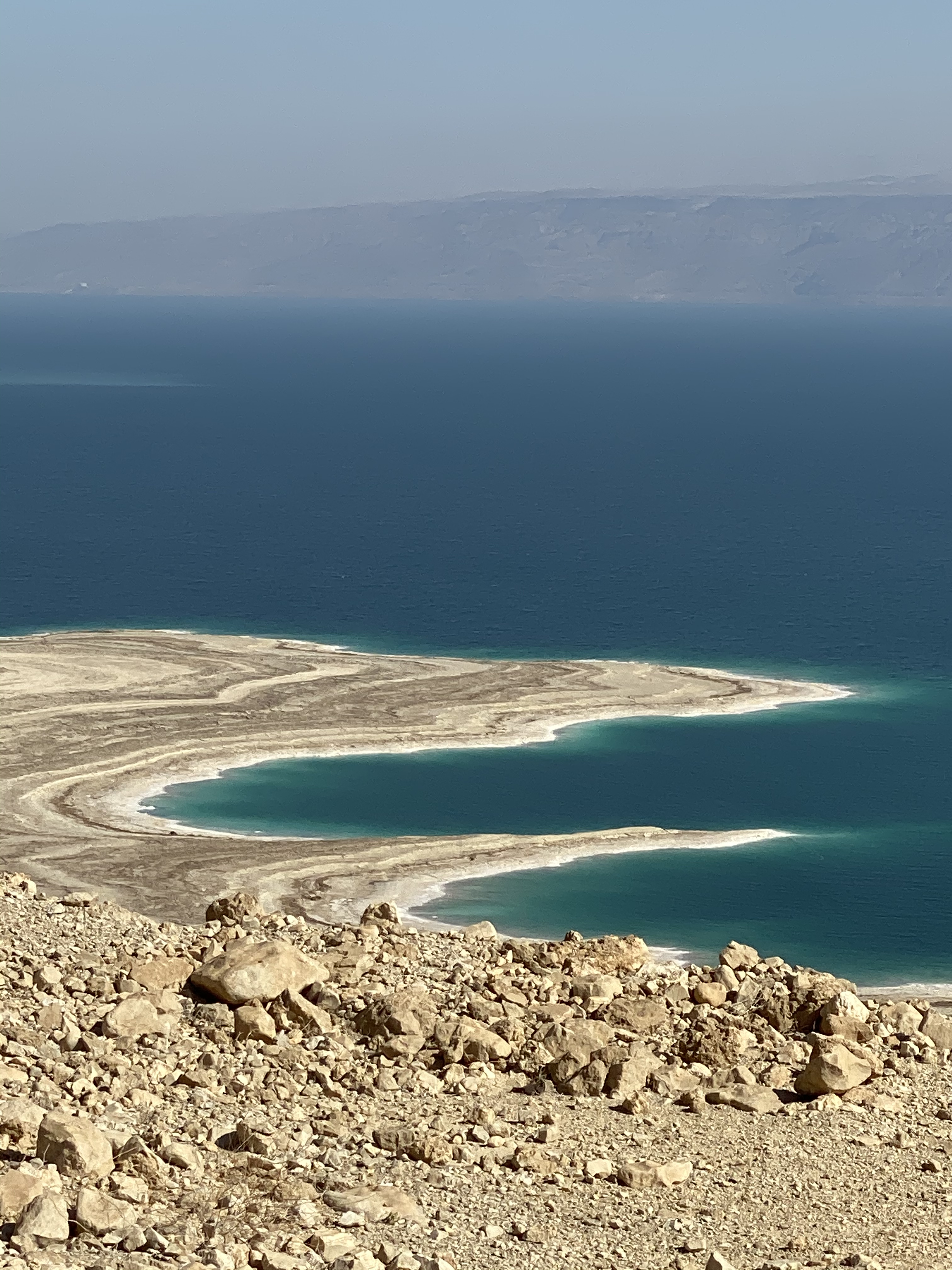
Dead Sea
Jesus in a Day
It was a whirlwind day! Have you ever heard the phrase, “There are no words” when something so big has happened that you find it hard to explain? That was today’s experience visiting Bethlehem, the birthplace of Jesus, and Jerusalem’s passion and crucifixion sites. Throw into that mix, Temple Mount, surrounded by ancient walls and the historic place of the Old Testament temple, now marked with a mosque. Oh, yes, add to all that the Jewish wailing wall and you see how overwhelming this day became.
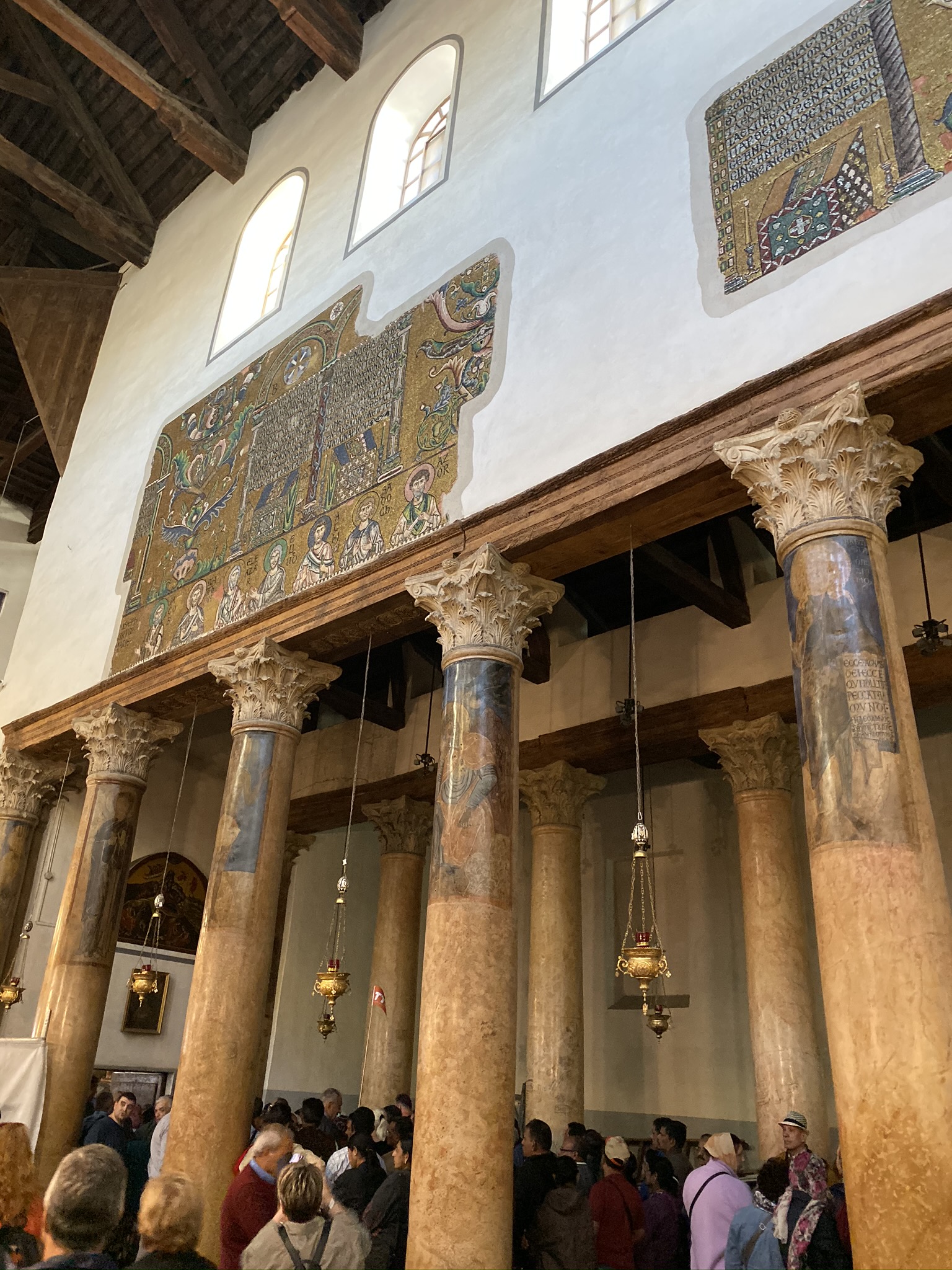
Church of the Nativity

Church of the Nativity
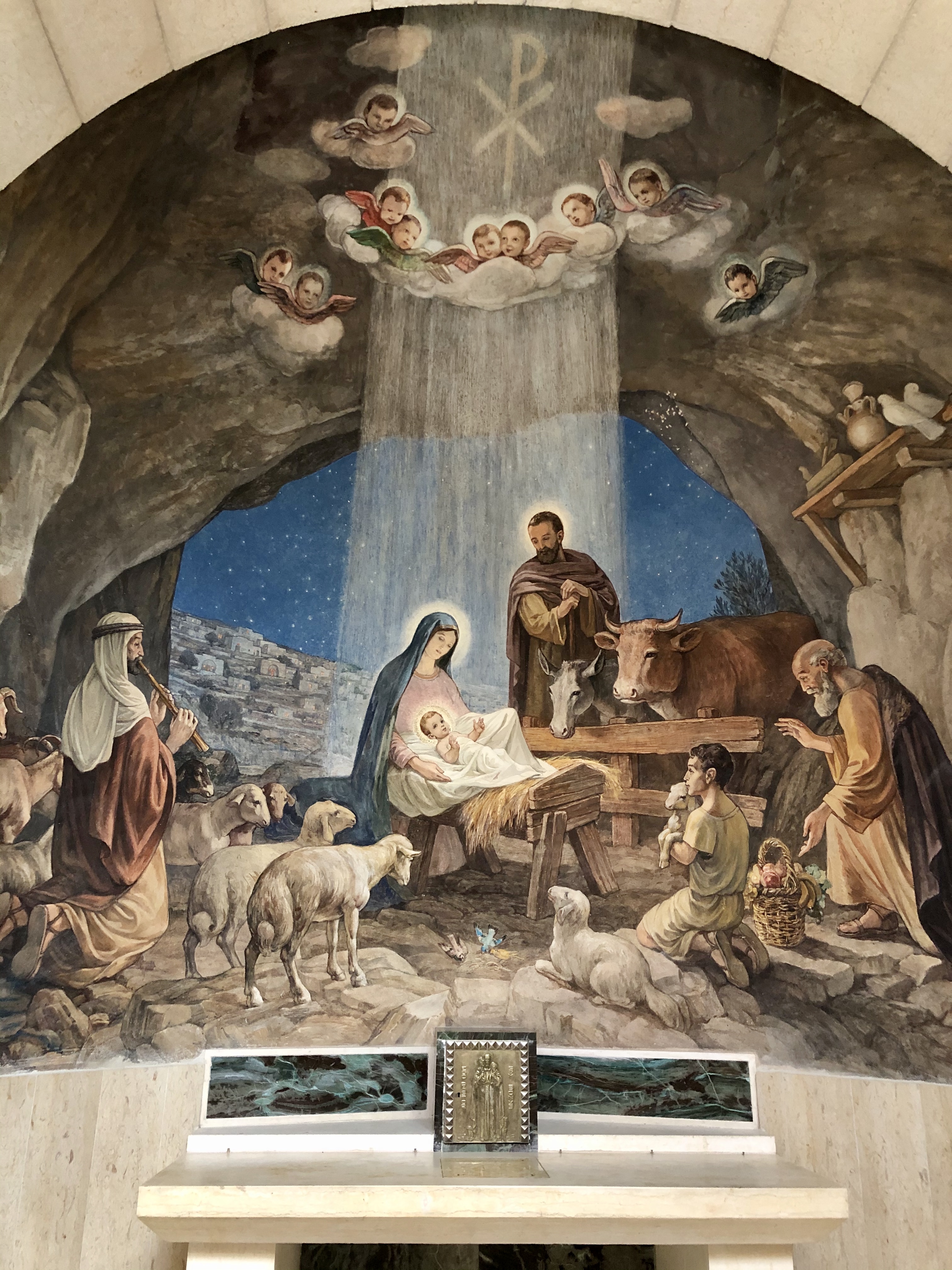
The cave over which the Church of the Nativity in Bethlehem is built marks the place where Jesus was born. The church itself is exquisite! A star on the ground of the cave marks the exact spot of Jesus’ birthplace. Faithful pilgrims queued up for hours to enter the cave. We sang three different Christmas carols while there. Shepherd’s Field followed, signifying the place where the Angels told the Shepherds watching over their flocks by night that Jesus had been born. Gloria in Excelsis Deo!
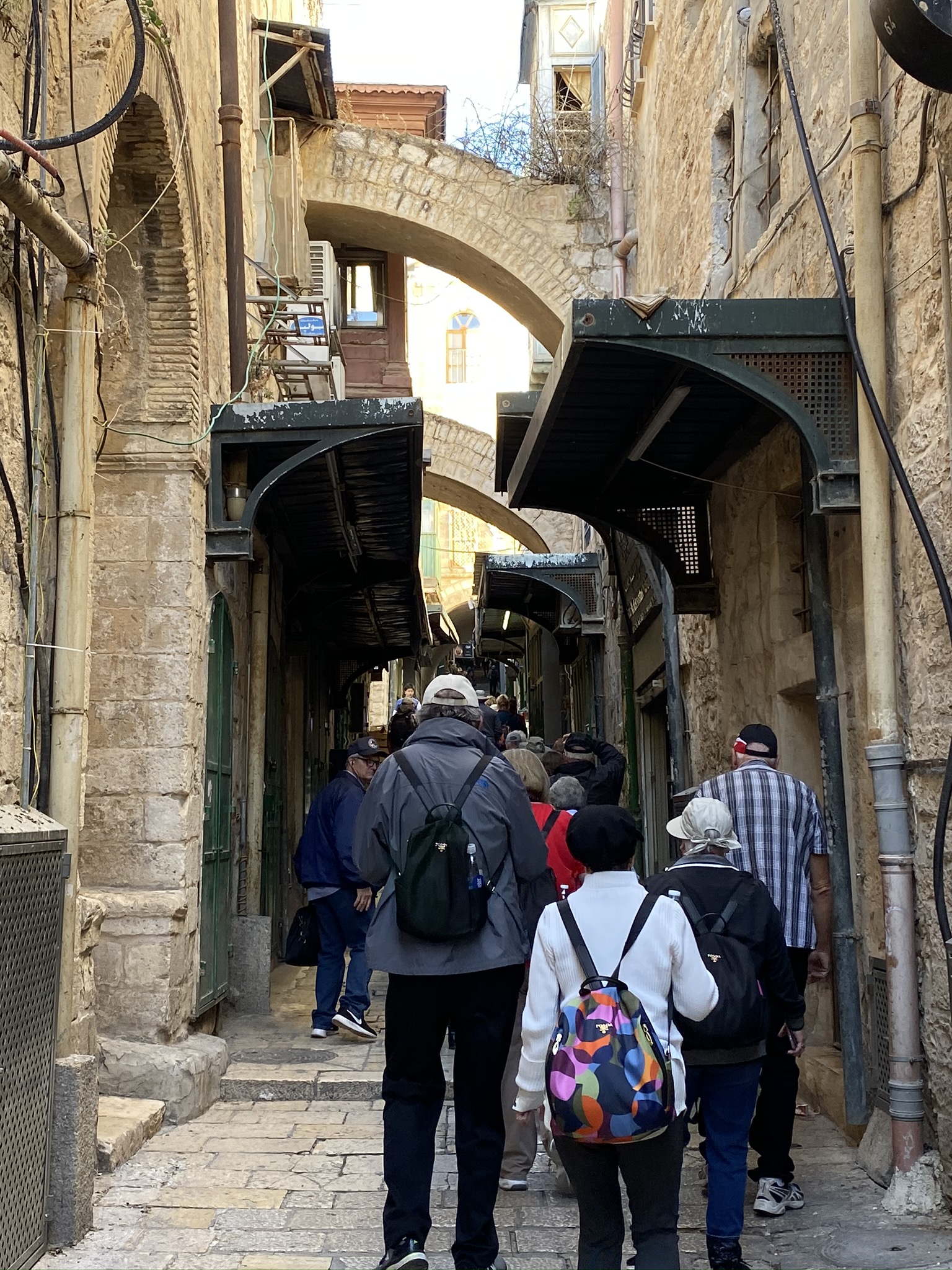
Via Dolorosa
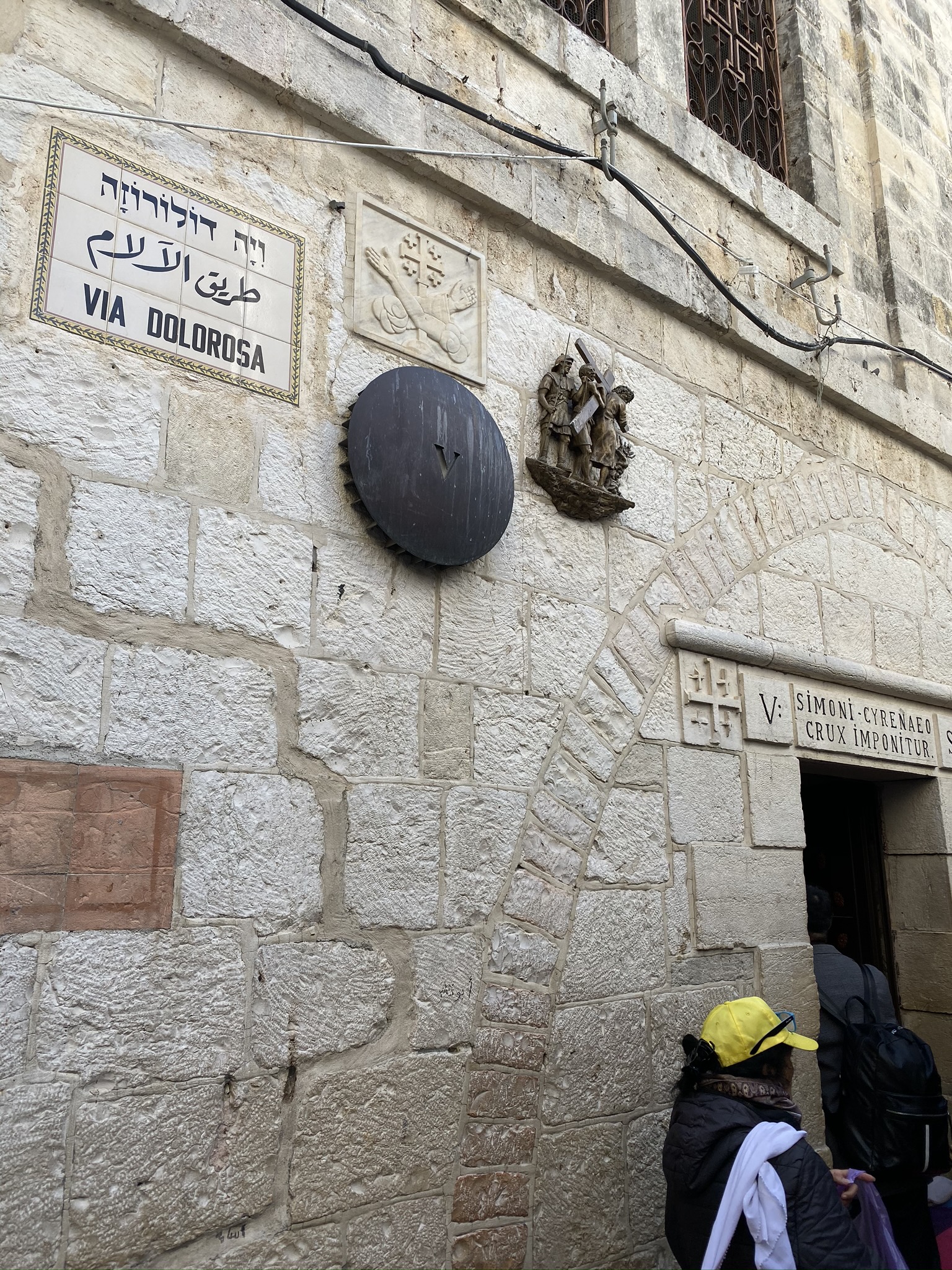

Via Dolorosa where Jesus saw His mother
We walked the Via Dolorosa, the Way of Suffering, where Jesus walked carrying the cross to Calvary. Chapels and churches marked each of the significant Bible stories of the passion—from the trial with Pilate to the crucifixion. Throngs of pilgrims the world over, singing, praying and carrying crosses walked the Via Dolorosa. It was a cacophony of spiritual sound. The walk is through narrow streets lined with shops and eateries and into and through the city marketplace. Somehow, this was all fitting, since Jesus was persecuted and killed in a very public way. His cross was available for all to see in a public square sort of way. When we arrived at the Church of the Holy Sepulchre, the crowds were thick. The church is large and beautifully ornate. The rock that marks the spot of Jesus’ crucifixion can be seen from above and from below ground. The marble slab on which Jesus’ body was placed to prepare for burial could be touched by hand. Emotional, moving, dramatic—words fail.
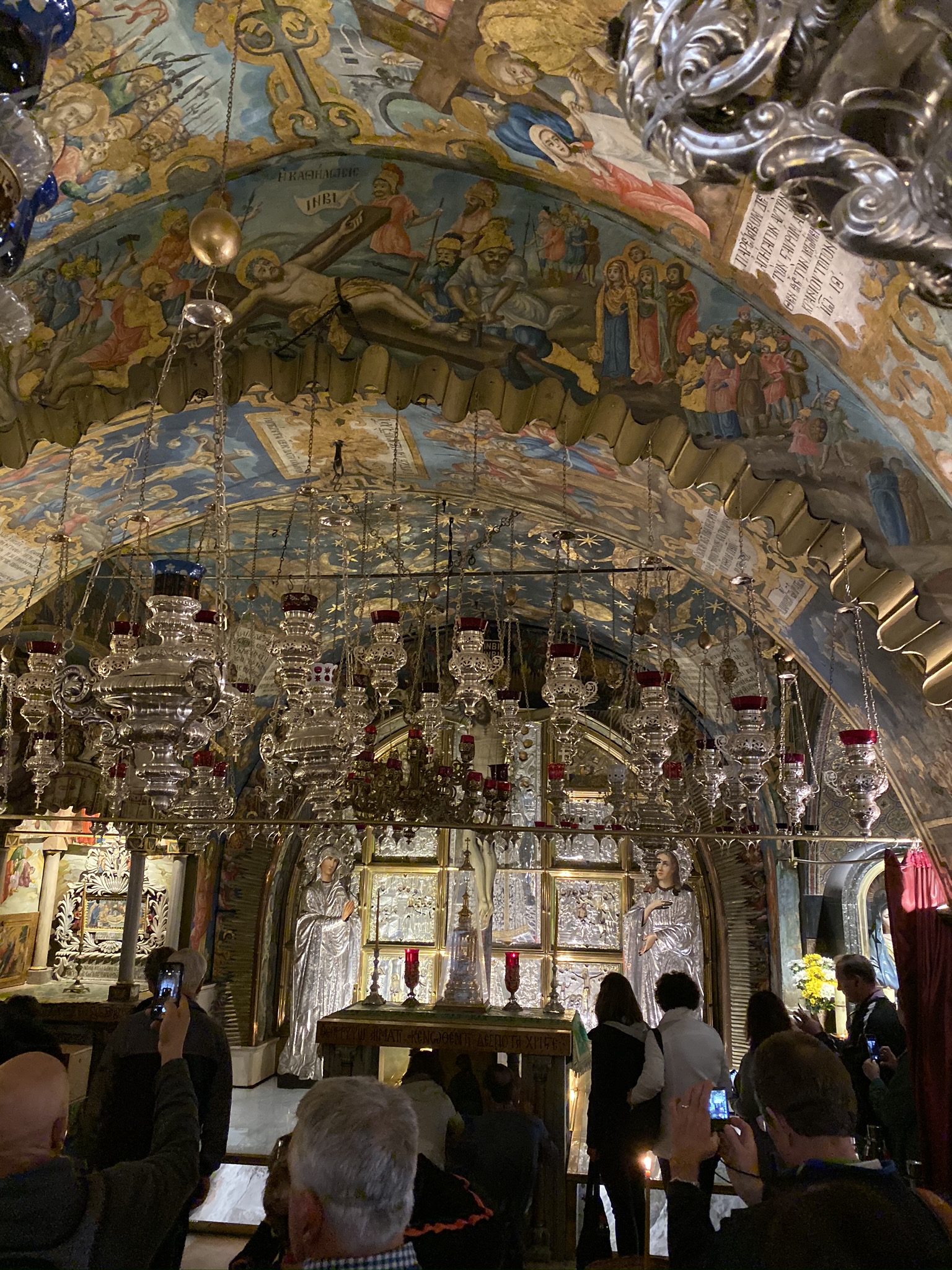
Church of the Holy Sepulchre

Church of the Holy Sepulchre
Temple Mount and the Wailing Wall were historic and grand, but the meaningful moments were the places that were significant stories of the birth and death of Jesus. These are the Biblical accounts that changed my life and gave me hope. “Oh, for a Thousand Tongues to Sing, My Great Redeemer’s Praise!” WEG
Expect the Unexpected
Today was a different day from our others in Israel, and it was all unexpected. First, it was a more leisurely day; second, I learned many things I did not know; third, we traveled many more miles to get to where we needed to go.

Caesarea Philippi
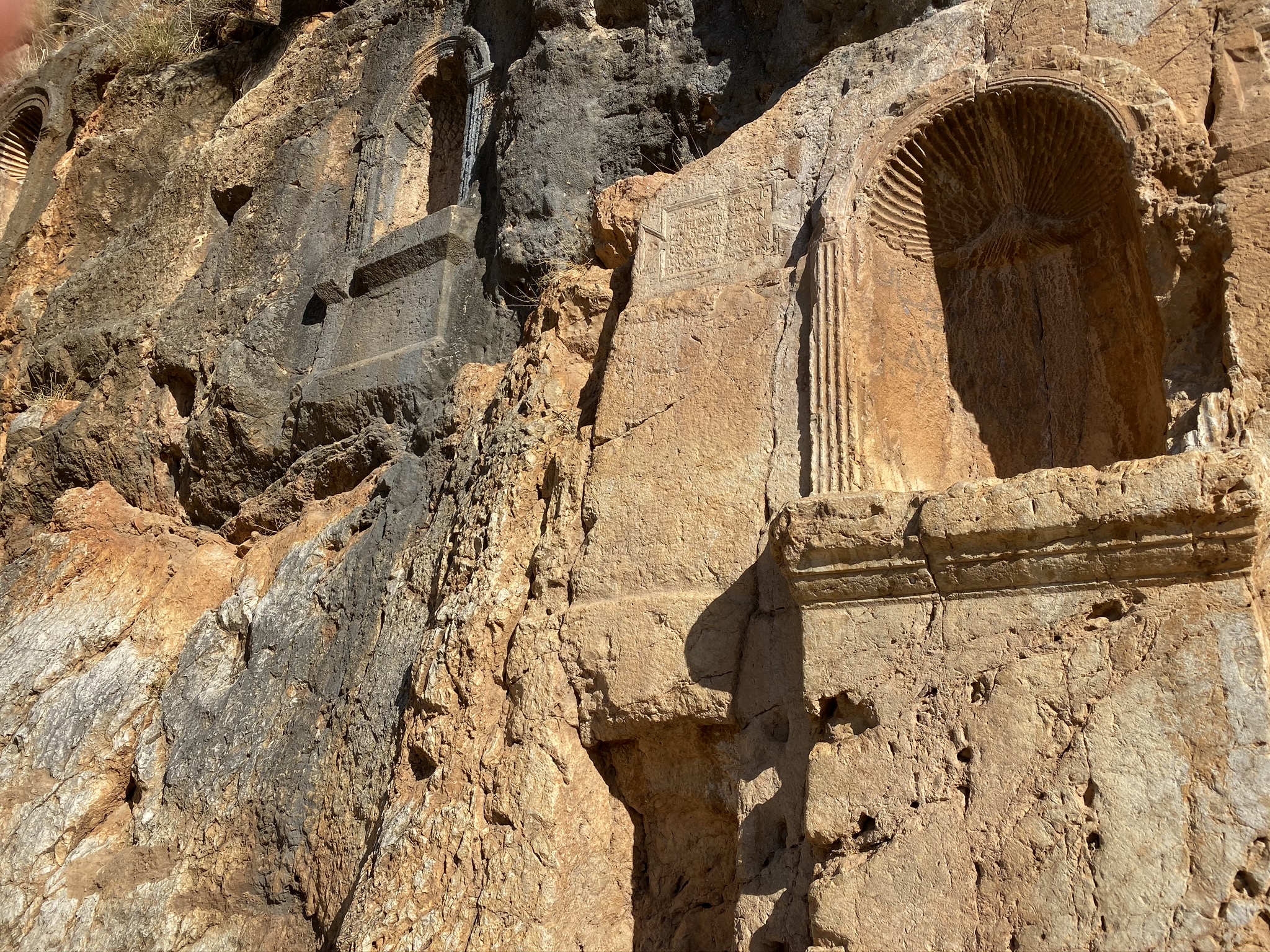
We started out at Caesarea Philippi/Banias in the far north of Israel, close to the borders of Syria and Lebanon. Now deserted, it had been the center for the worship of Pan, ancient god of the forest. An evil concept of god, our English words panic and pandemonium are derived from it. A very large cave in the face of the steep hill at the foot of Mt. Hermon was used for the sacrifice of animals and humans. If the water from the spring in the cave did not wash away the blood, they believed that their sacrifice was unacceptable and they had to get another sacrifice. All along the face of the cliff were carved-out niches in which idols of other gods were placed. It was here that Jesus brought His disciples and asked them basically to tell Him who they and others thought He was. Peace entered the Place of Panic. Power was overcoming Pandemonium. Peter gave the great confession, “You are the Christ, the Son of the Living God.” Jesus told Peter he was a rock and the church would be built on that confession. In that setting, the disciples learned that they were not to fear or panic in the face of unbelief and evil.

Wayne at Bet She’an
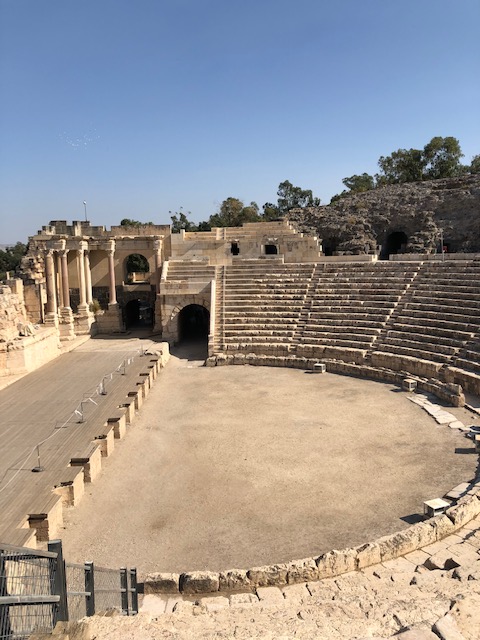
Bet She’an
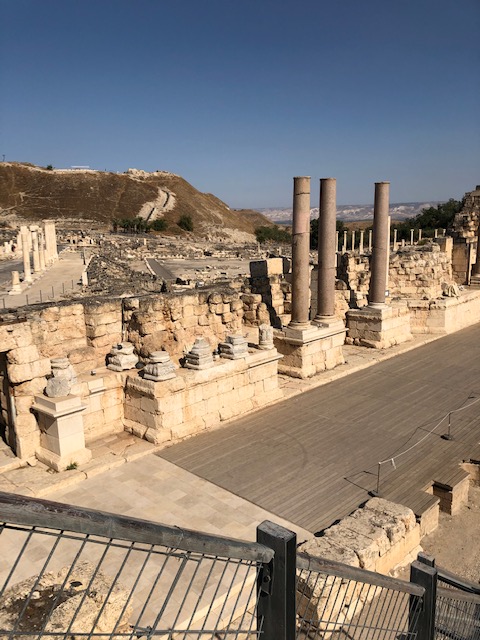
Bet She’an
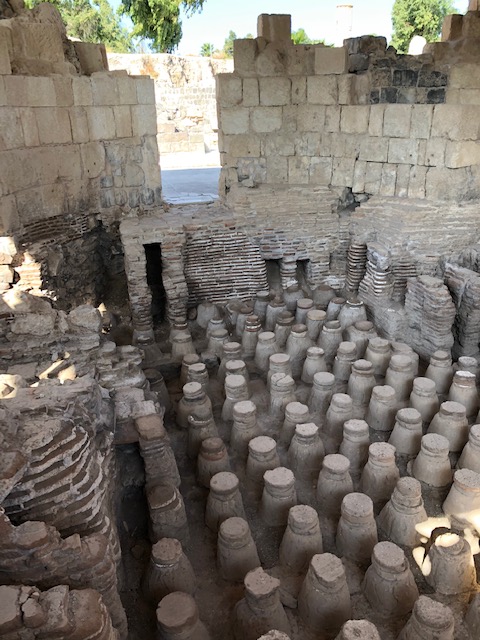
Steam Room in Bet She’an
The Bible recounts how wicked King Saul of ancient Israel and his sons were killed in a battle with the Philistines who cut off their heads and hung their bodies on the walls of Bet She’an. South of the Sea of Galilee, this now deserted city has a 7,000 year history. It is an impressive ruin. The theatre and bath house are amazing, and tall stone columns line the main avenues with still visible mosaic walkways. Frankly, I had no idea it even existed and there it was, huge and spread out in majestic array.

Gideon’s Spring

Gideon’s Spring
Further south, near the Jordan border we came to Gideon’s Spring. It marks the place where the military leader Gideon selected 300 men (from 10,000) who scooped water from the spring with one hand instead of two and lapped the water like a dog—one hand meant they were wise warriors who kept one hand free for the sword they carried—as his gorilla army who would surprise and overpower the superior invading Midianite army at night. This was a tranquil and beautiful place. The spring bubbled loudly, and pure water flowed into a stream surrounded by huge trees and rank upon rank of blooming bourganvilla.

Mount of Temptation

Mount of Temptation

Camel ride at the Mount of Temptation
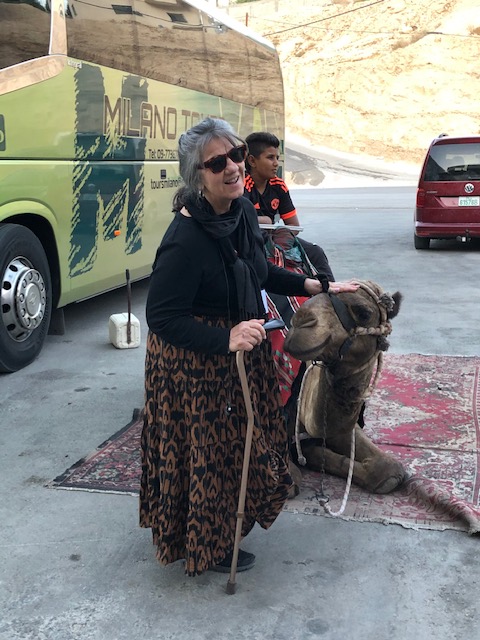
Camel affection at the Mount of Temptation
Driving further south we crossed over into the Palestinian Authority Controlled region of Jericho. What a difference from Israel! Mounds of trash and barely paved and unpaved roads greeted us. There were no flowers anywhere to be seen. The terrain was desolate. Jericho’s main site is the Mount of Temptation where Jesus entered the wilderness and overcame temptation from Satan. A 1,700 year old Christian Orthodox monastery sits on the spot but cannot now be reached on the slopes of the low mountain. We were in for a treat, however, at the nearby souvenir shop. We were greeted royally with sweet fresh dates and sycamore nuts (peanuts baked in sweet sesame). A man pressed pomegranate juice in front of us; a camel was kneeling ready for rides; pita to be dipped in olive oil and then hyssop was presented as well as pita and date honey. All of this, of course, enticed us to buy products in the store.
Now late afternoon, we turned west toward Jerusalem and to our hotel which will be our home for the next five nights. Amazing adventures await!
Smooth As Glass
From the East and the West, the North and the South, of every tribe and tongue, they come. This is the sight and sound of the Holy Land. It is glorious. Faithful Christians on pilgrimage. Different customs, styles and pieties are unashamedly on full display. People kneel, sing, pray, sit in quiet and talk in excitement. All on full display. Brothers and sisters in Christ in one place for one purpose—to experience the Bible lands and grow in faith. The joy is evident and the seriousness of the quest is ongoing reality.

Sea of Galilee view from the Mt. of Beatitudes


Today we were surrounded by the ministry of Jesus in Galilee. The Sea of Galilee was smooth as glass for our early morning sail. It was peaceful and the soft breeze was cool and refreshing. There was Capernaum over here and the Mount of Beatitudes over there. Look ahead and you will see the home of Peter, the Jordan River flows out to your left and the miracle of the feeding of the 5,000 is a short distance ahead. Story after story of the life of Christ filled the soul with peace and power at the same time. Suddenly, one didn’t just know a Jesus story; it sprang to life. God allowed your momentary timeline to intersect with the divine. Jesus was real.

Discovered boat from the time of Jesus
The museum housing the priceless find of a fishing boat from the time on Jesus was an unexpected pleasure. Hidden under mud from a Roman naval maneuver and thus preserved, science archeologists have concluded with some probability that it is possible that Jesus either knew the owner or even touched the boat. This was due to its discovery location near the area Jesus often traveled, the small population of the area in that time frame and the rather costly material of cypress wood imported from Lebanon used in its construction, indicating that it was a professional fisherman’s boat. Peter and his brothers were professional fishermen turned by Jesus into fishers of men. Such profound contemplation.
At the Mt. of Beatitudes where Jesus preached the “sermon on the mount” stands a lovely and peaceful grove of trees of many different varieties, with flowers in abundance, overlooking the beautiful Sea of Galilee. We were trying to get a quiet spot to hear the Beatitudes read, but the intensity of the crowds made it nearly impossible. Then, the spiritual reality that God had brought the world together in this one place, with our group as part of a much larger Christian whole, sunk in—we were all family by faith! Now the beatitudes took on special meaning. God provided a nun at just the right moment to begin asking the crowds to quiet, so that people could have contemplation. People in our group raised their hands when a beatitude was read that applied to their now. It was powerful.

Peering into Peter’s Home in Capernaum

Capernaum is the second most mentioned city in the Bible after Jerusalem. It was home to Jesus during his ministry. The temple where he prayed is here and so is St. Peter’s home where he stayed. While this blog would be mega longer if I gave all the information we are getting, I do want to give you a taste. How do we know this is Peter’s home? Because, first, the Bible says he lived in Capernaum and second, the residents of the small city pronounced it his home from the first century. On later discovery, the small apartment-sized home contained old graffiti praising Jesus, the only such graffiti in the city. Now a beautiful church surrounds the home and an observation area on the upper floor is glass, allowing an unobstructed view down to the home.
The Church of the Multiplication of the Fishes and the Loaves is not far from Capernaum. It dates from 350 A.D. and commemorates Jesus’s great miracle of feeding the 5,000. The guide asked us to look at the mosaic floor upon which we stood and then informed us it was 1,600 years old. “Take off the shoes from off your feet—for the ground upon which you stand is holy ground.” Amazing and awesome rolled into one emotion.

Remembering our Baptism
Then the Jordan! We remembered our baptisms in a special ceremony in the Jordan River. Jesus began His ministry with being baptized in the Jordan. Tears were shed, faith was recommitted, grace was abundant, the Holy Spirit was present, water was touched, and God’s gift of baptism was celebrated. Raw, yet heartfelt, emotion rolled with energy throughout. “Receive the sign of the holy cross on your forehead and upon your heart, to mark you as one redeemed by Christ the Crucified. The Lord will bless your coming in and your going out, from this time forth and even forevermore!” Amen! WEG
In the Heart of Bibleland

Mt. Carmel
Standing on Mt. Carmel—it was a climb worth every step—one looks west to the Mediterranean Sea; east to Nazareth and Cana of Galilee and south to Megiddo and Caesarea. All of Israel is jam-packed with history, both religious and secular. However, in the north of Israel, Bible stories come alive in this heart of the northern Bibleland. Mt. Carmel is where the great prophet of old, Elijah, challenged evil King Ahab and Queen Jezebel and their worship of the old Canaanite god Baal. He ridiculed 450 Baal priests in a worship duel where the God of Israel came down in fire to burn up Elijah’s worship offering; whereas, the Baal priests only received silence from heaven as they called upon Baal to burn their offering.
Nazareth was Jesus’ childhood home and the majestic Church of the Annunciation stands on the spot where the angel Gabriel told Mary she was to be the Mother of Jesus. We were struck with the multitudes of faithful Christians from around the world who filed past the House of the Holy Family inside the church walls. Kneeling and praying, singing or sitting in quiet solitude, the multicultural and multi-ethnicity of the Christian Church was on glorious display in this reverent space. Awesome falls amazingly short of describing the experience.

Church of the Annunciation

Church of the Annunciation

Church of the Annunciation
Just south is Megiddo and its ruins. Situated in the most strategic intersection between Egypt and Mesopotamia, whoever controlled Megiddo gained enormous financial and military clout. Because of this, Megiddo has several thousand years of history before King Solomon ruled the city and built Salomon’s gates, now being uncovered and restored near the even more ancient Canaanite gates to the city. In fact, the city has 26 layers of ruins, let that sink in—26 layers of antiquity! Here, the New Testament book of Revelations speaks of the final battle between good and evil under the name Armageddon. We walked past the ruins of King Ahab’s (Ahab and Jezebel fame) horse stables and entered the deep shaft subterranean water system dug during his reign. Incredible. We came out of the system at the base of Mount Carmel exhausted and fulfilled.

In Megiddo, we observe location of emergency storage of grain.

In Megiddo, our group prepares to view the underground water system.

Megiddo
The day began at awesome Caesarea. Extensive and well preserved ruins of this most important Mediterranean city remain—the theatre, the hippodrome (horse races), the port, portions of the palace, stone walls and the water aqueduct with its stone arches remain to this day. I stood where the Apostle Paul made his appeal to go for trial before Caesar in Rome that would eventually give him a martyr’s death. Moving indeed!

Caesarea

Caesarea

Caesarea
I could say it was a full day of activity, but I prefer a fulfilling day descriptor. And to top it all off—the Mediterranean food we were served has been gasp inspiring, which simply means we are all going to bed full! WEG

Only a tiny sampling of the delicious Mediterranean foods we are enjoying.
Passport Please

Clock Tower in Joppa/Jaffa

The Church of St. Peter in Joppa/Jaffa
Have you ever experienced that sinking feeling in the gut when you realize you are in a big mess? How does one get into the most security-conscious country in the world without a passport? Mind you, they were exquisitely kind, but bottom line, “No passport, no entry” to Israel.
I searched frantically, but no passport. Kathy and all of our friends were whizzing through passport control, but I was not going to be able to do so. I ran way back to the Air Canada flight entry point, but I was not allowed to enter. “Go to passport control,” they advised. I ran all the way back down; found police who also directed me to passport control. Once I found the office, they were efficient but unemotional—I was emotional! They called someone and told me to wait while the plane was checked. About fifteen minutes later, I was handed my passport. Somehow, during the night, it had been dislodged from my secure spot and fell onto the floor while I tossed and turned trying to sleep. I breathed a sigh of relief and rejoined Kathy, on the other side—in the Holy Land!
Our first day was wonderful. We got a feel of the country as we visited Tel Aviv and Joppa/Jaffa. Joppa is the Biblical site of the great port into which the cedars of Lebanon arrived to construct the great Temple in Jerusalem under King Solomon. It was also the port from which Jonah tried to escape his calling from God to go preach to the rebellious people of Nineveh and as a result was swallowed by a great fish. It was where Tabitha/Dorcas, the woman of awesome social work, was raised from the dead by St. Peter. Here St. Peter also received the amazing vision to spread the gospel of Jesus to the gentiles (non-Jews) and not to simply stick with his own Jewish friends, thus greatly expanding the reach of the early Christian Church. Old Joppa has narrow corridors and stone paving descending down to the port where so many Bible stories came to life.
We spent quiet time in St. Peter’s Church where art depicted the life of St. Peter as it related to the city of Joppa. It is believed the church was constructed on the site of Simon the Tanner’s home, the roof top from which Peter received the missionary vision from God.
Our long day—flight, plus site-seeing—ended beautifully at our wonderful hotel on the Mediterranean Sea in Netanyahu, Israel, a relatively new city north of Tel Aviv overlooking the Mediterranean Sea. The powdered sugar-white sand was a pleasant reminder that Israel is more than history, it is actually a beautiful country. Our meal to end the day with a buffet of local favorites hit just the right spot—Have you ever eaten small but whole pickled eggplant (quite tasty) or lamb burgers with crushed chick pea or turnips and cucumber in a seasoned vinaigrette? The unusual selections were extensive and we savored every bite before heading to our room for a good night’s sleep. Thank you, God, for travel mercies, even when I really messed things up, and for a great beginning to our Holy Land pilgrimage! WEG

Wayne leads a pilgrim meditation in Joppa/Jaffa
Kings and Champagne

The Cathedral at Reims, France, a masterpiece of 13th century Gothic art and site of the coronation of kings
We could imagine the pomp and circumstance as the Kings of France walked down the humongous aisle of the Reims Cathedral as colored light streamed through the luminous stained glass windows. Over 30 monarchs were crowned here after Clovis, the first French King, was baptized in the 400s. An engraving in the floor marks the spot. The gowns, robes, scepter, jewelry and crown of Charles X are on display in the Treasury of the cathedral, along with other artifacts of the royal extravagance. Heavily damaged during World War I, the cathedral was painstakingly rebuilt. Some of the statuary that was damaged in the war are on display in the Treasury, and that is when we noticed the immense size of the statues. High up on the cathedral’s facade they look much smaller. With much of the stained glass destroyed during the First World War, more recent glass artist’s designs are taking their place. Of particular interest are those of Marc Chagall that grace the rear chapel. The cathedral has intricate stone work, beautiful flying buttresses—the architectural breakthrough that allowed for the massive building size and ability to have large stained glass openings of the grand gothic style—and an elongated nave with soaring ceilings.


Wayne stands beside damaged statuary from the Reims Cathedral now housed with tapestry and royal treasures in the Palace of Tau in Reims
Reims is the major city of the champagne region of France. Only sparkling wine that comes from the grapes around Reims can legally be called champagne. There are many champagne chateaux in the region, and we visited Pommery on the outskirts of the city. Impressive. Eighteen kilometers of chalk caverns are below the surface. They contain over 20 million bottles of champagne in the aging process. We saw one million of them as we walked through the cool tunnels connecting the caverns. Our guide explained the complex champagne making process, and we saw bottles from the 1700s. The tour was informative; however, I was not thrilled that we had to walk the steps back up to the surface. Those steps were rewarded, joyfully, with a large glass of “bubbly.”

Pommery Champagne Chateau, Reims, France

Pommery Chateau Staircase leading to the Cellar

Pommery Chateau houses a collection of vintage champagne


The weather is amazing. Sunny and cool. Reims is a beautiful French city with wide boulevards, classic architecture and flowing fountains. Our two days here have been wonderful; however, tomorrow we must bid both Reims and France “good-bye” as we head to the Charles de Gaul Airport in Paris for our trip back home. What an amazing adventure we have been blessed to take! God is good. WEG

The Standly’s and Graumann’s toast a bubbly from the Pommery Chateau on their last evening in France.
The Beaches

Normandy Beach
The liberation of France from German occupation under Hitler in World War II was a pivotal event in the history of that time. The sacrifice of U.S. soldiers in the invasion of the Normandy beaches is well documented. This was our day to visit the historic sites of the invasion. It was a beautiful, cool and sunny day.

Outside WW II Museum in Caen, France
We met our tour at the World War Museum in Caen. A bus to the museum left from close to our hotel. As we arrived the flags of the nations that participated in the invasion were flapping in the wind. Caen held a strategic position in the immediate invasion route of the allied forces and over 70% of the city was flattened; hence, the city is quite modern by European standards.


Our first stop was Pointe du Hoc. Here the Germans had numerous cannon guarding the Normandy coast. They could throw a bomb with accuracy 14 miles. Lieutenant Colonel James Earl Rudder, a U.S. soldier, led a small force of GI’s in a stealth tactic to take the cannon out in the early morning hours. They were successful. Rutter later became President of Texas A & M University. The landscape here still contains bomb craters from American aerial bombardment as well as remnants of German concrete underground bunkers and cannon firing ramps. We looked out into the ocean from the high cliffs and watched the blue waves from the English Channel crash the shore and imagined how this beauty was shattered by the ferocious battles here almost 75 years ago.


We drove along the five mile Normandy beach that now has names such as Utah and Omaha and memorial markers along the way. We stopped at the section now known as Omaha Beach and viewed a memorial. The beach is beautiful, but on that day it was lain with land mines and invasion barriers and, on the hills above the beach, machine gun nests and mortar launchers. Many U.S. troops died before they even touched the beach. Eventually, the troops took the hills, and the invasion to retake France and enter Germany began.
Our next stop was the U.S. cemetery just off the beach. It is a beautiful and tranquil setting with trees shaped into large topiaries. A majestic columned entry features a statue of an American youth rising from the waves to protect freedom. (The average age of the U.S. soldiers killed here on that day was 23.) A reflecting pool reaches toward the cemetery where over 9,000 soldiers are buried. White Italian marble crosses are lined up in perfect order—humbling. Towards the end of our stay, taps began to play and the flag was retired for the day. Elderly troops visiting that day were seen visibly weeping—moving indeed!


Our day concluded with a 360* immersive movie of that time that included video and pictures recently uncovered of the invasion forces. We felt sadness for the loss of life, thankful for the sacrifices made, and proud to be American. WEG
 kgraumann
 wgraumann

