
Turning East
We trained with our friends, Allen and Rhonda, to Nuremberg where we said a sad farewell. Allen and Rhonda were headed to Frankfurt and home to Tomball, and we were headed to Bayreuth. We have had a wonderful time, a fun time and a memorable time with our friends. As we boarded our new train, we realized that we were turning east and were going to places we had never before seen. East Germany, Poland and the Czech Republic were our next destinations.
Our train followed the course of a valley with steep hills on both sides and a lazy river meandering through its fields. The trees are beginning to turn fall colors and it is beautiful. Every once in a while rock outcroppings and cliffs appear on the ridges. As is usual, tall church steeples tower over villages along the way–I never tire of that sight. Steeples come in different designs. Some are spires, some are onioned–a descriptive word I have coined–some are stone carved, some have five points, some are towers–either flat or square–some are coppered, some are wood shingled and all are beautiful.
Bayreuth is synonymous with the great composer Richard Wagner (pronounced Vogner). It was here that he constructed an opera house to perform his mighty operas. This is the 200th anniversary of his birth, and the city is hosting many events to honor the occasion. In addition to the Wagnerian opera house, Bayreuth is home to another amazing opera house which is a Unesco World Heritage Site. This is a city of music. WEG
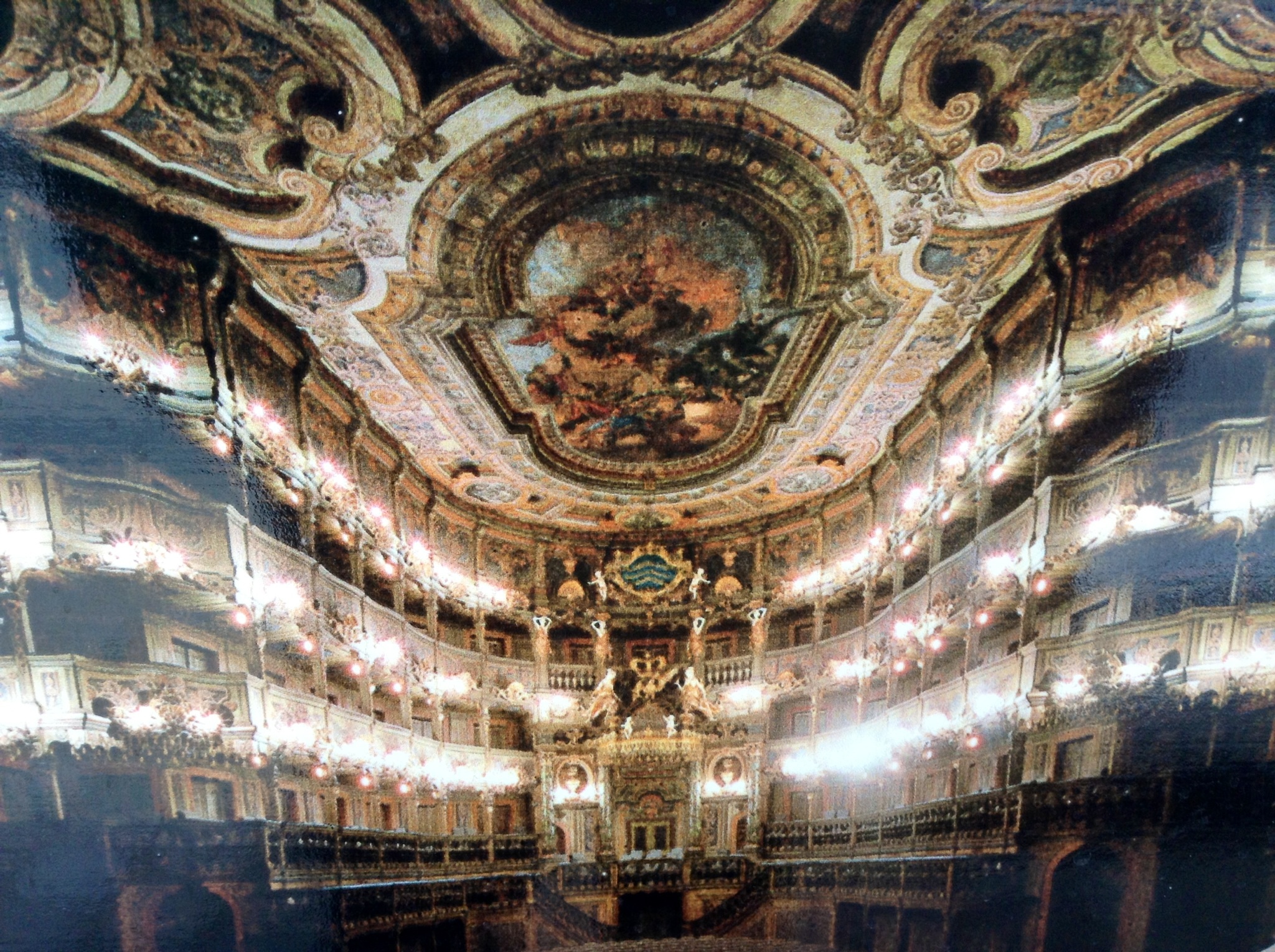
Margravial Opera House, Bayreuth, Germany, a UNESCO World Heritage Site

The Lutheran Church in Bayreuth

Schlosskirche, or Palace Church, a symbol and distinctive landmark of Bayreuth, initially a Protestant Church, as of 1813, a Catholic Church
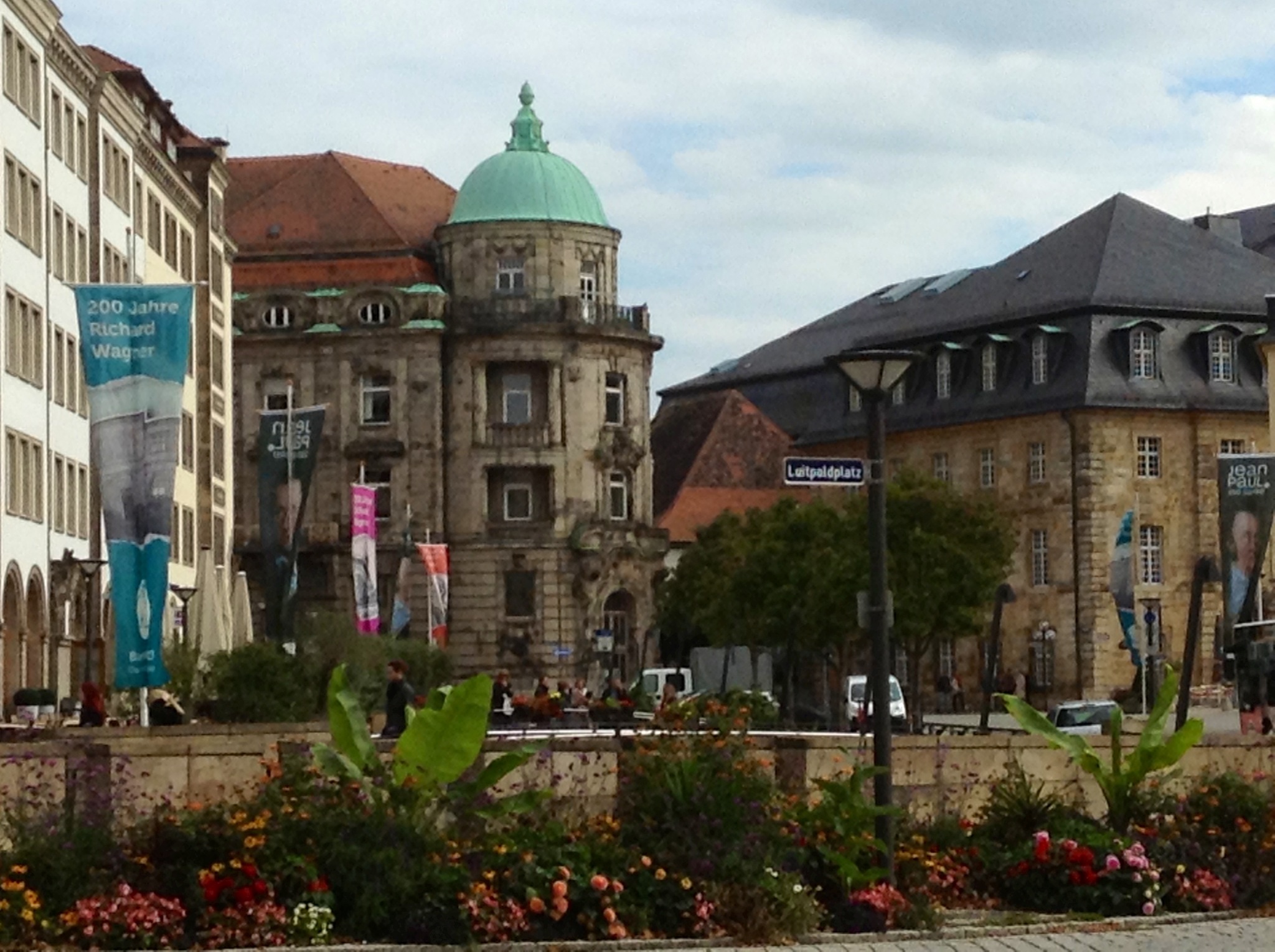
Schlosskirche Exterior, Bayreuth

Protestant Church Exterior, Bayreuth

Protestant Church Interior, Bayreuth
Chicken Rhonda
For the last day of the time our friends, Allen and Rhonda, are with us in Germany, we toured the German Alps around Garmische-Partinkircken, site of the 1936 Winter Olympics. It is beautiful country. Ettal Abbey, founded in the 1300s, is known for its brewery, its strong liquor, and fantastic church. We skipped the first two and concentrated on the last. We were in the church during Sunday Mass. The church is an outstanding work of rococo art. Some say it is one of the purest examples of that particular architectural and artistic design. Rococo is a riot of movement and color in imagery, and the church is resplendent in its explosive use of that technique. The eye cannot quickly comprehend all that is before it.
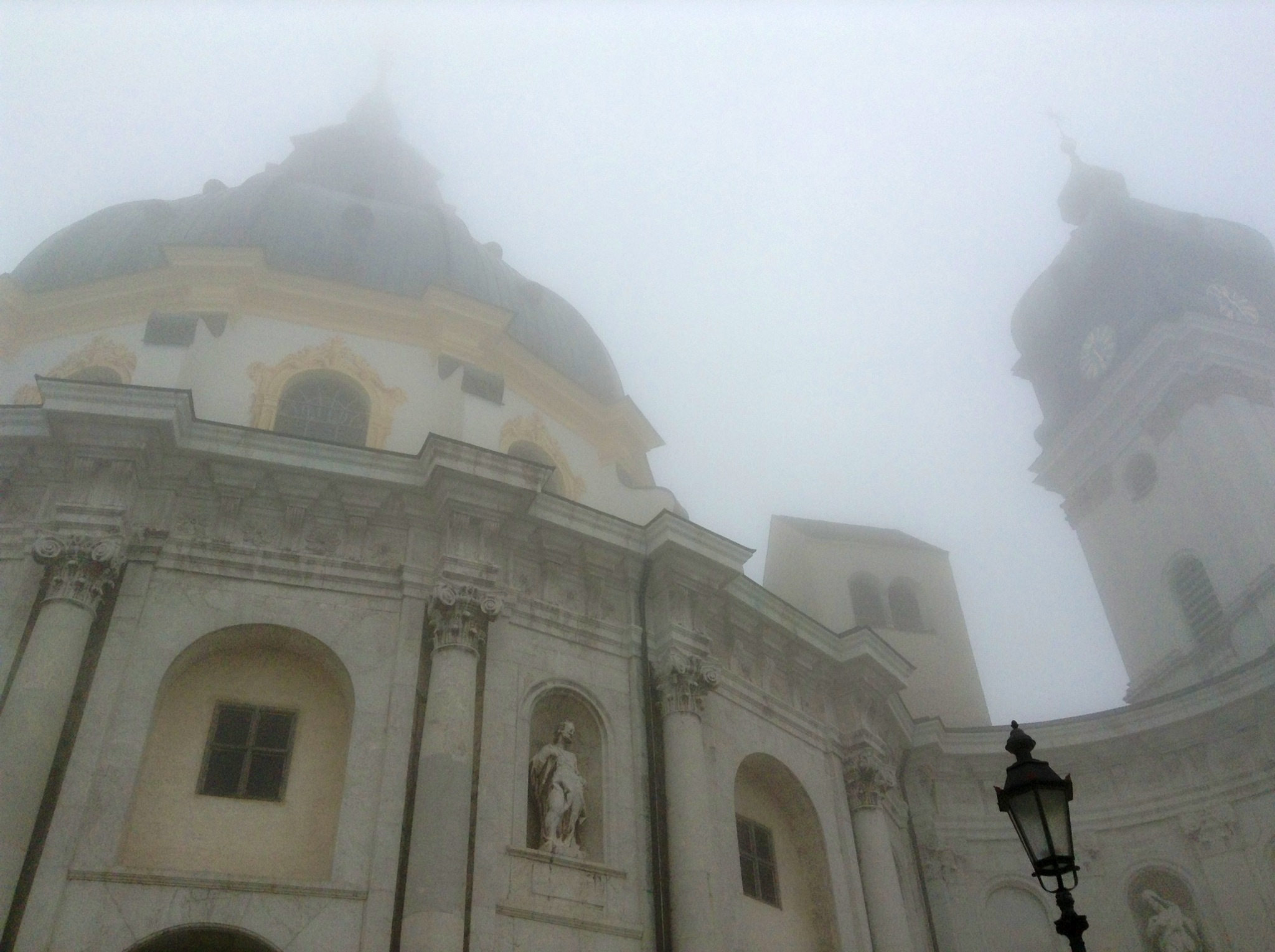
Ettal Abbey Exterior outside Munich, Germany
The Zugspitze, Germany’s tallest mountain, is close to Ettal. The gondola ride up is by far the most daring I have ever ridden. Unlike other gondola rides that soar above the trees as they sweep upward, this gondola ascends up the side of the mountain. You realize that there is absolutely nothing below you but air, and when the gondola makes its final ascent, it moves straight up like an elevator. Being used to gondolas that might reach heights above ground of 200 or so feet, I was terrified as I saw the ground underneath this gondola over a mile below. I am not sure I could ride it again. Of course, friend Rhonda was more chicken than I. She did not appreciate my running commentary of our ride upward, as in, “The last accident was over ten years ago and they haven’t made repairs since,” or, as we reached the top and the gondola came to a rest, “Since this thing is round, it could easily roll on down.” Honestly, the gondola did not glide into the station, it dangled in mid-air and you stepped onto a grate that led to the station. Then, you realized that the station was bolted to the side of the mountain–the station and platform are built around the peak and held in place by girders and cable wires. You soon realize that is no solid ground! I hollered at Rhonda, “The cables look like they are unraveling.” For those of you who know her, she gave me that look that said, “One more word…” The jagged peaks around us were in Austria and Switzerland. We could even see into Italy. We walked on a glacier, walked to Austria, and ate on an outdoor patio amidst God’s created beauty. Then, we took a cog-wheeled train through a long tunnel and through the mountain valley, past waterfalls and farms with goats and sheep. It was a fine final day with our friends. WEG

Zugspitze, the Tallest Point in Germany

Allen & Rhonda, Wayne & Kathy walked to Austria while on the Zugspitze.
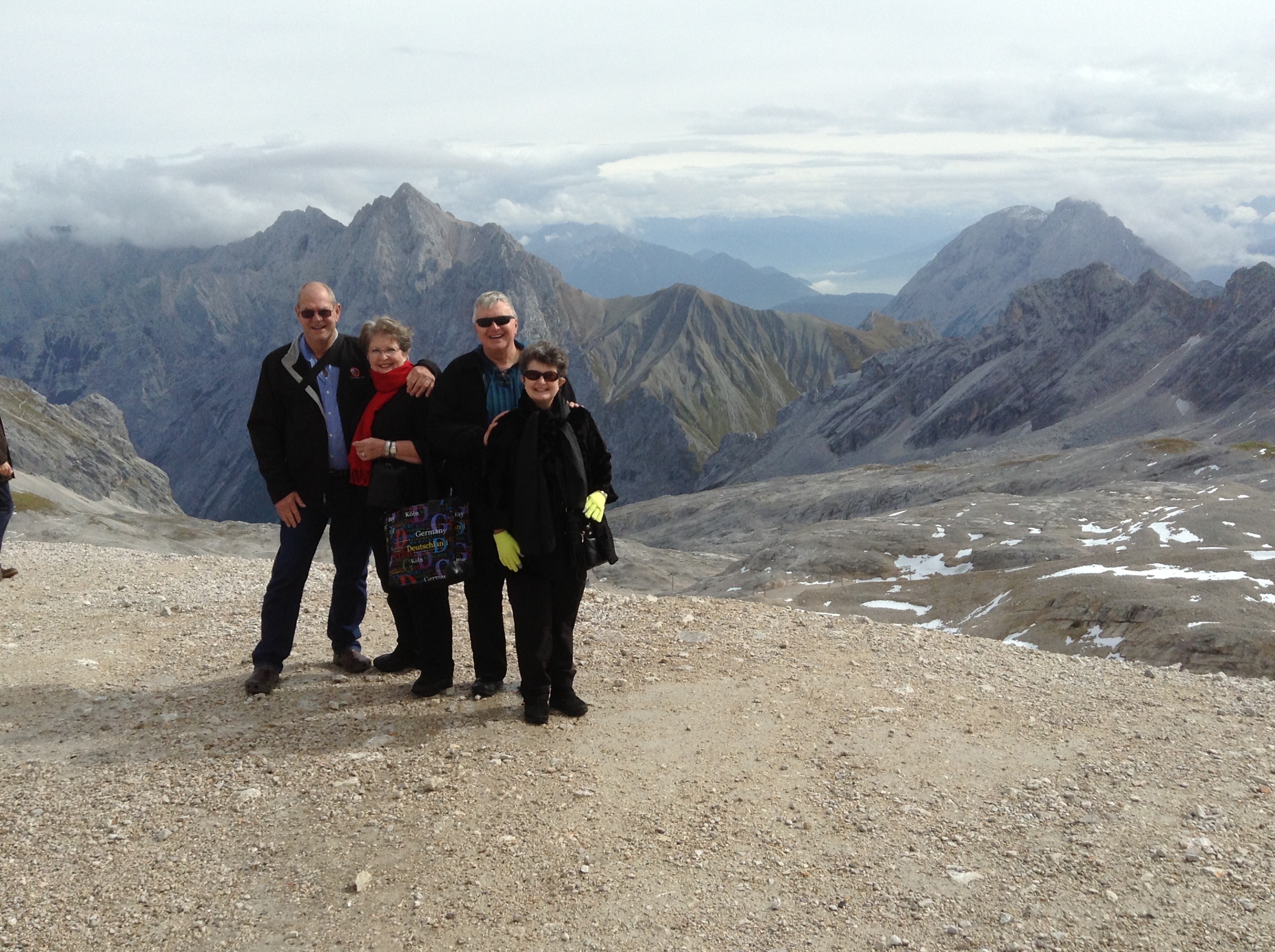
Allen & Rhonda, Wayne & Kathy with a view from the Zugspitze
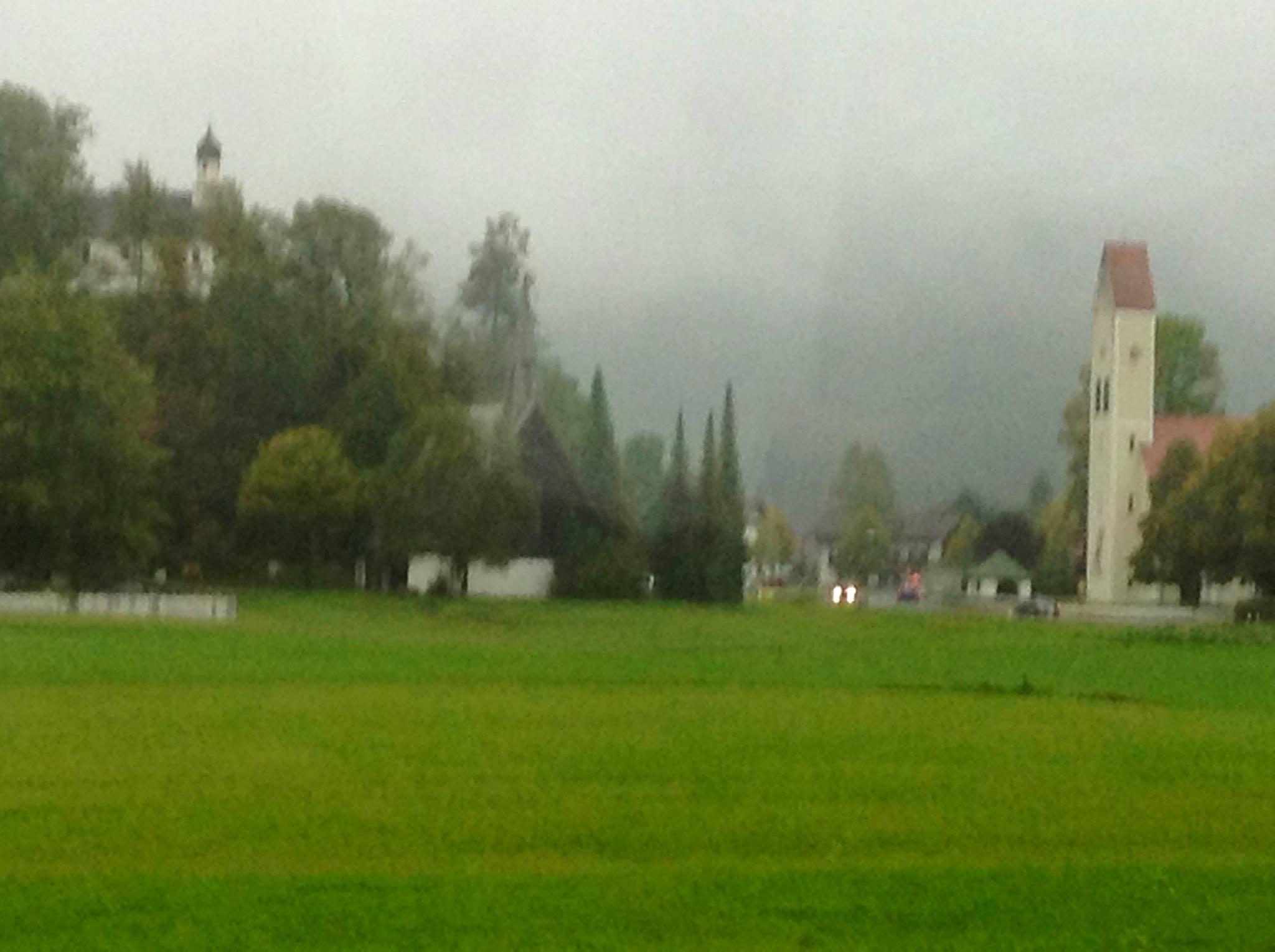
Beautiful countryside from the cog train ride below the Zugspitze
Highs and Lows
Over the past two long tourist days we have experienced some of the lows of humanity and some of the highs.
The Nazi Camp System, both concentration and death, is certainly one of humanity’s low points. It was evil planned and executed with precise detail. Dachau, on the outskirts of Munich, was the first official and model camp from which the extensive system grew. Tied to the SS, the elite core of Nazi leadership, Dachau was first the place where political opponents of Hitler were sent to be “re-educated,” and it turned into the place where the most horrendous crimes against humanity were carried out. Its crematorium burned night and day. Its slogan, later adopted by all the camps, “work will set you free,” was a cruel joke, since prisoners would only find death in this place. Our time in Dachau was a chilling reminder of the human capability to be inhumane.

Dachau’s chilling entry: “Work Will Set You Free”

Dachau’s Horrific Ovens
Building and artistic creativity are certainly some of highs we have experienced. Although the food is good and the Bavarian entertainment is indeed entertaining, the beauty of the Hofbrauhaus, the oldest beer hall in the world, was what I enjoyed the most. The huge barrel ceiling painted in Bavarian design uplifted the evening’s experience. The mountain castles, Linderhof and Neuschwanstein, of King Ludwig II in the Bavarian Alps, are indeed a flight into fancy and fantasy. From the choice of geography to the thematic art that coursed through the architecture, the castles are splendid. Linderhof is a tribute to King Louis the XIV, the Sun King of France. Gold and white to the max, each room holds exquisite pieces of art in crystal, porcelain, ivory, wall coverings, furniture and paintings. The grounds are filled with fountains and flowers and arbors that radiate from the palace with wonderful ease. Neuschwanstein is probably the most recognized castle in the world. It was Disney’s inspiration for his parks. Perched on a pinnacle in a gorge, with waterfalls flowing down from above and towering over a lake below, this castle is the ultimate in one’s King’s fantasy world. The castle was designed on the theme of Richard Wagner’s operas. Each room used an opera as its inspiration and tried through art to bring the opera to life. Unfinished inside, due to the King’s mysterious death only a few days after he was declared insane, the thirty rooms that are completed are astonishing. Some might think the castles are “overdone,” but most would agree that they are high points of art in the style of High Baroque.
My emotions have been stretched “every which way” the past two days. That is what the juxtaposition of humanity’s highs and lows does to a person’s psyche. WEG

Munich’s historic Hofbrauhaus
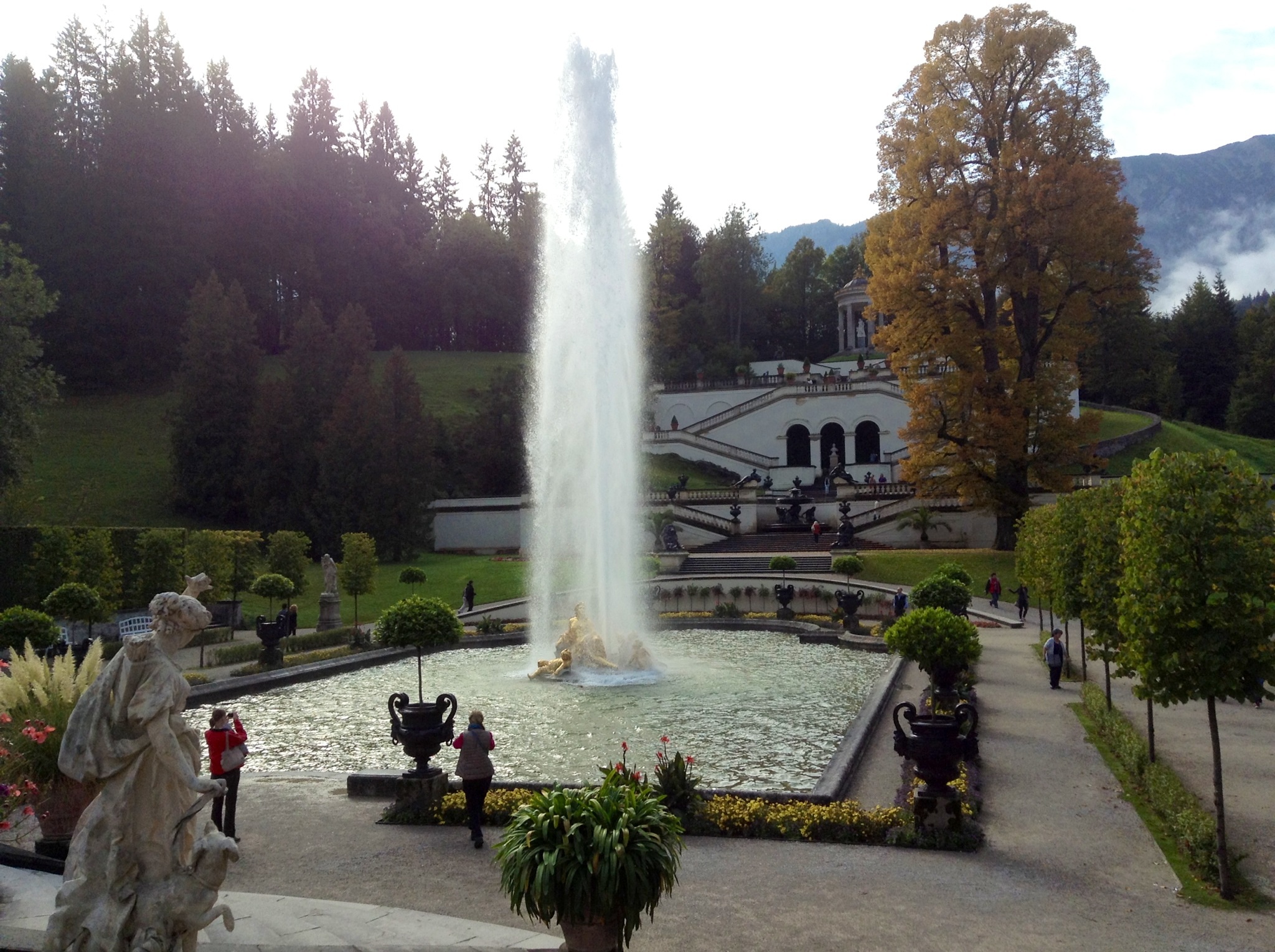
Linderhof Palace in Bavaria, Germany
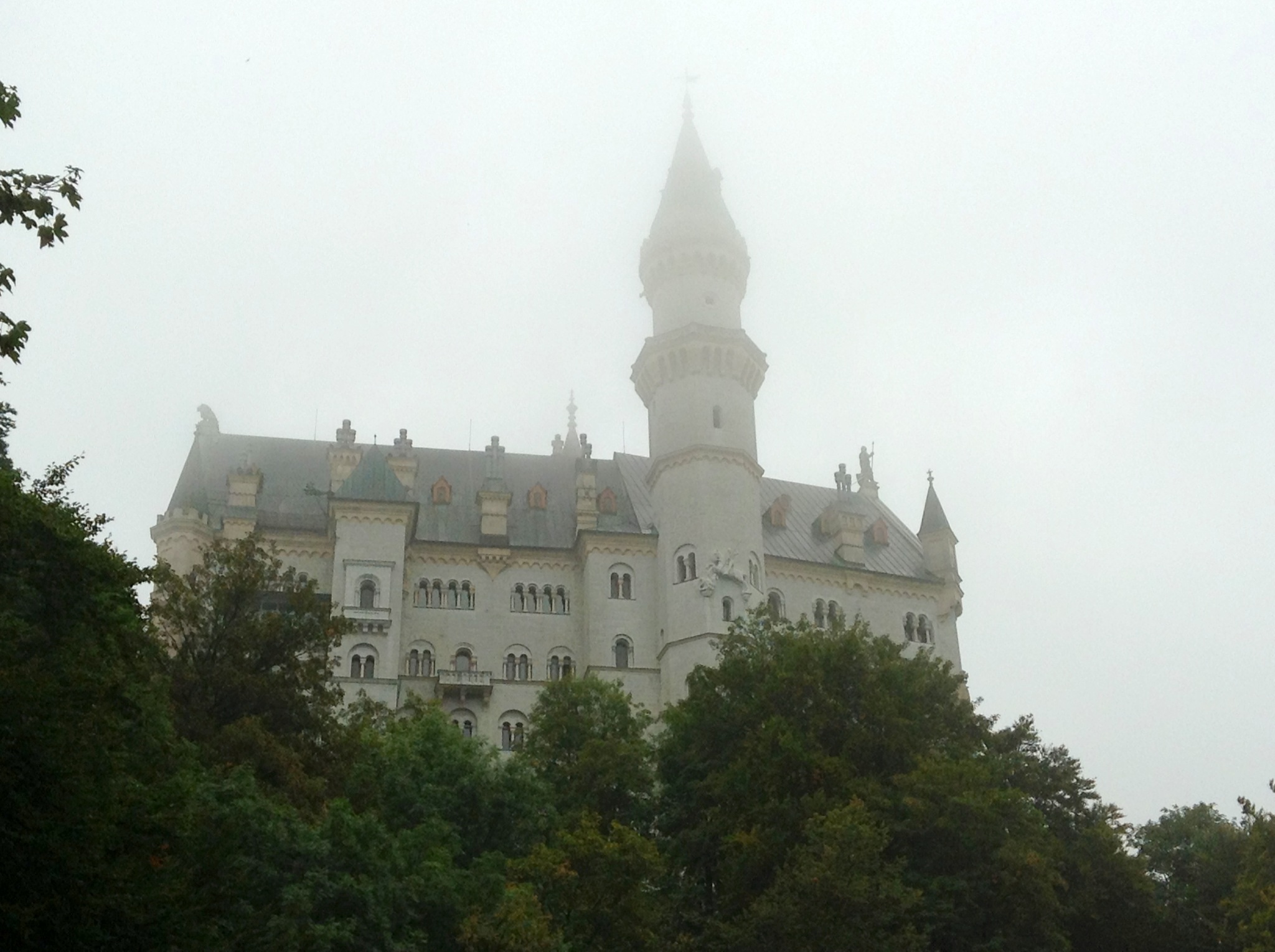
Neuschwanstein Castle in Bavaria, Germany
A Toast
It was Oktoberfest again today in Munich. It rained during the day and that drove the masses of people indoors. We finally found a place at a table in the Baurosl Tent. It was the tent we had picked out from the many choices because the tourist sites said it had some of the best music. It was wunderbar! The crowd of thousands sitting at the tables on two levels were fully engaged–some standing on chairs to sing along. We didn’t mind that the words were all German; it was a fun people-watching event. Folks danced in the aisles; vendors walked about selling wonderful food and German clothing; wait staff scurried about with food and beer–I saw one waitress carrying ten huge full beer mugs–and patrons stood and offered smiles and hugs. It is really hard to describe the atmosphere that was German to the core. Lederhosen and dirndls predominated the dress, and the yodel-singing lady was really good as she sang with a big brass band. The room rocked, and the crowd roared.
In the evening, we left the Wiesen–the field on which the Oktoberfest is held–and headed to the Marianplatz in the Altstadt so that Kathy and I could allow our friends, Allen and Rhonda, the experience of eating in one of our favorite Munich restaurants, the Augustiner. It was another wonderful, fun-filled day that was captured in this oft sung beer toast song:
Ein Prosit, ein Prosit
Der Gemütlichkeit
Ein Prosit, ein Prosit
Der Gemütlichkeit.
WEG
Almost Live from THE Oktoberfest
72* F, sunny, German music, German food, lederhosen and dirndls and German beer–it must be Oktoberfest in Munich. It is! I cannot believe we are here!
There are fourteen major tents seating between 2,000 and 10,000 people each. We made it into two of them today. Over half the people are dressed in traditional clothing and, surprisingly, nearly all the younger folks are. I think those not dressed in lederhosen (for men) and dirndls (for women) are tourists. The are over 20 minor tents as well and a full-blown midway. People are everywhere and, as the evening takes hold, it looks like hoards more are coming. You simply cannot move quickly.
The tents are not permanent, but look as if they are. They are massive and each one is decorated differently. The bands and singers are on stages above the crowds, and most tents have balconies for seating as well. You sit at tables and the waiters are quick to bring you beer in heavy glass mugs that are about two quarts in size (at $13 each). The food is also excellent, mainly sweinhoxe (braised ham shank) or other pork, chicken or fish with spatzle (German noodles), sauerkraut, German potato salad, enormous pretzels and cheese for sides. The people sing and sway to the music. It is a lively scene.
Outdoors is alive with food booths of every German description and games and singers and horse-drawn carts. It is wall to wall people. They say between 6 and 7 million folks will attend the 18 day Fest this year. By the way, most of the Oktoberfest is in September, but it goes into the first week of October.
What an experience! WEG

Selfie Photo at Munich Oktoberfest 2013
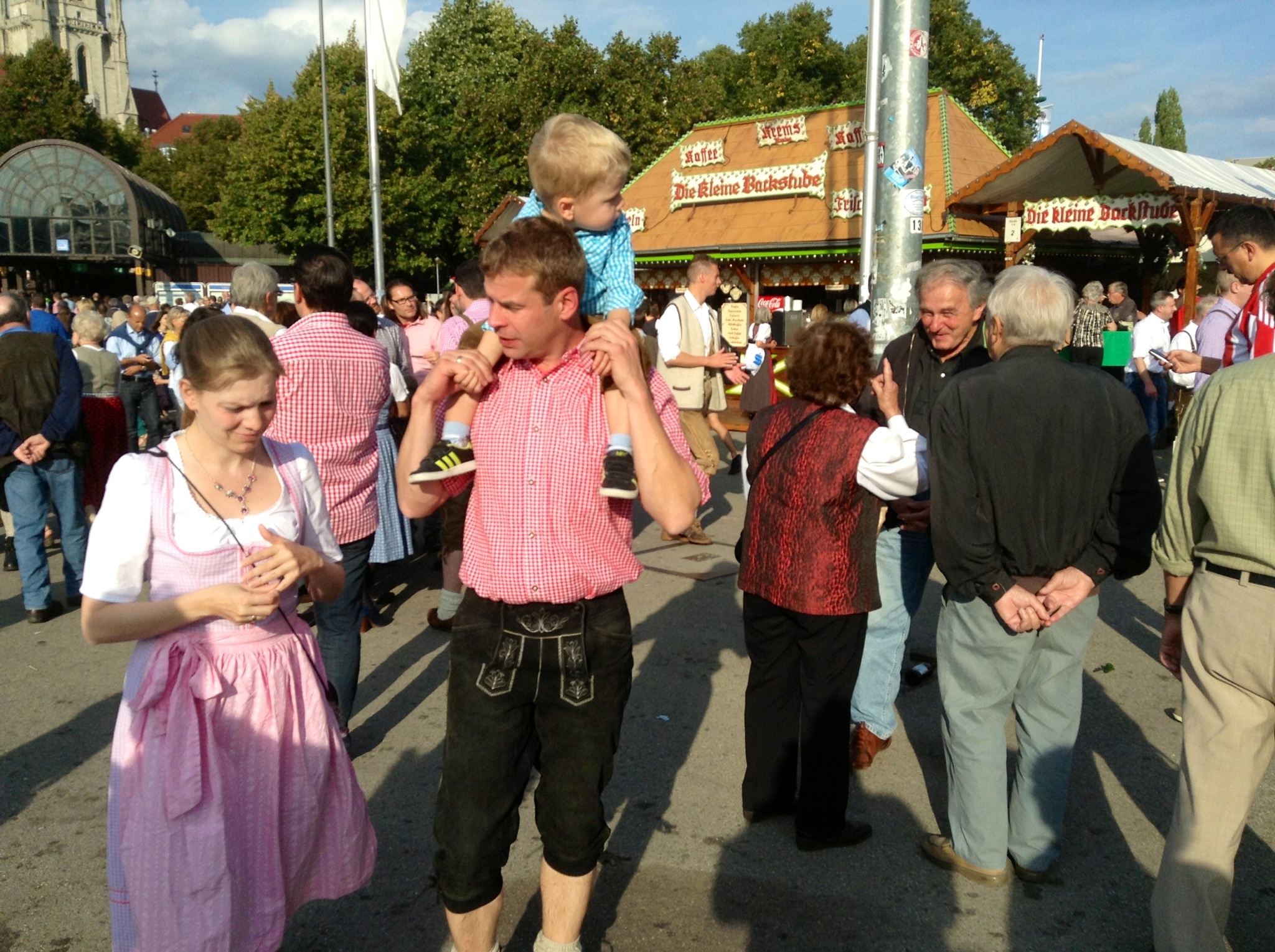
Munich Oktoberfest 2013 – Typical Dress at Oktoberfest
THE Pipe Organ
Passau is a beautiful city in southeastern Germany near the Austrian and Czech Republic borders where the Danube, Inn, and Ilz Rivers join together to make the Danube a mighty river. The Altstadt (Old Town) is built on a peninsula bounded by the rivers. Its cobblestone streets are lined with colorful German style buildings, but with rare exception, not the half timbered type we have seen in abundance along Germany’s Romantic Road. The onion-domed copper towers of the St. Stephen’s Cathedral can be seen from most vantage points in the city. By the way, in Germany, a cathedral can either be a Dom–Roman Catholic or a Munster–Lutheran. St. Stephen’s is a Dom.
St. Stephen’s is in the style of Italian Baroque. Massive and white in the interior, the eyes are drawn upward to the sculptures and painting on the ceiling. The windows are not stained glass, in order to let light flood into the interior. However, St. Stephen’s claim to fame is its mighty pipe organ, until recently, the world’s largest, with 17,774 pipes and 233 registers. Set within the whiteness of the cathedral, its blackness lets it stand out with impressive boldness and majesty. To say that it is an awesome sight is, indeed, an understatement. Stretching through the balcony into all three naves of the cathedral, the camera could not capture its immense size. In addition, two positivs are situated in the choir near the high altar.
We thoroughly enjoyed our day in this river city. WEG

St. Stephen’s Cathedral, Passau, Germany
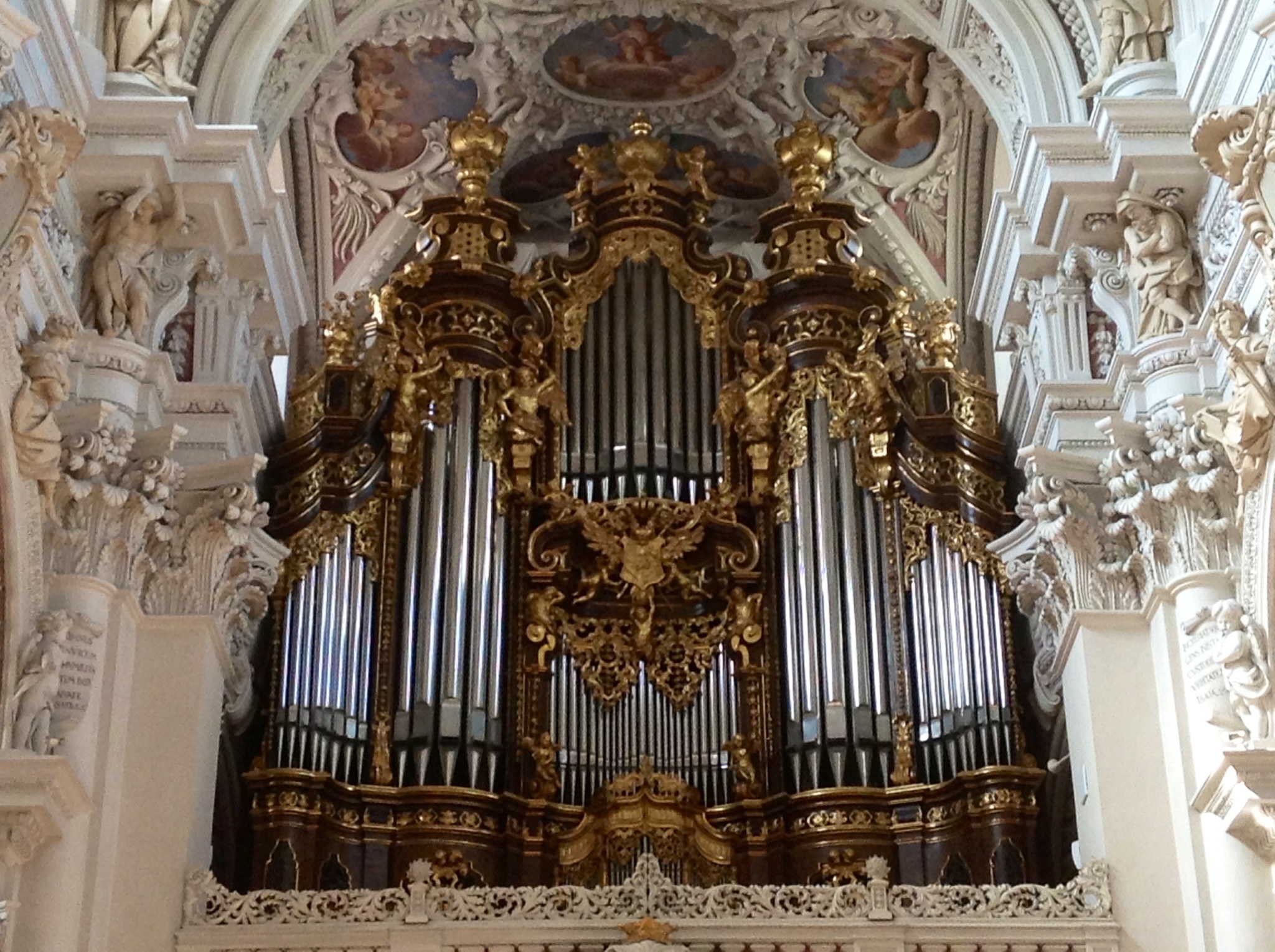
St. Stephen’s Cathedral Pipe Organ, the second largest organ in the world
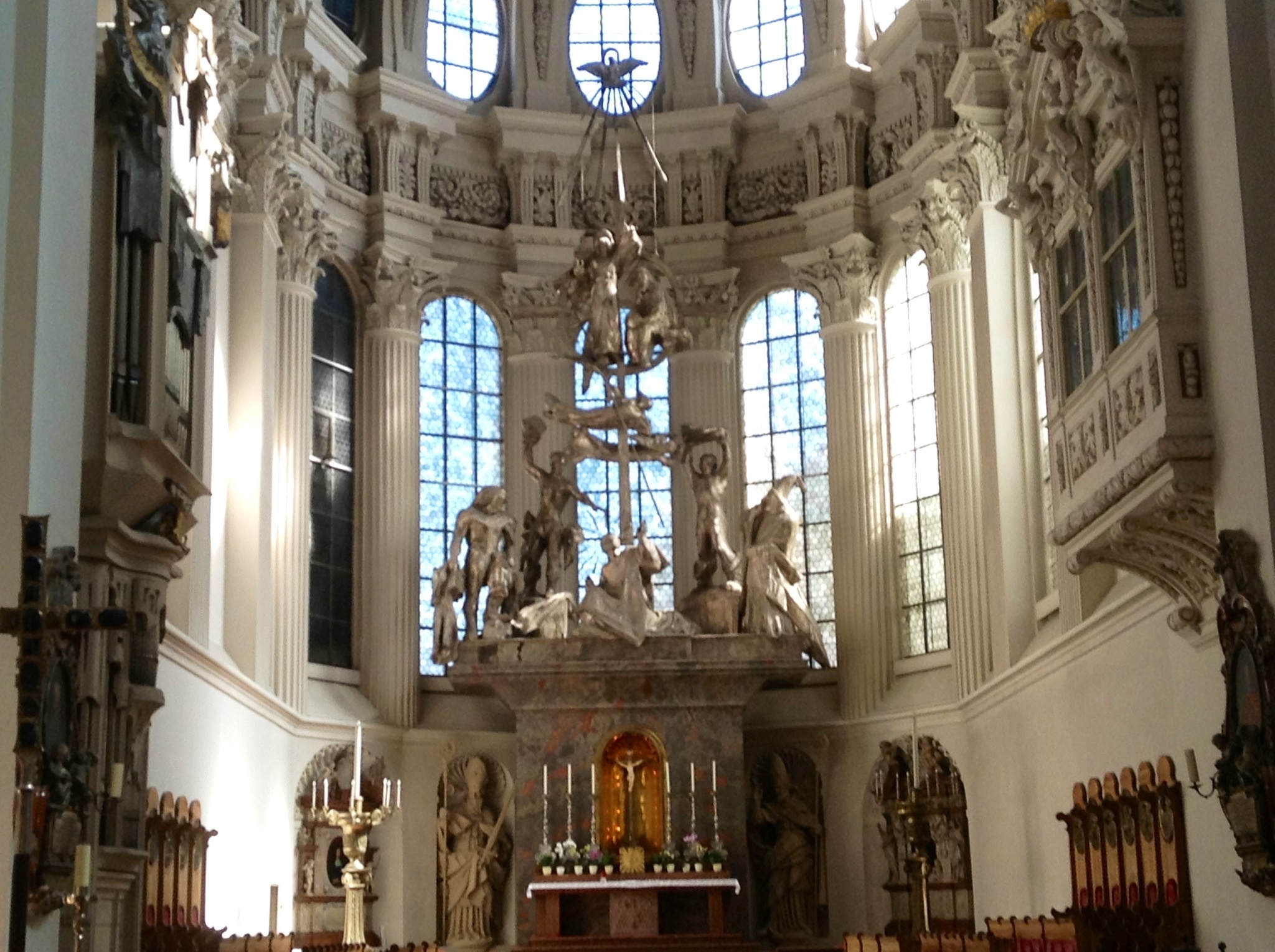
St. Stephen’s Cathedral Altar, Passau, Germany
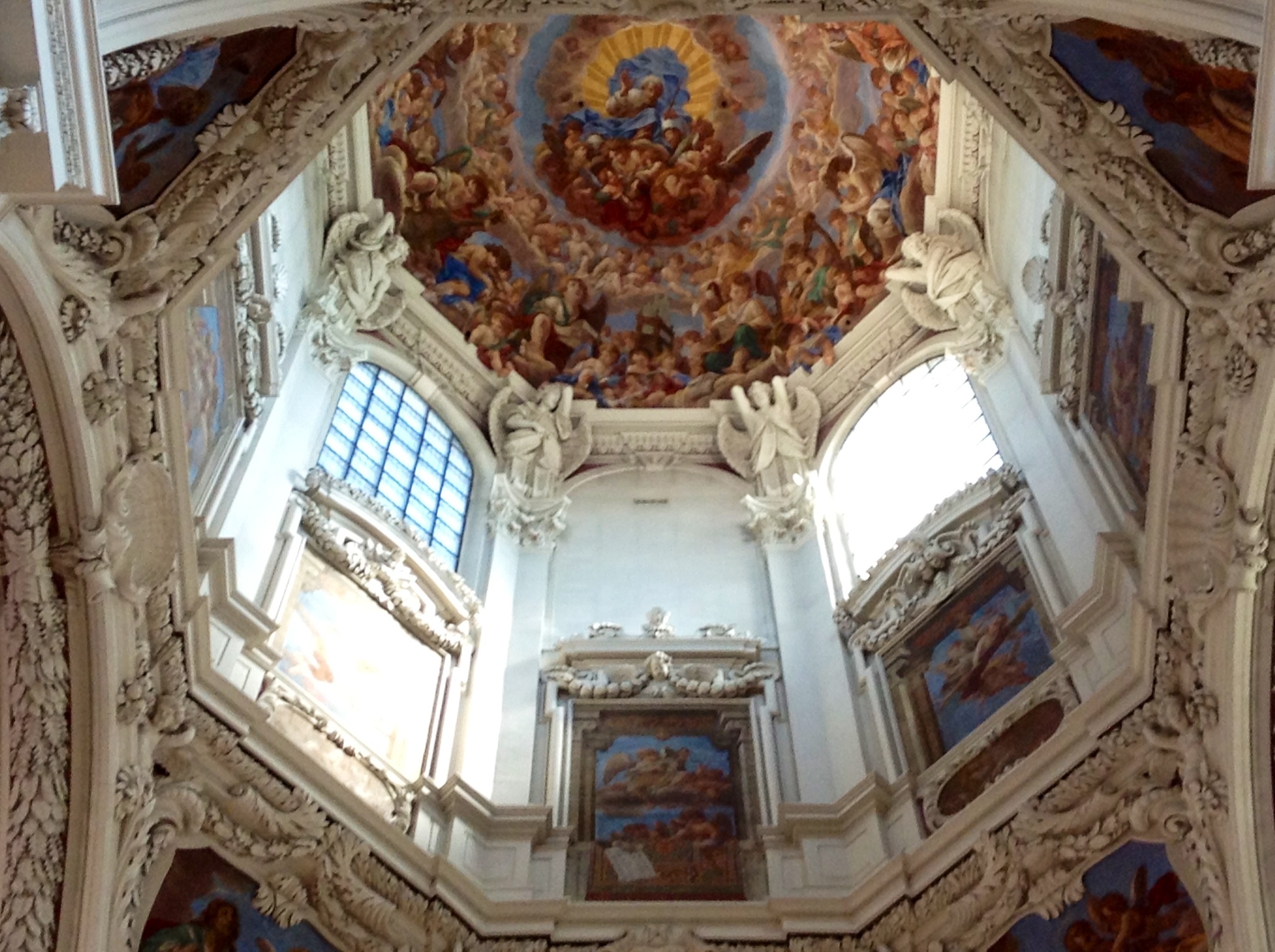
St. Stephen’s Cathedral, Passau, Germany, an Italian Baroque church
The Bridge
We walked the Old Stone Bridge over the Danube in Regensburg, Germany, today. It has stood for almost 1,000 years. The city gate at the end of the bridge invites you to enter the old city, and the towers and church steeples pull you towards them like a magnet. We simply enjoyed walking the streets lined with medieval buildings. You just find yourself immersed in the ancient beauty. It is fun to go into a restaurant that has served food for 600 years and soak in the ambiance along with a local beer and rich paprika goulash and wonderful hot bread. The Cathedral bells send deep gongs into the evening air. It was a relaxing and inviting day in this old city on the Danube River. WEG

Wayne & Kathy on Stone Bridge in Regensburg, Germany – 09/23/2013
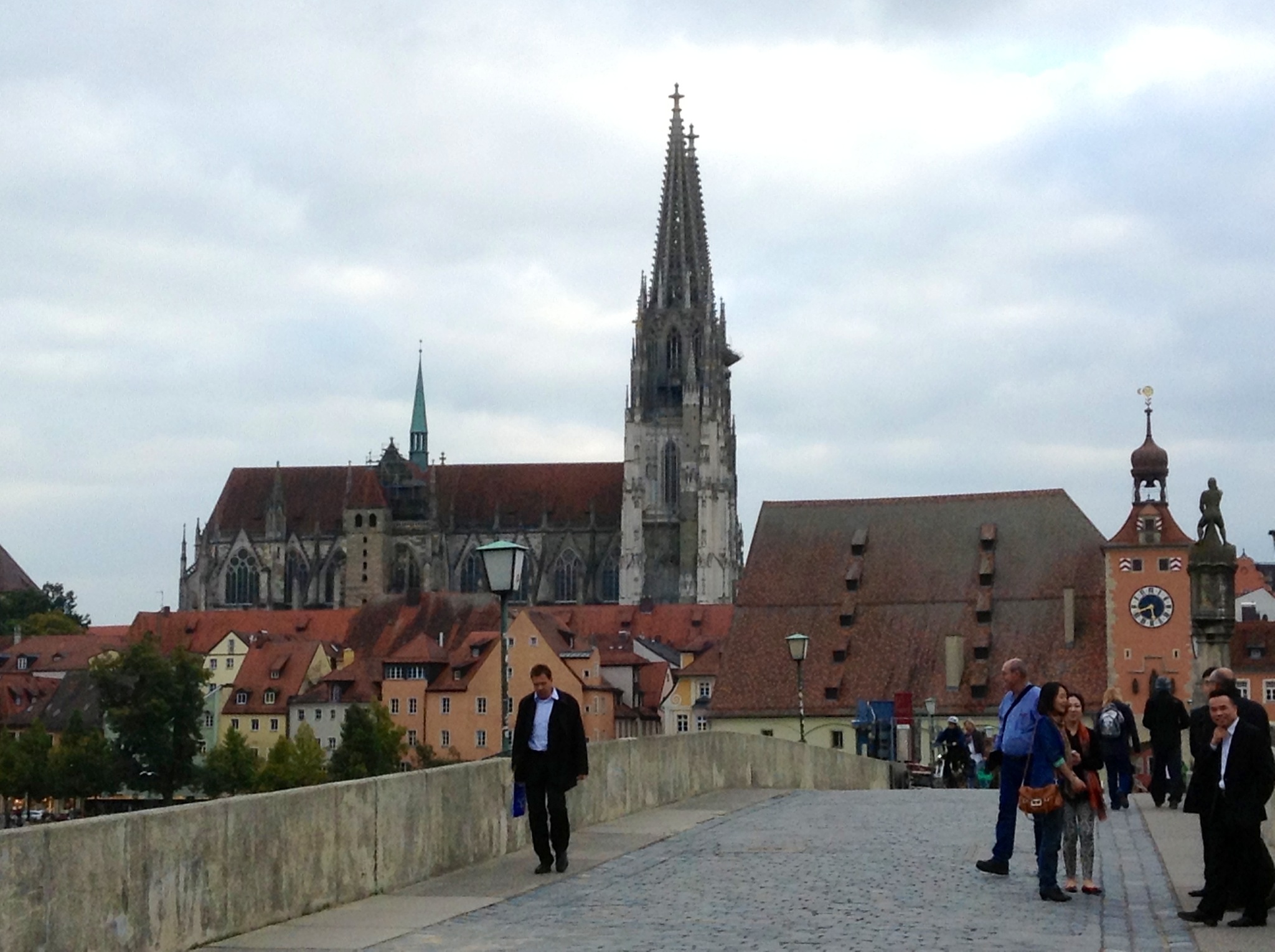
The Old Stone Bridge, Regensburg, Germany

Scene from the Altstadt, a UNESCO World Heritage Site in Regensburg, Germany
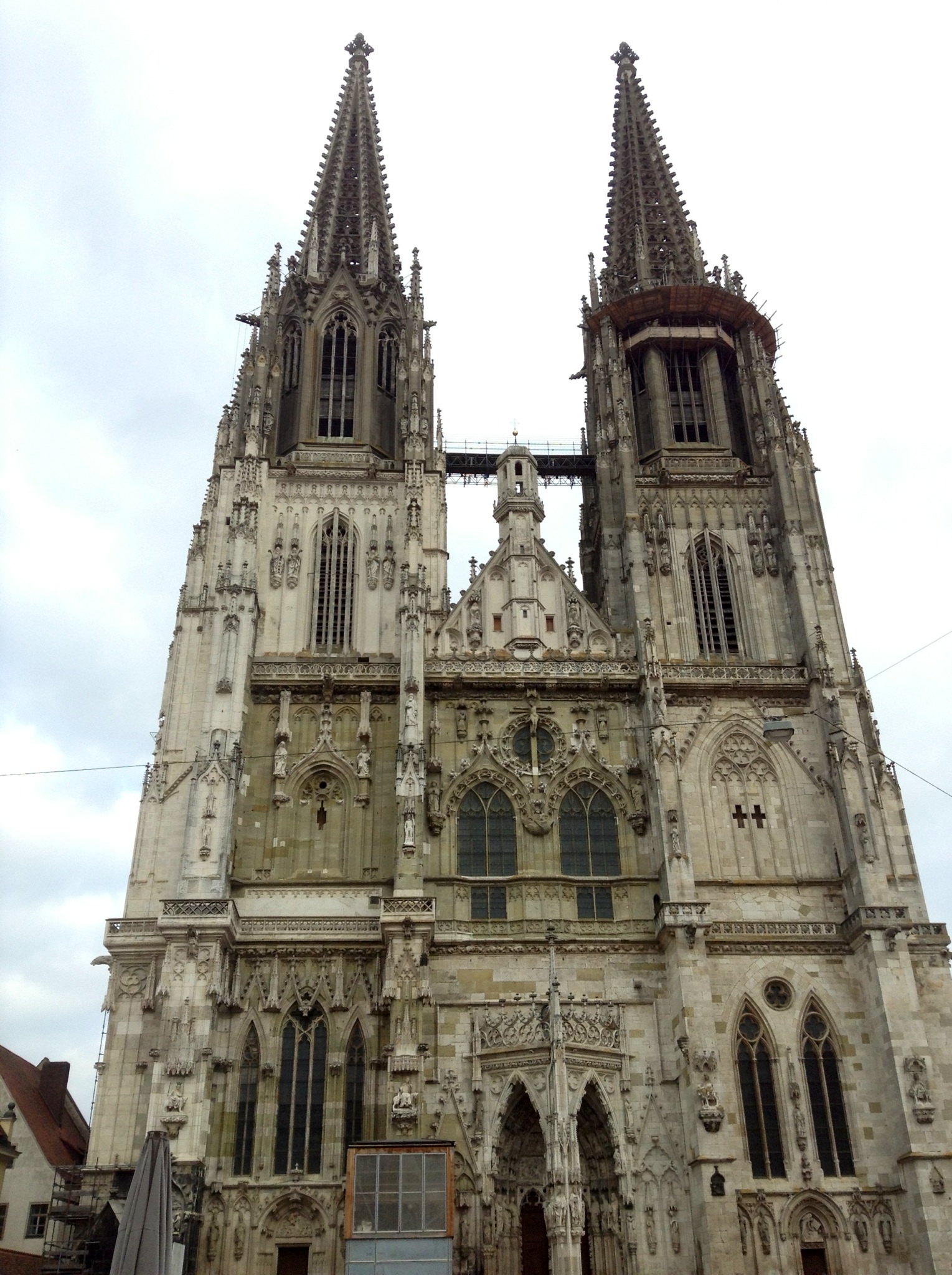
St. Peter’s Cathedral in the Altstadt, Regensburg, Germany
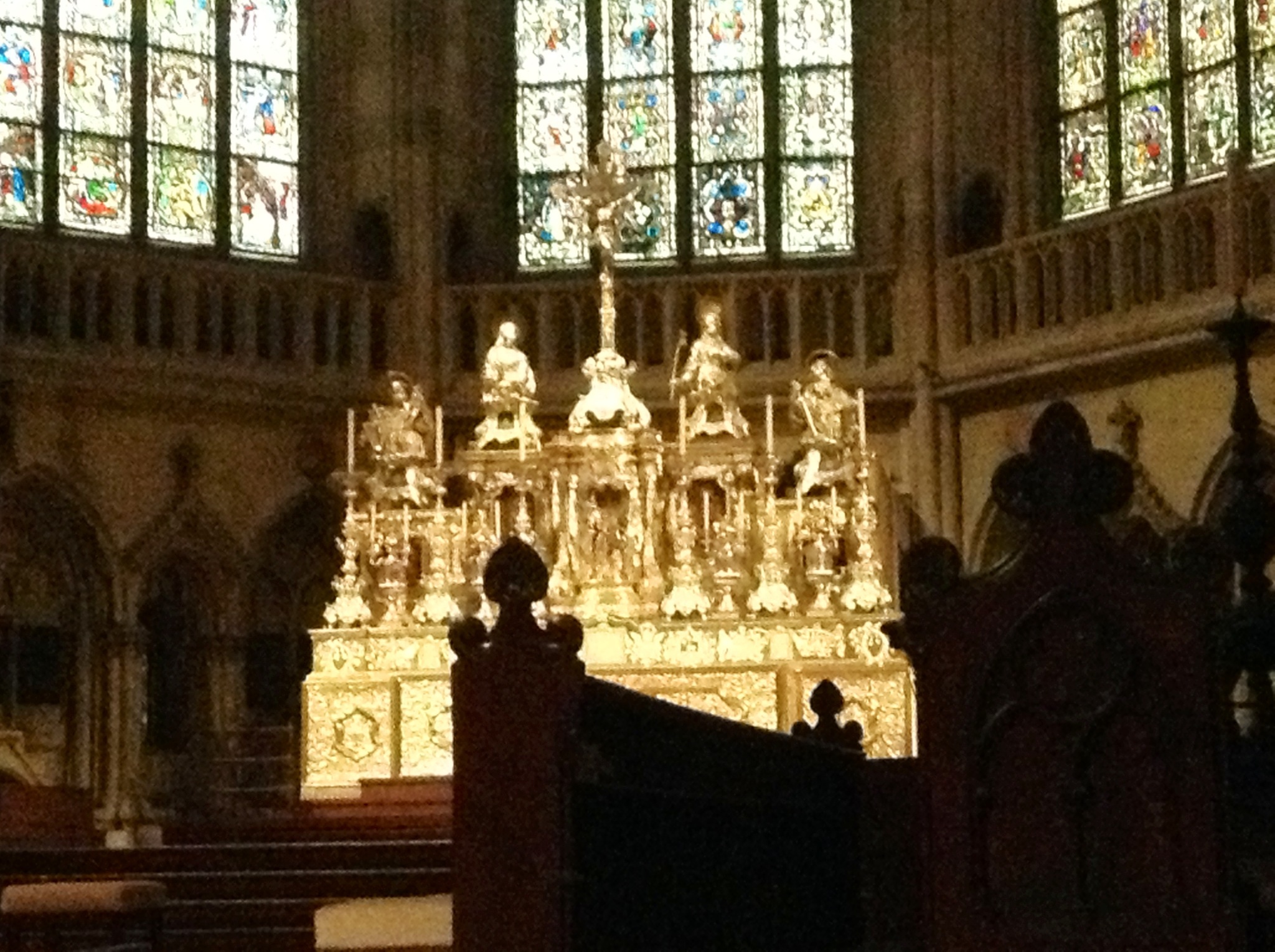
St. Peter’s Cathedral Altar & Stained Glass Windows, Regensburg, Germany

St. Peter’s Cathedral Entry, Regensburg, Germany
Lost in Rothenburg
Rothenburg ob der Tauber is one of Europe’s most loved medieval walled cities. Spared during World War II due to its historic value, the city is picture postcard perfect. German looking turrets rise above the high wall. Walking along the wall, it is easy to get lost in time and place, thinking of soldiers in armor running into place on the wall, peering through the slits in the wall, ready to shoot arrows at an approaching enemy. The cobblestone streets of the city are bounded by pastel half-timbered buildings. They run in every direction for block after block. Each view is better than the one before. Dated, many of the buildings sport 1300 signs. Many earlier. Walls are painted with imagery here and there and wrought iron black and gold signs hang from brackets on buildings to indicate businesses within. It is easy to get lost looking at German antiques and products sold within. An amazing Christmas store sold wood carved German style Christmas decorations, some room size and costing in the thousands of dollars.
Rothenburg’s Lutheran Churches are beautiful. St. Jakob’s contains one of the finest wood carved altars in Christendom. From ancient times, this church contained one of Catholicism’s greatest relics–a vial said to contain a drop of Jesus’ blood shed on the cross. It is still in the now Lutheran Church, on the altar. It is easy to get lost in thought meditating on the scene of Jesus carved into the altar.
But getting lost was our friend Rhonda’s sweater. We went from place to place where we had visited, looking in vain for that sweater. After some time retracing steps, Rhonda said we should just stop looking. I could tell from the look on her face that something was wrong. Upon further questioning, Rhonda admitted that she had just looked in her shopping bag and discovered her sweater–it was never lost, just forgotten. WEG

Rothenburg City Gate

Typical Rothenburg Buildings
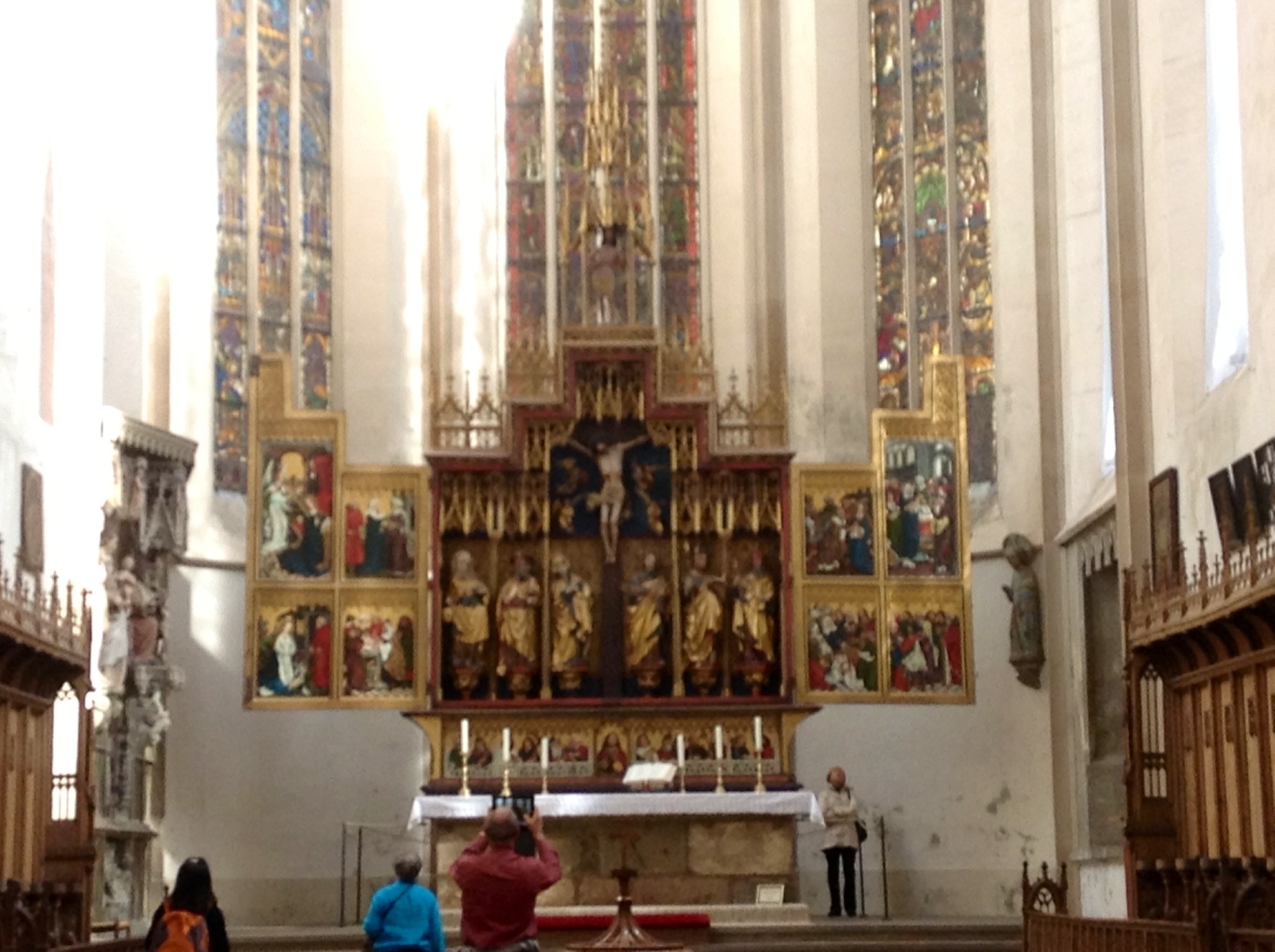
St. Jakob’s Lutheran Church Wood Altar with the Sacred Blood
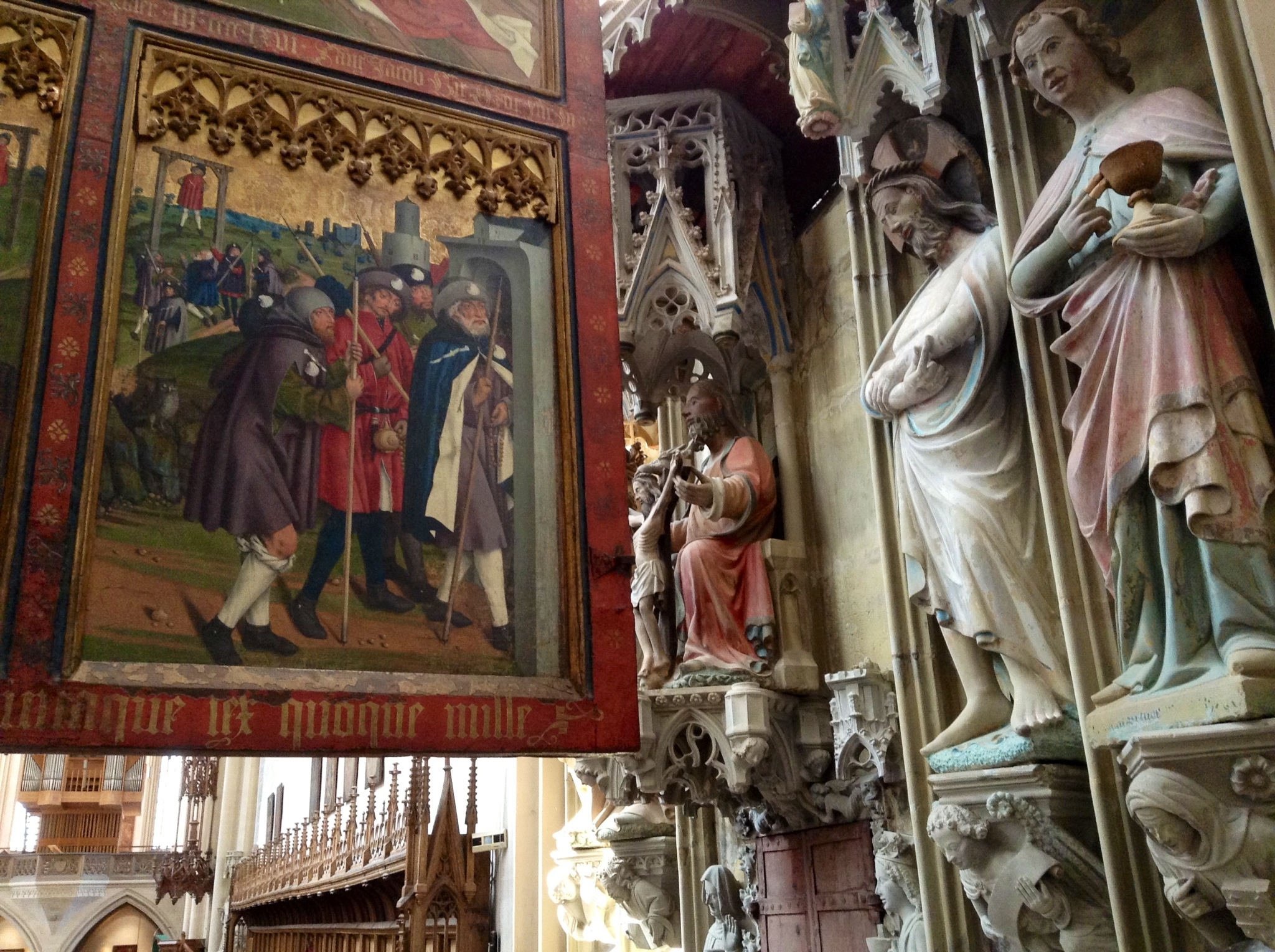
Beautiful art in St. Jakob’s Lutheran Church, Rothenburg
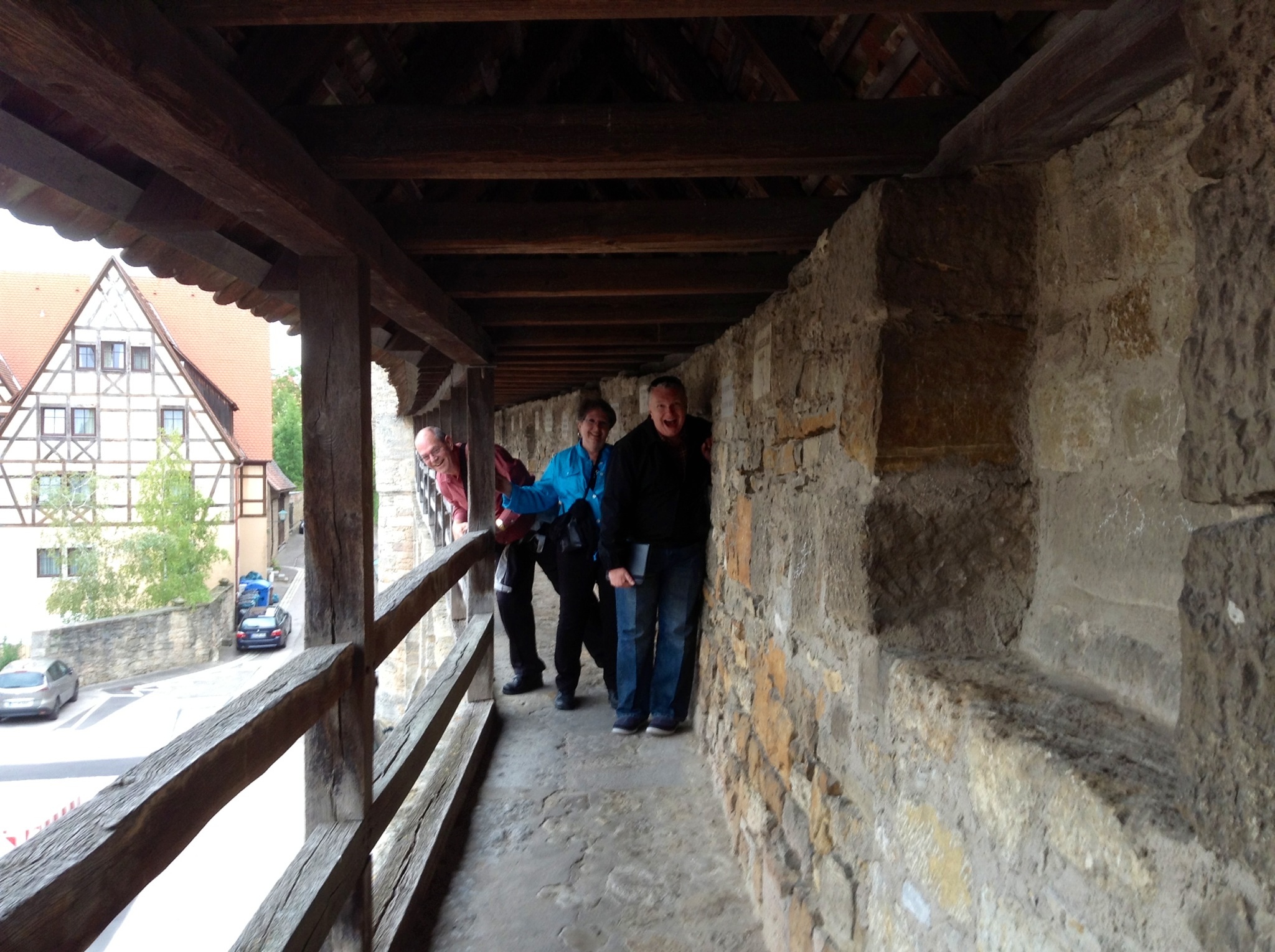
Walking the Wall in Rothenburg
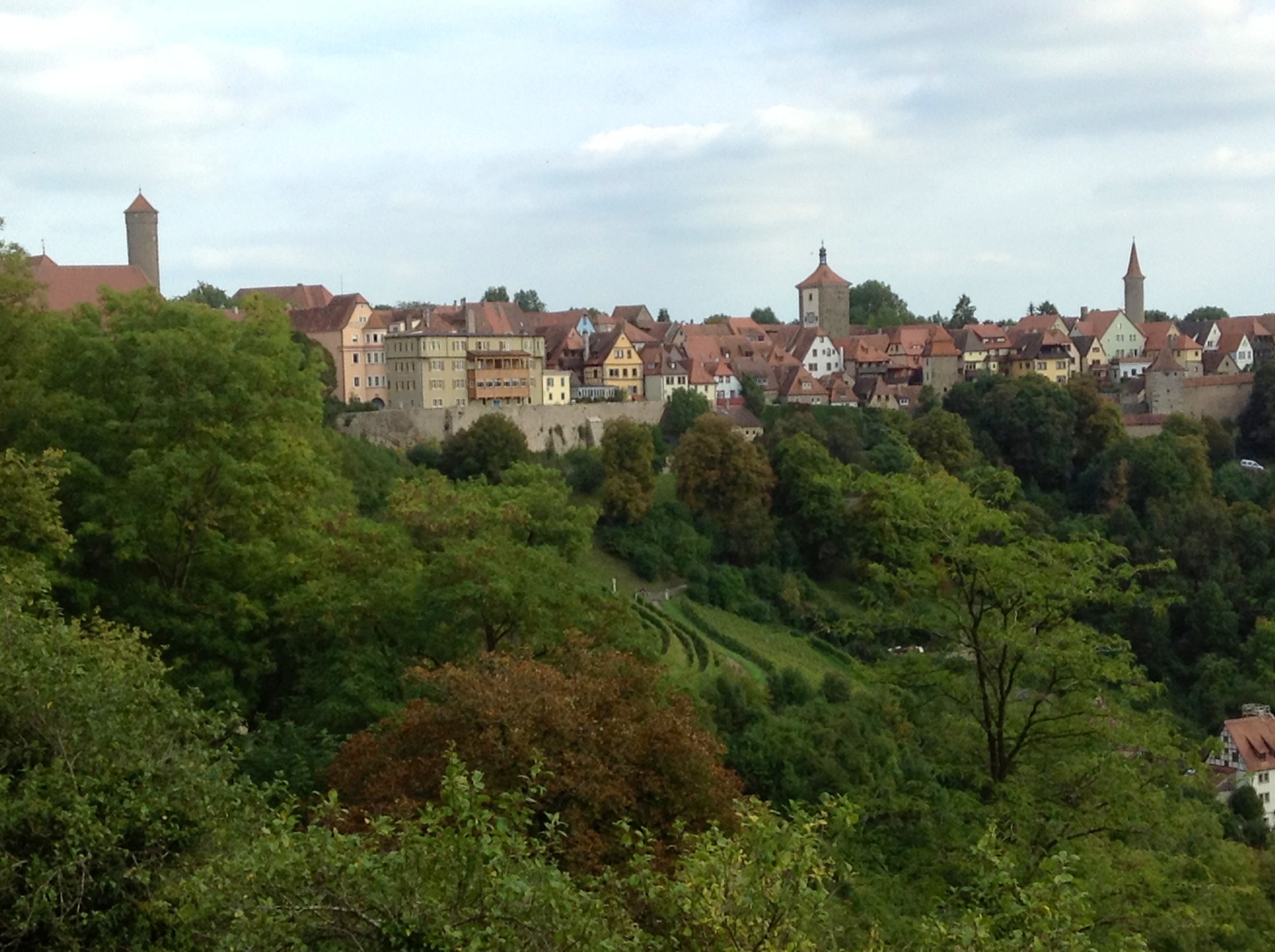
A view from one vantage point in Rothenburg on the wall across the valley to another
Fall Festival Time
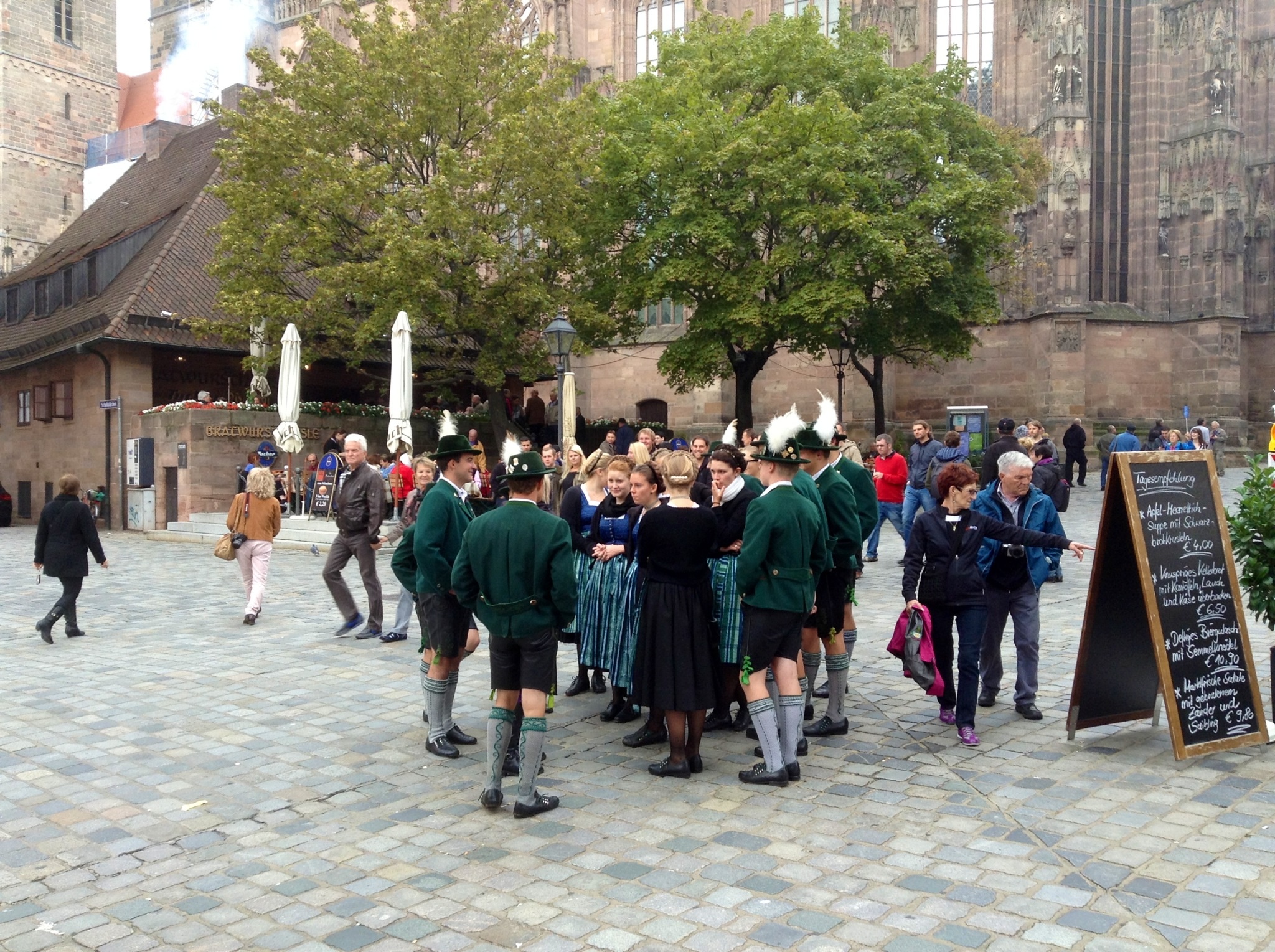
Kathy and I are sitting in a Nuremberg Old Town square as music fills the air. It has filled the air all day. In the morning we visited the magnificent and art-filled St. Lorenz Lutheran Church, Nuremberg’s main church. As we viewed its famous tabernacle, a 62 foot tall work of stone cutter’s art, an orchestra was rehearsing. Heavenly is the best way to describe the experience. We also saw the St. Sebald Lutheran Church, the city’s next major church, another huge and art-filled place. Nuremberg was the first imperial city to convert to Lutheranism in the early 1500s.
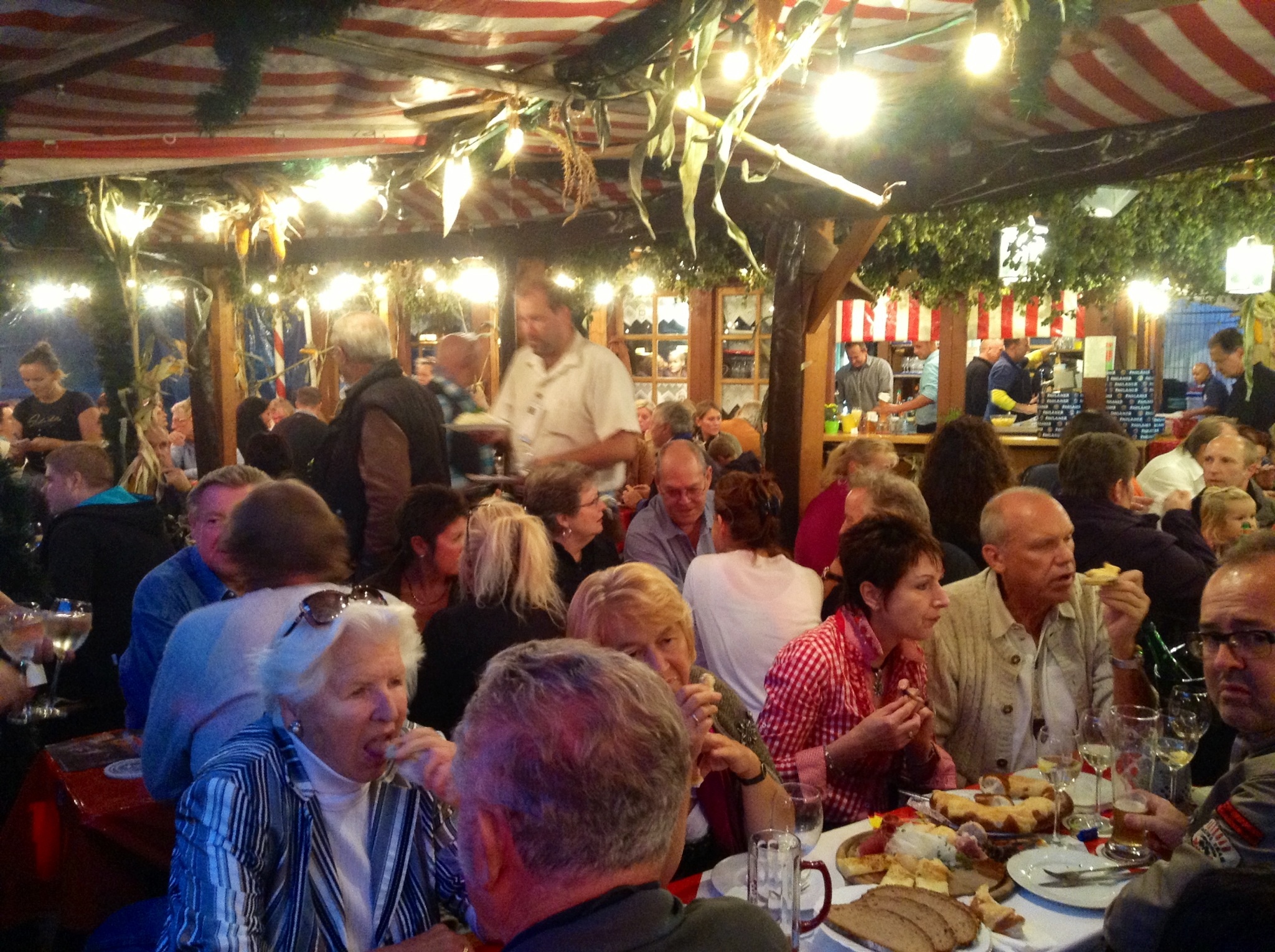
The city’s Altstadfest is in full swing. Music stages fill the squares and each of the over 300 beer and food huts–I can’t think of a better way to describe them–they are portable, but built of wood, and they have full kitchens churning out delicious food that features pork in some fashion on the menus–also have some kind of music, from German oompa to jazz and swing. Because of the crowded conditions, the Krahn’s ate with a couple from the Netherlands, and we ate with a couple from Germany–great international relations and interesting conversations. We have loved our time in Nuremberg and were fortunate our visit coincided with the Altstadfest.
PS–We have liked, many times over, the Lebkuchen and Hefeweizen, area specialities. WEG
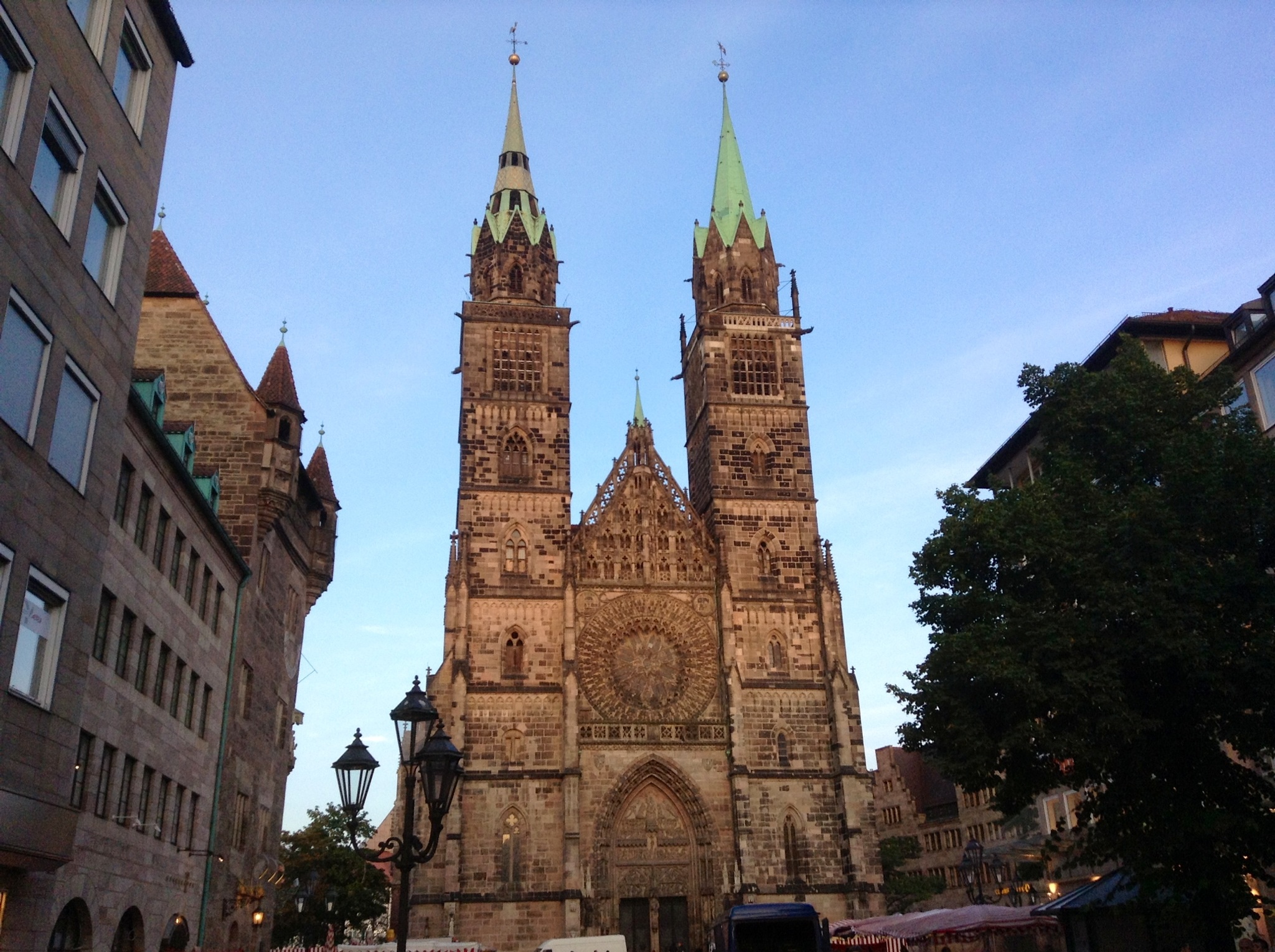
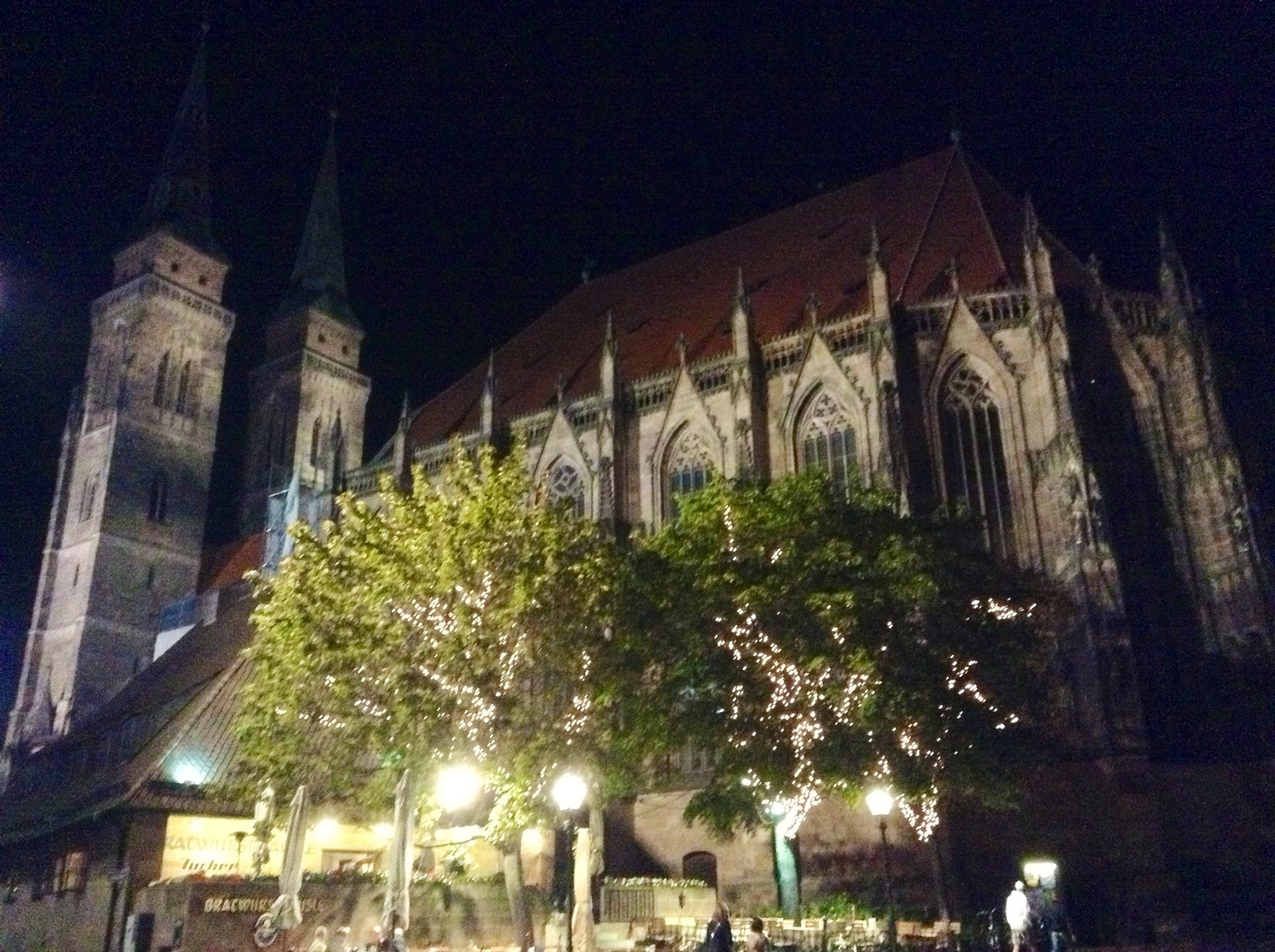
A Dark Past
Nuremberg, Germany, is a delightful and beautiful city. Its ancient past was glorious as it saw the construction of stately buildings surrounded by a mighty wall with strong towers. It was host to successive emperors of the Holy Roman Empire as the unofficial Capitol of the empire. Walking its streets one has the feeling of a place confident about itself.
It is hard to believe that just 70 years ago, Nuremberg was the stage for the rise of the National Socialist Party (Nazis) who, under Hitler, brought the world to a horrendous war that laid the city and German nation in ruins. Hitler loved Nuremberg, and because of his grandiose vision of a super state for superior humans, wanted to recreate in Nuremberg the ancient political importance of the city in the world. Here he envisioned buildings of such magnitude that they would last for thousands of years. The Nazi Rally Grounds was the scene of massive–in the hundreds of thousands–gatherings of the political faithful. Construction began on the master planned political site just outside the city. The war left only parts of the site standing. The partially completed Congress Hall is the only major building of the Nazi building program that remains in Germany. Its impressive size gives a clue as to Hitler’s plans. It is also a reminder of the horrors that Hitler visited upon the world.
It is interesting to note that the Documentation Center at the Rally Grounds stresses the point that Hitler did everything possible to point people to himself. All the buildings were planned so that the architecture itself served to elevate Hitler. All seats were planned to turn all bodies toward the place from where Hitler would speak; all staging was constructed to draw attention to Hitler; all lighting was planned to give Hitler prominence, and all major gatherings were orchestrated so that Hitler would appear at the most strategic moment. It was also stressed that the individual was diminished and, in its place, a united community of politically faithful were elevated.
Today, Nuremberg lives with its past in such a way as to not hide it, but use it as a teaching lesson for the future. Its ancient buildings are reconstructed, and the city, known as the most German of German cities, embraces what is best of the past. WEG
 kgraumann
 wgraumann
 gofarther.me