
Walking the Hill

The castle gate on Castle Hill, part of Budapest’s extensive World Heritage site, including the Turul statue, a mythical bird seen as the symbol of power, strength, & nobility, carrying the flaming sword of God

Matthias Church in Budapest on Castle Hill with King Saint Stephen’s sculpture in the foreground
Our hotel is located on the Pest side of the river, and so we spent the day walking the hill for which it is noted. We took a bus to the top and were amazed with the great transformation of the area since we were here about twelve years ago. Refurbishment had made everything appealing and clean. When we came to spend a week here years ago, Hungary was just being discovered again after years under the communist shadow. It has now definitely been discovered.
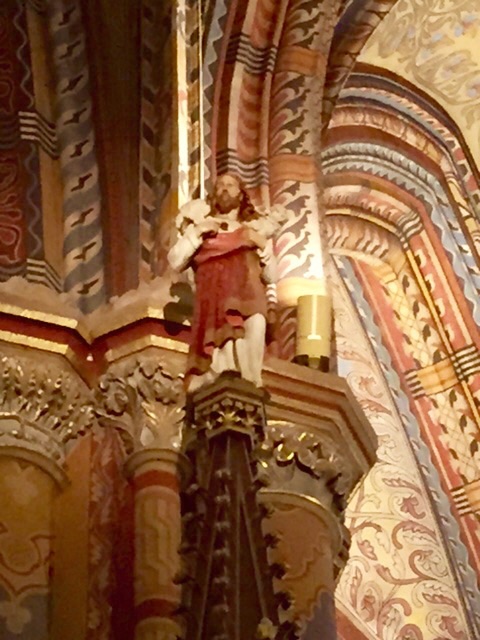
Interior of Matthias Church, founded in 1015 by King Saint Stephen
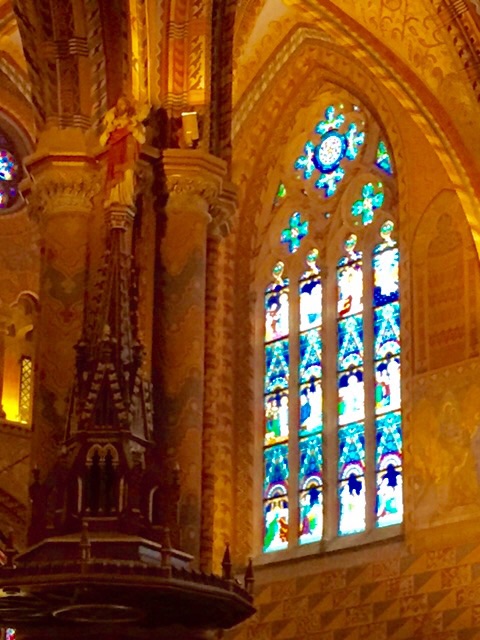
A stained glass window in Budapest’s Matthias Church
We spent major time around St. Matthias Church, the historic church of Budapest. Founded by King Saint Stephen in 1015, it has seen much destruction and renewal as the Mongolian hordes destroyed the city in the 1200s and later, in the 1500s, when the Turkish invasion turned the church into a mosque. The Muslims whitewashed the walls and destroyed most imagery, but walled up the Madonna statue, the Virgin Mary. It was forgotten until the Christian forces assaulted the hill in an effort to retake the city in 1686. As the Muslim leadership assembled in prayer, a powder arsenal accidentally exploded and shook the mosque so hard the wall crumbled, exposing the Madonna to the astonished praying Muslim Turks. That night, the hill fell back into Hungarian hands and the church reclaimed its heritage. Later, the church was badly damaged in both world wars, and then the Soviets turned it into a military vehicle storage facility and stable. The target of a terrorist bomb attack in the late 1990s by unknown assailants damaged some of the priceless stained glass windows. In spite of all these trials, today the church is a marvel of Art Nouveau style. It houses many treasures of the Hungarian heritage and is a testament to the Hungarian spirit.

Fishermen’s Bastion on Castle Hill – The entire Casstle District is a UNESCO World Heritage Site
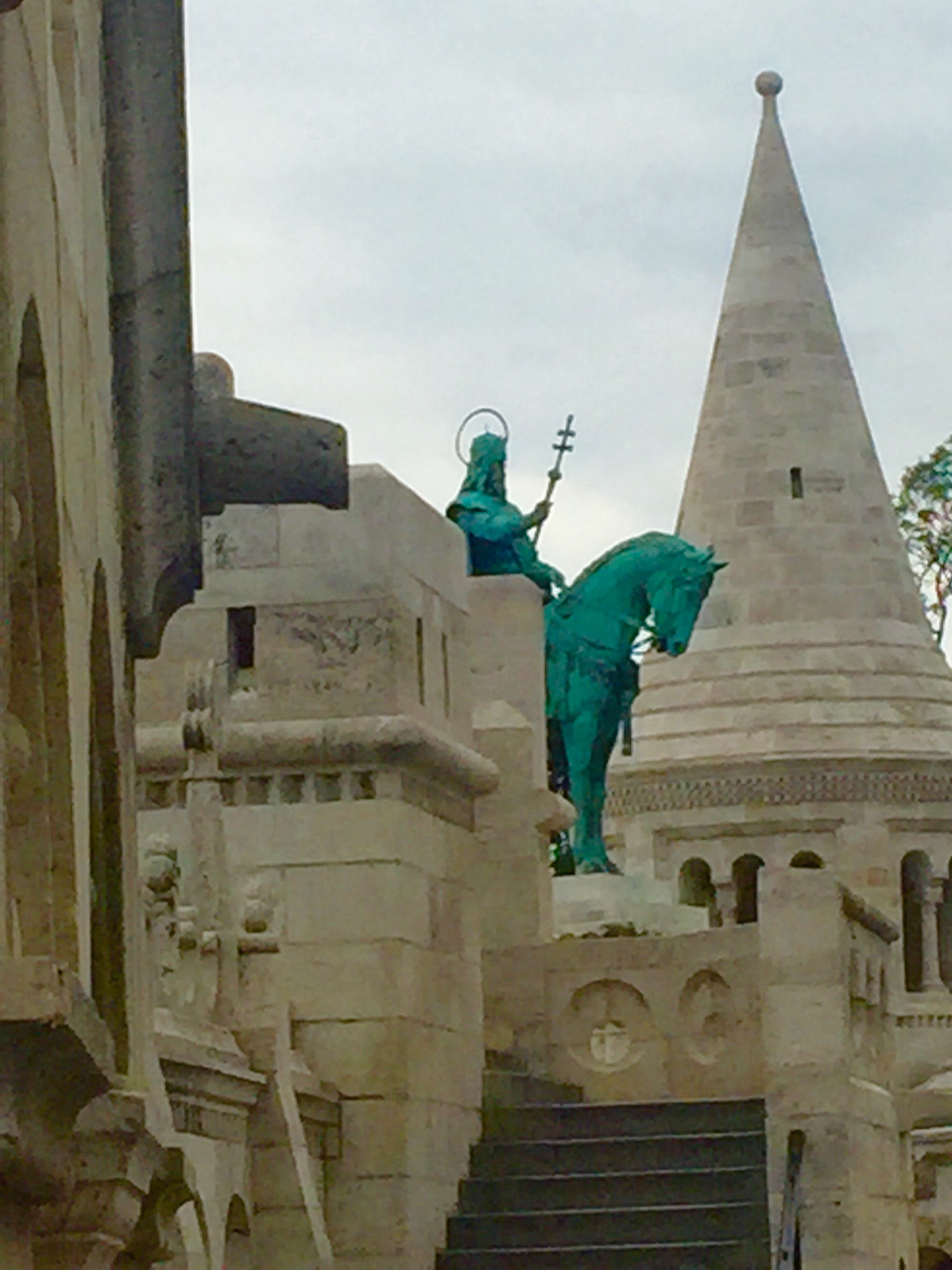
Budapest’s Fishermen’s Bastion, with seven white towers, was named for the guild of fishermen responsible for the defense of the city walls in the Middle Ages.
We walked to the Fishermen’s Bastion with its white stone buildings and beautiful monuments. The scenes from its terrace over the Danube give unforgettable views of the Hungarian Parliament building with its iconic red tiled roof and majestic spires standing out in regal beauty on the Buda side of the river. Then, we walked to the massive palace that gives the hill its name, “Castle Hill.” It has impressive statues and flower plantings.

A view from Castle Hill that includes St. Stephen’s Basilica across the Danube River
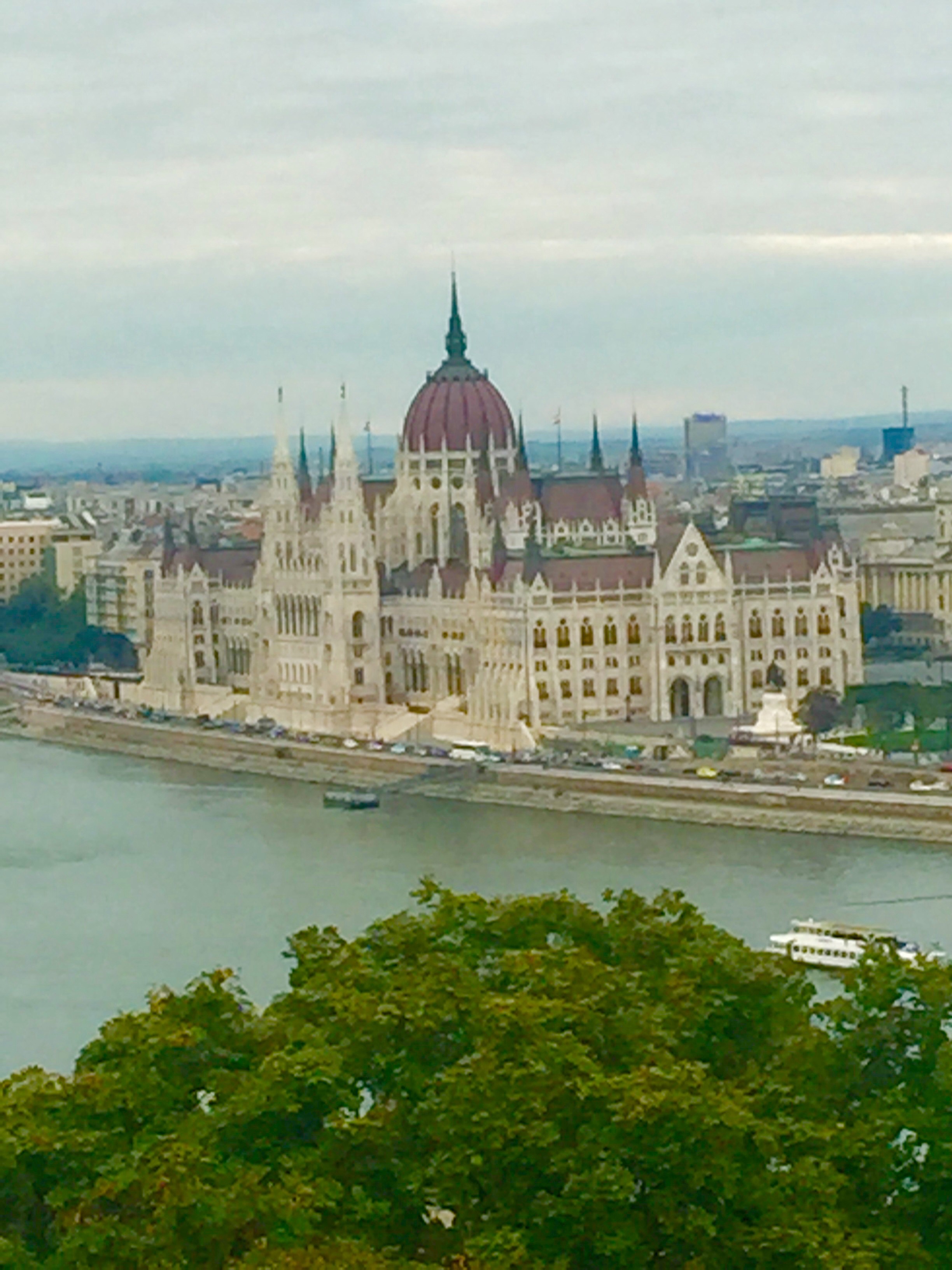
Another view across the Danube from Castle Hill
After some shopping, we got on the bus for the trip back down the hill where we spent a long relaxing meal time in a “cave” room with vaulted ceiling and stained glass windows of a great restaurant near our hotel. WEG – September 30, 2015
Beautiful, Belle Époque Budapest
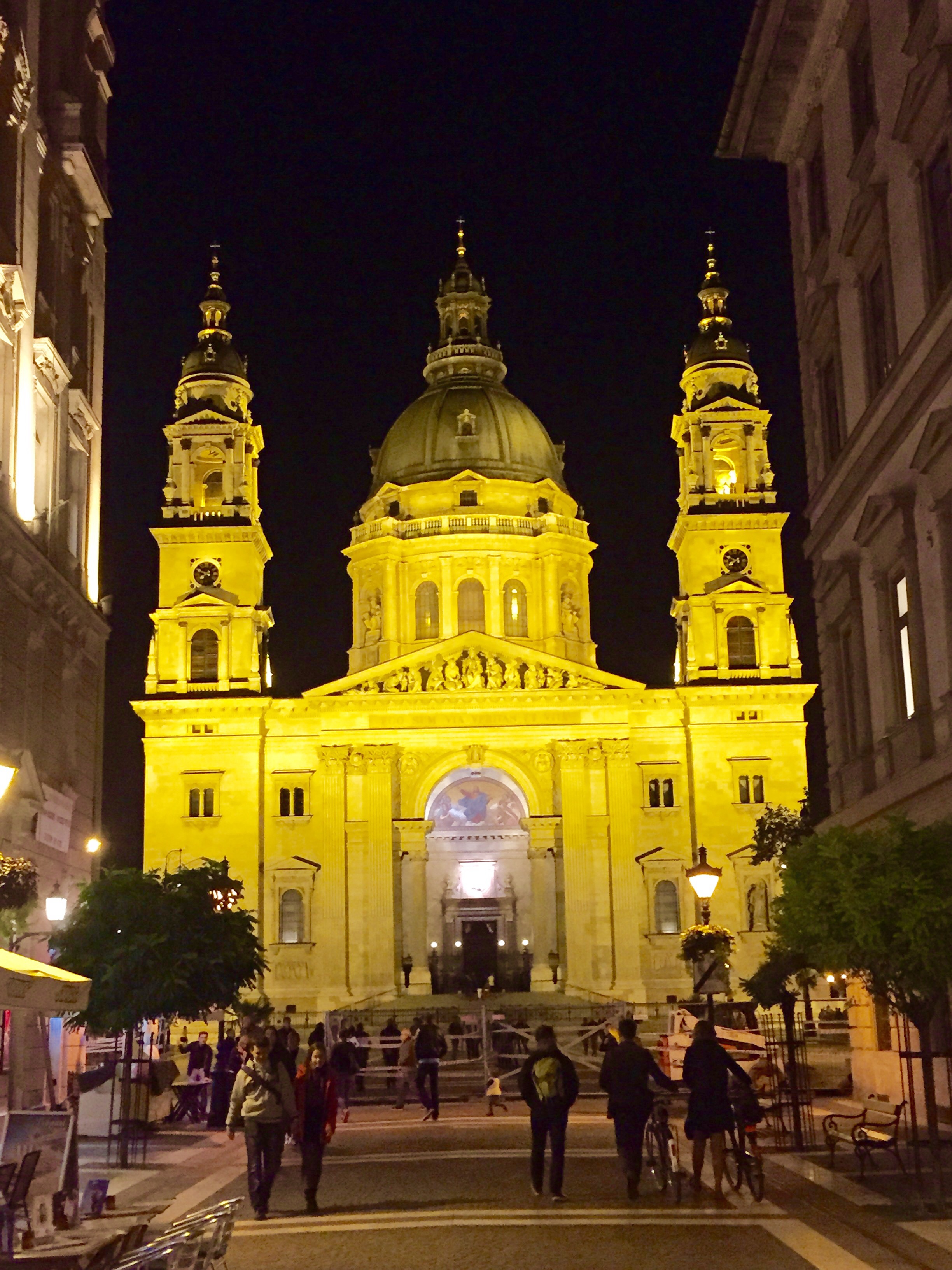
Evening exterior of St. Stephen’s Basilica in Budapest
The belle époque architecture that gives Budapest its distinctive feel is enhanced by the blue Danube that runs through the heart of the city, separating it into Buda on the “flat” side and Pest on the “hilly” side. Both sides offer much to see and do. While several bridges span the Danube and tie the city into a whole, the Chain Bridge is the handsome bridge with its huge lions and stone archways and lights that make it gleam in the dark. Kathy and I walked the Chain Bridge twice today–it has an enchanting pull.

The quarter mile long Szechenyi Chain Bridge connects Buda and Pest spanning the Danube River. Large lion statues guard all four corners of the bridge.

The Parliament Building in Budapest, Hungary, overlooking the Danube River
Budapest is a magical and majestic city. Landmark buildings, such as the Parliament Building and State Opera, are world renowned. On the opposite side of the river, Castle Hill, with its palace, churches and Fish Bastion, stands powerfully above the Danube. Everywhere, buildings stand out with interesting pediments or ornamental tops. Budapest is simply a beautiful, if not stunning, city. Few can compare.

St. Stephen’s Basilica pipe chamber in Budapest

St. Stephen’s Basiilica, Budapest, the site of an organ concert with violin, trumpet, tenor, & soprano
We were fortunate on our walk to get a flyer about a concert in the St. Stephen’s Basilica in Pest. We went to a great restaurant close to the basilica and enjoyed a fine meal in a charming candlelit atmosphere.
The concert was enchanting and the artists excellent. The massive gold, green and red basilica echoed with the voices of a powerful tenor and soprano who, joined by an accomplished violinist and trumpeter, performed well-known spiritual classics by Handel, Gounod, Liszt, Franck, Schubert and Mozart. The grand pipe organ accompanied and also soloed with some Bach and Widor. Kathy and I were enthralled and left thanking God for this hear-warming experience in such a magnificent place. It is such a rare experience that you absorb it into your soul to bring back out when you need times of refreshing.
WEG – September 29, 2015
Surprising Bratislava

The Cathedral of St. Martin in Bratislava, Slovakia
The Stare Mesto (Old Town) is comfortable and quaint–you know you are in eastern Europe; everything is different and in a good way. But the food!

The view from our Bratislava apartment on the fifth floor of the Old Town (Stare Mesto) that includes the Bratislava Castle

View from Bratislava Main Square in Old Town
One of the joys of traveling is trying new foods, expanding your pallet and taking risks. I cannot imagine traveling this far and eating things I can get back home. Tonight we dined in a brewery that has a traditional Slovak restaurant attached. The starter was a home made crackling that was chopped and ham fat drippings added to make something like a pâté. Served with sautéed onions and soft rye bread–I would be hard pressed to think of a spread that I have ever had that was better. Did you say, “carbs?” I didn’t hear you–I was too busy chomping away–remember the adventurous food part! Kathy and I will take a walk when finished. Main course for me was crispy duck legs on a bed of stewed red cabbage with ham dumplings–scrumptious. Kathy had stewed beef in a pumpkin cream sauce with puffed bread dumplings–excellent. We shared sides of marinated tomatoes and creamed cucumbers.

The delicious traditional Slovakian meal we enjoyed
The Stare Mesto (Old Town) of Bratislava is charming. Church steeples abound. Mainly Roman Catholic, the city has a large share of Lutheran churches as well. The streets are thick cobblestone–really old time thick cobblestone. The narrow streets curve around so that you don’t end up where you thought you were going. But, that was ok, since where you went was pretty and interesting. I saw a big crystal beer mug, hand-cut and crafted in Slovakia, in a store window, and that is my main souvenir for the trip. Each ancient archway leads to a new street to search, and we walked hand in hand around the entire area. The castle fortress sits on the hill above the Stare Mesto and gives the area a majestic feel. So, as you can see, I walked enough to eat that pátê.
WEG – Monday, September 28, 2015
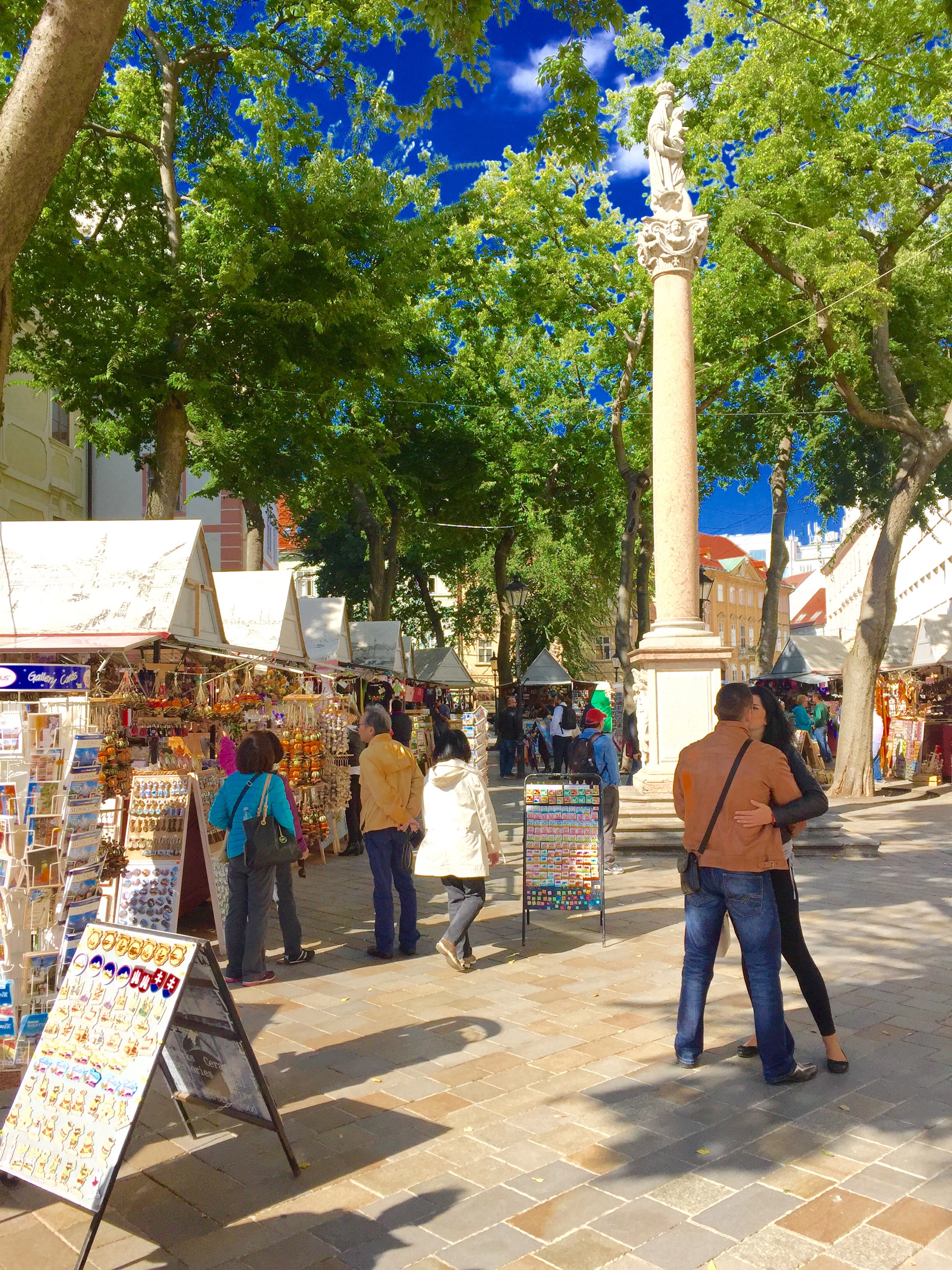
Outdoor market in Bratislava near thhe Main Square
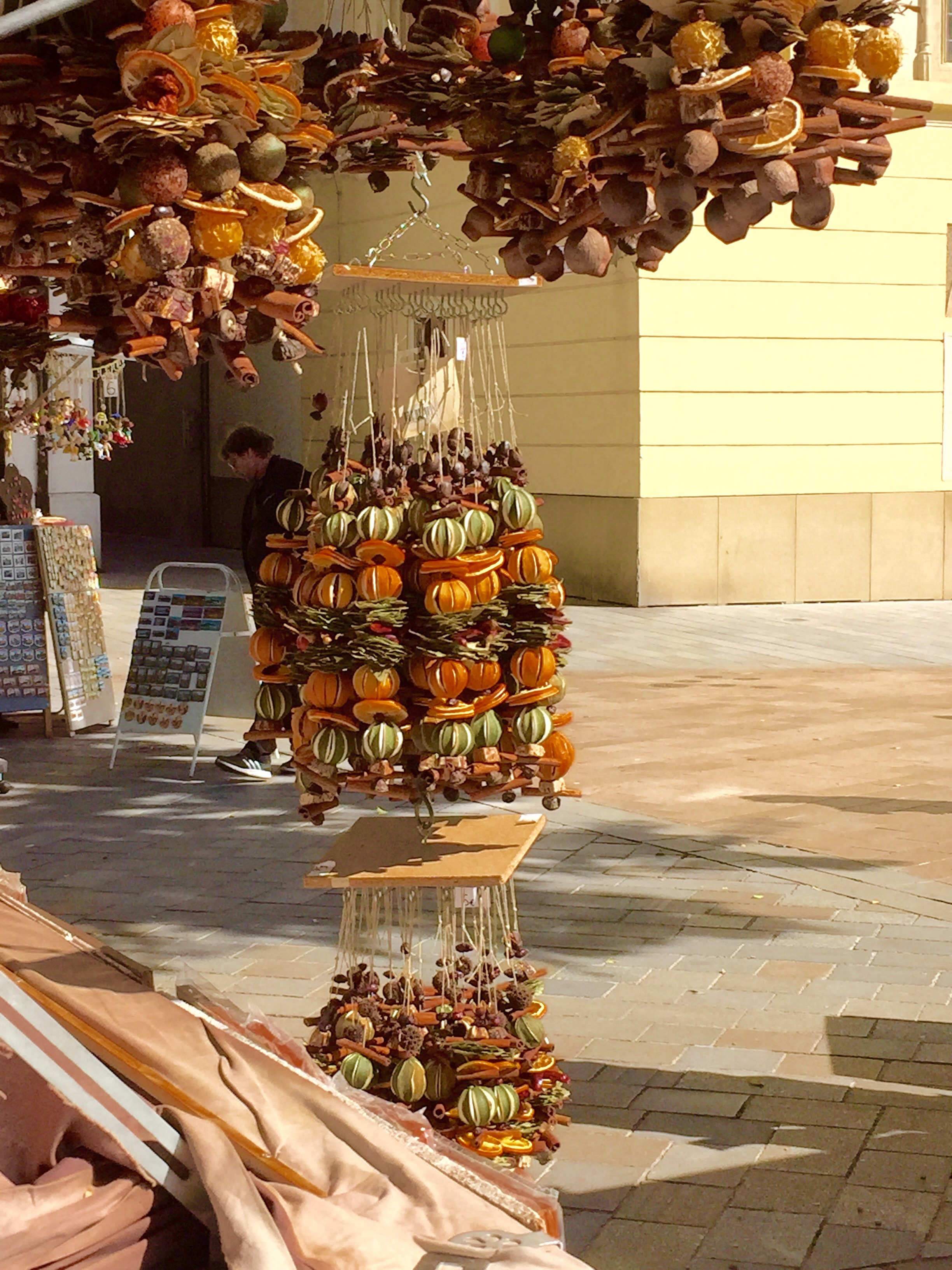
One of the items for sale at the market in Bratislava, Slovakia
Kathy’s post script: We are so pleased with public transportation in Europe and the ease of using it. We feel quite comfortable with the process and are performing quite well in our travels. Yesterday in Vienna, we looked at the map of the train routes and figured out (by ourselves) the plan to get to the train station the next day from our apartment, and we bought our tickets — for less than three euros. This morning we left our Vienna apartment, walked a block to catch the U6 tram, transferred at the appropriate stop to the U4 tram, then transferred to the U1 that brought us to the main hauptbahnhof in Vienna where we then boarded the train to Bratislava. Upon arrival in Bratislava, we paid less than two euros to take the x13 tram to our stop in Stare Mesto (the Old Town) where we met our apartment manager & settled in to an apartment in the Old Town.
Apartment living in Europe has been a positive experience for us. Our apartment in Bratislava is wonderful. For a mere 72 euros, we have a fully furnished apartment with a kitchen equipped with cooktop, microwave, dishwasher, refrigerator, coffeemaker, cookware, & dishes; two master bedrooms each with a king-sized bed; a couch & chair; dining room; bathroom with a shower & a washing machine; & two TVs with English channels (which we don’t have time to watch!) — and internet that works! It is beautiful. In our Vienna apartment, I was amazed to have use of a clothes washer/dryer combination that effectively performed both tasks.
Just wanted to share with you some of the details of travel in Europe with the Graumann’s.
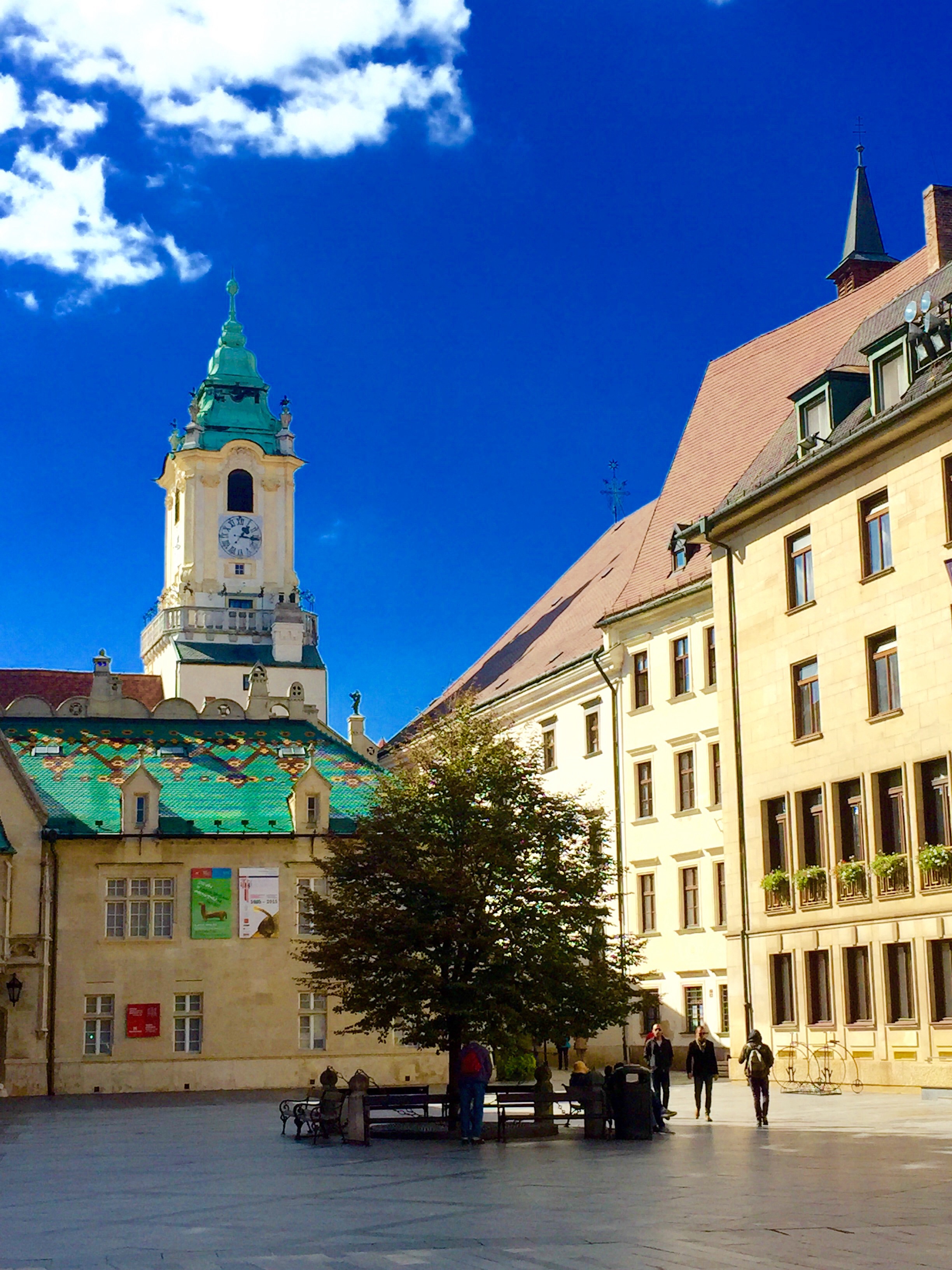
Bratislava, Slovakia
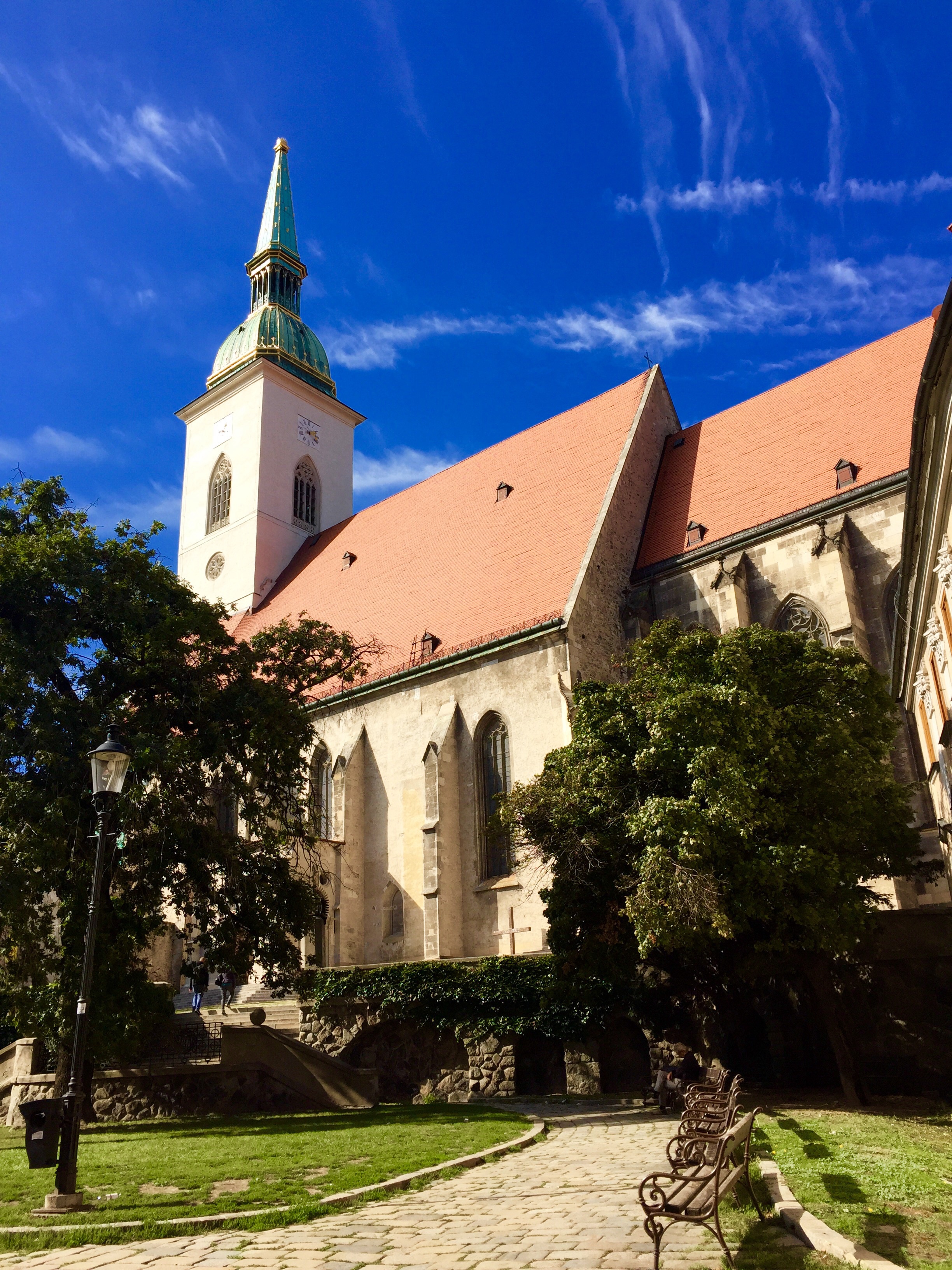
Another view of St. Martin’s Cathedral in Bratislava
Glory of a By-Gone Era

Vienna’s Schönbrunn Palace
The Royal Imperial Habsburg’s ruled the Holy Roman Empire and then the Austro-Hungarian Empire. They were industrious, hard working, generally frugal and duty-bound. Emperor Franz Joseph said, “When you have worked until you are exhausted, you have had a good day.” He practiced what he preached, waking at 4 AM for morning prayer and then working 16 hours straight. He slept in his grand palaces on a hard iron framed bed in simple circumstances.

Vienna’s Schönbrunn Palace
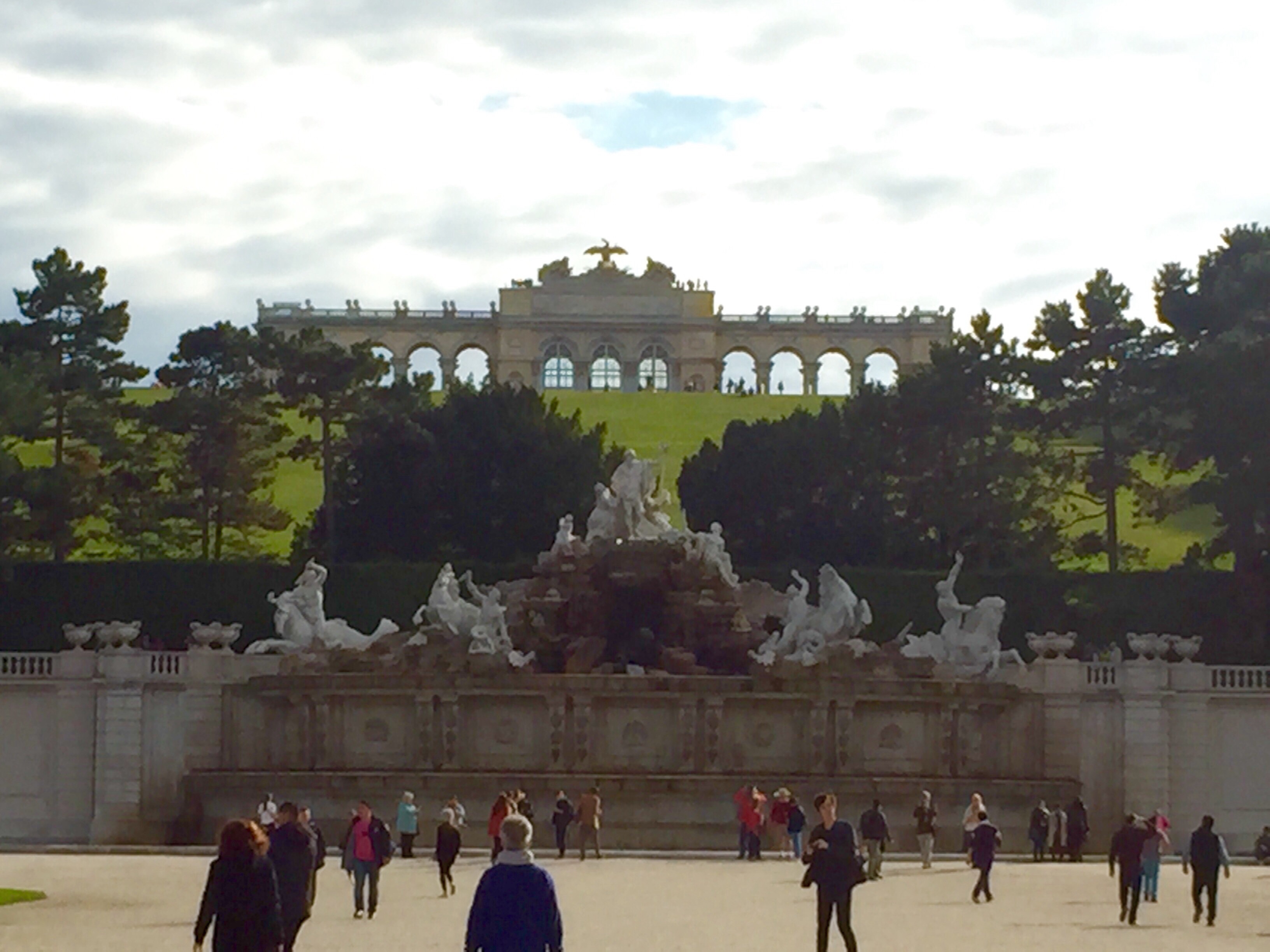
Vienna’s Glorietta in the gardens of the Schönbrunn Palace
As we toured the Schloss Schönbrunn, the Imperial Summer Palace, we walked through beauty and history. Gold and white rooms with huge chandeliers and porcelain fire stoves, with beautiful paintings of Habsburg historic events and family members went on without end. After all, there are over 1,400 rooms in the palace complex. Silk wall-coverings and Belgium tapestries adorned others. The magnificent ballroom with frescoed ceilings and crystal glass mirrors held many important world events, including the meeting of JFK and Premiere Khrushchev in the 1960s. Empress Maria Theresa married off her daughters to secure the Habsburg reign. One, Marie Antoinette, died at the guillotine during the French Revolution. The Empress said that she only hoped that the daughters would do their duty, take care of their husbands and save their souls–whether they were happy or not did not matter. The Habsburg reign came to an end at the conclusion of World War I, since the Empire was a part of the defeated Axis powers. All the palaces became state museums.
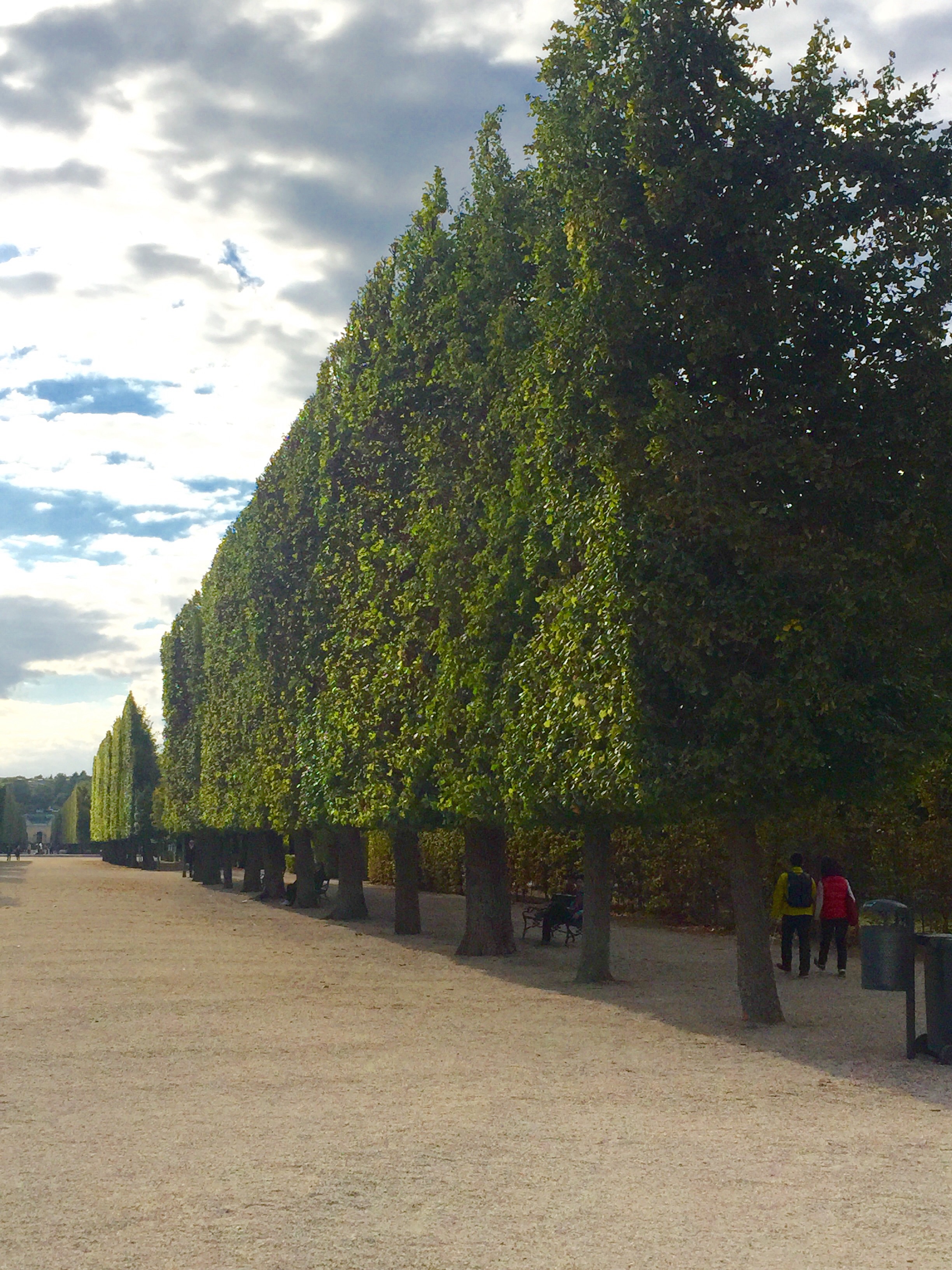
The gardens of the Schönbrunn Palace
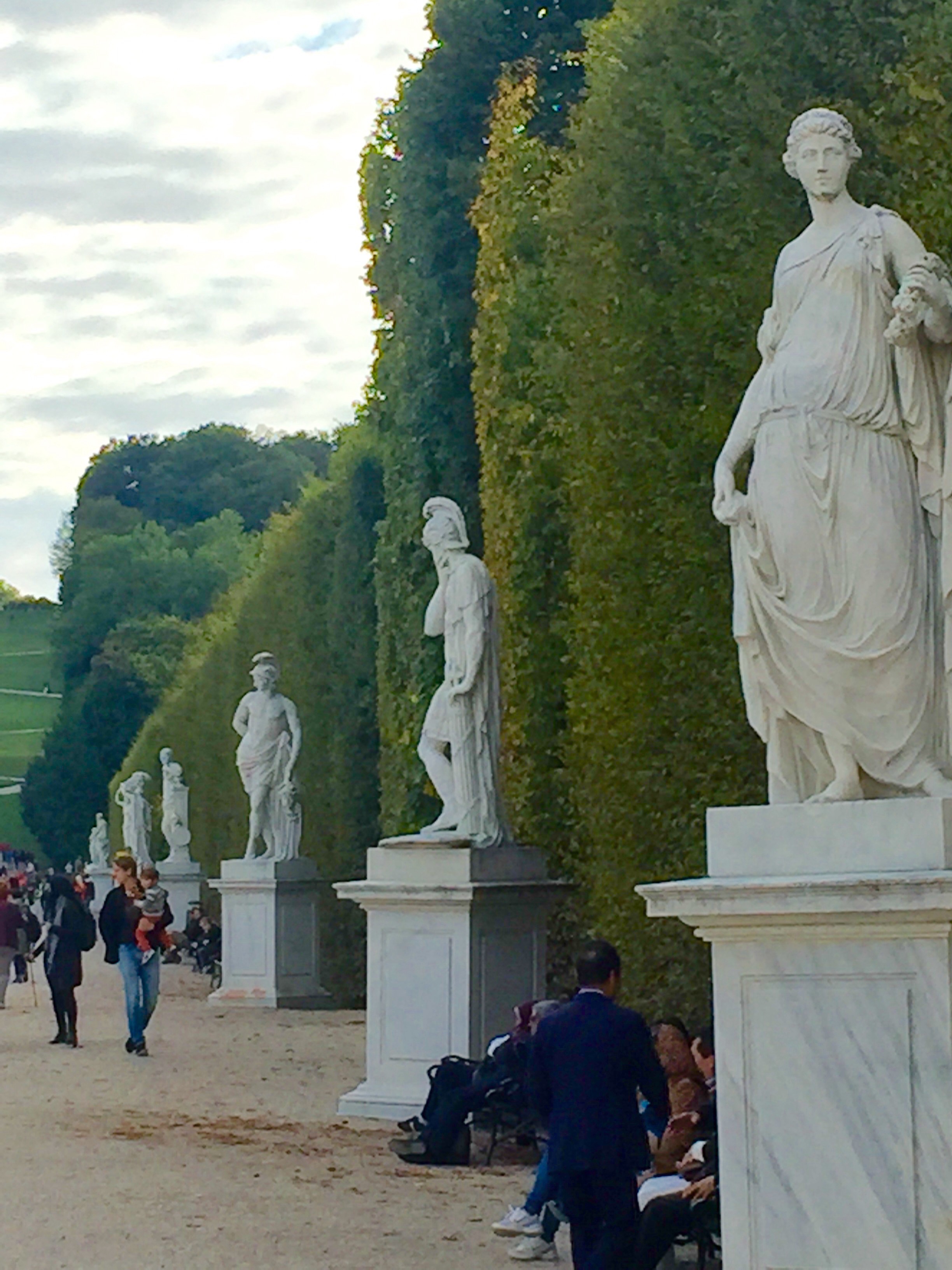
Statuary in the gardens of the Schönbrunn Palace
The exterior gardens of the Schönbrunn are gigantic and spectacular. A hedge and flower maze surrounded by a long arbor adorn one side of the palace while the opposite side hosts a rose arbor and garden with fountains. The rear gardens reveal magnificent flower design plantings lined with statuary and sheered hedges. Fountains dance in the gardens overseen by the amazing Gloriette, a white marble fountain with statuary at the base rising up to a masterful building silhouette on the hill above. Truly, this is one of the most wonderful gardens in the world.

Another view of the beautiful gardens of the Schönbrunn Palace in Austria
Kathy and I are proud of our ability to maneuver with public transportation. Today, without map or help, we moved through Vienna like pros.
WEG – Sunday, September 27, 2015
Night Scenes

Vienna by Night
We arose late and lollygagged for awhile, then Kathy said she was going to take a nap. She slept another 3 1/2 hours. That kind of put a hole in the day, so we called family and spent time talking. On a long trip, there comes the time to take time off from all the adventures, and our comfortable apartment was a wonderful place to take a respite. Eventually, as evening approached, I said, “I’m taking off my pj’s and dressing to go out for a walk,” and that is what we did.

Vienna by night
The air was fresh and clean, the temperature perfect at 55 F. We were surprised with the large number of people out in the evening air. We strolled past magnificent government buildings brightly lit since Vienna is the national capitol. Other historic buildings and fountains came into view as we followed the Ringstrasse, or ring road, that ties the inner core into a whole. My health app on the phone was ringing happy tones as I piled up the steps on our invigorating walk. Vienna is beautiful by night!

Vienna at night
As we tended homeward, we stopped into a nice coffee caffe for a light evening meal and some sachertorte, a traditional Vienna dessert. It was not only a lazy day, but a healthy one at that.
WEG – Saturday, September 26, 2015
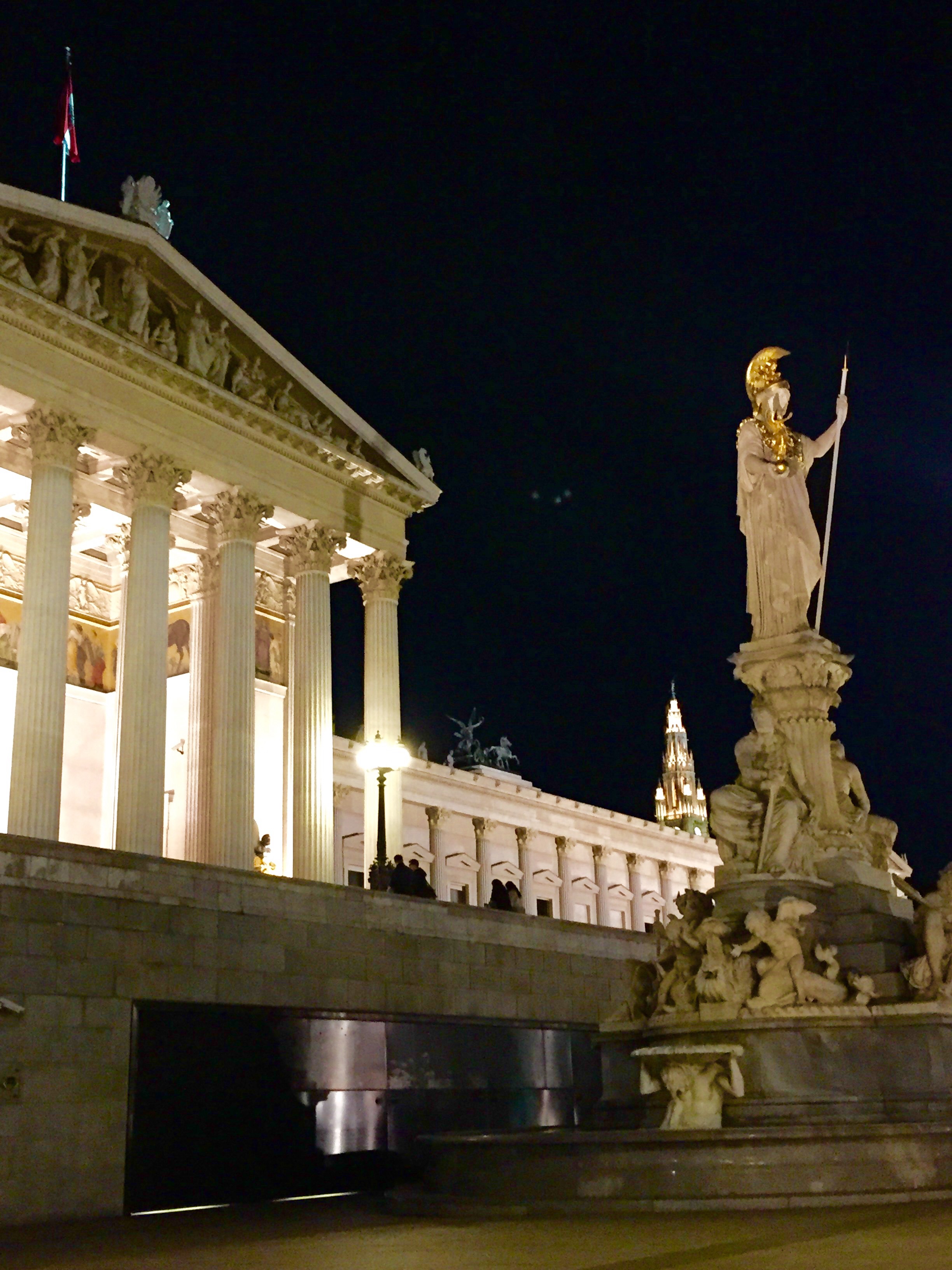
Vienna at night

Vienna, Austria

Vienna, Austria

Vienna, Austria – a night scene
Sweater Weather

Central altar in St. Stephen’s Cathedral, Vienna, Austria
Our journey to Vienna brought out the sweater. It became cooler the closer we came to the capitol of Austria. It felt like a winter day in Texas, around 45 F with a light rain in a light breeze. Huddling inside the grand St. Stephen’s Cathedral while the organ played felt exactly right. It was dark inside and the stained glass windows were bright with color. The light on the golden altar gave a shimmering effect. In spite of the massive size of the room, it felt cozy and warm. We ducked into a cozy restaurant in the early evening for a wonderful meal. The dark paneling and close tables filled with people was just right for the weather. The waiter told us what to eat because it was cold outside–hot skillet meals with fried potatoes and spaetzel with bacon and eggs. It was, in fact, just right.

A brief sample of the beautiful interior of St. Stephen’s Cathedral in Vienna, Austria
We had some interesting experiences today. Getting to Vienna, I was surprised that we were getting off at the West Bahnhof, since we always go to the Hauptbahnhof (main station). Our apartment was in the city close to most sites and not close to the West Bahnhof. We ended up needing to take an underground train and a tram to get close to our lodging. (We could have taken a taxi, but I am sure it would have cost $30 because of the distance and the U/tram tickets cost us $3–I am not good at spending more than necessary, especially when it is a challenge–I don’t tend to stress when on an adventure.) Amazingly, with the help of friendly Viennese, this trip was quick and a piece of cake.
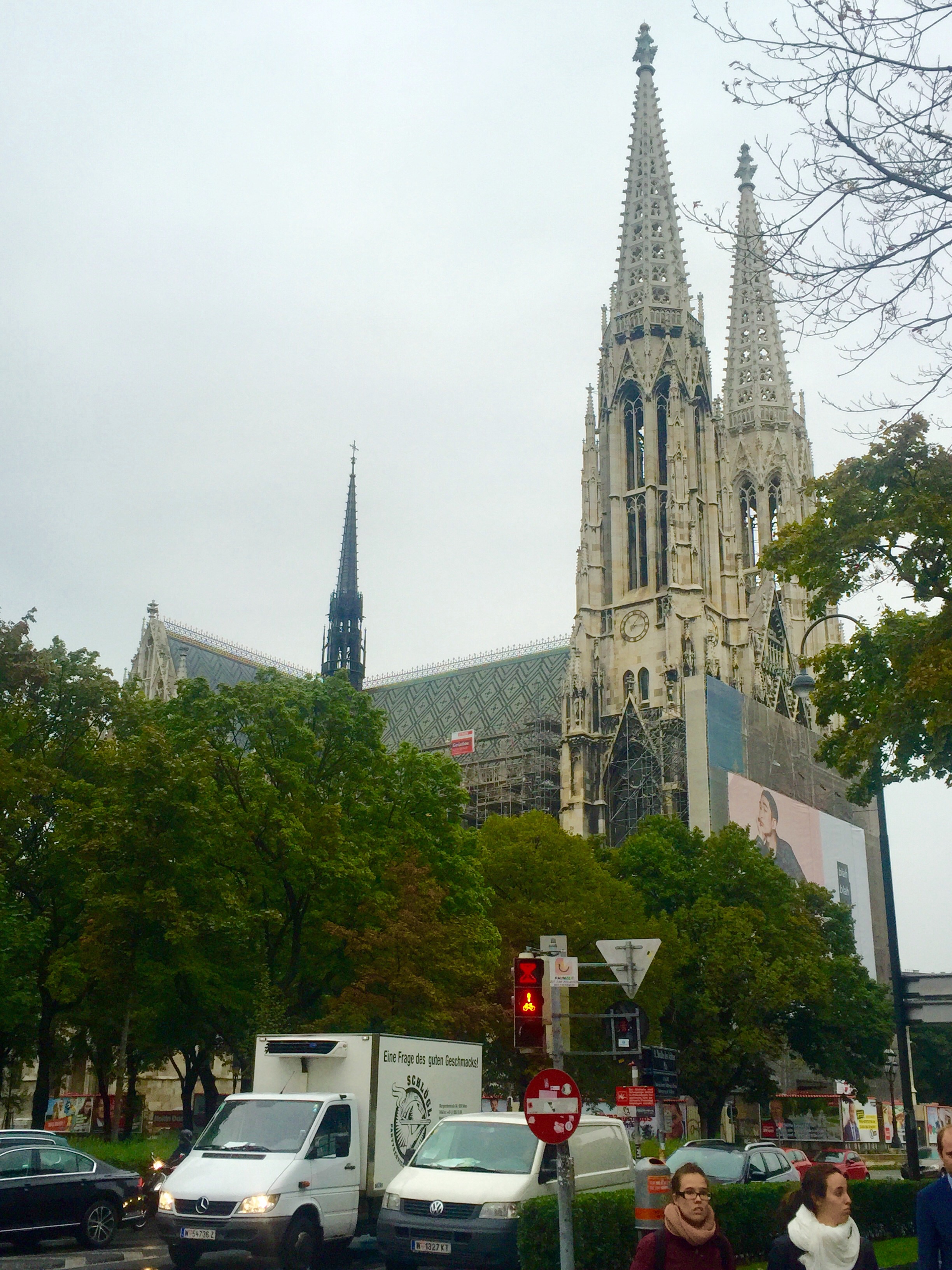
St. Stephen’s Cathedral, Vienna, Austria, from a distance
Getting into our apartment was another story. Our directions were not complete–we found the apartment, but we did not know how to get inside. Finally, I got someone to answer a phone and the person said, “Why didn’t you push buzzer 42?” Our directions said nothing about buzzer 42! We were led to our beautiful and spacious apartment and given keys. Yeah! The Rathaus (city government) spire is right outside our fifth floor (yes, there is an elevator) window. EXCEPT, after walking to the Rathaus and St. Stephen’s Cathedral and eating our wonderful meal, my key got stuck in the big front door to our apartment building. Wonderful, helpful people tried to help us get the key out to no avail. You can’t just leave a key in the main door of an apartment building, can you? “NO,” Kathy said, “I’m not sleeping down here all night!” I finally got “Buzzer 42” to answer the phone. “You must have positioned your key wrong; it goes perpendicular to the earth to pull it out.” Sure enough, turning my key 90 degrees until it was perpendicular to the ground allowed it to be pulled out of the latch easily. I was so very thankful that German-speaking Buzzer 42 knew the word perpendicular. WEG – Friday, September 25, 2015
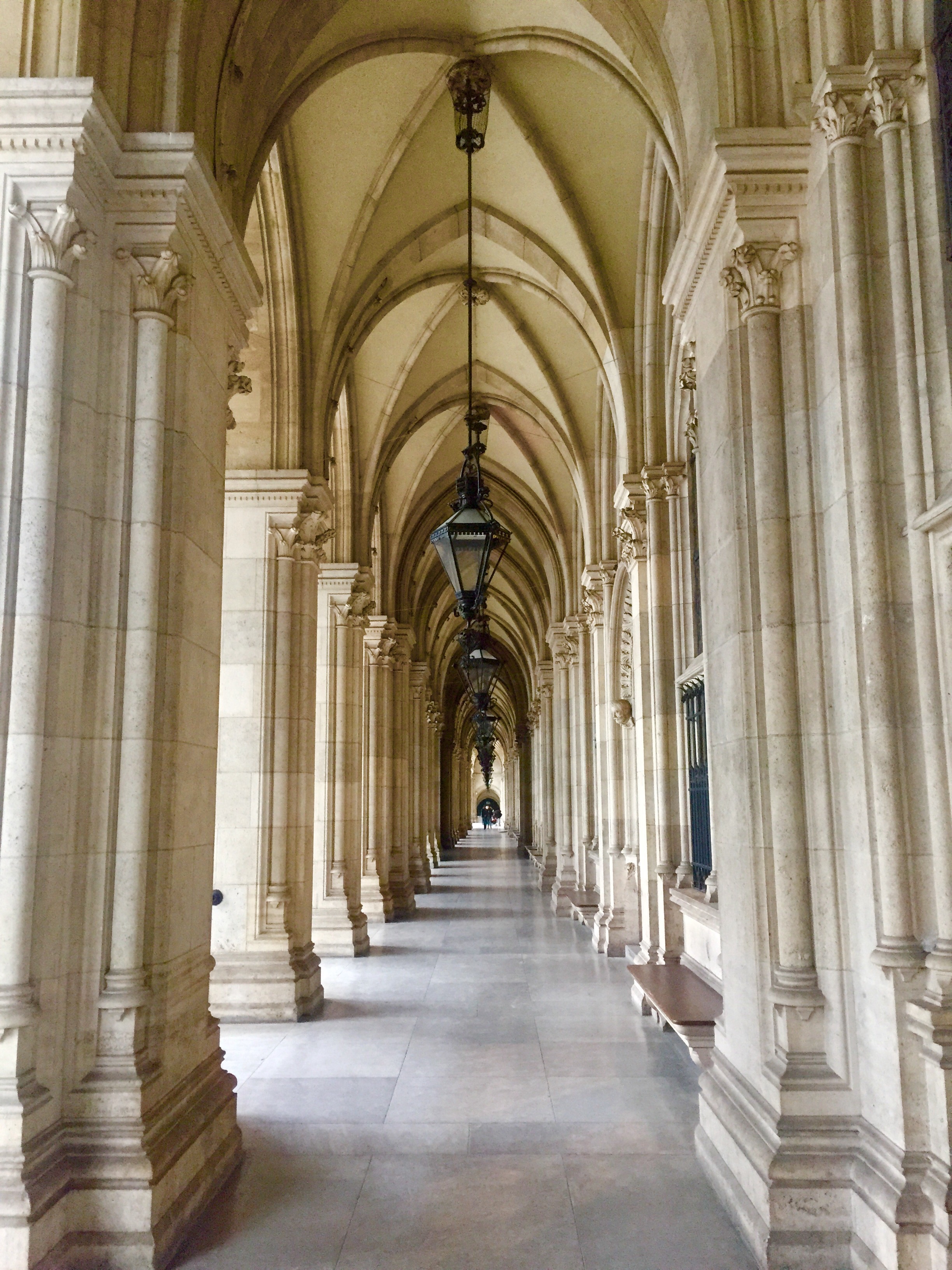
The Rathaus colonnade, Vienna, Austria

Vienna’s Parliament Building
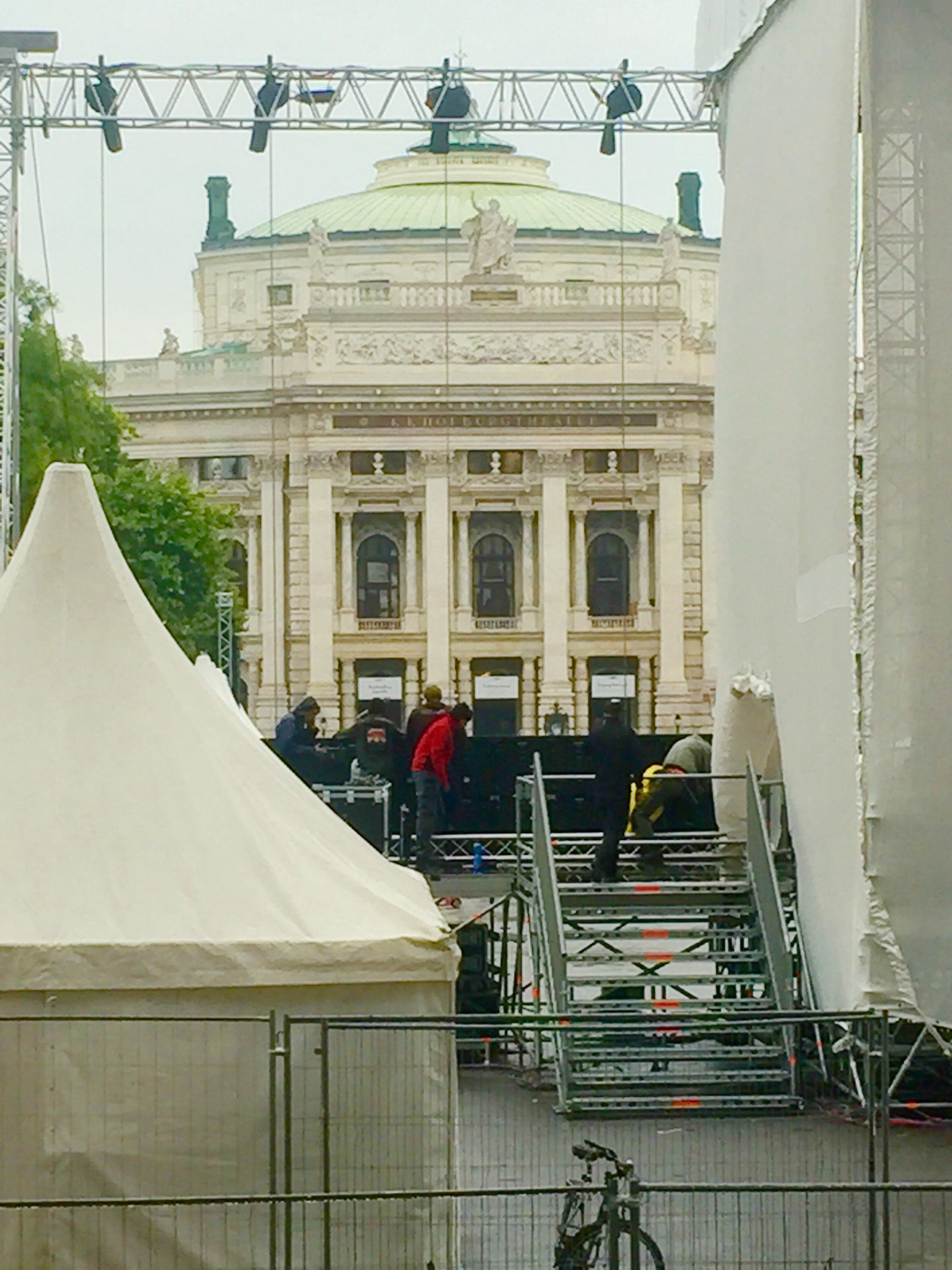
The Burg Theatre in Vienna, Austria, where an outdoor festival is being set up
Pumpkin Time

The Melk Abbey, home of Benedictine monks since 1089, prominently located in Melk, Austria
Pumpkin has appeared on the menus as the autumn season begins here in Austria. Kathy is enjoying cream of pumpkin soup, and I am having pumpkin goulash. As we traveled to Melk to visit the Abbey, we saw field after field of orange pumpkins ready for the picking.
The Benedictine Abbey in Melk was founded over 900 years ago when Leopold II gave one of his castles to the Benedictine monks. Today, the Abbey is a UNESCO World Cultural Heritage Site. Awesome is a good word to describe it. The yellow gold colored Abbey sits massively on a rock promontory. The displays are both educational and devotional at the same time. The theme of the Abbey is the Cross of Christ, and it is well integrated into every presentation. Artifacts from throughout the history of the Abbey are beautifully displayed as you wind your way to the Baroque masterpieces held within the grounds.
The first inkling of the beauty to come is in the grand marble dining room, done with both natural and faux marble painting. Massive and with a dramatic ceiling fresco, the dining room played host to many Austro-Hungarian personages. From the dining room, we are led out onto a courtyard balcony that overlooks the Austrian countryside with the Danube River flowing below. From there, the great library, one of the world’s finest, held our rapt attention. The main room holds 10,000 texts with the same ancient binding on each. The bookshelf woodwork with gold etchings is marvelous and intricate; the frescoed ceiling is stunning. The library contains over 750 printed works before 1500 with a total today of 100,000 volumes in all.
The treasure, however, is the Abbey Church. Considered the pinnacle of Baroque design, the room is aglow with gold. The beautiful frescoes and statuary harmonize into the total design, intended to portray heaven on earth. At first sight, we stood transfixed, not moving, such was the sight.
It was a “beautiful” day in Austria! WEG – Thursday, September 24, 2015
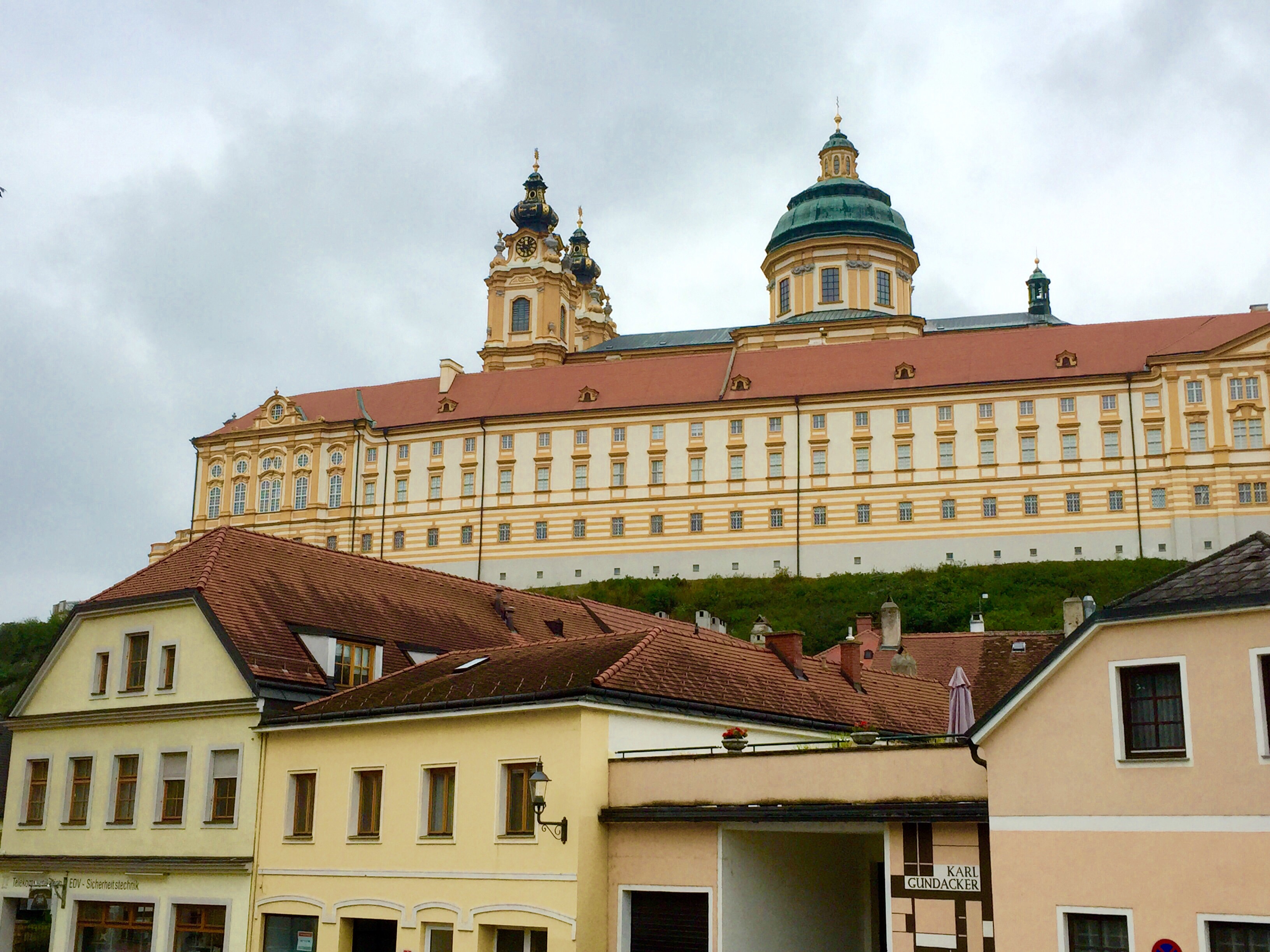
A view of part of the exterior of the Melk Abbey in Melk, Austria, that sits high above the community of Melk, Austria.

The beautiful Melk Abbey Church, a Baroque masterpiece that places its emphasis on the cross of Jesus Christ and, through its art, it seeks to “bring Heaven to Earth.”

A scene from within the Melk Abbey Church, one of the most beautiful Baroque churches in the world
Czech it Out
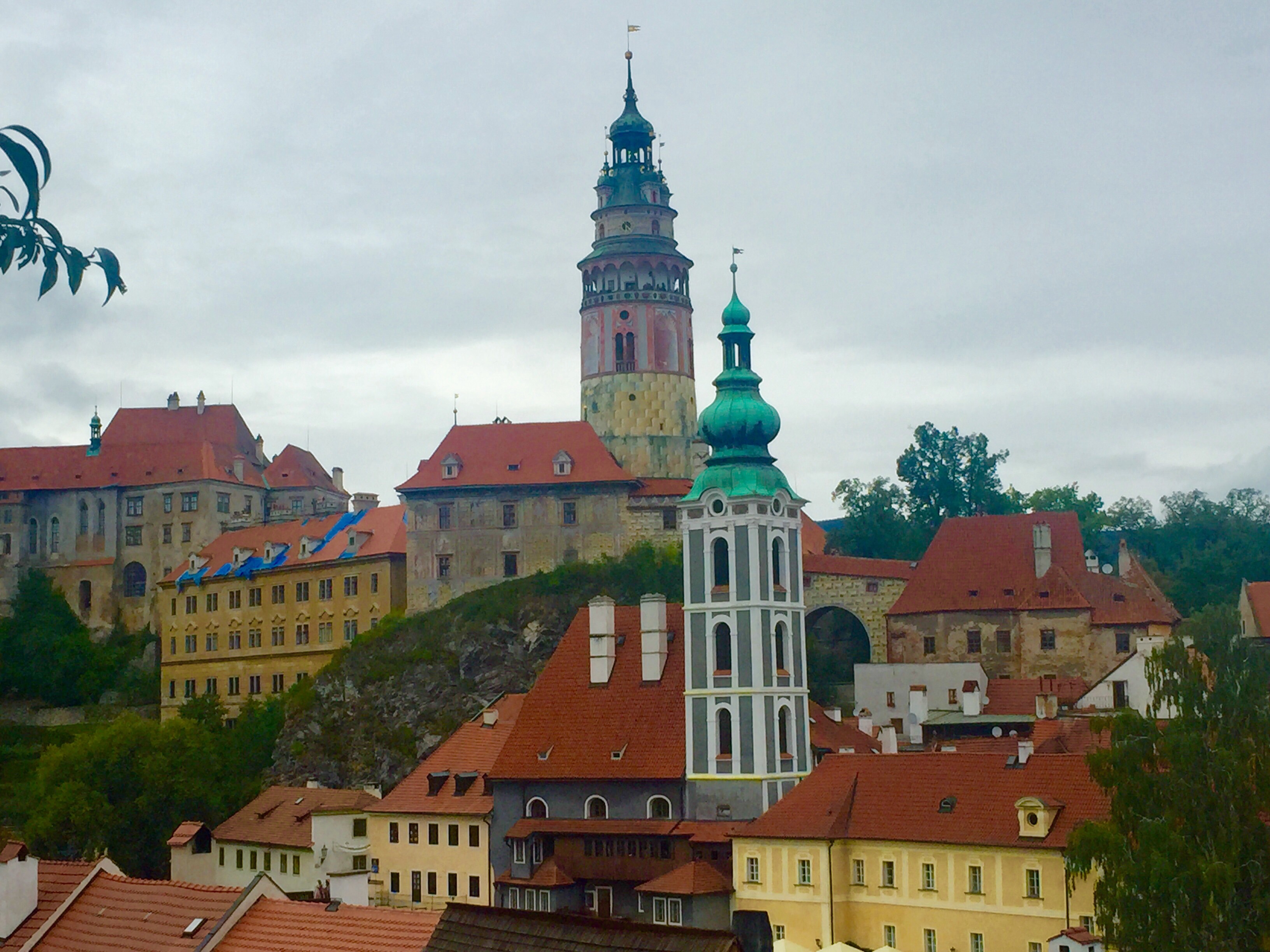
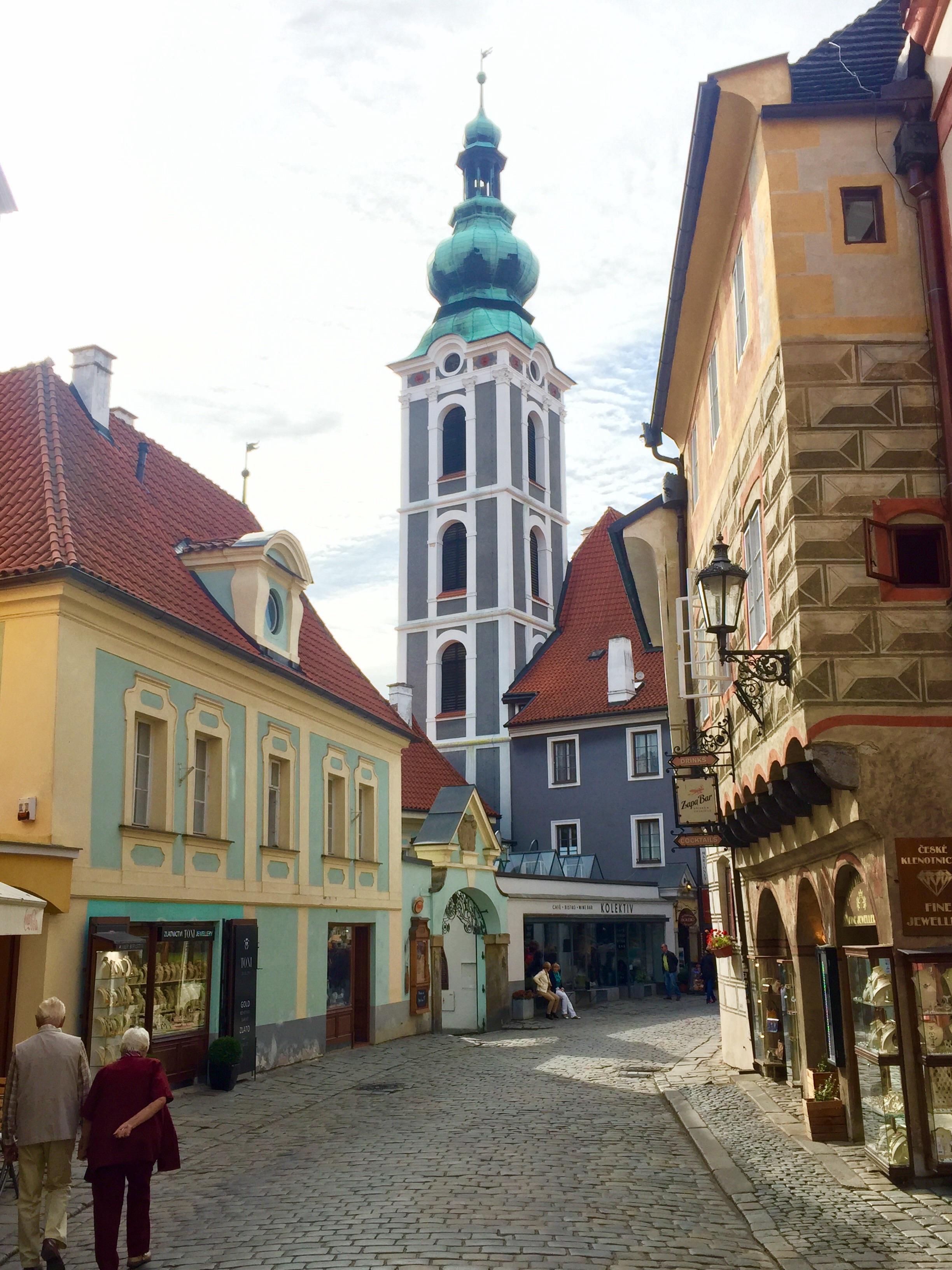
Beautiful Cesky Krumlov in the Czech Republic
I had one of the best meals on our trip today. That is saying a lot, since our food in Italy and Germany was wondrous. First of all, it only cost $10 –things are quite reasonable in the Czech Republic. The beef filet was perfectly cooked and was topped with fresh cranberry sauce, a marinated lemon slice and whipped sour cream. It sat in a bed of mushroom gravy and along side it sat three puffed Czech bread dumplings. I had to fend off Kathy trying to eat them away from me. It had complex seasonings that worked well. It will be my only meal for the day, besides the amazing breakfast this morning that is part of the hotel cost. We were shocked to find our table waiting and laid out for us with wonderful foods. Fresh fruits beautifully arranged in a basket, yogurts, and a fruit pastry cake beckoned. Drinks were quickly provided as were cheese and meat plates. Made to order eggs/omelets were offered. This turned out to be a “lollygagging” kind of day in Český Krumlov. It was a cloudy, cool day, and we enjoyed our time together in this enchanting place.
WEG- Wednesday, September 23, 2015

Cesky Krumlov
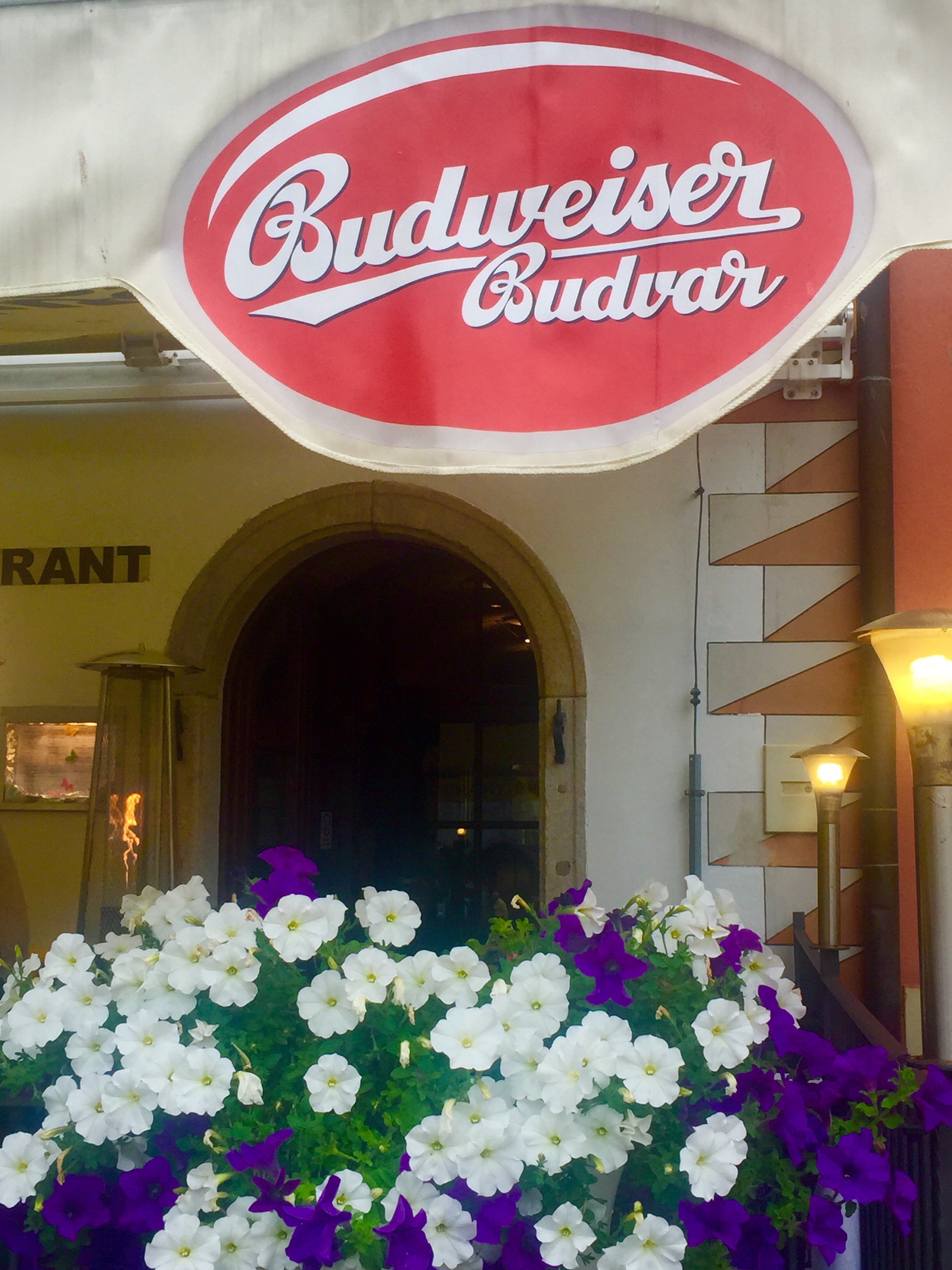
The original Budweiser brewing company is located a brief bus ride from Cesky Krumlov’s town center.

Cesky Krumlov, Czech Republic
CK
Český Krumlov is what Bohemia (one of the major divisions of the Czech Republic) has always been. It is frozen in time. Visitors from all over the world come to walk its very narrow and heavenly cobblestoned streets surrounded by ancient medieval dwellings (our hotel dates from the 1490s). The Vltava River rushes its way through the center of the village overseen by a royal castle perched on a rock outcropping, giving it a look of solid strength.
Our trip here from Hallstatt, Austria, was by private shuttle. It was the only viable way. Reasonable in cost and comfortable, our van moved along roads and highways in Austria past beautiful lakes for most of the journey. Once we passed into the Czech Republic the land became rolling hills filled with pastures and farms. Eventually, we followed the Vltava River all the way to our destination, passing castles and churches commanding the hillsides. When we turned onto our final road to Český Krumlov, it narrowed to basically a one lane road. Large trees hugged the roadside, painted white on the trunks to remind drivers that they shared the road. We drove slowly around curves and when we met traffic going the other direction, both drivers moved carefully.
Arriving into Český Krumlov was unmistakable. A UNESCO World Heritage site, towers and multi-spired steeples abounded, and old dwellings in a concrete plaster wash with aged pastel colors greeted us. Our shuttle could not drive us into the narrow pedestrian zone, so our luggage clunked over the heavy stones as we walked. Our hotel is ancient and our room spacious with huge wooden beams and a seating area and Austrian lace curtains and decorated in 1700s Bohemian style…all at a very affordable price. We ate beside the Vltava River and looked out at the 13th century castle above with Gothic, Renaissance, and Baroque architectural elements. We then searched out a Trdelnik shop, a traditional pastry/dessert in Czech Republic. We watched as the pastry chef rolled out the dough and wrapped it around a metal cylinder, hand rolling it until flat on the cylinder, then rolling it in cinnamon before placing it on a shallow grilling surface on which the cylinder continued to spin slowly as the dessert slowly baked. When browned, the Trdelnik is slid off the cylinder piping hot with a crispy exterior and soft interior. Delicious. Off to a good night’s sleep under duvets, window’s open to the cobbled-stoned street below and cool air wafting into the room.
WEG – Tuesday, September 22, 2015
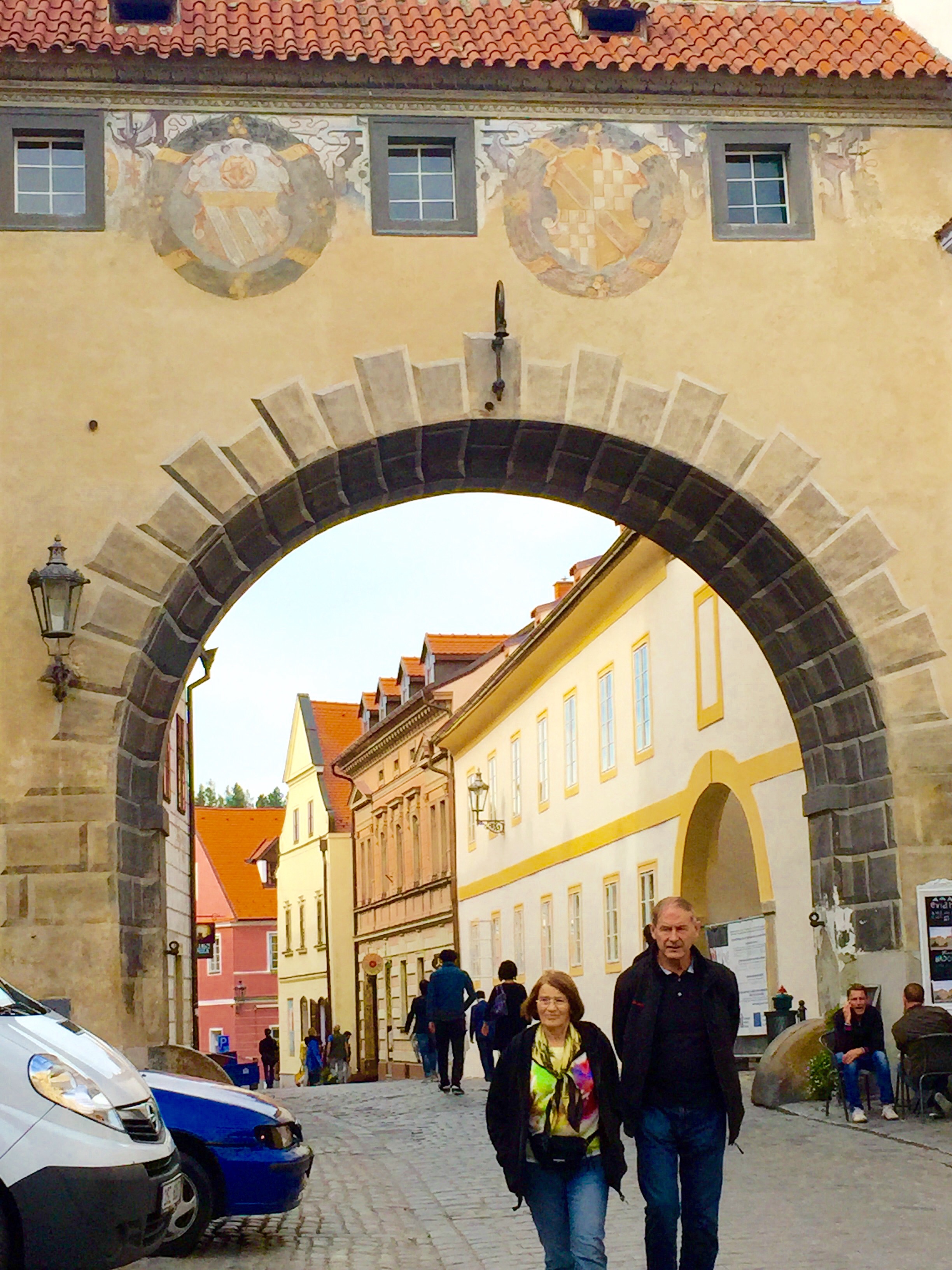
Cesky Krumlov, Czech Republic
Cesky Krumlov, Czech Republic

Cesky Krumlov, Czech Republic

Enjoying lunch outdoors at the base of Cesky Krumlov’s 13th century castle with the Vltava River flowing beside us
Refreshed and Inspired
We awoke to 34 degrees Fahrenheit and looked down from our hotel room balcony on a clear glassy blue lake whose shores licked the base of tall mountain peaks. Swans swam the shores. We got back under our warm down duvets and snoozed again. Eating a late breakfast, we determined to spend the day leisurely in Hallstatt and not slide down the shoots into the world’s oldest salt mine, or take the cable car up to see the peaks of the Tyrol and a mountain glacier or visit the skull cemetery, but rather just soak in the beauty of the town on the cliffs by the lake. And soak it up we did. God willing, we can return for the other activities another time.

Wayne and Kathy view the enchanting village of Hallstatt, Austria, from a hilltop overlooking the Lutheran church that ministers to the community in Word and deed.
I discovered Hallstatt by searching the internet about Europe’s prettiest villages or Top 10 things to see in Europe or Austria and such, and the name Hallstatt, Austria, appeared often. So onto the itinerary it went. We soon knew why so many love the city and the surrounding lake and mountains. While the main street is relatively flat as it runs along the lake, the village reaches up the cliffs for businesses and homes. Stone or wooden staircases cling to rock cliffs or tunnel into the rock for upward mobility. Homes and shops are built on solid rock foundations, and boulders protrude through some. The buildings and homes have thick wooden shingles and are painted in pastels. Gardens are planted wherever possible and flower boxes with flowers blooming profusely adorn almost every building. Thick green moss clings to walkways and railings and roof shingles. The “white gold” salt made the region wealthy, and while the mines are no longer major producers, salt in one form or another is found in most shops. Two beautiful churches adorn the city’s skyline, one Lutheran/Protestant and the other Roman Catholic. A waterfall drops into the mid- point of the city, and the lake and mountains are always in view. We walked the narrow lanes and dropped into shops that caught our attention. We watched a wood craftsman at work on his lathe. Later in the day, we dined in a lakeside restaurant under a huge tree whose leaves were now turning yellow as the fall approaches–lake fish soup and cheese dumpling soup, beef goulash with spaetzle and roast breast of duck with red cabbage and cranberries and, of course, the local beer. As usual, mine was weis (blond or light colored) and Kathy’s dunkel (dark). As they say, opposites attract.
As the evening approached we headed back to our hotel, relaxed and refreshed on a day when the sun shone brightly and the temperature was a mild 64F. WEG – Monday, September 21, 2015

A Hallstatt, Austria, scene with the Catholic church on the left and the Lutheran church on the right

The serene outdoor setting in which Wayne and Kathy lunched while spending the day in Hallstatt, Austria

A pear tree laden with fruit is pruned to grow functionally and attractively up the wall of a home in Hallstatt, Austria.
 kgraumann
 wgraumann
