
Home » Uncategorized (Page 13)
Category Archives: Uncategorized
The Dam


Saturday was a travel day into the interior of China. First, we flew for two hours on a China East airline from Shanghai to Wuhan, whereupon we boarded a bus and traveled another six hours until we reached our river cruise ship, the Victoria Katrina, in Maoping. After a quick night of sleep, we arose to eat breakfast and depart on a tour of the Three Gorges Dam on the Yangtze River. The largest dam and water conservation project in the world, the Three Gorges Dam took seventeen years to construct. The main purpose of the construction was to control the river of the severe flooding with its corresponding loss of life that had occurred throughout the centuries on this third longest river in the world that has over 700 tributaries. Next, the river is a source of hydroelectric power, providing three percent of China’s power for its nation of 1.4 billion people. Since the dam would hold back a huge volume of water and thus raise the level of the river, the government, which owns all property in the nation, relocated millions of people to new cities created above the new water levels. The Chinese are naturally proud of this marvelous feat of engineering.


In the afternoon we visited the Tribe of the Three Gorges in the Xiling Gorge. The tranquil and serene setting that was attained via foot featured a crystal clear river/stream and a beautiful waterfall surrounded by towering forest-covered hills. Old water mills and wooden fishing boats intermingled with intricately carved wooden buildings. People in colorful clothing representative of the local tribe were interspersed along the pathway, some singing, some playing Chinese musical instruments. It was a 2 1/2 mile walk, but the weather was pleasant and we were mesmerized by the beauty as we learned about the culture and customs of the indigenous Tujia people. Arriving back at the cruise boat, we enjoyed a good Chinese dinner. Too tired, Kathy and I skipped the captain’s reception and evening entertainment and went to sleep in our small but comfortable suite. WEG


Kourtnie

Today was an exciting day for us because we were going to be able to visit with Kourtnie, a young lady we have known from her childhood. The morning was first spent taking a ride on the world’s only magnetic levitated train (no wheels-it rides on air) where we reached a top speed on 264 mph. Later, we visited a silk worm exhibition center to see the production of this fiber from beginning to end. The Chinese lead the world in silk production and already, in ancient times, cultivated a special mulberry tree with larger leaves and no fruit that gave them an edge in both quantity and quality in their silk products. Later, we visited the Shanghai Urban Planning Center to learn of the vision for this city that is the site of the largest building program in world history. (To get to this part of the city, our tour bus needed to climb a multi-lane spiral highway to reach a massive bridge over a river that cuts through the city.) We then went to the Chinese Cultural Museum where we were to also meet Kourtnie.
Our time with Kourtnie was blessed. We eagerly heard of her ministry with children with disabilities. These are “throw away” children. Because of the strict and enforced family planning in China, a high value is placed on having “perfect” children, and kids with disabilities are often not acceptable, and thus handicapped children are left in dumpsters or abandoned in parks, etc. Kourtnie and the ministry with which she is associated take in these children and, with great sacrifice, take care of them and raise them. There is no hope for adoption. Amazingly, the children are being raised to speak three languages so that they can get a job later in translation or in the service sector, i.e., hotel industry where knowledge of English is highly prized and rarely available. Thank God for people like Kourtnie! We had a delightful time eating an extended and somewhat late lunch and walking in the expansive and beautiful park at People’s Square. We were surrounded with tranquility, beautiful flowers, stands of bamboo and lily pad-covered ponds as we meandered a beautifully tiled walkway. High above us, however, were skyscrapers with amazing architecture. Kourtnie took us back to our hotel on the spotlessly clean subway, after which we said farewell. Oh, yes, we delivered gifts to Kourtnie from her parents. She was a happy girl. WEG
Totally Planned


Over the past fifteen years, Shanghai has grown from six million people to 27 million people. To accommodate this growth, the city was totally planned down to the last apartment building. It is awesome! Huge green spaces and beautiful parks with amazing flower plantings frequently dot the landscape. The architecture is creative and modern. We drove for miles amongst 30-50 story apartment buildings with taller skyscrapers forming town centers here and there. It truly is impossible to overemphasize the efficiency of transportation, the distribution of green space, the eye-catching architecture amidst the immense space of this city transversed with rivers and streams. There is nothing cookie cutter in Shanghai.


We spent time at the Hu Gardens—the ancient city home of a wealthy merchant. It is a fine place with many separate and traditional Chinese rooms scattered among the streams and ponds with native vegetation that make this a garden. One quite interesting item on display is one of the most valuable rocks ever discovered. The emperor at the time gambled his kingdom on purchasing the rock, only to have it lost in a storm at sea as it was being brought to land. He spent a fortune having the area searched, but the rock was lost. It was found much later and brought to the Hu Gardens. The rock is a quite large limestone with 74 holes, but each hole is connected individually on the inside so that when water is poured on the top, it follows the interior channel to each hole (one at a time) until it flows out at the bottom. No other such rock is known to exist.
We visited the trendy French Concession with its galleries, boutiques and restaurants set in tree-shaded colonial Shanghai. Across the river, the Pearl Tower, Shanghai’s iconic skyscraper/tower vied for attention with the “beer bottle opener tower,” with its square topped opening at the top, and the 120 story spiraling Shanghai Tower. The “beer bottle opener tower” was designed by a Japanese architect with a round opening, but when it was discovered that the sun streaming through the opening caused a reflection that closely resembled the Japanese flag, the architect was fired and the circle became a square.
After another dim sum dinner, with way more food than was possible to eat, we went to the amazing acrobat arena for a show. Wow! I marveled at the acrobat who balanced on five layers of boards, each layer sitting atop a roller, all the while placing saucers and cups on one foot, only to toss them in the air and catch them on the top of his head. Higher and higher the stack grew. Kathy screamed so loudly when an acrobat on a very high ferris wheel with spinning circular wheels lost his balance at the highest point, that hundreds of people diverted their attention from the acrobat to her, missing the acrobat’s recovery. The theater was built specifically for these world famous acrobats, and the acts were accompanied with laser and light shows and live Chinese instrumentation with a wonderful vocalist. The concluding act with eight lighted motorcycles driving at breakneck speed inside a sphere in synchronized patterns was indeed a showstopper. We were exhausted but fulfilled as the day came to a close. WEG
China Time

Our journey from Houston was a long one, and we arrived in Shanghai in early evening, tired but excited. First impressions are these: the people are friendly and helpful; everything is well organized and efficient; Shanghai is beautiful and huge and there is no visible bureaucratic overreach. We got a great night’s sleep and arose in the morning to explore our surroundings.

Our hotel is located in “the Bund” waterfront district–the heart of Shanghai and the financial and commercial center/hub of China. The Bund runs along the Huangpu River and features European colonial style buildings from the past on one side and striking modern skyscrapers on the other. Right out the door of the hotel was an alley that led directly to the old Shanghai shopping market. The architecture was everything one imagines China to be: narrow passageways and intricately carved wooden buildings with pagoda styled roofs and red Chinese paper lanterns adorning the shops. It was fascinating.

We walked the promenade along the Huangpu River and enjoyed watching the ships gliding by the amazing architecture of the city. We noticed that, in spite of its immense size, Shanghai is dotted with parks, and streets are lined with trees–many stately sycamore with white pealing bark. We walked through one park with topiaries, flower plantings and expansive green lawns. On one side, under the trees, Chinese music wafted through the air and people were dancing in the middle of the day. It was delightful.


We ate in a Dim Sum restaurant for lunch. I followed the instructions of the server and picked two “small” portions from each category. Oh my! Overall, I picked foods I have never eaten, i.e., dates in plum sauce with water chestnuts, Chinese congee with ham, crayfish in chili sauce with ? (I have no idea, but it was crunchy). It was all very tasty, but it just kept coming and I could not eat all the food on the plates. At the seventh course they brought a bowl of vegetable fried rice. I was maxed out and this bowl was anything but small. Literally, it could have fed three people for lunch by itself. I felt so guilty leaving so much food behind on the plates–think of the irony of it all–my mom telling me to clean my plate as a kid because of all the starving children in China! Unfortunately, we didn’t have enough money to buy Kathy any food, so she just watched me eat. She said the wonderful smells soothed her hunger. (She ordered fried seafood with cheese and avocado.)

It was a relaxing first day and we are super excited for the ones to follow. WEG
Best to Last


We had no idea what would lie in store for us today on Lake Titicaca, South America’s largest lake that lies between Bolivia and Peru. The lake is beautiful with reeds growing in the shallows along the shore and ringed with low lying hills. At 12,500 feet above sea level, Lake Titicaca is the highest navigable lake in the world. It is 103 miles in length and 27 miles in width and its deepest point is almost 900 feet. Big lake!


We took a boat ride on the lake from our hotel’s dock. We followed a channel cut through the reeds. Our destination was the floating islands of Lake Titicaca. We were immediately blown away when we approached the islands. They are indeed floating. In fact, they are anchored so that they will not float away into the deeper lake. When we got off our boat onto one of the islands, we were greeted by the inhabitants dressed in native dress and shouting out welcomes in the native language of the Uros people.


The best way to describe walking on the floating islands (there are many in close proximity) is to say it’s like walking on a soft mattress. Try doing that for several hours. The islands are covered in small homes built out of the reeds along the shore that our boat had passed through. Some have rounded and pitched roofs and others are “tepee” like. Everything is made of reeds–furniture, beds, flooring–even the island’s earth is of reeds. One of the women invited Kathy and me into her home where she insisted that Kathy try on some of her clothing. Fun! Kathy and I agreed that this was the most intriguing place we have ever visited in all our travels.


Why and how did these islands come about? Five hundred years ago the Incas were invading the lake’s native peoples in an attempt to bring them under the control of the empire. The people in this part of the lake realized that their future was threatened, and so they escaped by boat into the lake. After living in the boats and realizing they had no place to go, they noticed that mounds of tortora reed roots that had dried out in the dry season were floating in the lake. They tied the floating roots together and covered them with layers of reeds. Then, they constructed their housing on top using the reeds. This tradition has continued until today. However, maintaining the islands is labor intensive, and we were told that in the next twenty years, the islands will likely no longer be what we were able to experience today, since children are going to college never to return. The floating islands will probably become government maintained in the future with hired actors to welcome the tourists.


All of a sudden a large flock of flamingos flew overhead, portending the large migration of this bird from Chile to the lake. Lake Titicaca was an unexpected surprise that we enjoyed immensely. WEG
Sexy Woman


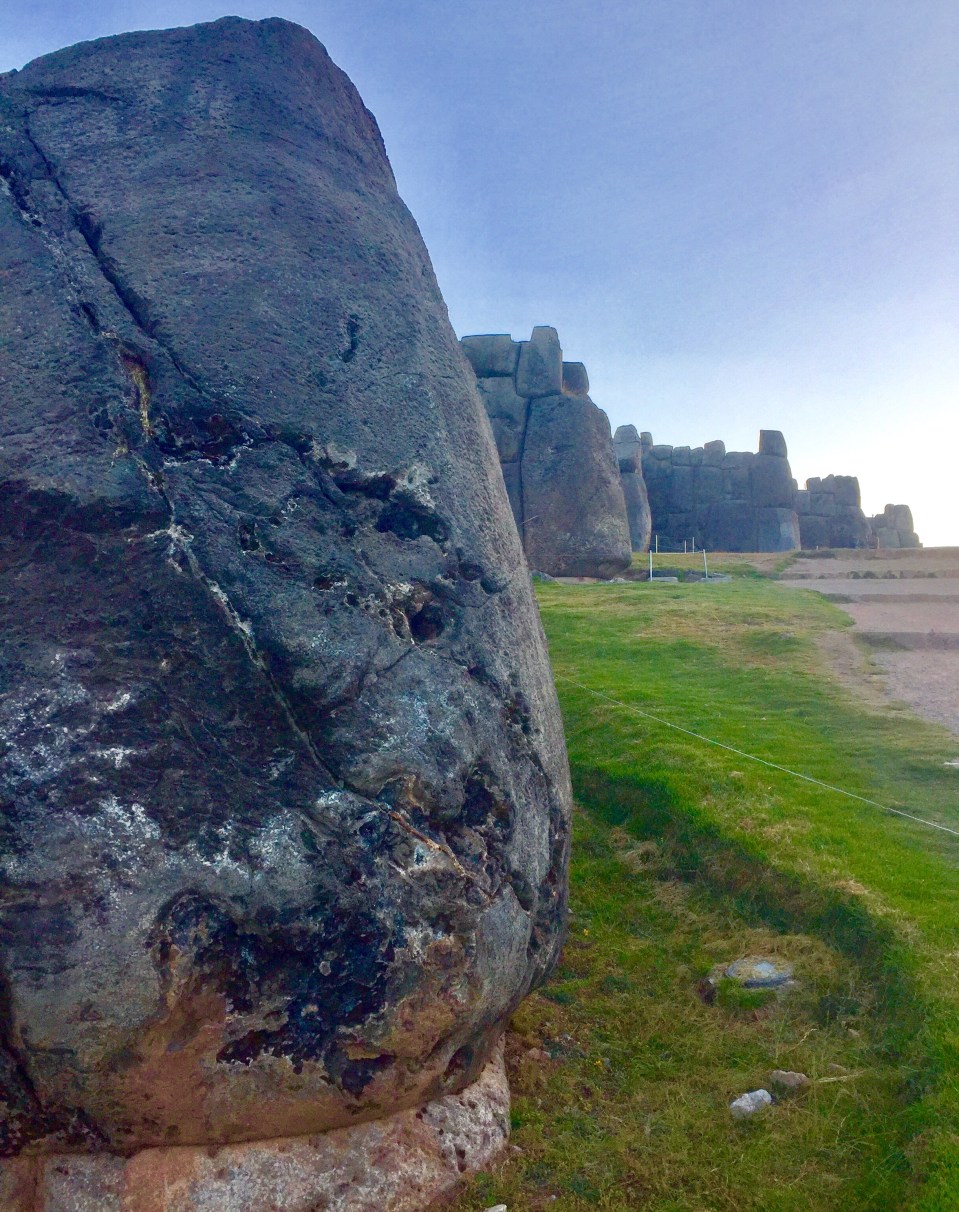
Sacsayhuaman Fortress, Cuzco, Peru


The day began with a Cusco city tour to the archeological site of the Temple of the Sun. Covered in pure gold, it was an instant attraction to the invading Spanish conquistadores, who took all the Inca gold (22 carat) and silver (pure) that they could find and had it shipped to Spain. The temples were often torn down to use the stones in other construction, and colonial cathedrals were built on top of the remains. An earthquake exposed the Temple of the Sun’s foundations, and now it is a protected site.


We arrived in Cusco on the major holiday in Peru, Corpus Christi. Huge parades had brought ornate, larger than life-sized statues of the Virgin Mary from churches in the area to the city cathedral. When we toured the cathedral, the statues were on display. We admired the altars clad in 22 carat gold. “Look, but don’t touch, and no pictures.” We gazed in wonderment at the massive painting of “The Lord’s Supper” by a Peruvian artist as he used the inspiration of Leonardo daVinci’s famous painting, but personalized it for a Peruvian audience using tortillas for the bread and roasted guinea pig for the meat in the Passover meal. Judas was portrayed as Fernando Pizarro, the invading Spanish conquistador.


Outside was a big party! Thousands of people–young and old–were parading in native Indian costume (do not think North American Indian–there is no comparison in dress or music) with bands playing native music. It was beautiful and an explosion of color. You really did want to dance along.


We had another evening of “dinner and a show.” Kathy and I had mountain trout, and we both thought is the best trout we have ever eaten–and we have eaten trout around the world! The music and dancers showcased the Peruvian art forms over time. It was fast-paced, colorful and entertaining.

Wayne and Kathy with the statue of Jesus as He watches over the people of Cuzco, Peru – June 16, 2017.
P.S. We could not post this blog yesterday. So, it is a day late. Today, we flew into Juliaca and then drove to Lake Titicaca, taking most of the day. This short note will suffice for today’s blog. There will be pictures and descriptions of the largest lake in South America and the highest navigable lake in the world in tomorrow’s blog as we get back on schedule.
Food


Traveling the mountain highlands at 13,000 feet above sea level, the farmlands stretched out further than the eye could see. Above them loomed the ever present Andes. At one point, I could count five over 18,000 feet peaks that were snow/glacier covered. It was breathtaking. One could think I would get used to the sight, but I am mesmerized every time. We boarded the domed PeruRail in the early afternoon in Machu Picchu Town for an almost two hour ride to Ollantaytambo. It was fun. The staff dressed in costume for dancing and also for a fashion show of native arts. Of course, the scenery along the way was fantastic, since we followed the river the entire way.


Once in Ollantaytambo, we boarded a bus for our ride to Cusco, the imperial capital of the Incas and now a city of around 500,000. We stopped along the way at a brewery named the best in all of South America. We had a tasting of five of their beers that have won major awards as the brew master explained each one. Really cool!

Peruvian beers brewed in South America’s best craft brewery
We have been treated to some excellent food along the way. Our hotel in Machu Picchu Town hosted a cooking class for us. We learned how to make Pisco Sour, the national drink of Peru, as well as cerviche. We learned some important culinary tricks, such as, squeeze only 3/4 of the juice from the lime used in cerviche because, if you squeeze the lime next to the pith, it will sour the fish used in the dish. It was a great time, and we have an apron to prove we passed the class.


Our food has been excellent, and I did try the grilled alpaca. Delicious! One thing we have noticed is that much care is placed on appearance of the dish. The food looks good before you ever take a bite. Next, we have learned that only fresh and organic foods are used. Finally, Peruvian food is complex. The cerviche, for instance, had twelve ingredients, each used in a specific way at a specific time. I can say that Peruvian food is some of best looking and best tasting food I have eaten.


As we close out the day, we are encouraged and at rest. We have been blessed to have an adventure far beyond our expectations and, since it is fall of the year here in the Southern Hemisphere, the weather is gorgeous. WEG
Machu Picchu

This is the view the Incas had of the mountains from one side of Machu Picchu.
One mountain peak stacked upon another and another and another; deep valleys running in several directions with more mountain peaks, like ducks in a row; tropical foliage with bromeliads growing in the trees and colorful flowers, even orchids, adding color to the green landscape and then steep sheer cliffs adding drama. This was our amazing ride up from Machu Picchu Town to the World Heritage Site and one of the Seven Wonders of the Modern World, the wonder city of the Incas, Machu Picchu.


We arose early from our mountain retreat and took the dome car PeruRail, itself known as one of the best train rides in the world, to Machu Picchu Town at the base of the mountains leading up to the famed ancient city. The sights were wonderful. First, we were in high country farm land, and all of the sudden, in the tropics along the river that is a tributary to the Amazon, which originates in Peru. Snow-capped mountain peaks could be seen here and there. We pulled into the handsome train station in Machu Picchu Town and walked across bridges above rushing streams to the bus terminal, with buses leaving every five minutes to take visitors up the mountains to the famed archeological site. What a ride! The bus drivers make those hairpin curves quickly.


And then, there it was, the mountain city of Machu Picchu. Only the leader of the ancient peoples was known as the Inca, the Son of the Sun, his wife, the Daughter of the Moon. The Temple of the Sun was clad in gold and the Temple of the Moon in silver. While the imperial city was in Cusco, the Incas loved Machu Picchu, and it was a royal retreat. I can see why–the scenery is stunning, overwhelming, impressive, captivating, astounding! It was a citadel, surrounded by imposing peaks, some snow-covered with steep cliffs. It was isolated, in fact, so much so that the Spanish conquistadors did not find it to destroy it as they did every other Inca city. Canals were built from the glaciers of nearby mountains to bring fresh water into the city for hygiene, irrigation and drinking purposes. Here in Machu Picchu, the astronomers developed the calendar that was precise. By watching the stars, through water plates that reflected the stars on the surface like a mirror, strategically located throughout the city, they mapped and chronicled the movement of the stars and created an accurate knowledge of the heavens, and their sun dials were marvels of time keeping.


Machu Picchu is a wondrous city. Its buildings climb up and down the hills. There was a place for the common people, with a farming area, with fabulous terraces built down the mountain sides for agricultural purposes. What human might it must have taken to carry the stones and build the walls on such steep inclines. And, there was a place for the Inca and the elite. Here the temples were built and the royal homes. There were gates to the city and garrisons for soldiers. It is a large archeological site. We walked up and down steps, marveling at the sites and listening to the history and explanations of the site given to us by our guide. You had to be careful in walking. It was so marvelous that you could easily forget your bearings. While we walked, in fact, two tourists had major accidents–one backing up too far to take a picture and falling over the ledge for a five foot drop, and another gazing in wonderment, not noticing the steps and breaking her leg in the fall. I held onto the rock walls to stabilize my path! What can I say about Machu Picchu but that it is a marvel of industry and might and ingenuity and science. It is breath taking!


Our evening is spent in a very nice hotel in Machu Picchu Town. We were greeted after our rather grueling day with iced tea and hors d’oeuvres. Hors d’oeuvres were also delivered to our room. The mountain stream passes by and the mountains rise up before us. My mind is and will be occupied at how these people built such a magnificent place for us to marvel over today. WEG


Glory of the Andes

The Peruvian Highlands
The sight was glorious! Everywhere we looked, we saw snow covered mountain peaks. We were at 12,000 feet up in the Andes, but the snow covered peaks were 18-20,000 feet in height. Yes, it was a glorious sight! We were in the high meadows of the Incas most of the day. Corn, potatoes, wheat, barley and various beans are grown at these heights which are remote from the world. We traveled on narrow one lane unpaved roads that switchbacked even in the more level areas. There were times that our small tour bus (large buses are not allowed as the roads cannot accommodate them) was on the very edge of the lane with up to 1,000 feet drops into chasms cut into the mountain. Kathy spent a lot of time praying, while I feigned that the tire was part way over the edge.


We stopped at the salt mine in the Andes. It is unique in that it is not an underground mine, but a glorious invention of the pre-Inca natives in the area. There is a salty spring that flows near the mine, and the natives dug shallow pools and lined them with hardened clay and allowed the spring to fill the pools and then let the sun evaporate the water and the dry salt remained. Today, the same techniques are utilized that were in play 3,000 years ago, but on a larger scale. Over 150 tons of salt are exported each year from this mine.

Ollantaytambo Incan Ruins, Peru
We next stopped at another pre-Inca/Inca settlement that is an important archeological site. Not as well known as Manchu Picchu, Ollantaytambo is the oldest continually inhabited pre-Inca/Inca community in existence. Ollantaytambo was at the crossroads where two valleys intersected, and thus, it was a trading center as well as a strategic military site. The ancient stones still remain and the site is an adventure that requires some serious climbing.


Our big destination for the day was a remote mountain village where we were greeted by people of the village in native dress. They played and sang for us and then led us into the village where we had a traditional meal in a private home. It was four courses–appetizer of beans and corn with a spicy pepper sauce; potato corn soup; meat balls with a native sauce, and a dried potato dessert. We then were led into the farm lands where we witnessed the spiritual connection of the Incas with the land and observed a demonstration of mountain farming. There are no mechanical tractors or tools here (cattle with wooden plows) and no pesticides of any kind. At the end of our time in the village, the native people grabbed us by the hand and led us in a native dance. It was a heart-warming experience!
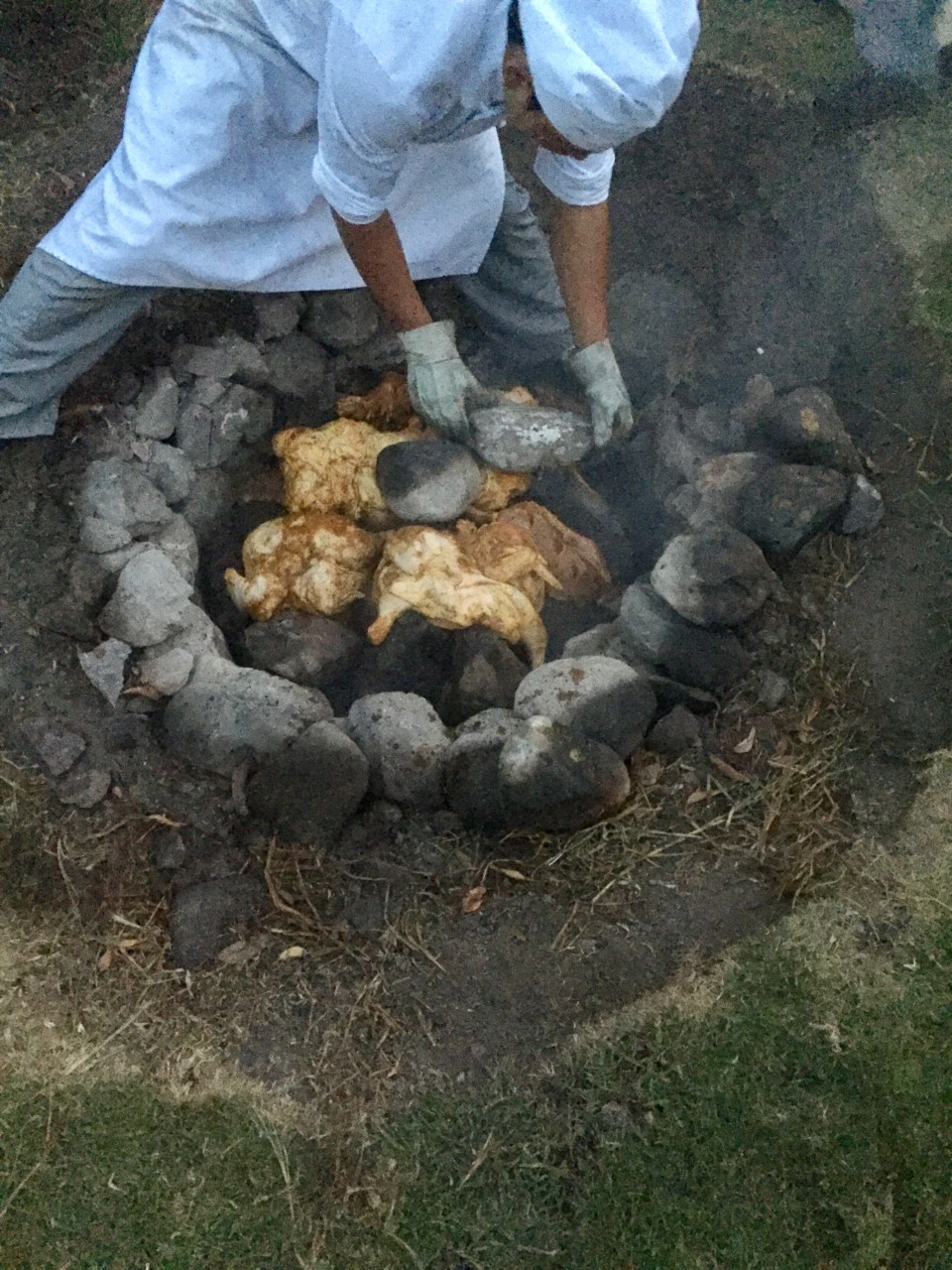
Back at our mountain lodge, the staff brought us out onto the green where they prepared our Pachamanca meal before us, a traditional Peruvian way of cooking with hot stones using the land as an oven. In a large hole, they began to place hot stones that had been washed with salt and heated for five hours. On the first layer of stones, the hotel guests placed both white and sweet potatoes, then more stones were placed on top and beef, pork, lamb, and chicken were laced with hot stones. On top of this was placed a soaked reed mat, and on top of that mountain grass, followed by a wet sheet, and on top of that dirt. One hour later we were served an elegant meal on the terrace with a wood burning fireplace and a person in native dress playing native music on a harp. What a treat!
Now it is off to bed because tomorrow, God willing, we go to one of the seven wonders of the modern world–Machu Picchu. WEG
Pisco Sour is All You Need to Know


We entered the Sacred Valley of the Inca’s today. The ancient Inca’s were astronomers and they saw that the river in the valley seemed to go toward the Milky Way. They believed it was from the heavens; and, therefore, sacred. The valley is mystical and magical. It varies from only 1/4 mile wide to 1 mile wide, goes forever and has wonderful mountains on each side with the sacred river running in the middle. It is rugged territory and the Incas built their cities on the mountains so that the valley below could be kept for farming. Because the need for food was great, the Incas developed a system of terrace farming on the steep mountain sides that is still not only visible today, but in use as well. Kathy and I simply soaked in the wonderful scenery.


Our plane landed in Cusco, the ancient capital of the Incas, but we immediately boarded a bus for a six hour journey to our hotel into the Sacred Valley. Along the way we stopped at an Alpaca farm to get up close and personal with alpacas, llamas and vicugnas (the fiber from which is considered the rarest and most expensive on earth). Further along, we stopped in Pisac Village, a market village, where the finest Peruvian folk arts are practiced and sold. Colorful and active, Kathy shopped until she dropped or ran out of money–you choose. I found a woman cooking Inca corn (hominy) on the cob–white and tasty served with a mountain cheese and in its corn husk. I couldn’t resist! Finally, we stopped at a ceramic studio where the ancient Incan art form is kept alive. It was a most appealing setting and we watched native craftsmen and women practicing their craft.


We arrived at our outstanding mountain country lodge hotel. It is in the hills all to itself, and it is the image of what I would have expected a South American mountain lodge to look like. Tiered up the mountain side, with manicured green lawns and beautiful flowers and an open fire place in the lobby, the staff stands at attention in strategic places along the way. Our room is white washed, plaster and stone walls and timbered ceiling–white washed. It is rustic and comfortable and roomy and modern–a 65″ TV built into the wall. It is cool in the Sacred Valley. We are no longer on the equator, but have moved closer toward the South Pole. We will sleep well tonight after our long and wonderful day. WEG


P.S.–I forgot about the Peruvian national drink, the Pisco Sour. It is Pisco brandy, key lime juice and ice blended with egg white foam (with bitters) on top. You can add a simple syrup to sweeten it, if desired. It is delicious, but one will do ya!

Wayne enjoys a Pisco Sour, Peru’s national drink, with evening meal in the Sacred Valley of the Inca’s, June 2017
 kgraumann
 wgraumann
 gofarther.me