
Home » Uncategorized (Page 23)
Category Archives: Uncategorized
Almost Live from THE Oktoberfest
72* F, sunny, German music, German food, lederhosen and dirndls and German beer–it must be Oktoberfest in Munich. It is! I cannot believe we are here!
There are fourteen major tents seating between 2,000 and 10,000 people each. We made it into two of them today. Over half the people are dressed in traditional clothing and, surprisingly, nearly all the younger folks are. I think those not dressed in lederhosen (for men) and dirndls (for women) are tourists. The are over 20 minor tents as well and a full-blown midway. People are everywhere and, as the evening takes hold, it looks like hoards more are coming. You simply cannot move quickly.
The tents are not permanent, but look as if they are. They are massive and each one is decorated differently. The bands and singers are on stages above the crowds, and most tents have balconies for seating as well. You sit at tables and the waiters are quick to bring you beer in heavy glass mugs that are about two quarts in size (at $13 each). The food is also excellent, mainly sweinhoxe (braised ham shank) or other pork, chicken or fish with spatzle (German noodles), sauerkraut, German potato salad, enormous pretzels and cheese for sides. The people sing and sway to the music. It is a lively scene.
Outdoors is alive with food booths of every German description and games and singers and horse-drawn carts. It is wall to wall people. They say between 6 and 7 million folks will attend the 18 day Fest this year. By the way, most of the Oktoberfest is in September, but it goes into the first week of October.
What an experience! WEG

Selfie Photo at Munich Oktoberfest 2013
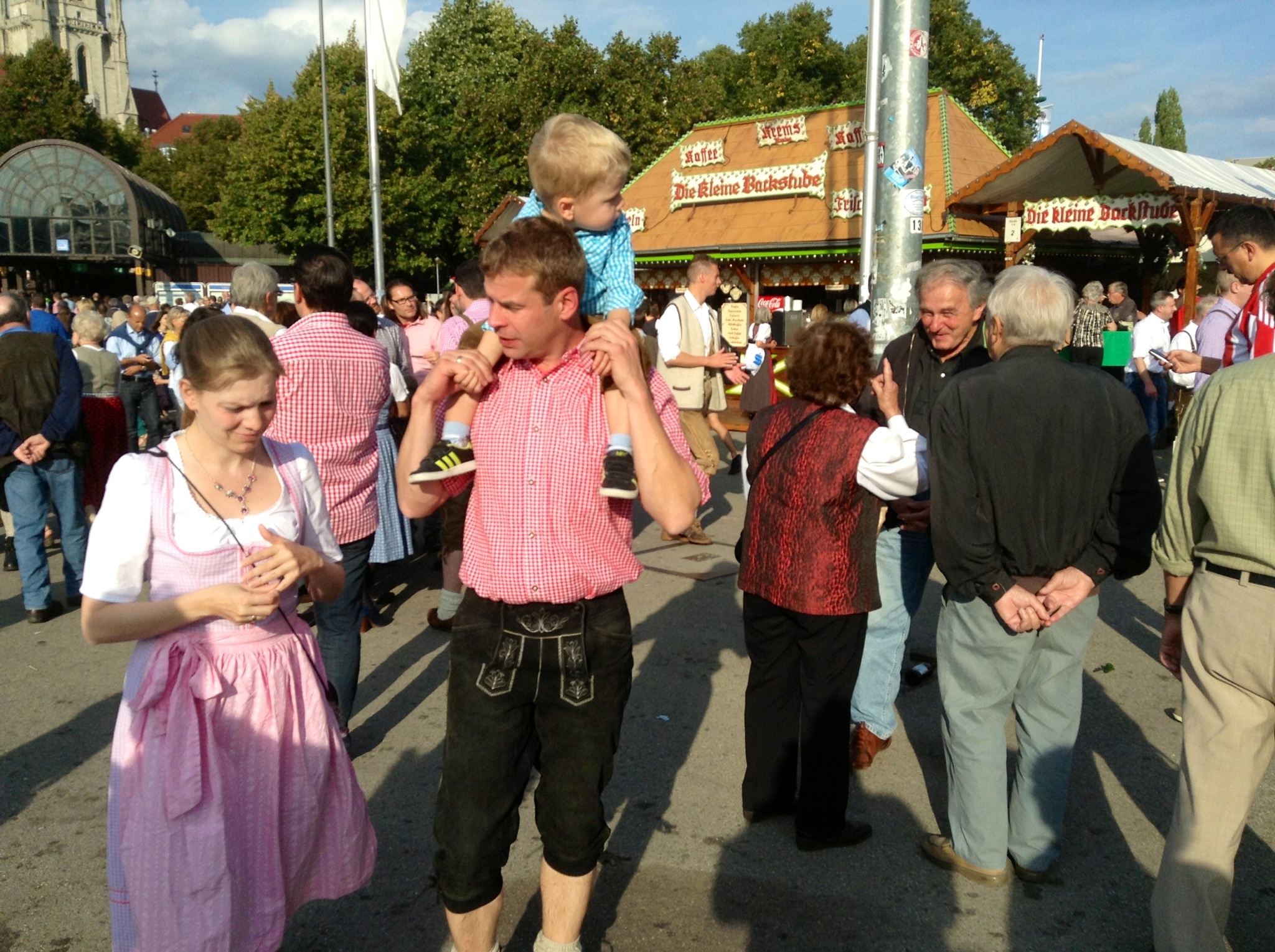
Munich Oktoberfest 2013 – Typical Dress at Oktoberfest
THE Pipe Organ
Passau is a beautiful city in southeastern Germany near the Austrian and Czech Republic borders where the Danube, Inn, and Ilz Rivers join together to make the Danube a mighty river. The Altstadt (Old Town) is built on a peninsula bounded by the rivers. Its cobblestone streets are lined with colorful German style buildings, but with rare exception, not the half timbered type we have seen in abundance along Germany’s Romantic Road. The onion-domed copper towers of the St. Stephen’s Cathedral can be seen from most vantage points in the city. By the way, in Germany, a cathedral can either be a Dom–Roman Catholic or a Munster–Lutheran. St. Stephen’s is a Dom.
St. Stephen’s is in the style of Italian Baroque. Massive and white in the interior, the eyes are drawn upward to the sculptures and painting on the ceiling. The windows are not stained glass, in order to let light flood into the interior. However, St. Stephen’s claim to fame is its mighty pipe organ, until recently, the world’s largest, with 17,774 pipes and 233 registers. Set within the whiteness of the cathedral, its blackness lets it stand out with impressive boldness and majesty. To say that it is an awesome sight is, indeed, an understatement. Stretching through the balcony into all three naves of the cathedral, the camera could not capture its immense size. In addition, two positivs are situated in the choir near the high altar.
We thoroughly enjoyed our day in this river city. WEG

St. Stephen’s Cathedral, Passau, Germany
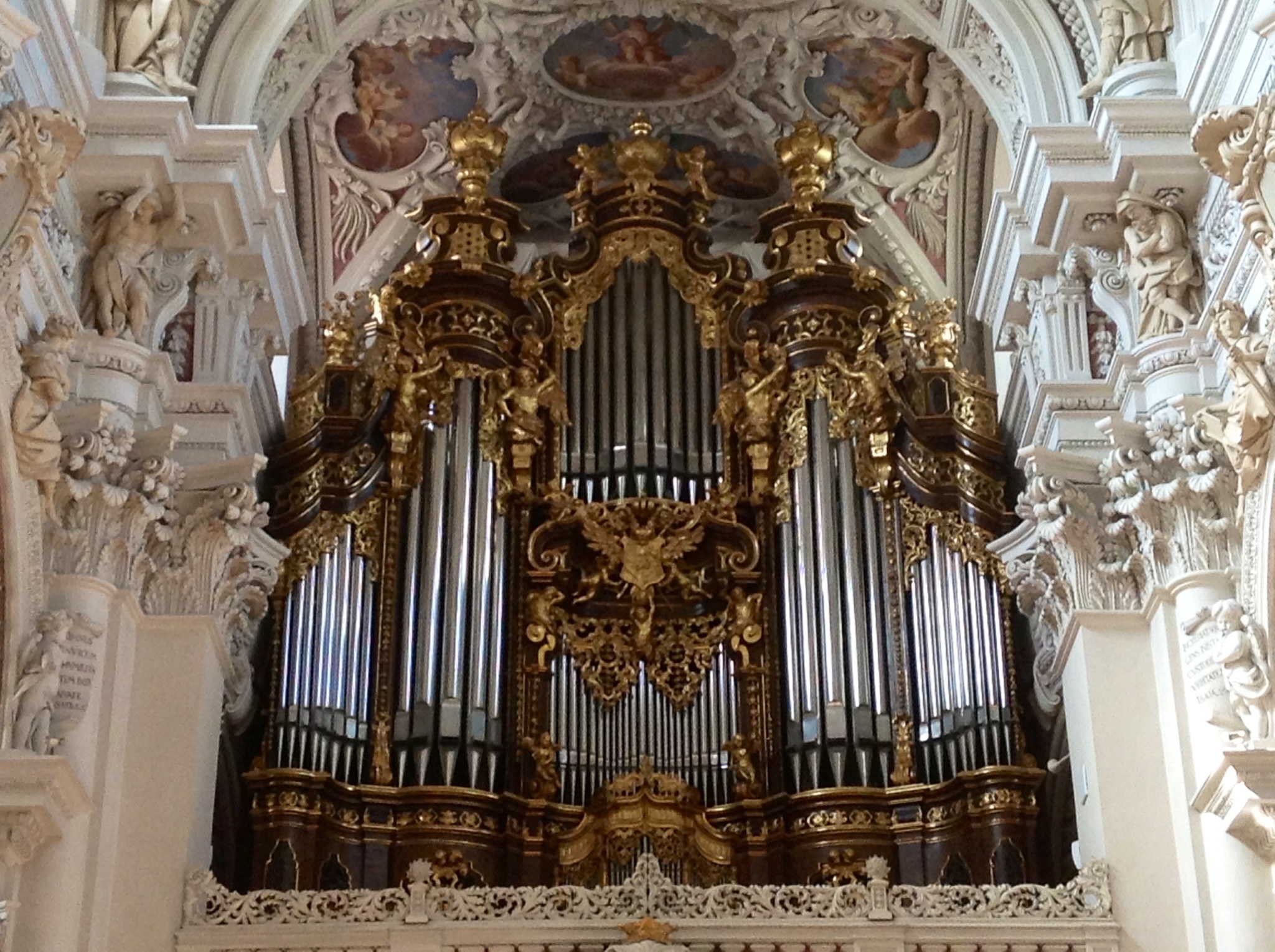
St. Stephen’s Cathedral Pipe Organ, the second largest organ in the world
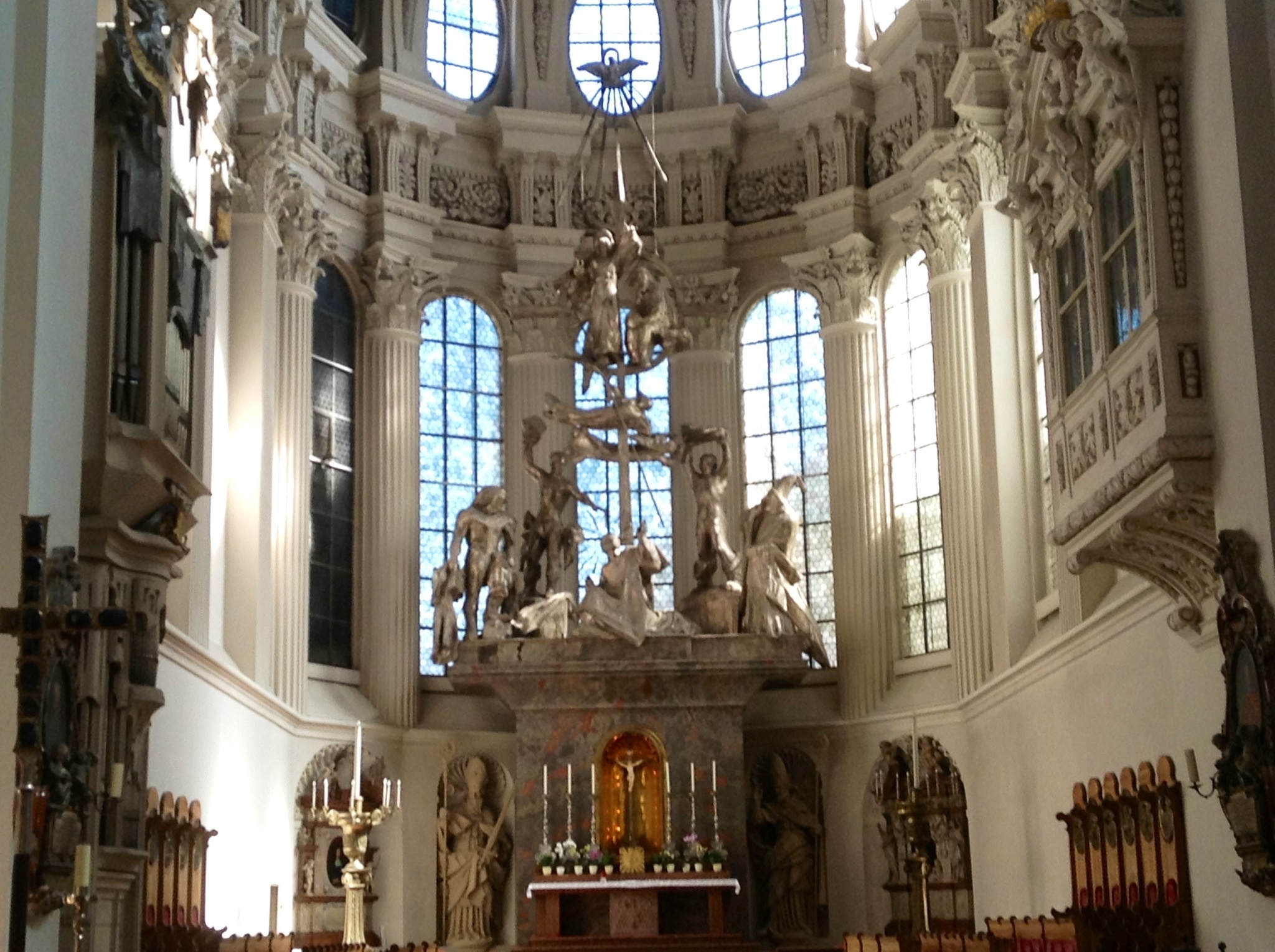
St. Stephen’s Cathedral Altar, Passau, Germany
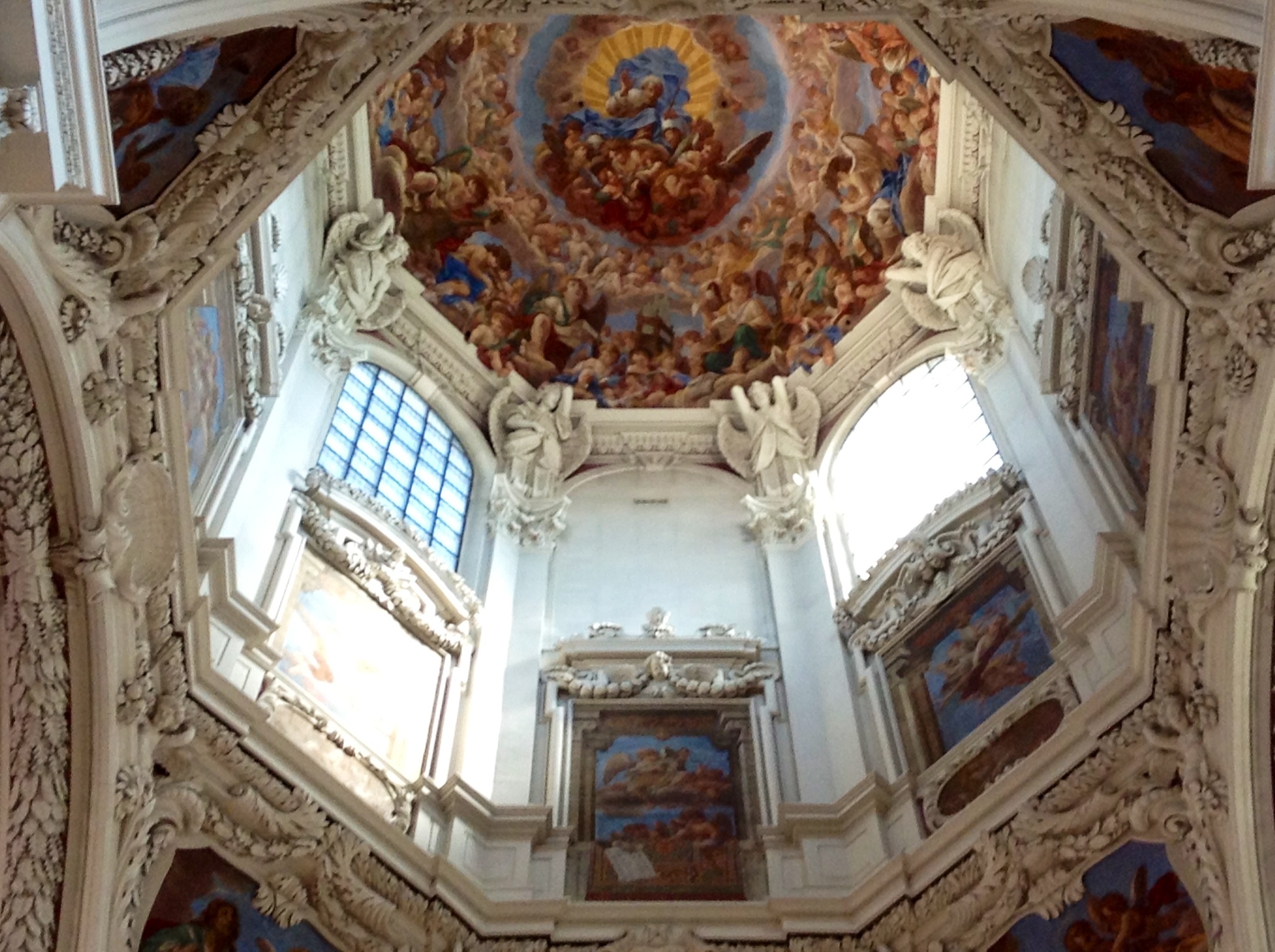
St. Stephen’s Cathedral, Passau, Germany, an Italian Baroque church
The Bridge
We walked the Old Stone Bridge over the Danube in Regensburg, Germany, today. It has stood for almost 1,000 years. The city gate at the end of the bridge invites you to enter the old city, and the towers and church steeples pull you towards them like a magnet. We simply enjoyed walking the streets lined with medieval buildings. You just find yourself immersed in the ancient beauty. It is fun to go into a restaurant that has served food for 600 years and soak in the ambiance along with a local beer and rich paprika goulash and wonderful hot bread. The Cathedral bells send deep gongs into the evening air. It was a relaxing and inviting day in this old city on the Danube River. WEG

Wayne & Kathy on Stone Bridge in Regensburg, Germany – 09/23/2013
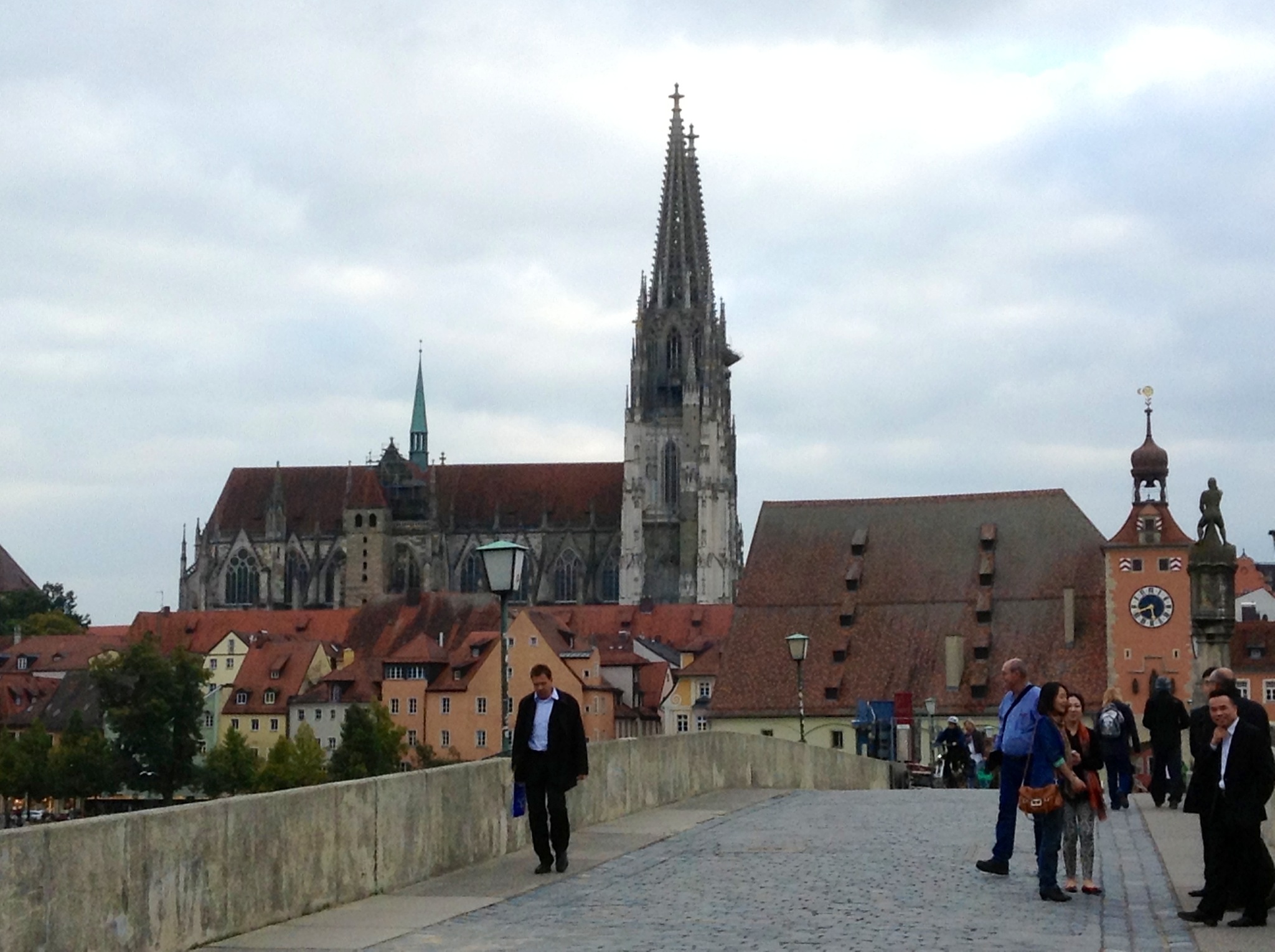
The Old Stone Bridge, Regensburg, Germany

Scene from the Altstadt, a UNESCO World Heritage Site in Regensburg, Germany
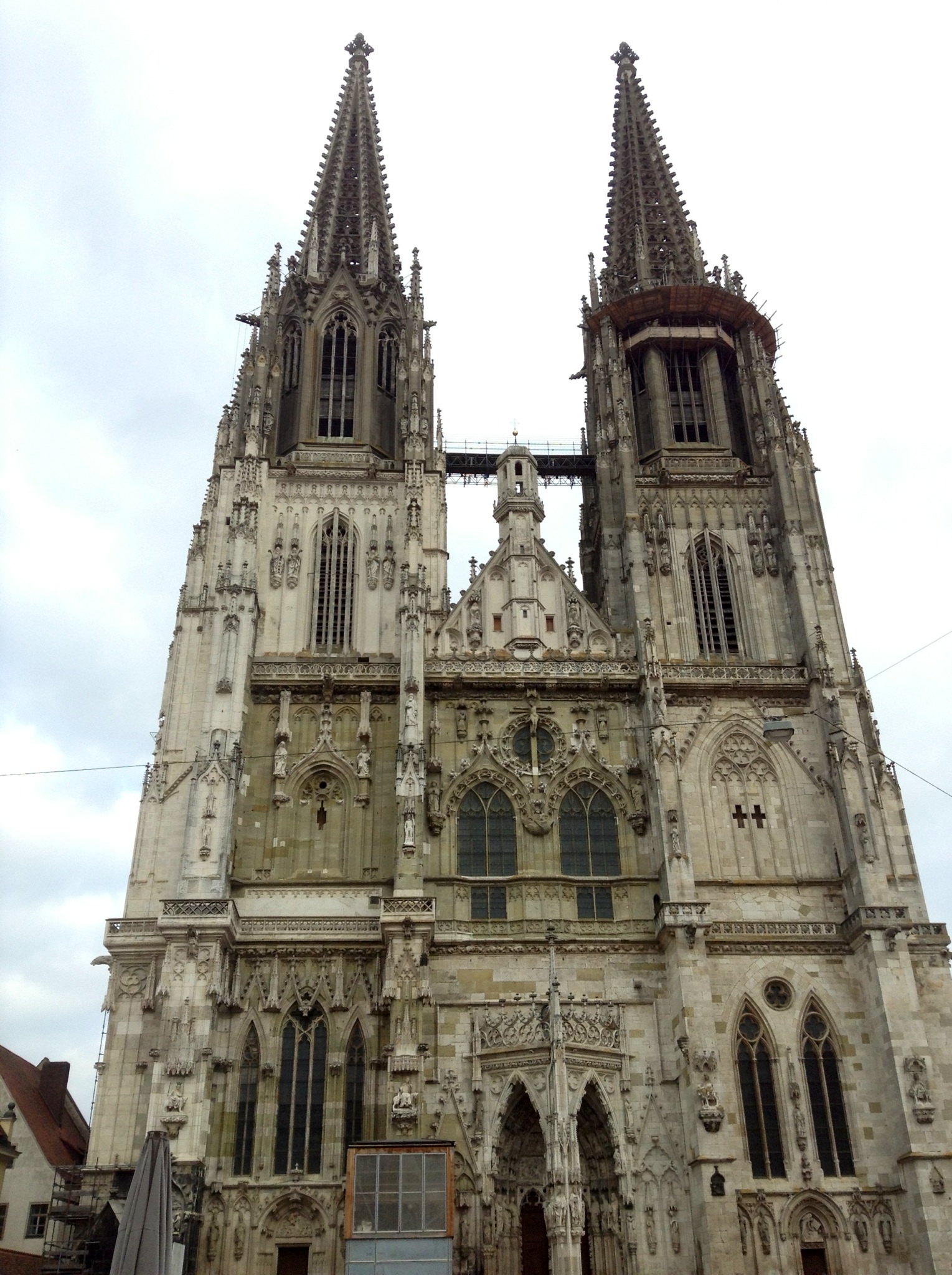
St. Peter’s Cathedral in the Altstadt, Regensburg, Germany
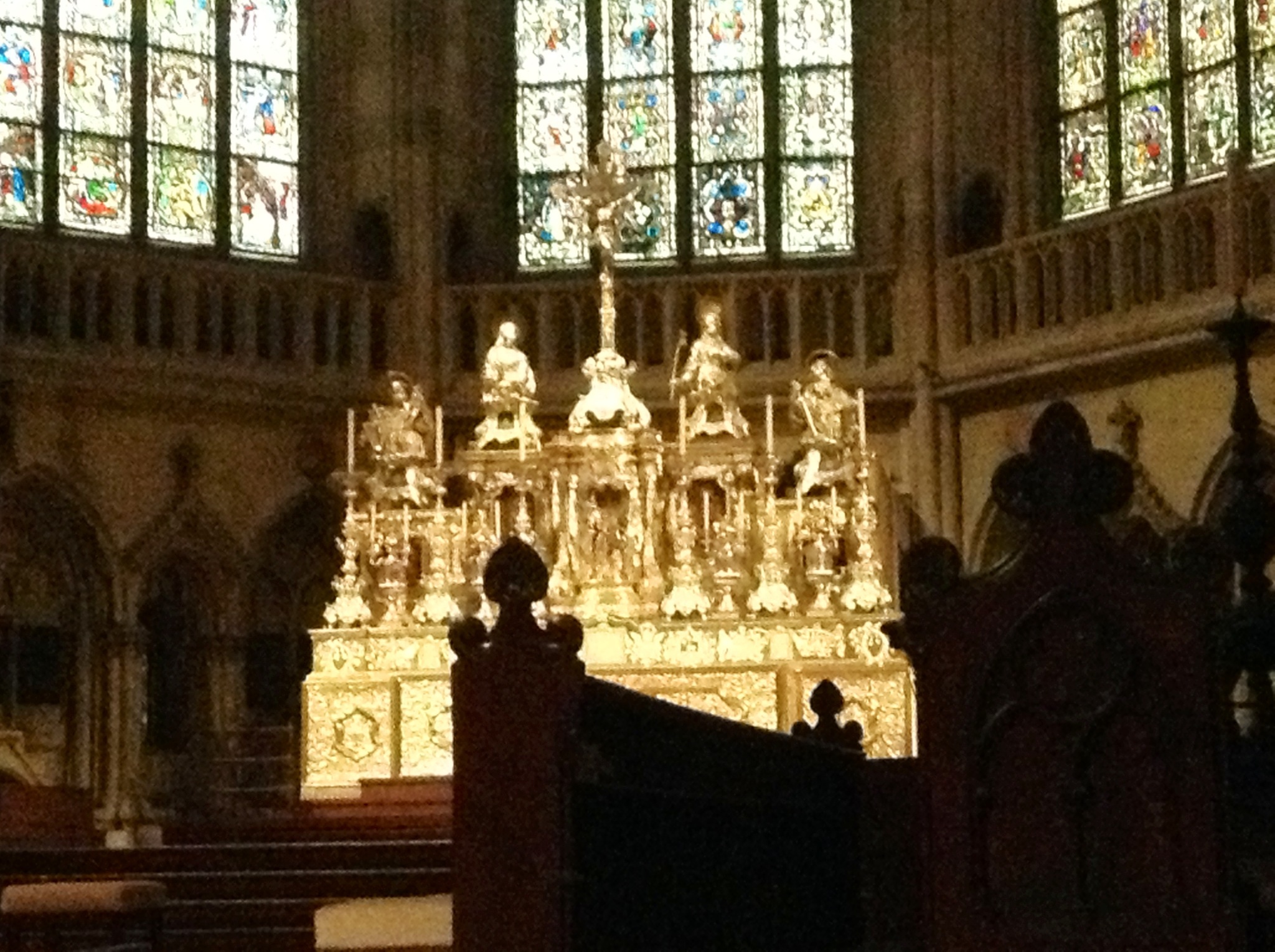
St. Peter’s Cathedral Altar & Stained Glass Windows, Regensburg, Germany

St. Peter’s Cathedral Entry, Regensburg, Germany
Lost in Rothenburg
Rothenburg ob der Tauber is one of Europe’s most loved medieval walled cities. Spared during World War II due to its historic value, the city is picture postcard perfect. German looking turrets rise above the high wall. Walking along the wall, it is easy to get lost in time and place, thinking of soldiers in armor running into place on the wall, peering through the slits in the wall, ready to shoot arrows at an approaching enemy. The cobblestone streets of the city are bounded by pastel half-timbered buildings. They run in every direction for block after block. Each view is better than the one before. Dated, many of the buildings sport 1300 signs. Many earlier. Walls are painted with imagery here and there and wrought iron black and gold signs hang from brackets on buildings to indicate businesses within. It is easy to get lost looking at German antiques and products sold within. An amazing Christmas store sold wood carved German style Christmas decorations, some room size and costing in the thousands of dollars.
Rothenburg’s Lutheran Churches are beautiful. St. Jakob’s contains one of the finest wood carved altars in Christendom. From ancient times, this church contained one of Catholicism’s greatest relics–a vial said to contain a drop of Jesus’ blood shed on the cross. It is still in the now Lutheran Church, on the altar. It is easy to get lost in thought meditating on the scene of Jesus carved into the altar.
But getting lost was our friend Rhonda’s sweater. We went from place to place where we had visited, looking in vain for that sweater. After some time retracing steps, Rhonda said we should just stop looking. I could tell from the look on her face that something was wrong. Upon further questioning, Rhonda admitted that she had just looked in her shopping bag and discovered her sweater–it was never lost, just forgotten. WEG

Rothenburg City Gate

Typical Rothenburg Buildings
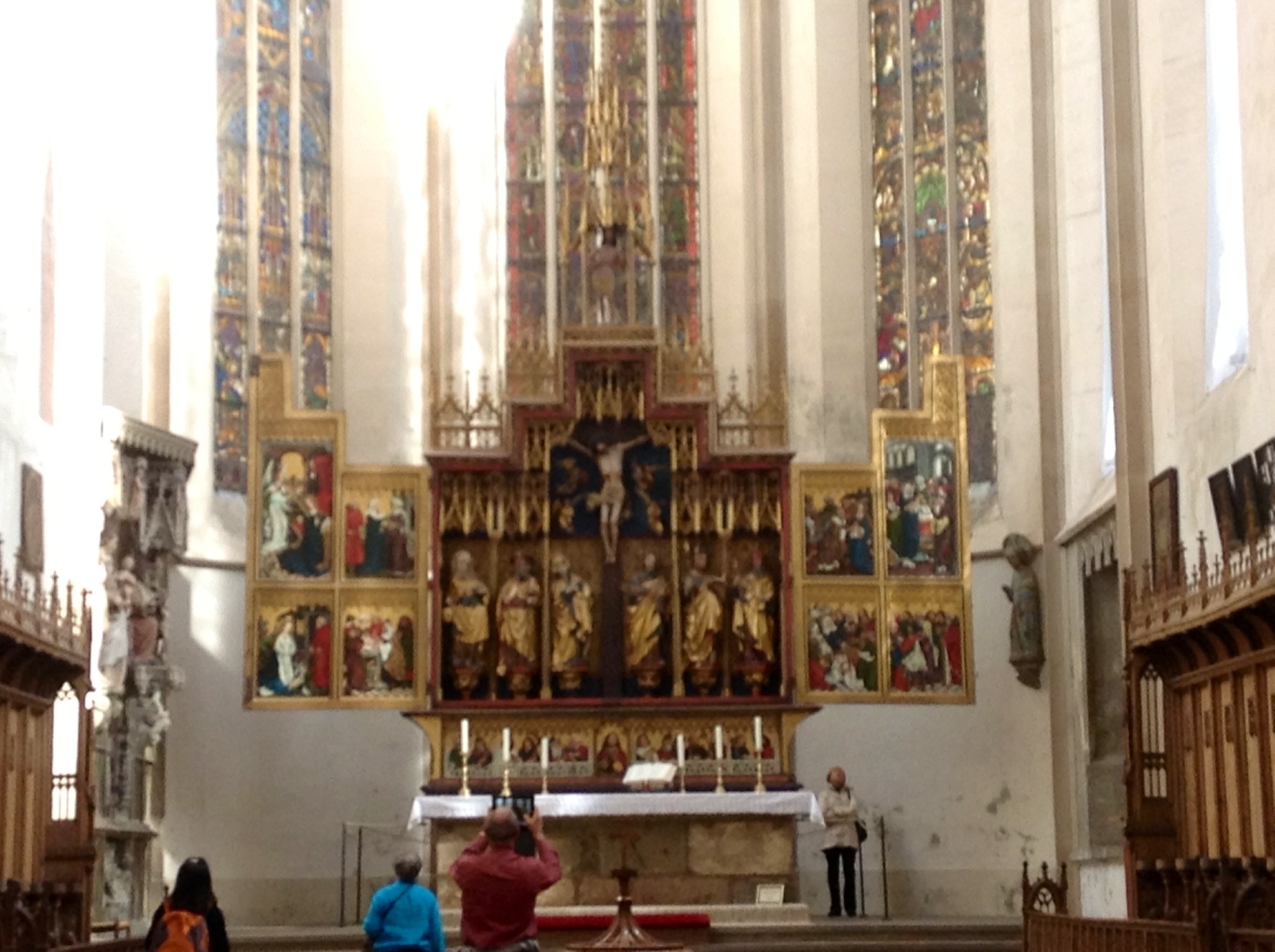
St. Jakob’s Lutheran Church Wood Altar with the Sacred Blood
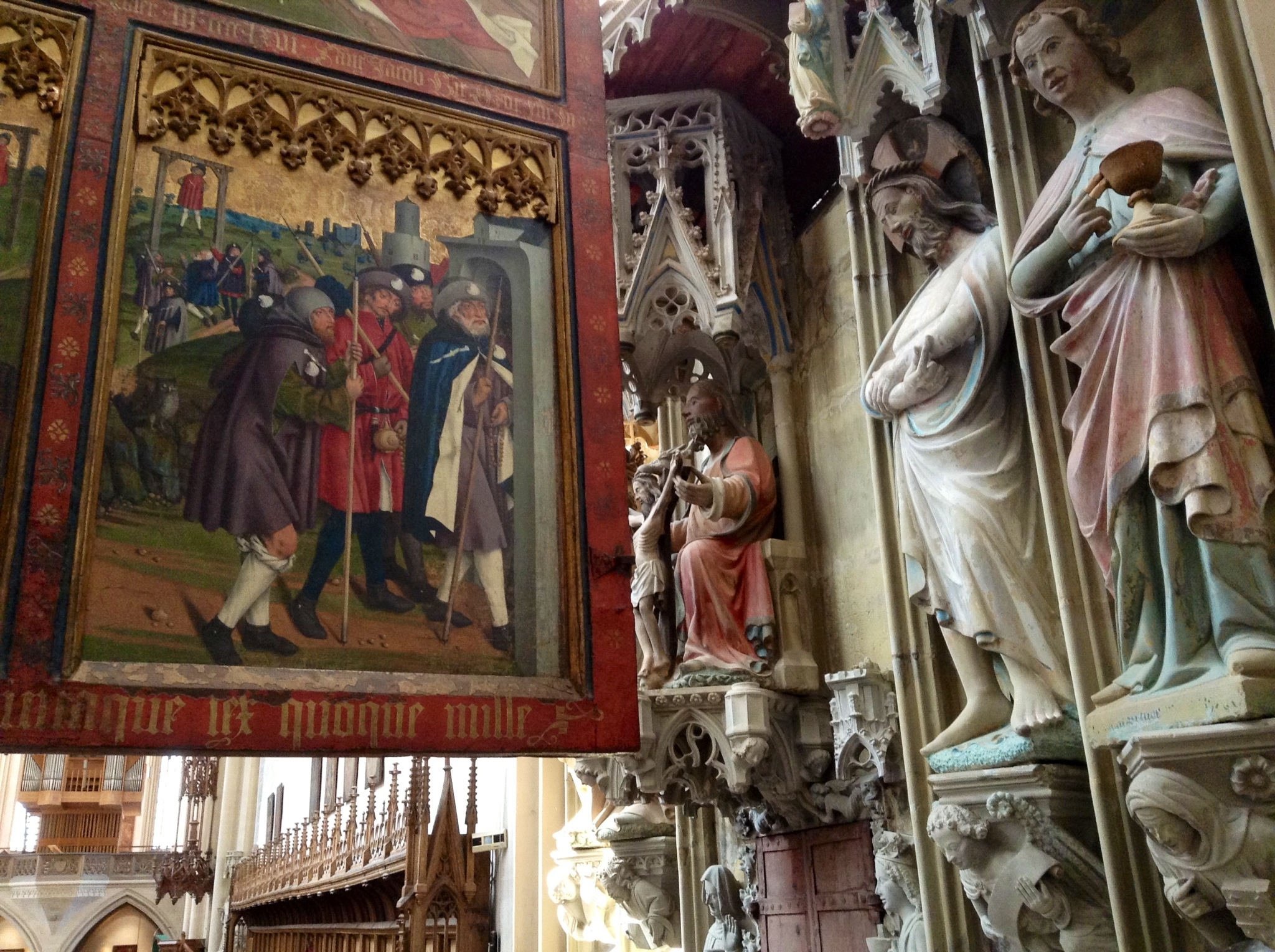
Beautiful art in St. Jakob’s Lutheran Church, Rothenburg
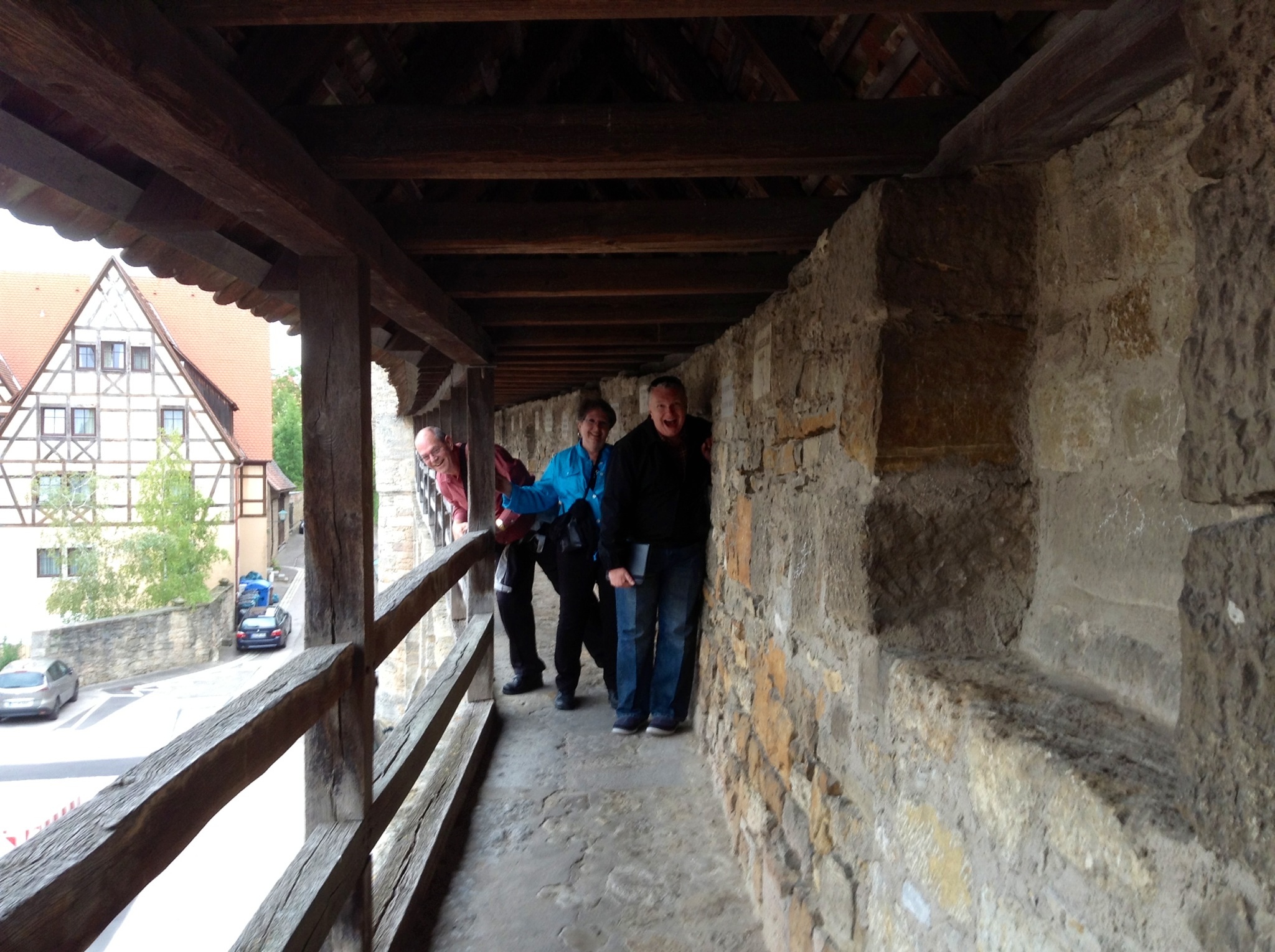
Walking the Wall in Rothenburg
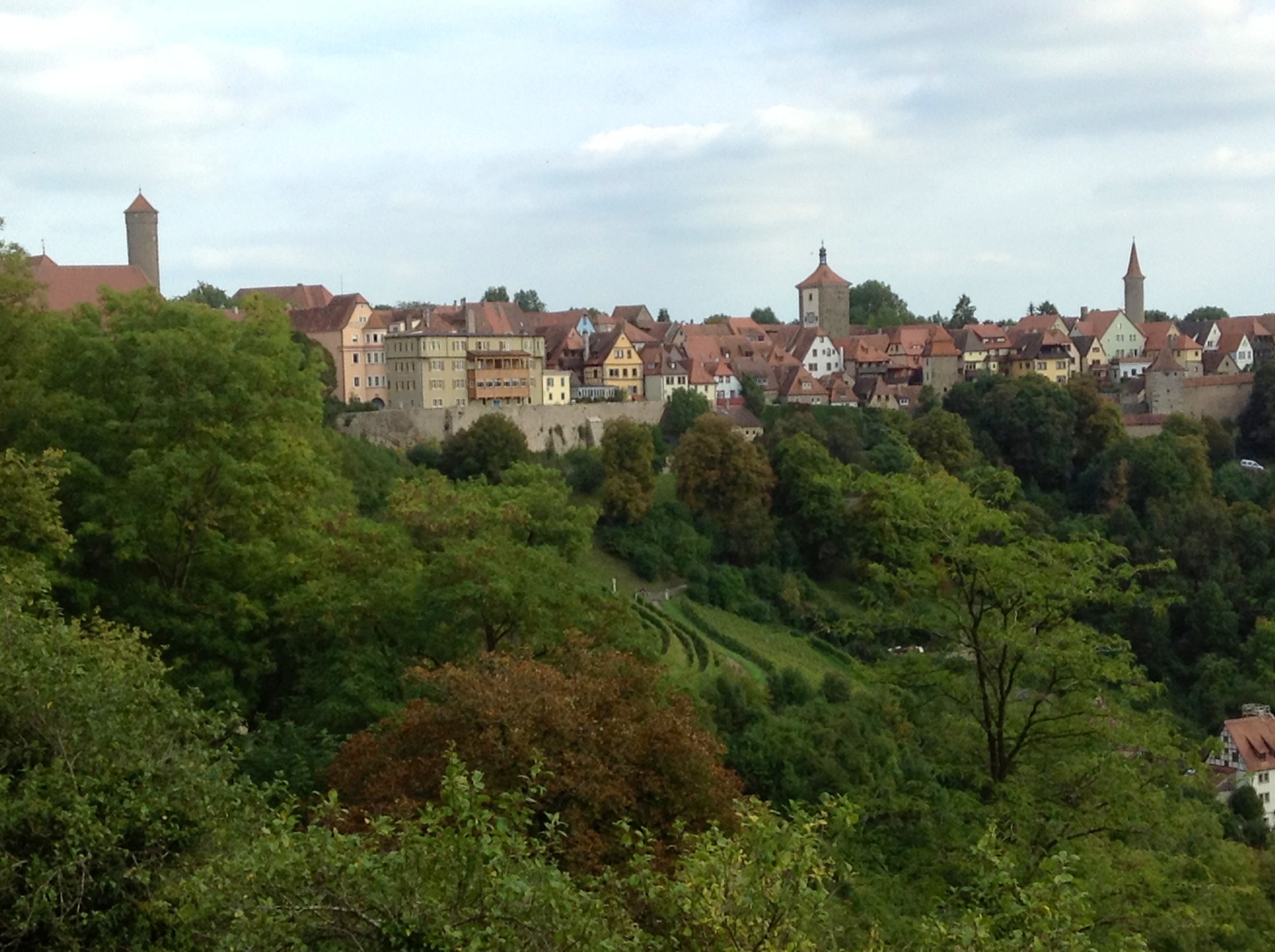
A view from one vantage point in Rothenburg on the wall across the valley to another
Fall Festival Time
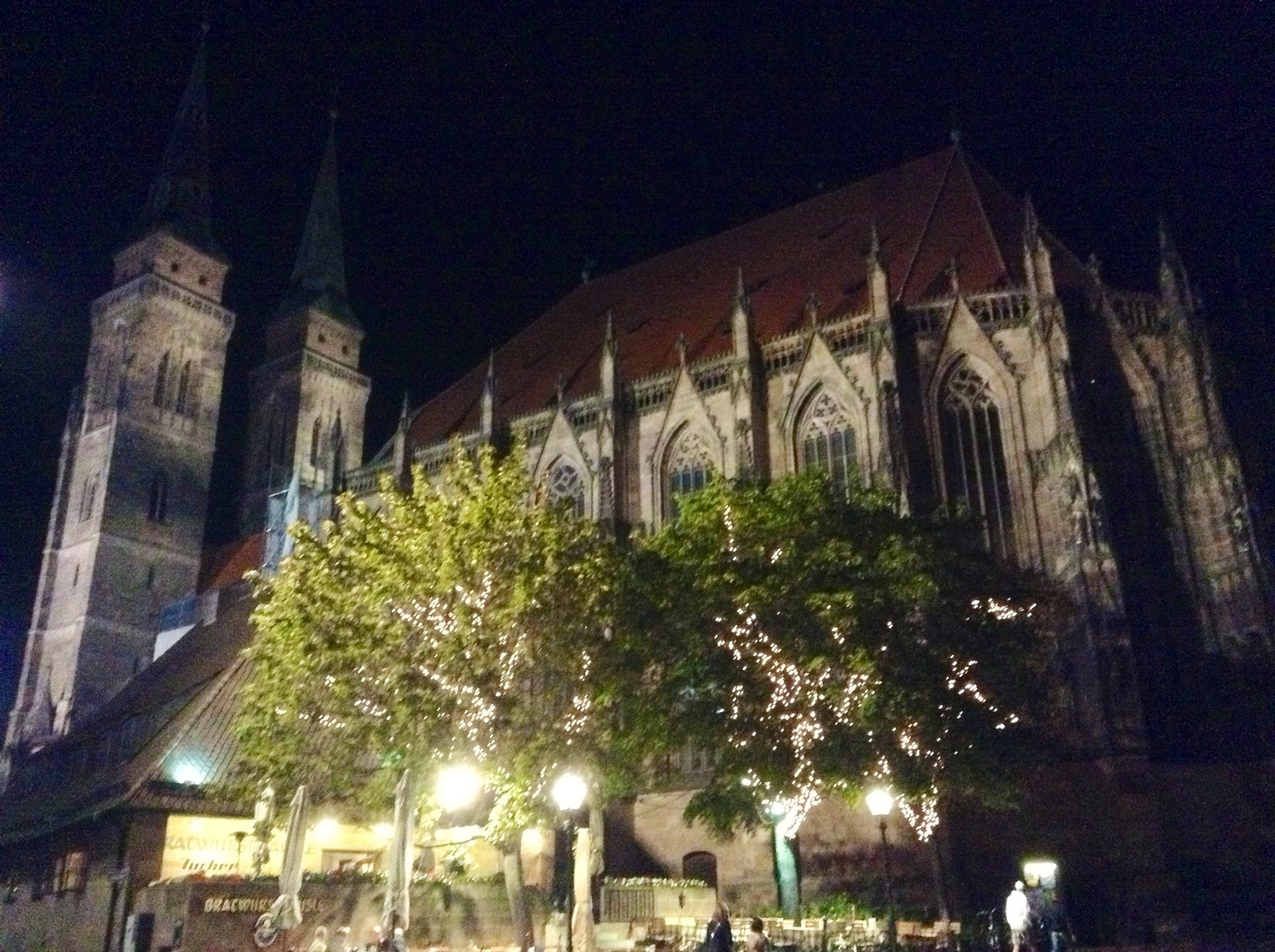
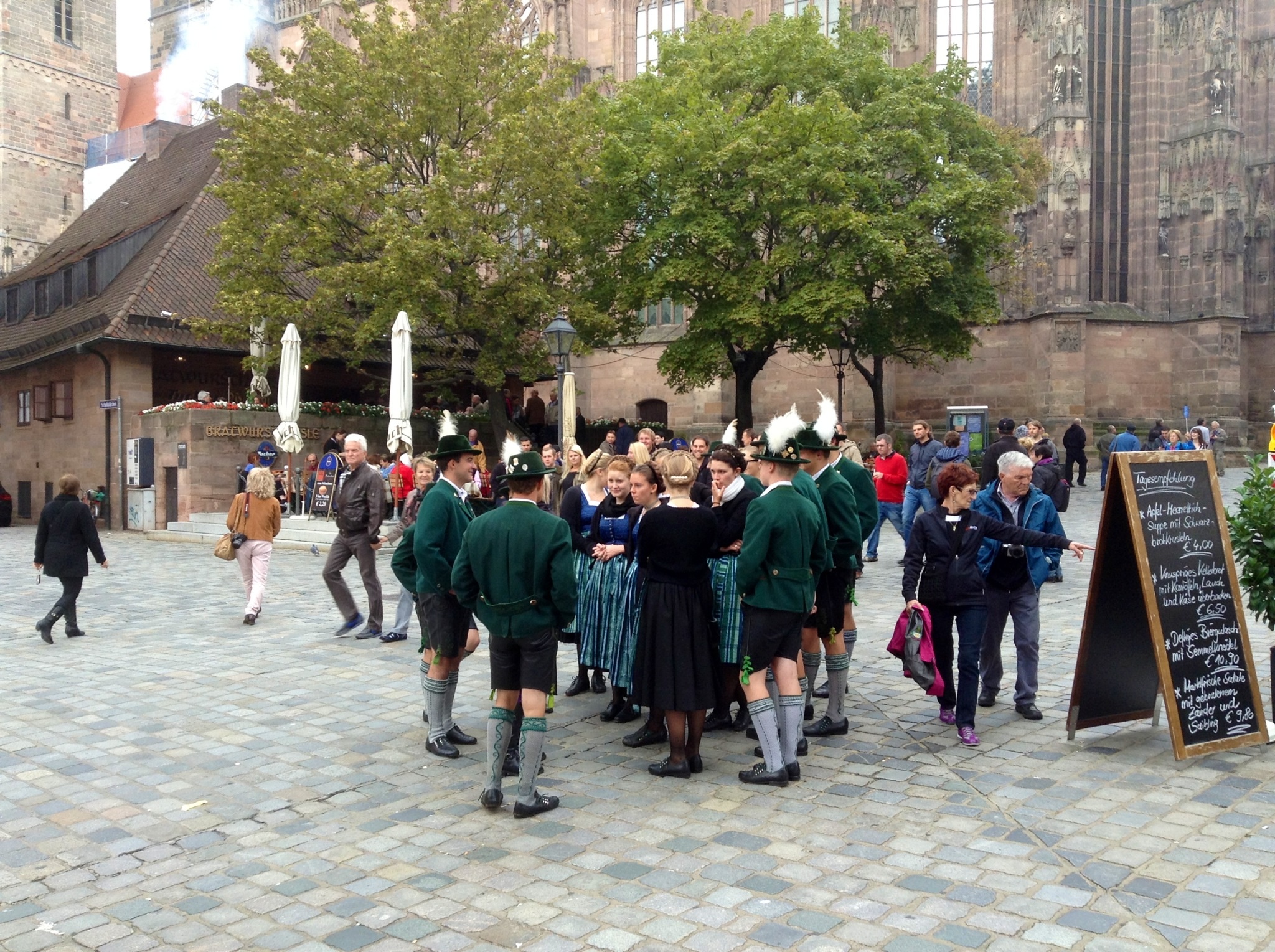
Kathy and I are sitting in a Nuremberg Old Town square as music fills the air. It has filled the air all day. In the morning we visited the magnificent and art-filled St. Lorenz Lutheran Church, Nuremberg’s main church. As we viewed its famous tabernacle, a 62 foot tall work of stone cutter’s art, an orchestra was rehearsing. Heavenly is the best way to describe the experience. We also saw the St. Sebald Lutheran Church, the city’s next major church, another huge and art-filled place. Nuremberg was the first imperial city to convert to Lutheranism in the early 1500s.
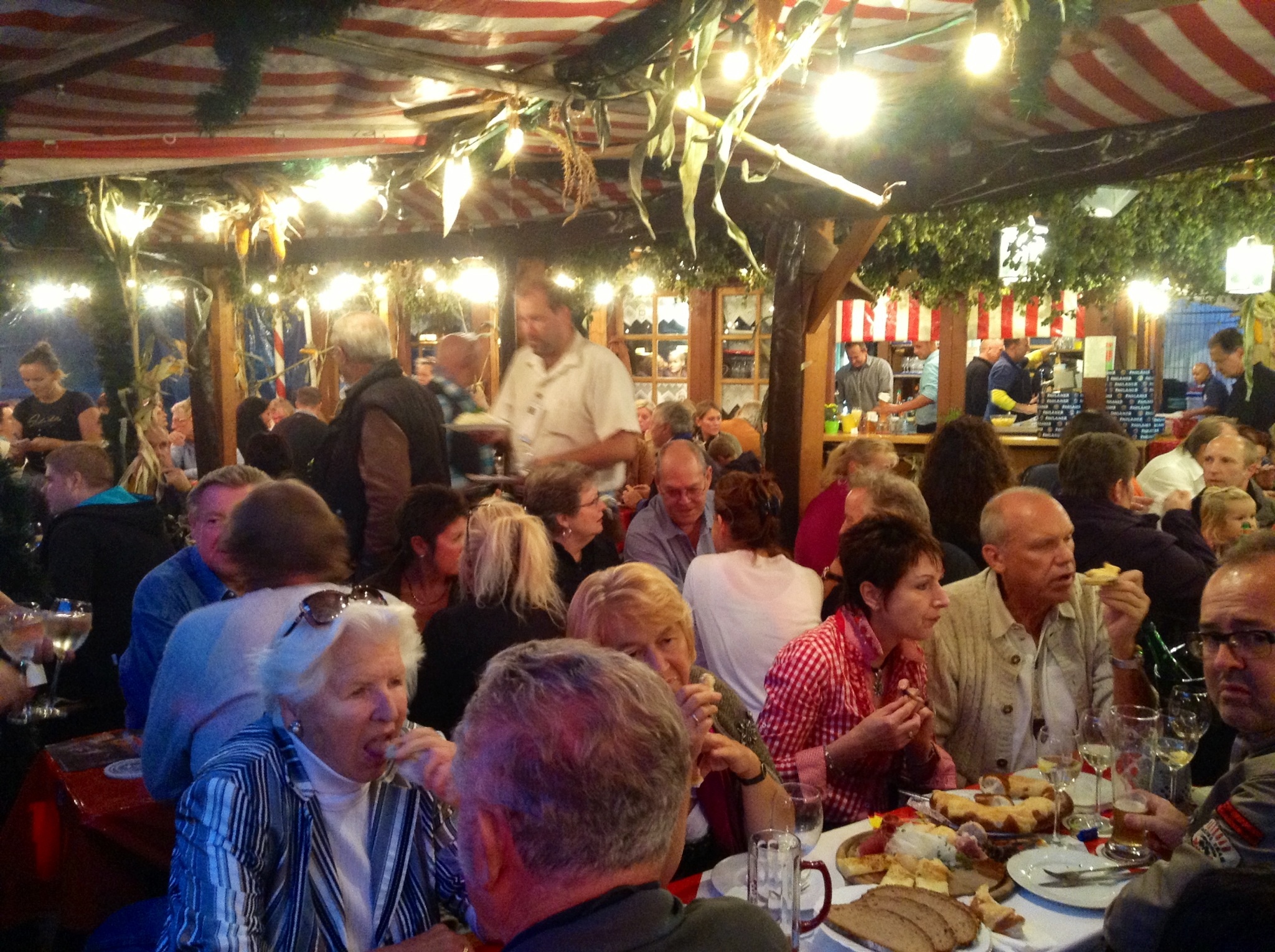
The city’s Altstadfest is in full swing. Music stages fill the squares and each of the over 300 beer and food huts–I can’t think of a better way to describe them–they are portable, but built of wood, and they have full kitchens churning out delicious food that features pork in some fashion on the menus–also have some kind of music, from German oompa to jazz and swing. Because of the crowded conditions, the Krahn’s ate with a couple from the Netherlands, and we ate with a couple from Germany–great international relations and interesting conversations. We have loved our time in Nuremberg and were fortunate our visit coincided with the Altstadfest.
PS–We have liked, many times over, the Lebkuchen and Hefeweizen, area specialities. WEG
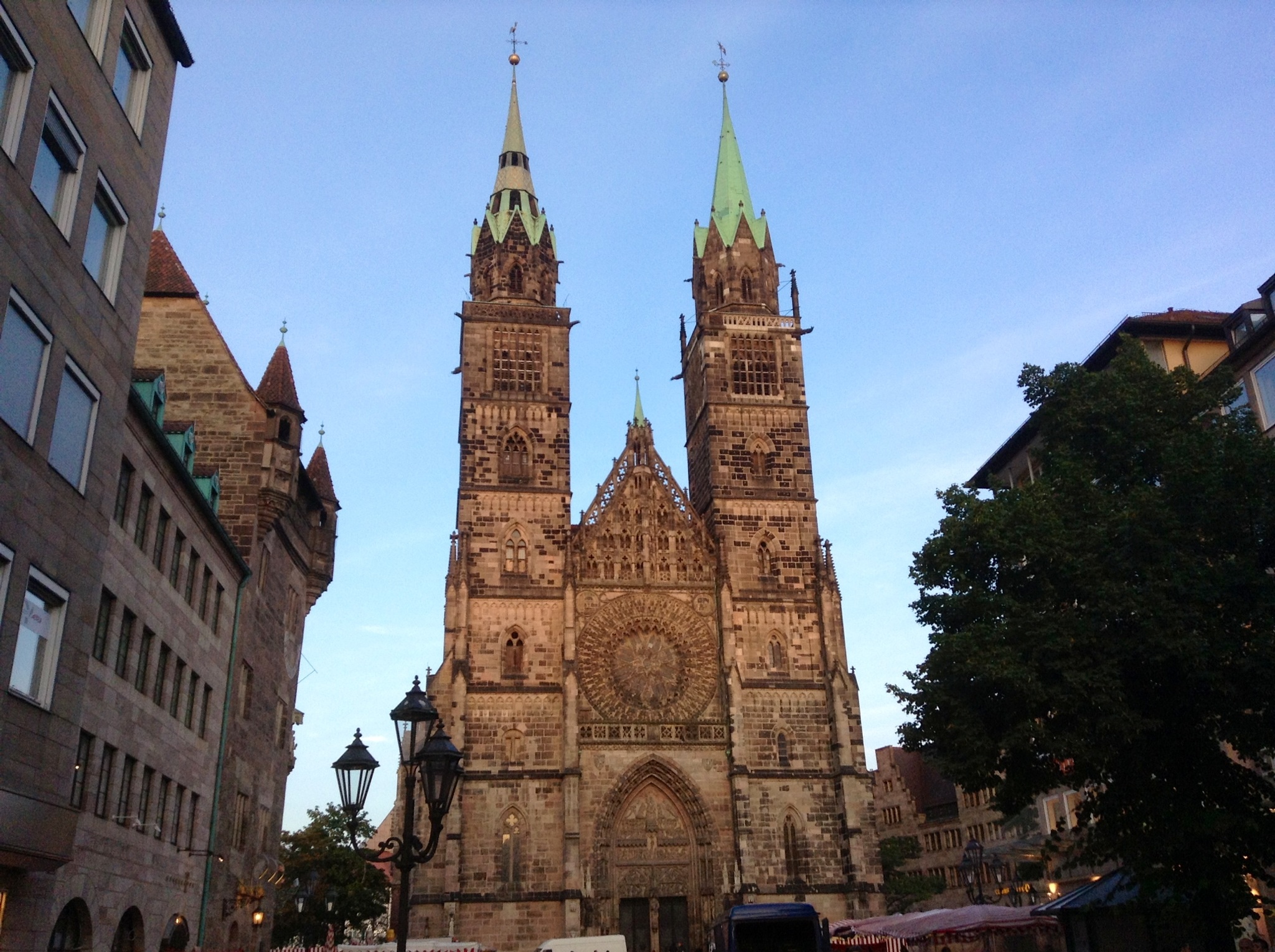
A Dark Past
Nuremberg, Germany, is a delightful and beautiful city. Its ancient past was glorious as it saw the construction of stately buildings surrounded by a mighty wall with strong towers. It was host to successive emperors of the Holy Roman Empire as the unofficial Capitol of the empire. Walking its streets one has the feeling of a place confident about itself.
It is hard to believe that just 70 years ago, Nuremberg was the stage for the rise of the National Socialist Party (Nazis) who, under Hitler, brought the world to a horrendous war that laid the city and German nation in ruins. Hitler loved Nuremberg, and because of his grandiose vision of a super state for superior humans, wanted to recreate in Nuremberg the ancient political importance of the city in the world. Here he envisioned buildings of such magnitude that they would last for thousands of years. The Nazi Rally Grounds was the scene of massive–in the hundreds of thousands–gatherings of the political faithful. Construction began on the master planned political site just outside the city. The war left only parts of the site standing. The partially completed Congress Hall is the only major building of the Nazi building program that remains in Germany. Its impressive size gives a clue as to Hitler’s plans. It is also a reminder of the horrors that Hitler visited upon the world.
It is interesting to note that the Documentation Center at the Rally Grounds stresses the point that Hitler did everything possible to point people to himself. All the buildings were planned so that the architecture itself served to elevate Hitler. All seats were planned to turn all bodies toward the place from where Hitler would speak; all staging was constructed to draw attention to Hitler; all lighting was planned to give Hitler prominence, and all major gatherings were orchestrated so that Hitler would appear at the most strategic moment. It was also stressed that the individual was diminished and, in its place, a united community of politically faithful were elevated.
Today, Nuremberg lives with its past in such a way as to not hide it, but use it as a teaching lesson for the future. Its ancient buildings are reconstructed, and the city, known as the most German of German cities, embraces what is best of the past. WEG
Living History
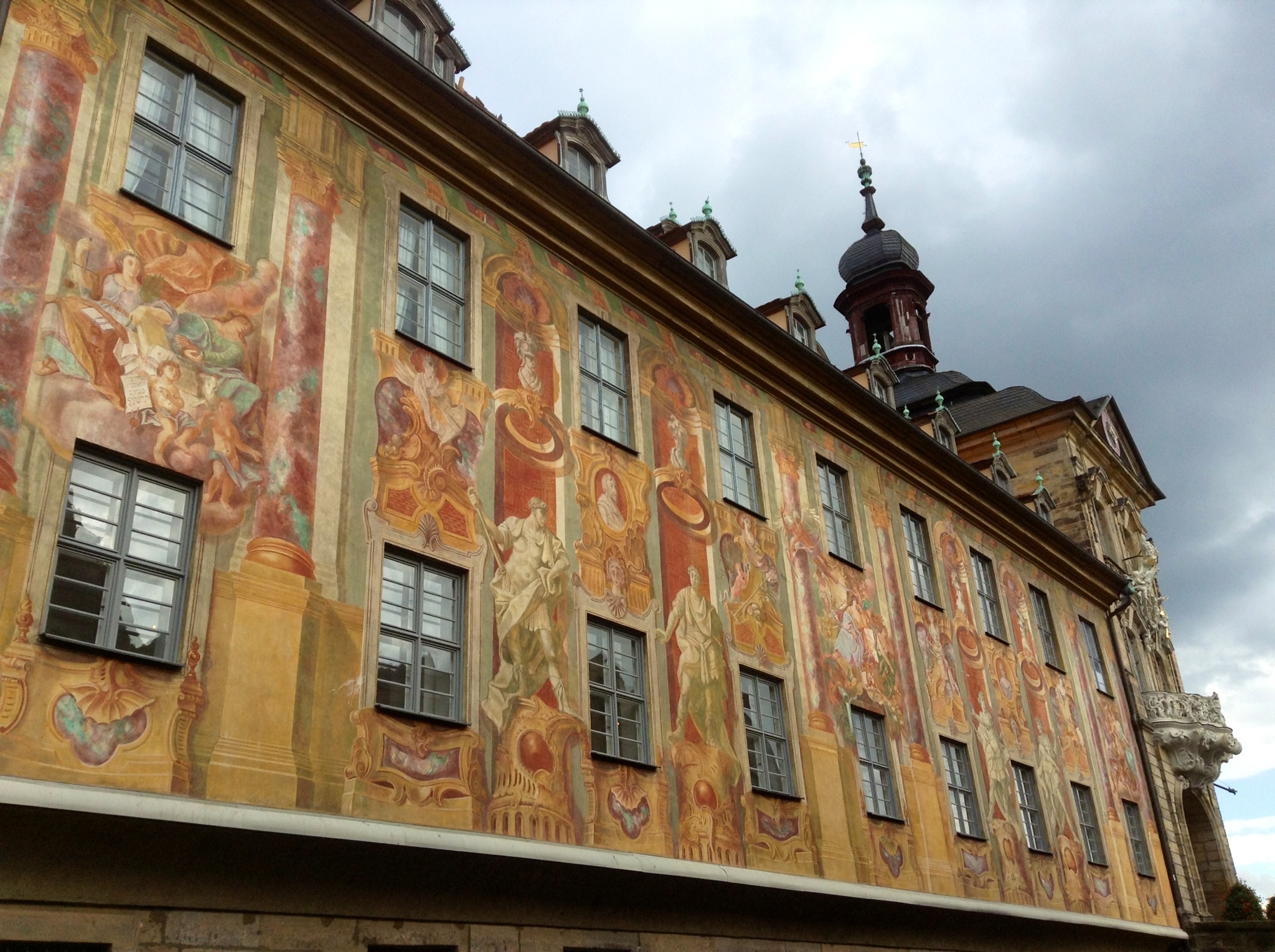
The mystique of Europe for many is the ability to experience the history of the past while walking among ancient buildings and visiting ancient sites. That was our day today in well-preserved Bamberg, Germany. The cobblestone streets traverse two rivers crossed by ancient bridges. The extensive Altstadt (Old Town) contains wonderful buildings that evoke an opulent past. The Residenz (Palace) of the Elector Prince Bishop is grand in scale and rich in interior. There were seven Electors in the Holy Roman Empire who were the chief Princes of the Empire. When an emperor died, these electors met to choose the next emperor. They alone were allowed to wear ermine robes that symbolized their position. The Residenz contains a massive hall that was built to receive the Emperor should he visit. It uses the painting technique known as
trompe l’oeil which tricks the eye into seeing something that is not there. In the case of this magnificent room, the eye sees a high-tiered room, when in fact it is a rather low and flat ceiling. Really amazing.
We ate our evening meal in a thick-raftered old style restaurant in the same family since 1536. We tried and enjoyed the smoked dark beer. You could smell the smoke as you drank. The place was packed and people continued to stream in. We realized they came by bicycle or walked. Such is life in ancient German cities. WEG

Drowned Rats
It had to happen sooner or later–a rain-laden morning. And of all mornings, when we had the Wurzburg Residenz on our morning agenda. I prefer to plan relaxing days, focusing on a few wonderful sights or museums, rather than rushing through to see everything. I prefer staying in one place several days and finding a good local restaurant or brew pub in which to sit and enjoy a leisurely meal watching the local customs and world go by. I love finding a bakery and enjoying the local bread. But on this day, we had a more packed agenda–catch the early train to Wurzburg in order to get the 11am English tour of the Residenz, catch another train to Bamburg, the Unesco World Heritage City. And there was rain!
Of course, being the well-planned traveler :-), I was fully prepared: weather-proof jacket and travel umbrella for me and rain cape with hood for Kathy. Allen and Rhonda were also well-prepared, except for one big problem: they left their rain gear in the rail station lockers. Here is the truth–Allen does not prefer his rain cape–he looks like a big blue thumb when wearing it (please, do not let him know I think this)–and his rain jacket is NOT rain proof, nor is Rhonda’s rain coat–go figure. We got a taxi to the Residenz so that was ok, but after the tour, no taxis were to be found, and it was raining rather briskly. The rail station (Hauptbahnhof) was a good 20 minute walk from the Residenz. I offered my umbrella and even my weather proof jacket to no avail. The end result was that two prepared people were dry and two, um, how should I put it–well, two people were like drowned rats. Ever the gentleman, I was too gracious to rub it in.
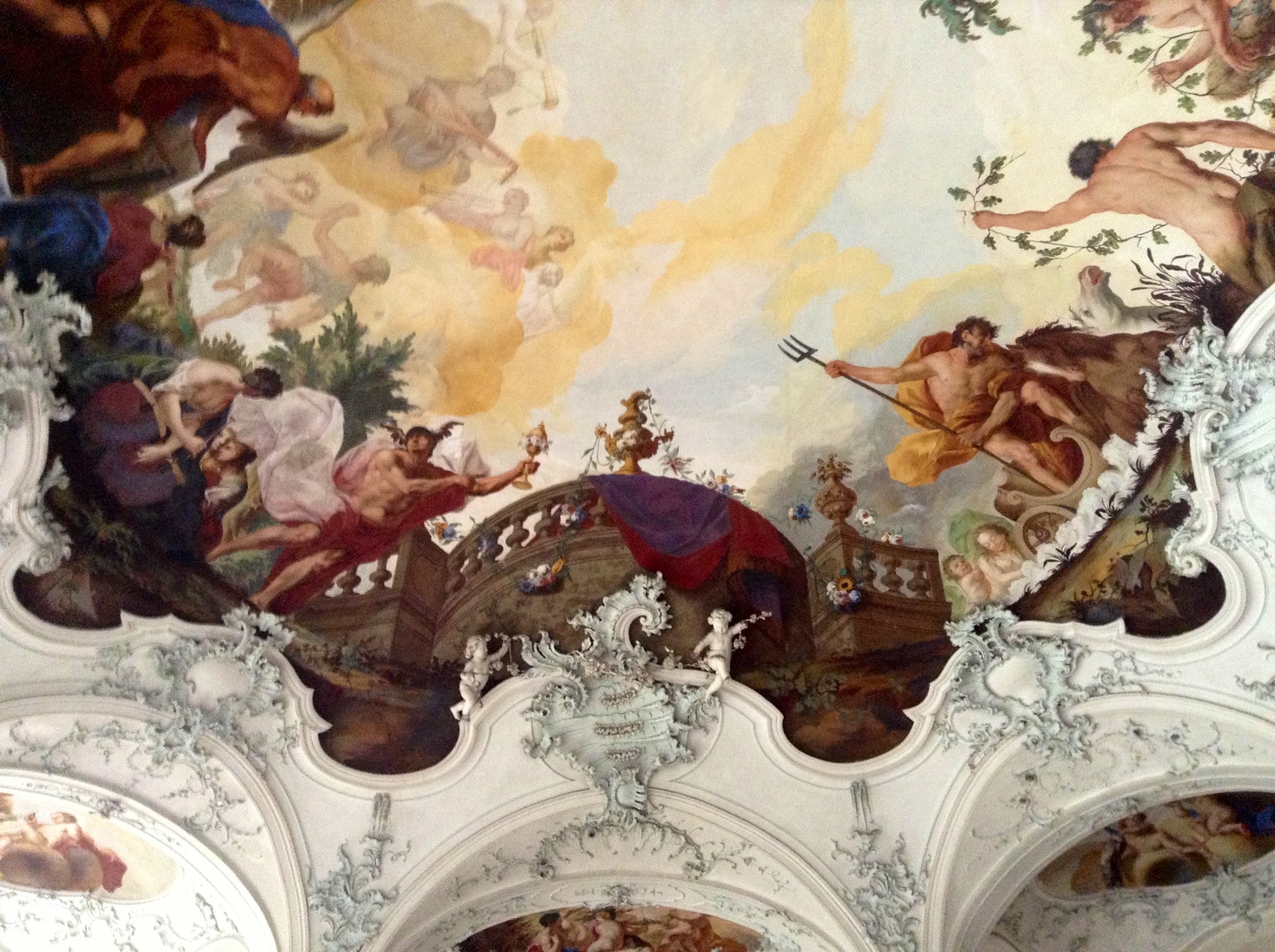
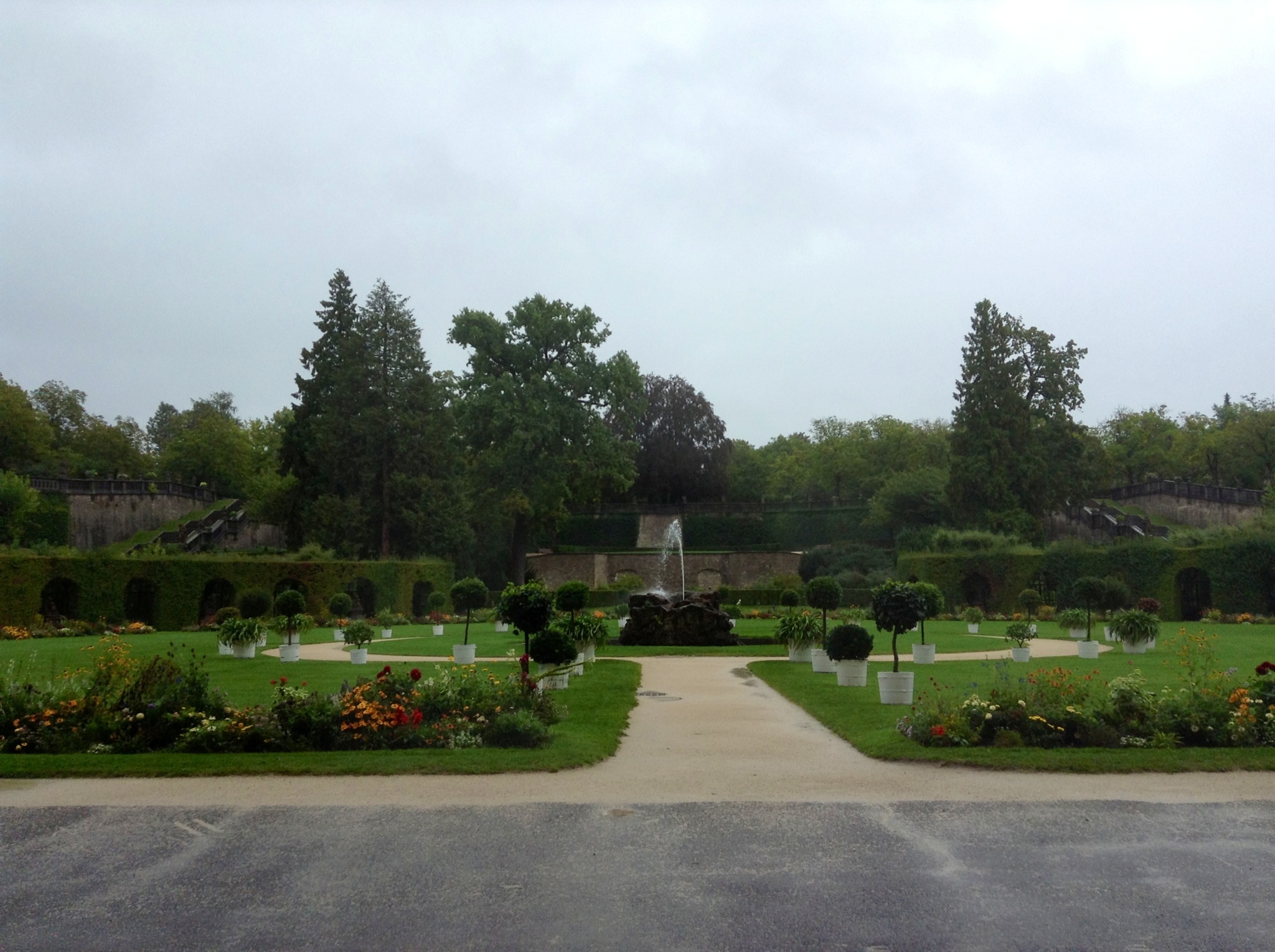
The Residenz is grand! The ancient home of the Prince Bishop (both political and spiritual ruler in one) sits majestically in Wurzburg’s Old Town. A large foyer had gates that swung open to allow room for carriages, pulled by six horses, to enter and turn indoors in order to allow their passengers to step out into opulence and to ascend the grand staircase into the palace living quarters. They were treated at the top of the stairs to the world’s largest painted ceiling, depicting life on the four known continents known at that time. The American scene included a Native American riding an alligator, something frightening to the Europeans of the 1700s. Among the 300 rooms of the palace is the Mirror Room, the most mirrors in any one room in the world–600 panes. They were gold-gilded, framed and hand painted. The room was simply stunning.
Training on to Bamburg, we entered the German state of Franconia. The dress and food are distinctive. The clothing has a more rural and yet elegant feel. The food highlights liver, as in liver dumplings and liverwurst. The traditional beer is dunkel (dark) and smoked. Eating in a crowded local establishment and sharing a table, as is common, with other restaurant guests was a wonderful way to dry out two drowned rats. WEG
The Trumpet Shall Sound
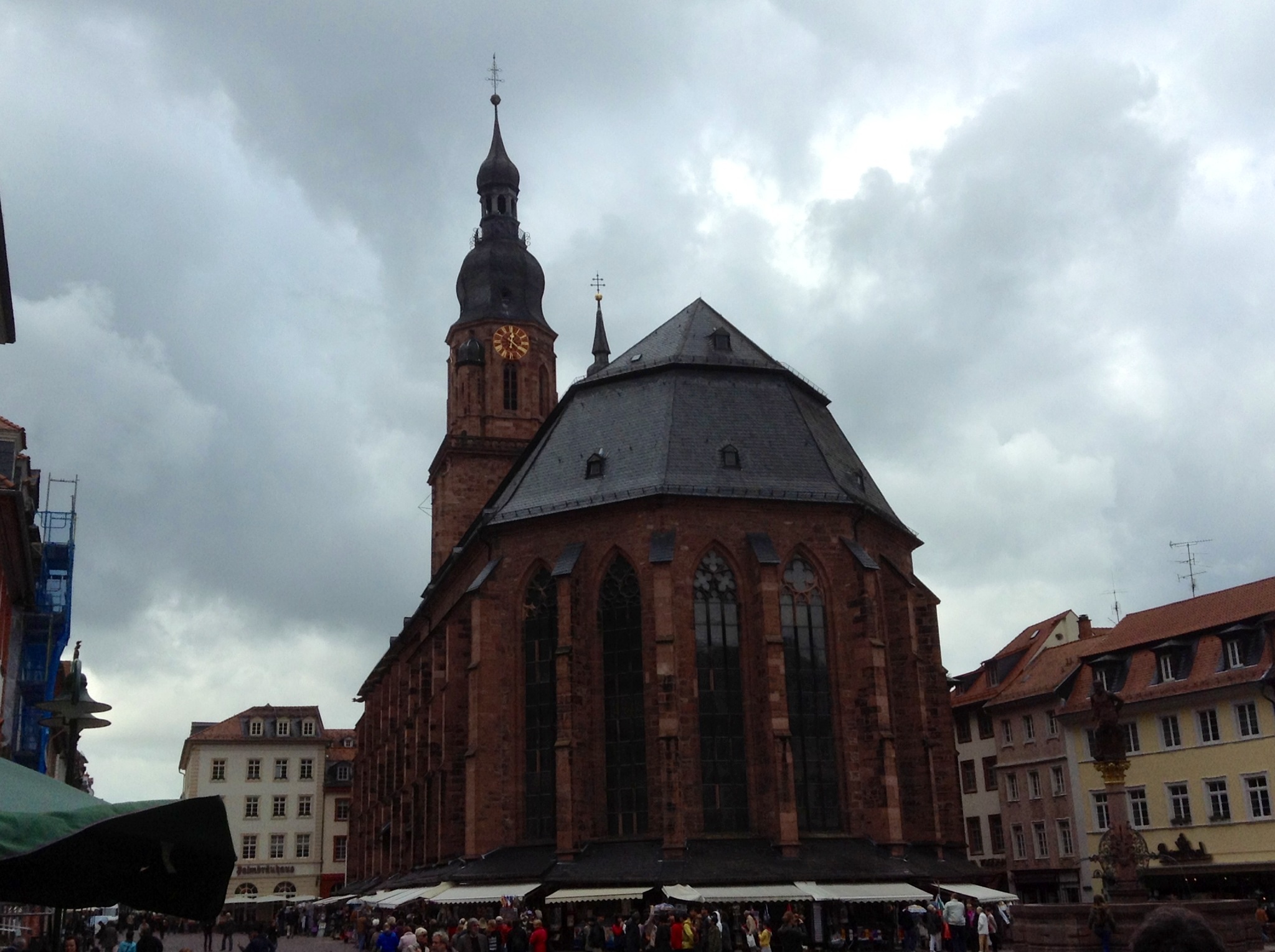
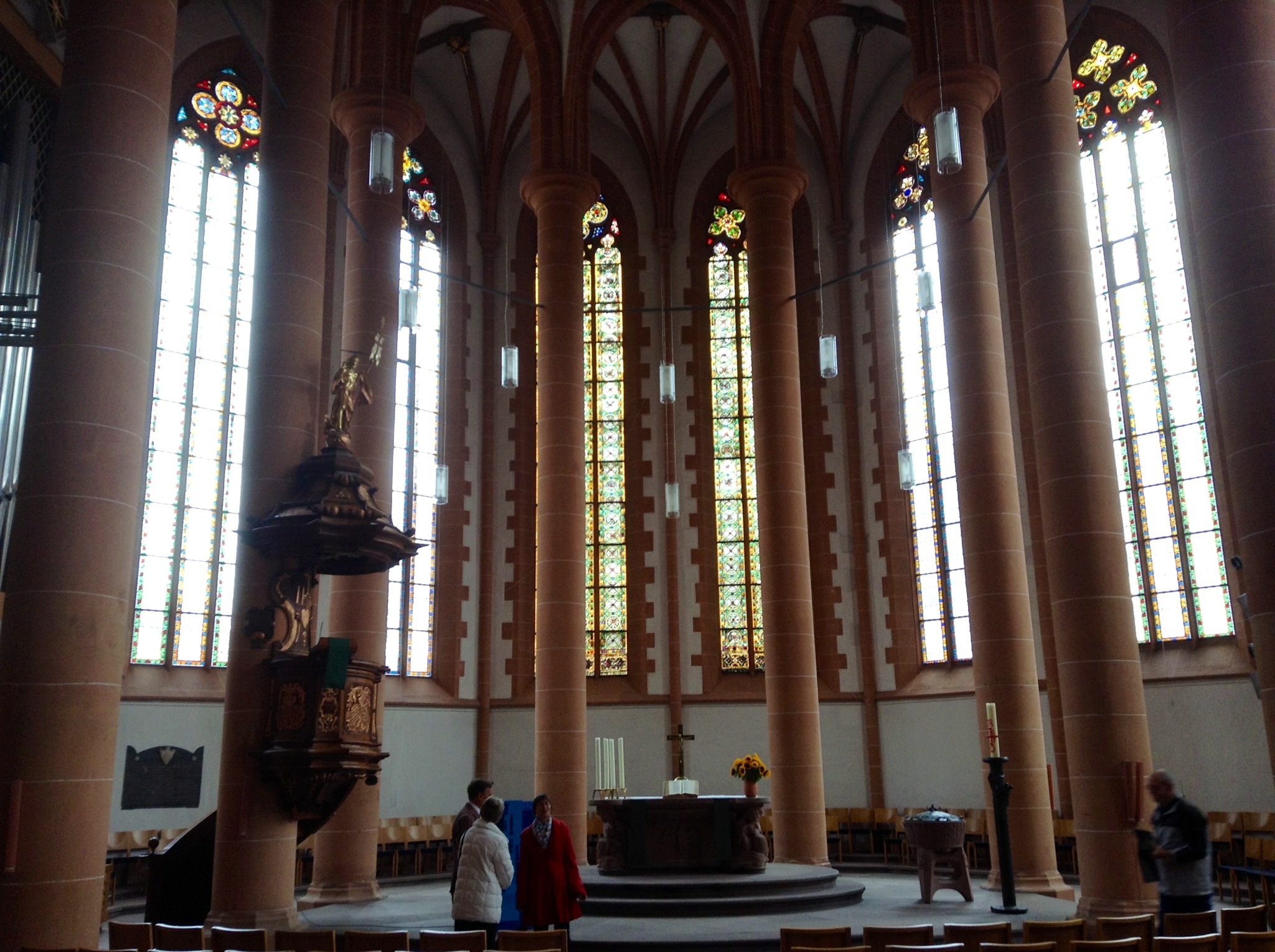
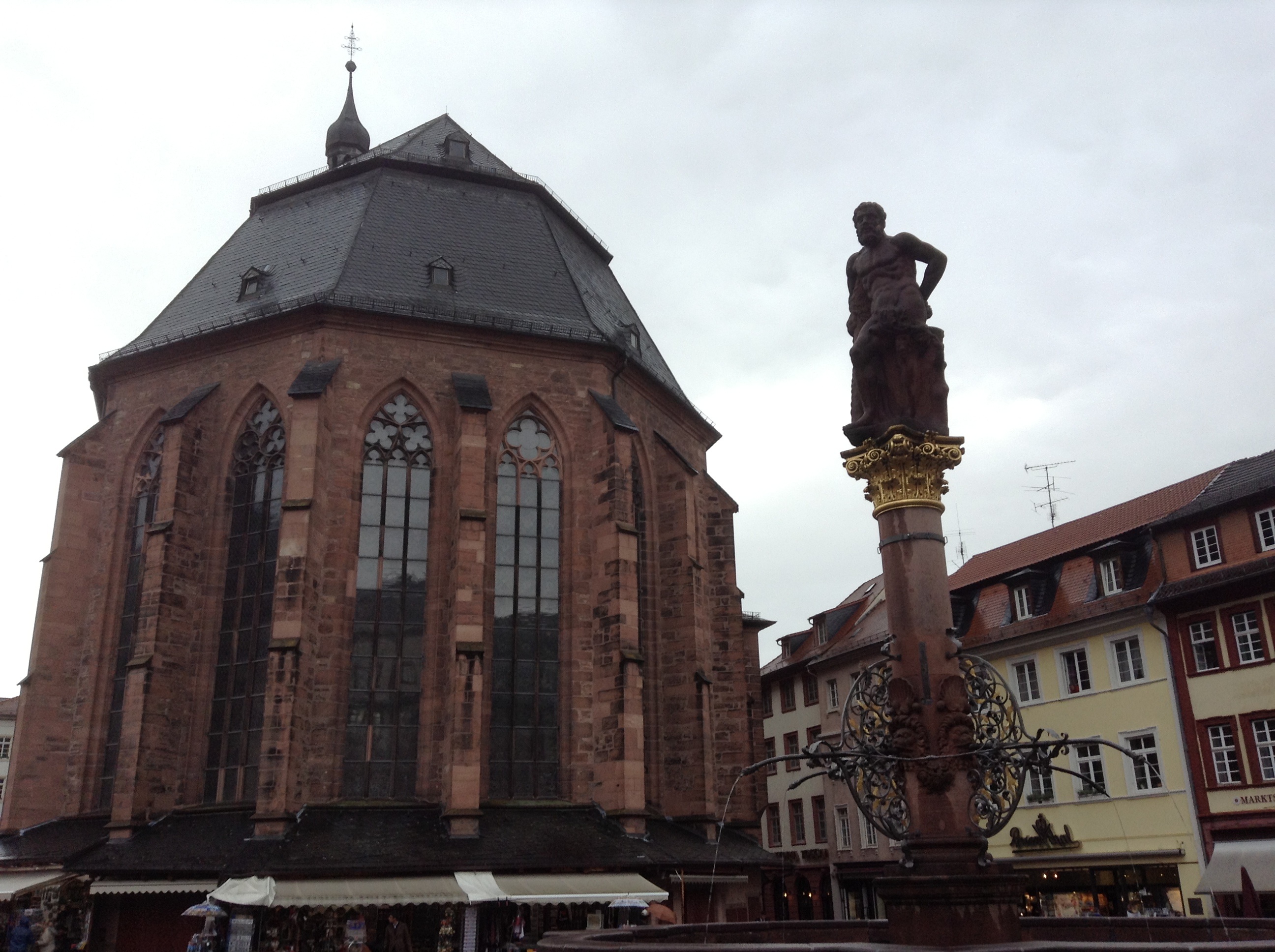
We happened into the Heileggeist (Holy Ghost) Church in Heidelberg, Germany, just in time for the noonday devotional. What a treat–organ, soloist and the finale of a trumpet playing “Amazing Grace.” While short, the service was heavenly–the music simply wafted and reverberated through the massive interior of this Lutheran Church.
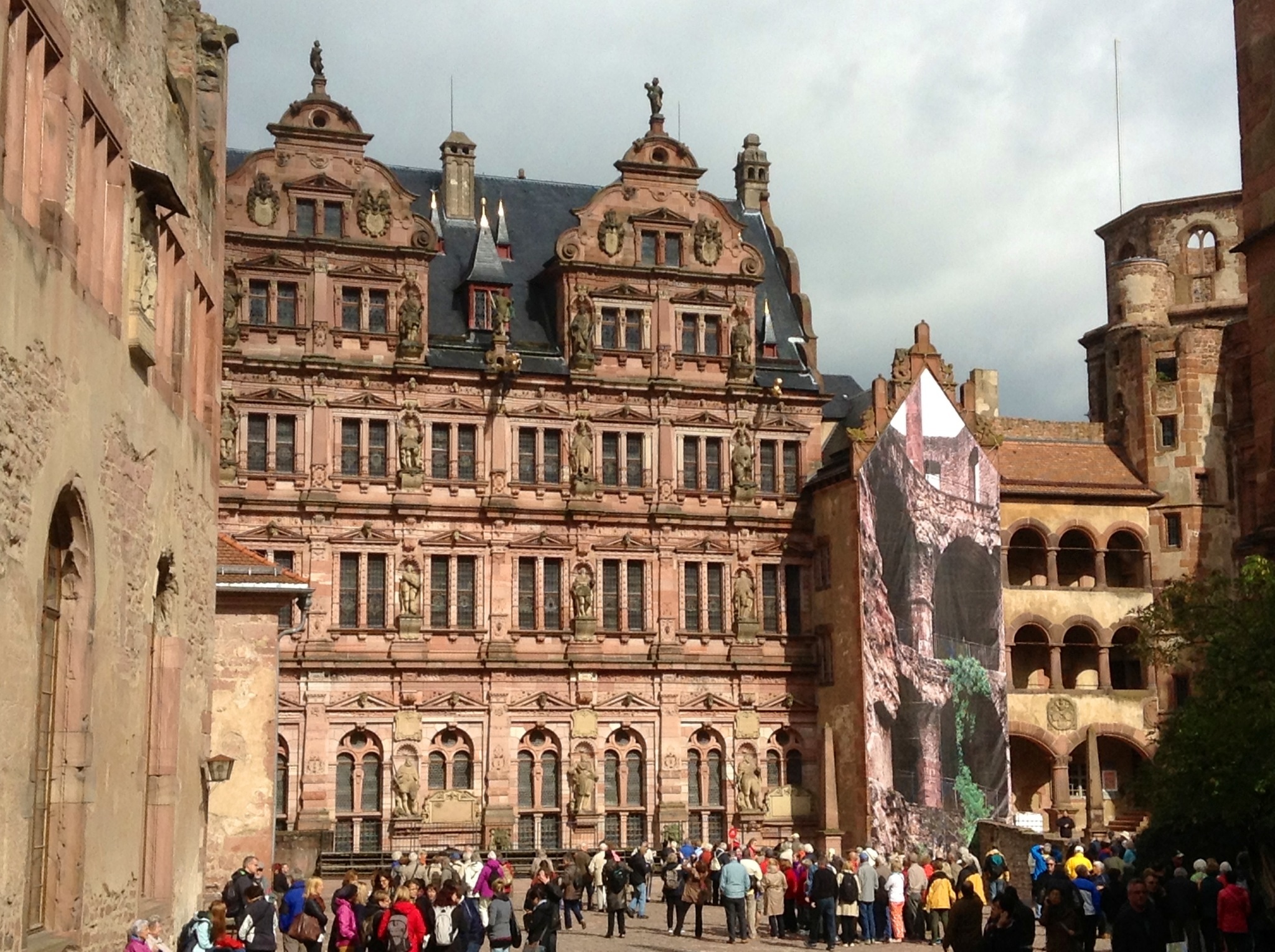
We also took the funicular up the valley hill to the imposing remains of the Prince Elector Schloss (palace) which overlooks the city. The opulence is evident still, and restoration work continues. Impressive views of the Necker Valley spread out before us. The massive stone walls of the palace are filled with statuary. We enjoyed viewing the wine cellar and a massive cask that took 130 oak trees to construct and is capable of holding 58,000 plus gallons of wine! It is the largest wine cask in the world. An ancient staircase is used to access the cask, and we crept along it to see the entire cask.
One of the joys of Germany is the food, and we once again found an authentic restaurant and ate some fantastic cabbage rolls and pumpkin soup. Fall is definitely in the air here as the trees turn more colorful by the day. Kathy and I took a stroll along the river while Allen and Rhonda walked through the Old Town and did some window shopping. WEG

The King Takes His Throne
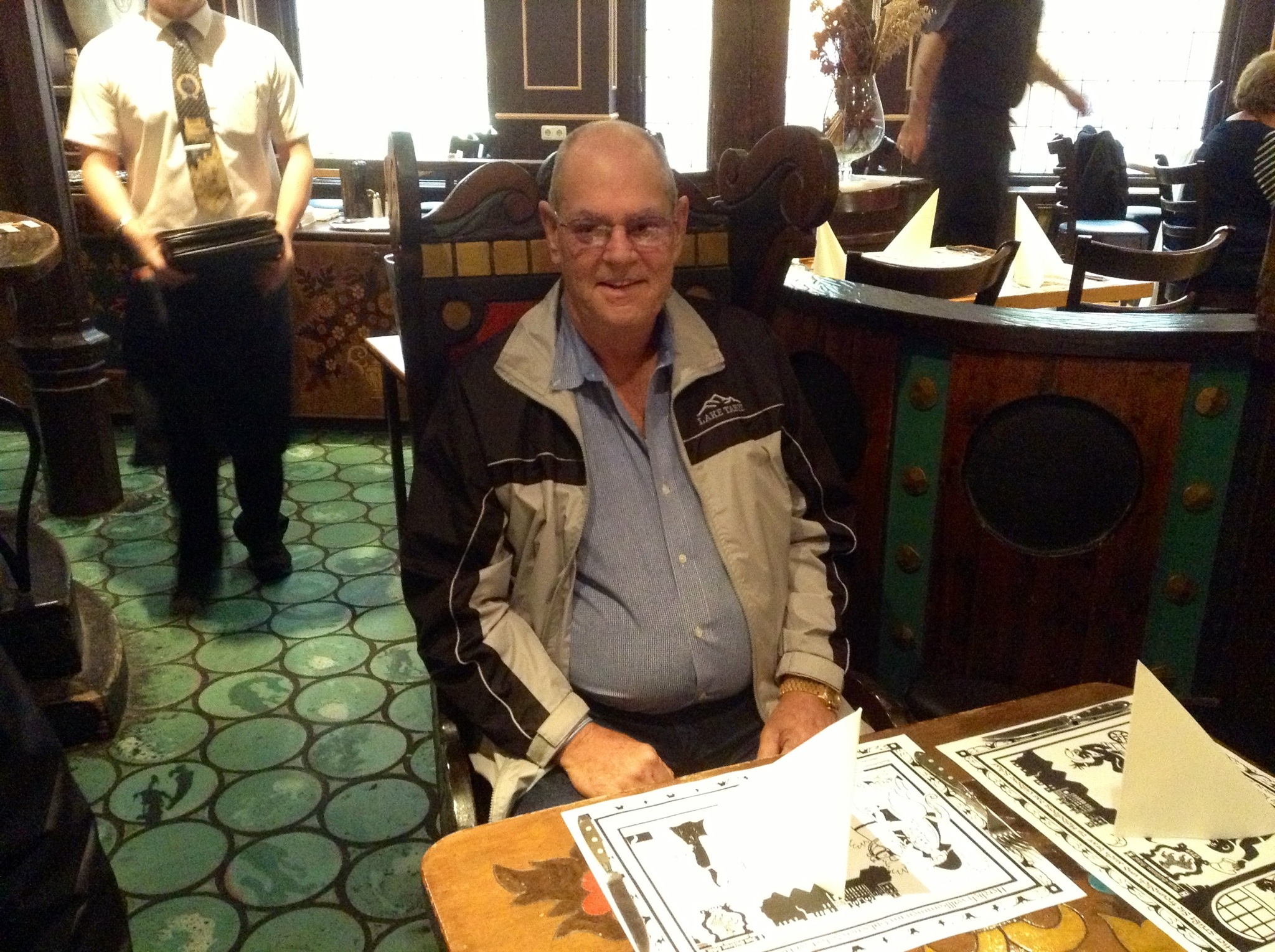
Allen finally found a chair to his liking in Heidelberg, Germany. In an authentic regional restaurant, the biergarten interior had a throne-like chair at one table, and Allen immediately claimed it as his own, declaring that “he was from royal blood” and so he deserved to sit there. Rhonda blamed his delusional thinking on high blood pressure.
We were able to see some of the Altstadt (Old Town) and visit several beautiful Lutheran churches in this university city on the Neckar River. We were able to hear the pipe organ in concert at the Heiliggeistkirche (Holy Ghost Church), a beautiful Lutheran Church. We then visited a large Christmas store with German handmade items and got into a Christmas mood. Today we also added tram to the modes of transportation our friends have experienced while on our German journey. We are having a splendid time and collecting beer coasters from all the biergartens we are visiting along the way.
Oh, and, by the way, we had to pry Allen out of his throne chair. “I am a King,” he cried, as we led him out the door. WEG

 kgraumann
 wgraumann
 gofarther.me