
Home » Adventure (Page 4)
Category Archives: Adventure
Up and Away
Almost immediately after we left Munich for Austria via train we began an upward ascent. It took some doing, however. Germany closed its border both from and to Austria due to the crisis of refugee/immigrants, which the European media is now reporting is less than 20% from Syria’s war-torn provinces and mostly people (young men) seeking better opportunity in the west, meaning northern Europe and mainly Germany. Our train was cancelled, and after standing in an information line in the Hauptbahnhof (main or central train station) for awhile, we were reassigned a new route which could get us into Austria. The rub was that now we had to make four transfers and add another five hours to our travel. At least we were able to use our original tickets “no questions asked” even if we were now on different trains and times than the original tickets stated. So off to the new train we went, and soon found that all the first class seats were pre-reserved (we had reserved seats on our original schedule which did not work on the new train) and the tourist class was standing room only. Kathy noticed that the train had a dining car and immediately went for a table. We stuffed our luggage behind our seats and sat down to a linen covered table with comfortable chairs and ordered breakfast as the train began an ascent into the German highlands. No room in first class soon meant nothing.
Upward and upward we went as our trains eventually took us into the Austrian Tyrol. Amazing sights unfolded before our eyes: mountains of raw timber covering acre upon acre ready for some application to industry or home use; tidy farms with cattle grazing on the hillside–how do those cattle seem to stand so effortlessly on such steep hills; corn fields almost ready for harvest; bright yellow fields with some crop of which I have yet to discover the name; neatly stacked cords of wood by barns and homes ready for winter fires; dark thick forests extending into the horizon; mountain lakes with cozy villages with tall-steepled or onion-domed churches, usually white or yellow, nudging against the waters. Gradually, as we ascended higher and higher, the steep green hills and farms disappeared and the forests receded, roof pitches on buildings became steeper and jagged mountain peaks appeared. We had moved into the high mountain Tyrol, and it was awesome!
Both sides of the train held extraordinary views. I was almost dizzy from going back and forth. Then, amidst all that beauty, came something even more beautiful. On our car was a pretty Austrian mother, cradling her infant daughter in her lap, with a three-year-old son as blond as blond can be and big blue eyes looking on as she read a children’s story book in German and softly sang while caressing her daughter’s cheek. Time both stood still and warped–what my mother did for me and Kathy did for our children and they for theirs, as I am sure is also true for you, and as it was being done before me then and there as the train moved past one mountain peak to another and across rivers and by lakes until we arrived at our destination high in the Tyrol. WEG – Sunday, September 20, 2015
A postscript – As we post this blog, our travel companions, Rhonda & Allen Krahn, have returned safely home to Texas, and Dan & Charlotte Berg are flying over the East Coast of the continental United States on their way back to Houston.

Obertraun, Austria – September 20, 2015
The view from our hotel balcony upon our early evening arrival

A captivating scene from Hallstett, Austria
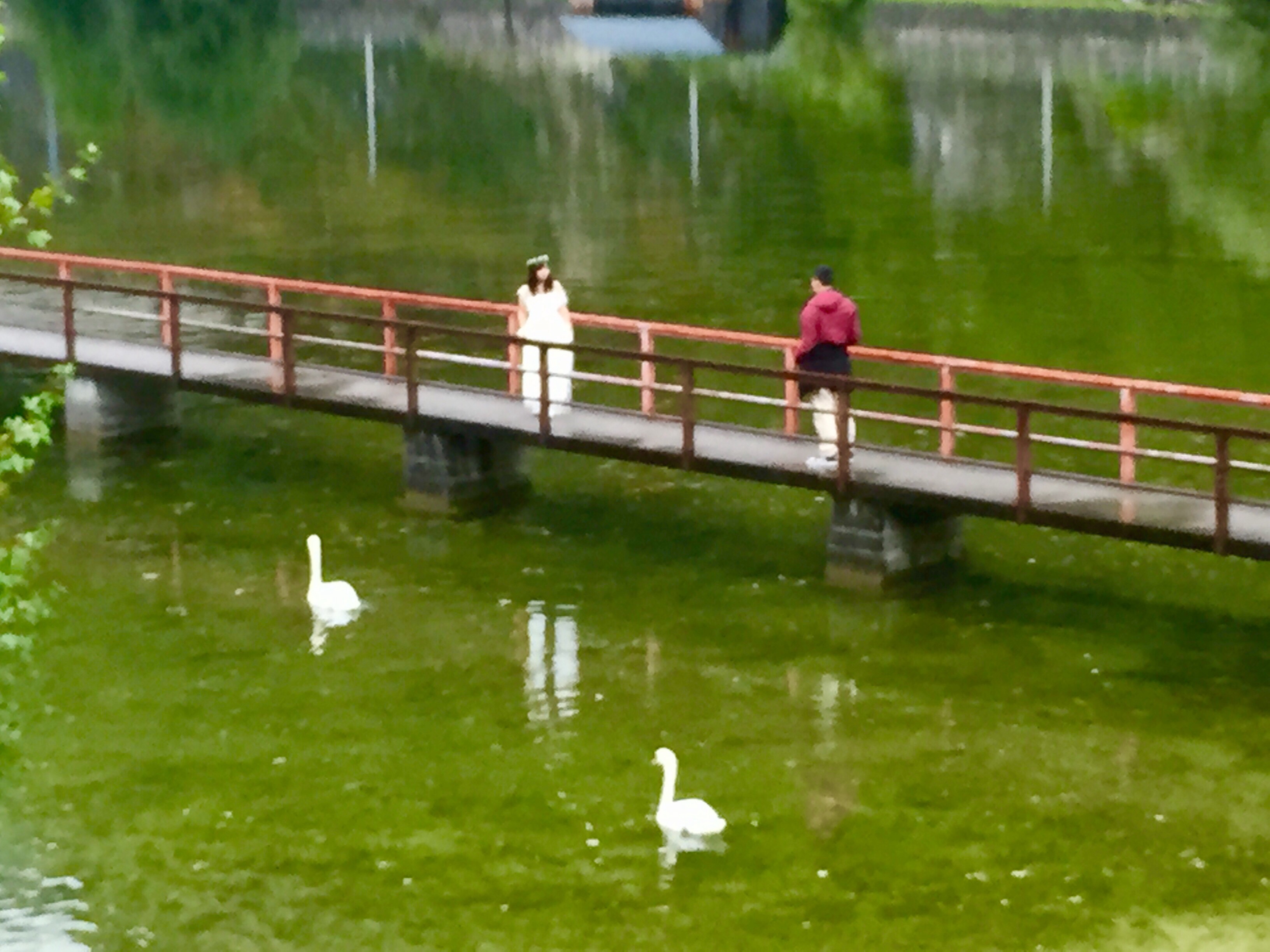
A young groom photographs his bride as we walk from the Obertraun train station to our lodging
Oktoberfest in Munich
What a day in Munich! Saturday, September 19, was the opening day of Munich’s 2015 Oktoberfest that will last through October 3. Since we were told the crowds were humongous, we opted to go later in the day and use a secondary train stop rather than the popular Theresienwiesen stop. It was a good choice.
With an open schedule in the morning, we visited the Schloss Nymphenburg, the Baroque palace on the outskirts of Munich that was the main summer residence of the former rulers of Bavaria, and is now a state historical site. The grounds were impressive; flowers surrounded man-made lakes where swans and wild geese swam above and large carp swam below. The palace was designed in an impressive array of inter-connected buildings that formed an oval, enclosing a beautiful park festooned with colorful floral plantings. The main entry gallery, the Great Hall, was stunning with its pastel-colored fresco paintings encased in elaborate baroque frames of gold and white. Huge crystal chandeliers hung from the frescoed ceiling. Ludwig II, “the mad King,” was baptized in this Great Hall. The rear gardens were even more impressive than the front gardens since clipped hedges, mass flower plantings in full bloom, statuary and fountains stretched as far as the eye could see.

The Great Hall in Munich’s Nymphenburg Palace

Front exterior view of Schloss Nymphenburg in Munich
As we wandered the palace, we stumbled upon the rooms that contained the royal carriages through the centuries. The Marstallmuseum (Museum of Carriages and Sleighs in the former Royal Stables) houses a collection of historic state coaches, ceremonial sleighs and riding equipment. The carriage of Emperor Charles VII was gold and massive, exuding strength while the golden carriage of Ludwig II was ornate and whimsical, portraying his love of opera. What surprised us most, however, was the collection of horse-drawn sleighs. Some were constructed of ornate wood with Bavarian paintings on the side. Others were gold with elaborate golden decorations and lamps. The seats were fur-lined. We were able to observe archivists meticulously restoring one sleigh. After walking through the porcelain gallery containing the table settings and decorative arts that surrounded the royalty on a daily basis, we headed off to the Oktoberfest grounds, the Theresienwiesen.

One of the sleighs of Ludwig II found in the museum at Scloss Nymphenburg in Munich
It was easy to know where to go since thousands were headed in the same direction. The vast majority of folks were wearing the lederhosen (men) or dirndls (women) that is traditional Bavarian dress. The Oktoberfest was boisterous and packed with people. We went into a couple of the tents (that hold up to ten thousand people) to hear the bands playing “oompa” music and watch the “Gemütlichkeit” (camaraderie, fellowship, warmth and friendship) of the singing crowds. “Ein prosit, ein prosit, Gemütlichkeit” and our day at the Oktoberfest was done. We spent the evening at the famous beer and Bavarian food house, the Hofbrauhaus eating crisp pork shank and potato dumplings along with the smooth Hofbrau beer (HB). We sat in the rustically ornate and huge upper dining room, as the beer garden and lower rustic rooms were packed. The band, dressed in Bavarian clothing, played as we ate. It was early to bed since the Bergs are flying to Rome early in the morning to catch their scheduled plane home. And, good news, Allen is out of the hospital, and plans are being made for Allen and Rhonda’s return home. WEG – Saturday, September 19, 2015

Oktoberfest 2015 – Munich, Germany
Hospital and Travel Difficulties
Our Sound of Music day in Salzburg, Austria, was fantastic. But that was not the big travel news and experience of the day; what experiences we have had!
First, a fuller explanation of Allen’s story about going into the hospital in Salzburg. His situation with the prostate condition worsened while at the hotel in Salzburg. In the late evening, Rhonda and I got him to the university hospital for testing with the hope of getting permission for him to travel back home to the U.S. (I blogged about that earlier.) Allen did not receive permission to travel. Instead, the medical professionals wanted to admit him to the hospital immediately because his blood count was acutely high. Understandably, Allen was hesitant. This was something completely unexpected and out of his expertise, being in a foreign country and with doctors he did not know. After consulting with his medical office in Tomball, the decision was made for him to be admitted to the university’s urological hospital wing in Salzburg. The admission process was quick and easy. When we arrived at the hospital by taxi, I thankfully saw someone who was being brought out of the hospital on a stretcher. I promptly used the opportunity to enter through the same automatic door that closed behind me. Thankfully, I had made it inside, because the automatic door could be opened only with a pass card from the outside. When I saw Allen and Rhonda approach the entry, I was able to activate the door from the inside that permitted them to gain entrance. Now inside the hospital entry, we saw no one; it was dark and silent. A young intern eventually walked in and appeared surprised to see us. He summoned a doctor. It took Rhonda some explaining to do before the doctor could understand why we were there. Once that was successfully communicated, Allen went for testing. About an hour and a half later, someone from the hospital came to escort Rhonda and me to Allen’s room where a very efficient and pleasant nurse met Allen to explain everything about his room and what to expect next. We were impressed with how quickly everything transpired. Other than medications, there were no forms for Allen to fill out and no payments required. The next day, a hospital representative came by to require payment; the fee was quite reasonable. Allen is steadily improving and, God willing, will be able to be released from the hospital and given permission to travel home in a few days. Rhonda has a safe, comfortable hotel room and spends time with Allen during the day. Last night, Dan and I went to say “goodbye” to Allen, and this morning, Charlotte, Dan, Kathy and I said “goodbye” to Rhonda. Allen and Rhonda are being helped by the travel insurance personnel who will arrange for their trip home.
Dan, Charlotte, Kathy, and I are traveling on to Munich where the Berg’s will catch their scheduled plane home via Munich to Rome. Kathy and I will then continue our adventure alone.
If it were only that easy! Travel always has the unexpected, and seasoned travelers know it comes with the territory and you must go with the flow. The refugee/immigrant crisis in Europe caught up with us in Salzburg. We learned that all trains into Germany were cancelled. Hotlines were of little help. It was “every man for himself.” A doctor at the hospital, in an offhand conversation about our plans to go to the Oktoberfest in Munich, mentioned that he had tickets to the Oktoberfest. Since the rail lines into Germany were closed, he planned to drive to the border and go across to the small German city of Freilassing where he would catch a German train to Munich. With that tip in mind, we called a taxi to take us to that German city. We all had to go through border checks with passports examined to make sure we were not illegally entering the country. We saw army personnel standing along the waterways to make sure no one crossed there. When we finally arrived at the bahnhoff (rail station), we went to the ticket office and found out that our original tickets from Salzburg would be accepted on a German train. What a relief! The train station was filled with refugees/immigrants. There were social agencies on hand to help. Upon inquiry, we were informed that people already inside German borders were being processed and resettled throughout Germany. We were told nearly all the refugees/immigrants wanted to come to Germany and not other European countries, and so border controls were initiated to regulate the flow. Our observations were that families fleeing war (refugees) were the minority and young men seeking employment (immigrants) were the majority.
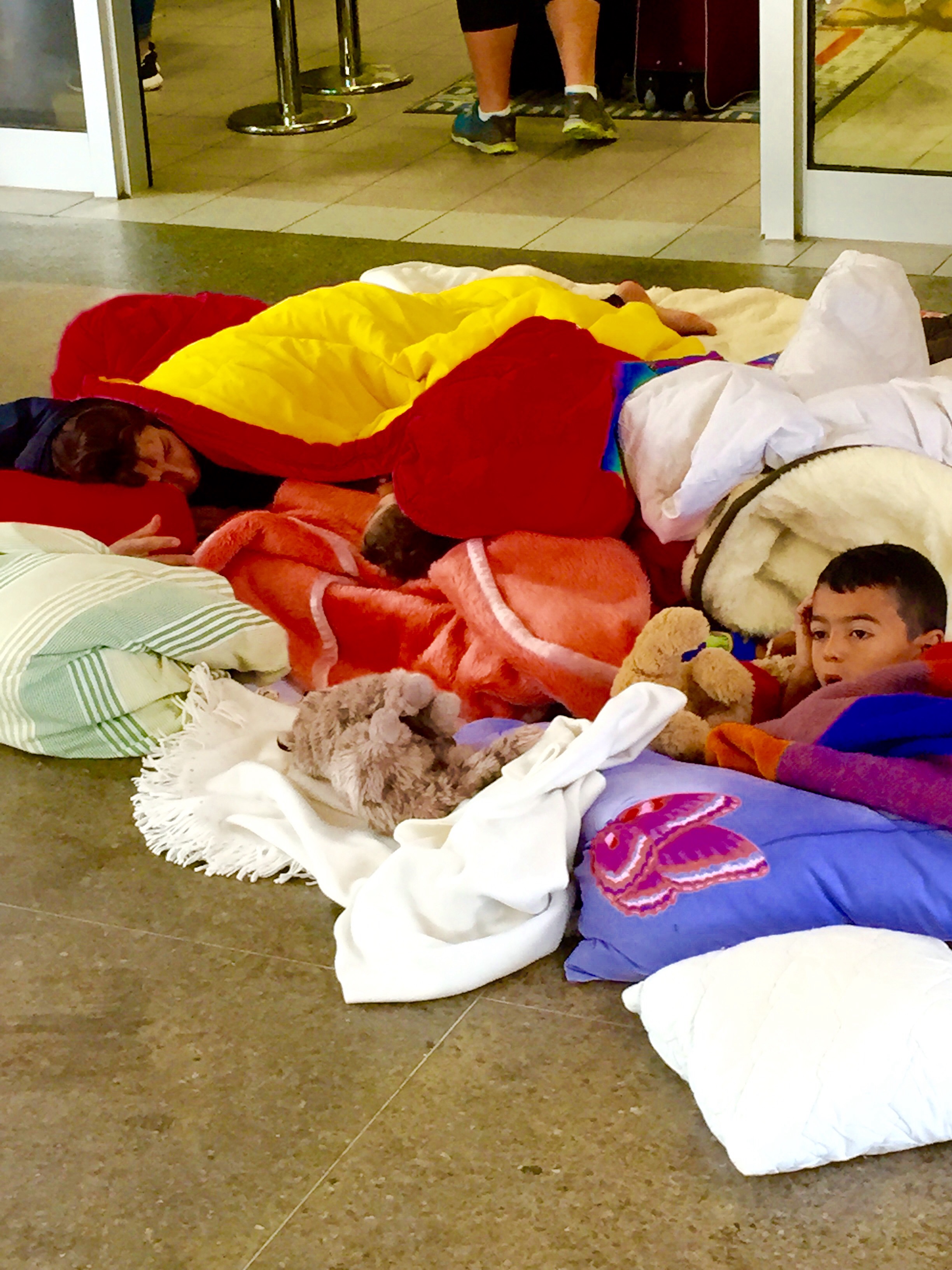
A refugee family asleep on the floor of the train station in the border town of Freilassing, Germany
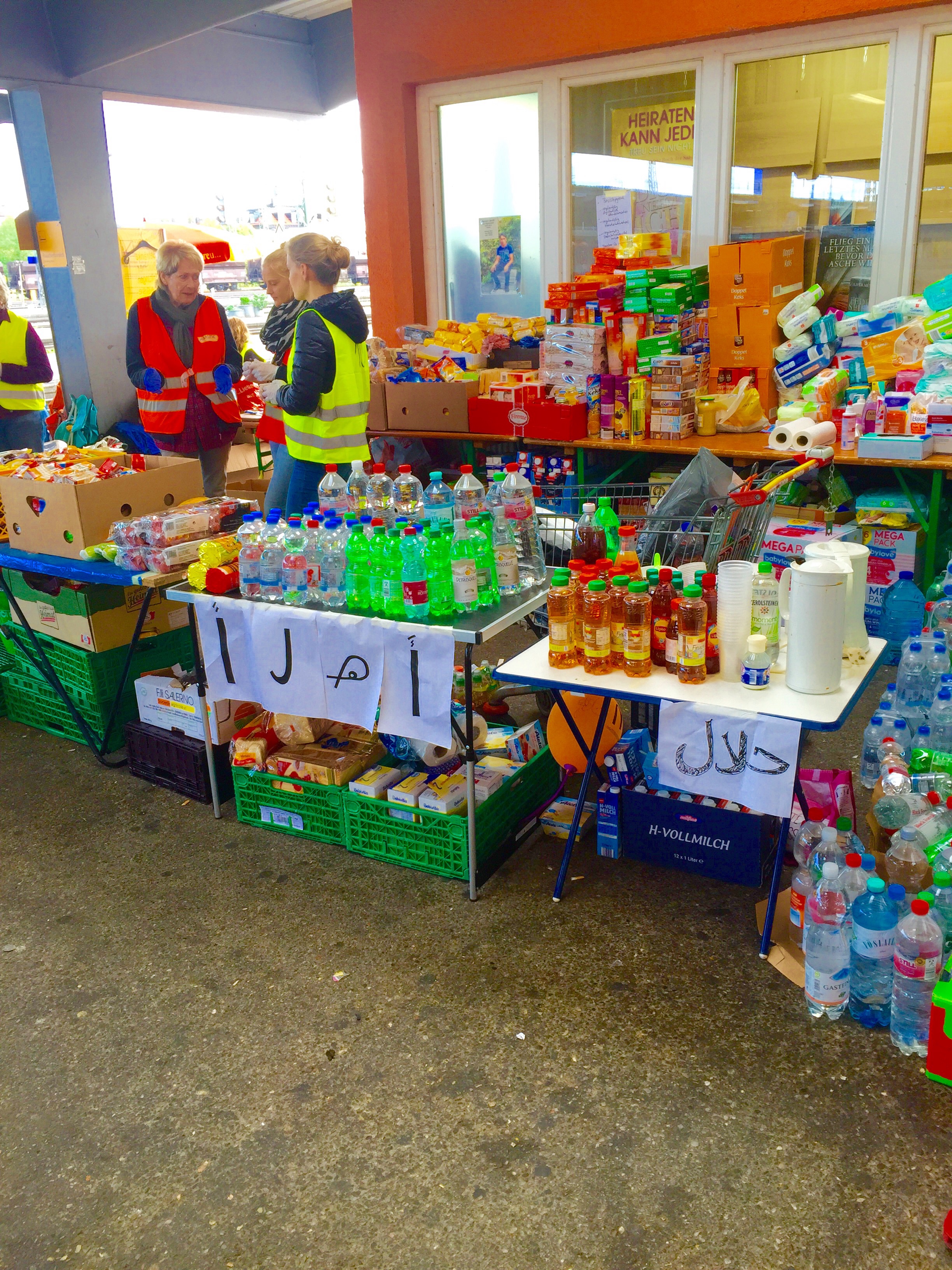
Assistance is provided to the refugees who have come to the train station in the small border town of Freilassing, Germany

Police cars parked outside the train station in Freilassing, Germany, as they manage the influx of refugees/immigrants who want to enter Germany
Now, back to the Original Sound of Music tour that all of us, but Allen, took. It was a lovely day seeing the places in which the movie was filmed. We saw the homes (rear of one home and front of another) where Baron Von Trapp and his family lived, the gazebo where his oldest daughter fell in love, the bridges over which the children played and sang, the beautiful Mirabell Gardens where several of the scenes were shot, and the church in which the wedding of the Baron and Maria took place. We were able to witness a funeral in progress at the church. A choir was singing, and the people in attendance were finely dressed in traditional Tyrolean clothing. The white horse-drawn funeral carriage outside was festooned in brilliant flowers and led by a funeral band clothed in red Tyrolean clothes with black hats. As we drove, we were in the beautiful mountain and lake district of Austria where the mountains ring soft baby blue lakes. Our guide pointed out the hotel frequented by the Bill Gates family and the Red Bull (the drink that has made the owner the second richest person in Austria) campus headquarters building that was framed in glass. The huge bulls charging out of one building into a lake, with water flowing out of their mouths, was eye-catching. This tour, coming amidst all the other travel issues, was a spirit refresher. WEG – Friday, September 18, 2015
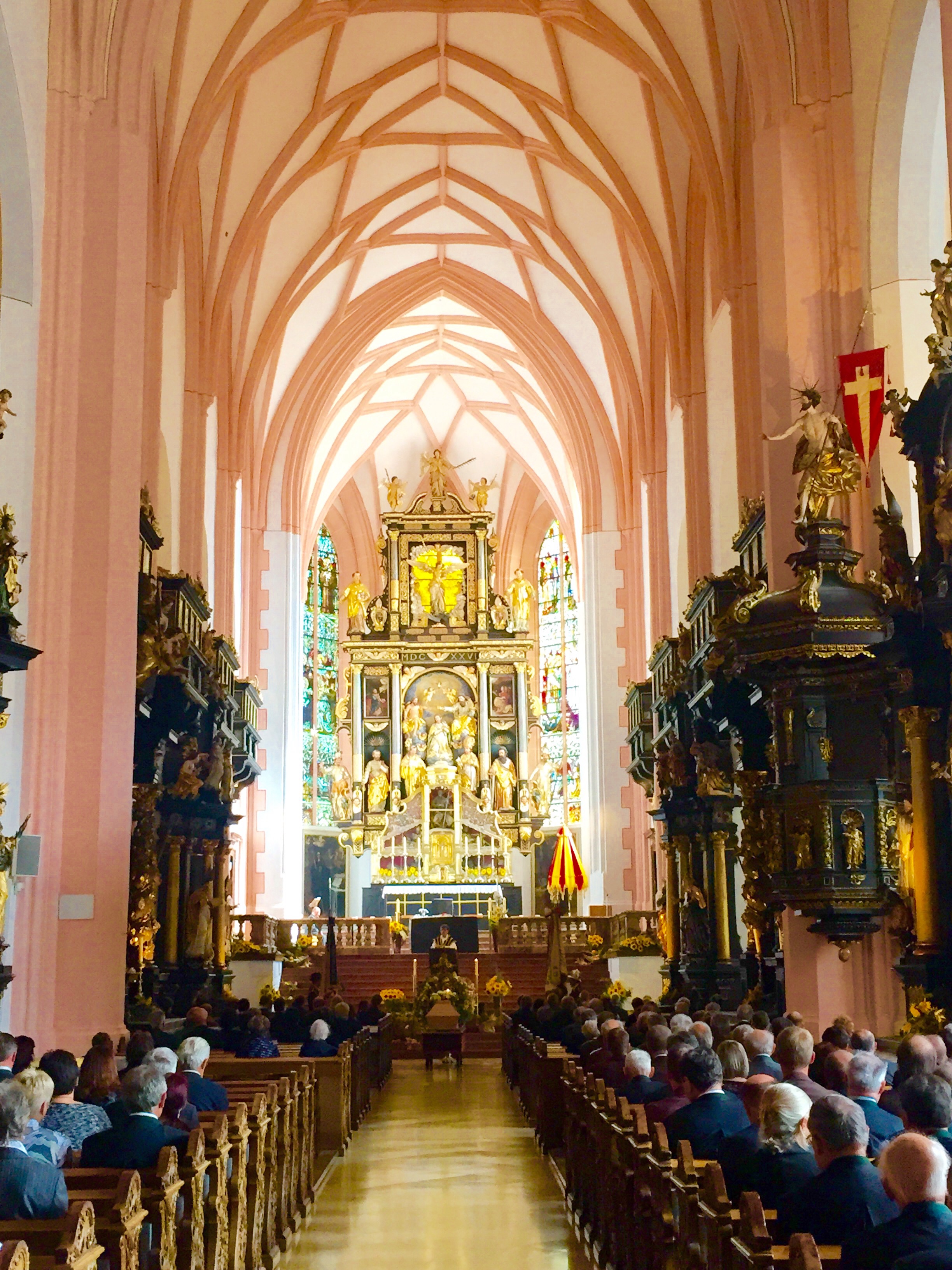
The beautiful church in Mondsee, Austria, in which the wedding between Captain von Trapp and Maria was filmed in the movie, “The Sound of Music.”

Salzburg’s beautiful Mirabell Gardens in which many scenes from “The Sound of Music” were filmed.

Wayne and Kathy happily immersed in the beauty of Salzburg’s Mirabell Gardens
The Crises
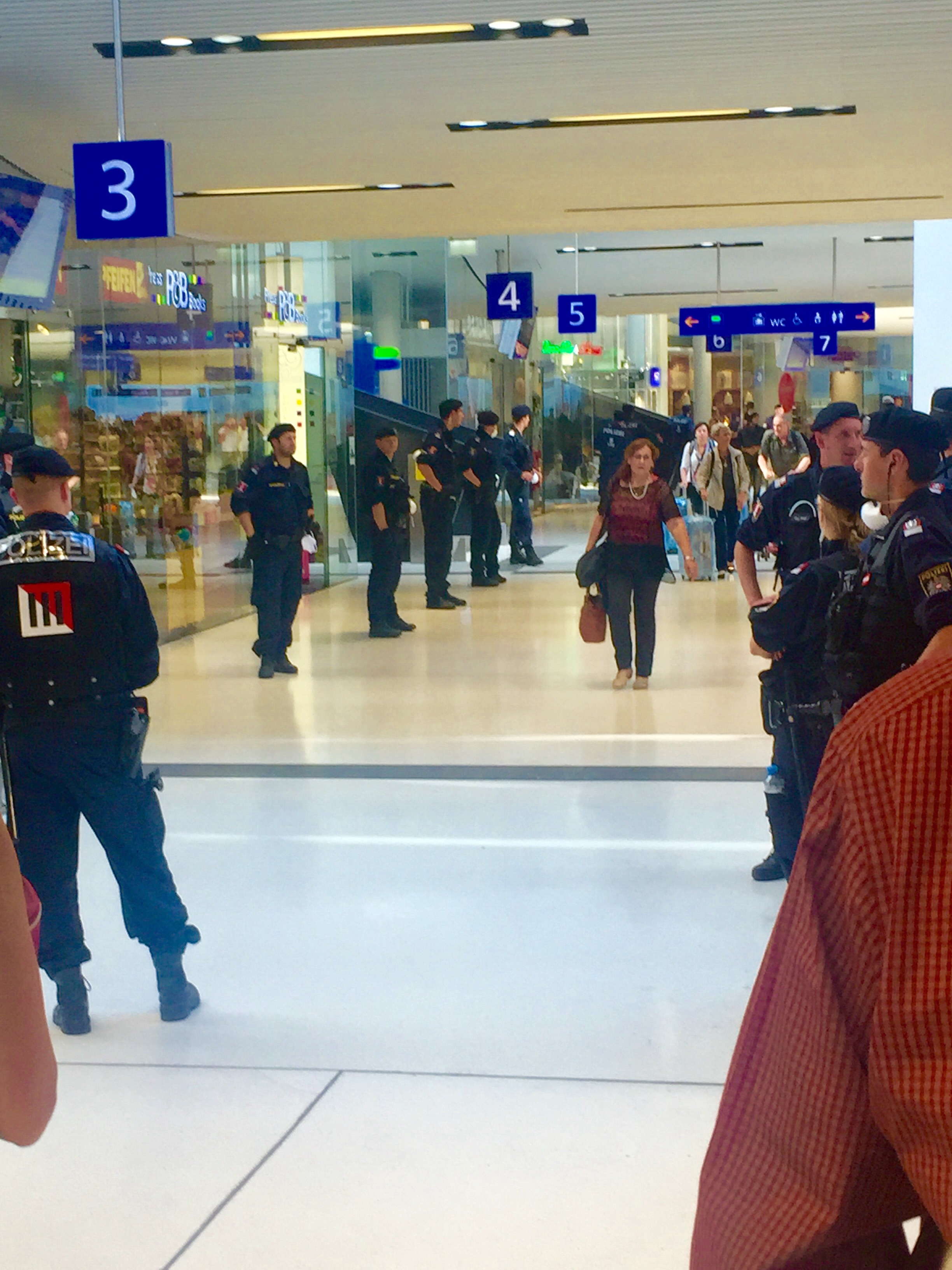
Salzburg’s train station was guarded heavily by uniformed police as 4,000 Syrian refugees sought to gain entry into Germany the day of our arrival.

The refugee assistance tent set up just outside Salzburg’s train station
Our train ride from Innsbruck to Salzburg was magnificent. Allen, Charlotte and Dan snapped away as one majestic mountain scene after another passed in front of us on either side of the train. How impressive is God’s handiwork!
Once we arrived in Salzburg we immediately saw police and military cordons. This was new. We had seen a larger number of safety personnel along the way than we were used to seeing. But this was different. Military and local police were everywhere. Then, we began to see large numbers of people from the Middle East clustered in groups. We inquired and found out that these were refugees/immigrants and now numbering in the thousands in Salzburg. We were told 4,000 had arrived today alone. Some were families, and many were young men. Outside the central station, relief agencies were providing food and counseling help, and tents were set up. While the situation was tense, there was no chaos. It was obvious that some of the children riding up and down the escalator had never seen such a contraption before by the look of amazement on their faces.
With that sober experience in our minds, we taxied to our hotel and took a walking tour of beautiful Salzburg with the Hohensalzburg Fortress towering on the bluff above the city. We saw Wolfgang Mozart’s home on one of the busy streets. Salzburg is an upscale city, clean and charming with many fashionable shops.
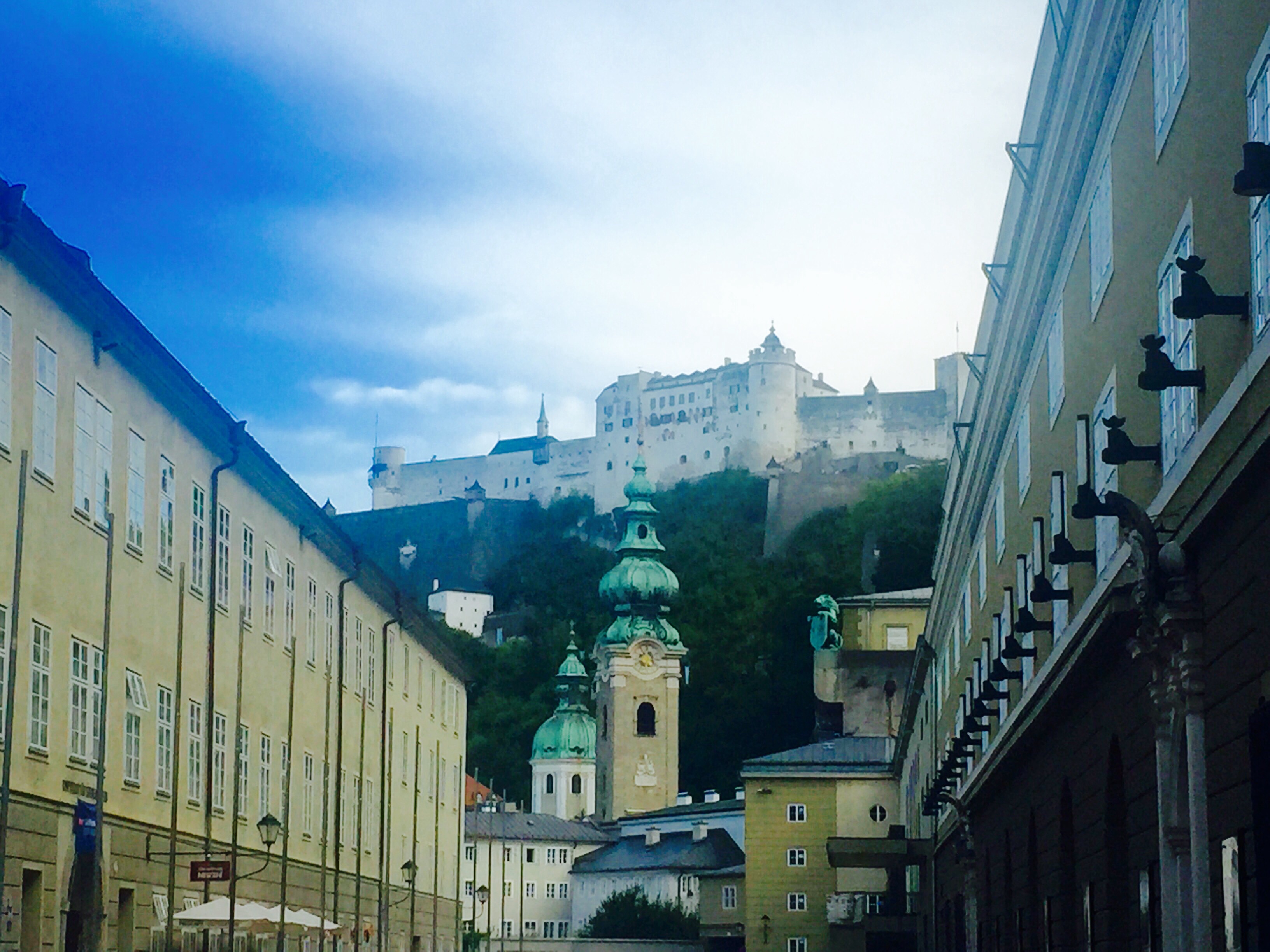
Hohensalzburg Fortress, the largest preserved fortress in central Europe, sits atop a high hill over Salzburg and is reached by the Festungsbahn funicular railway.
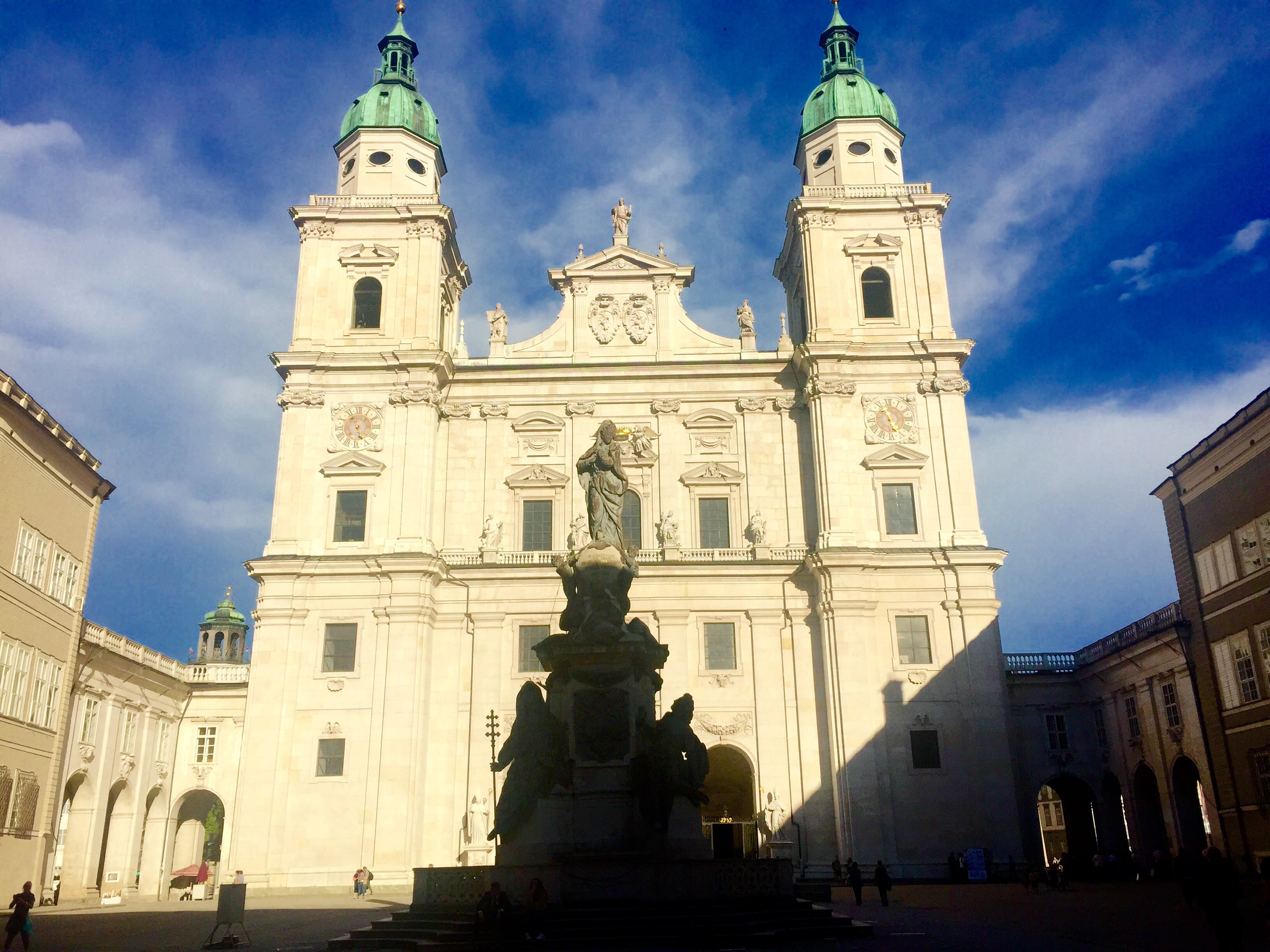
The Salzburg Cathedral, built in the typical Austrian baroque style, along with many other Catholic churches in Salzburg, helped Salzburg gain its reputation as the ‘Rome of the North’. Wolfang Amadeus Mozart was baptized in this church.
Once back at the hotel, Allen was again not feeling well. He made the decision to go home and checked with the trip insurance folks about the details. He has had a bout with his prostate in the past and it was a difficult recovery and he did not want the issue to progress so far that hospitalization would be required while in Europe. We traveled to a medical clinic to get a doctor’s permission for him to travel as required by the insurance. Thorough tests were performed. How thankful we are that we took out travel insurance for this trip! Unfortunately, the doctor would not give permission for Allen to travel. After calling to the medical office Allen uses at home, the decision was made to admit Allen to the hospital here in Salzburg. The process was easy and fast–no questions asked about anything other than medical needs. The room was ready immediately and the nurse was waiting to get Allen settled into his room. Everything is modern at this large university hospital. Prayers for speedy recovery are requested for Allen. WEG – September 16, 2015

Salzburg’s New Residence and carillon look upon the magnificent fountain on Residence Square

Salzburg’s central Old Town

Salzburg, Austra
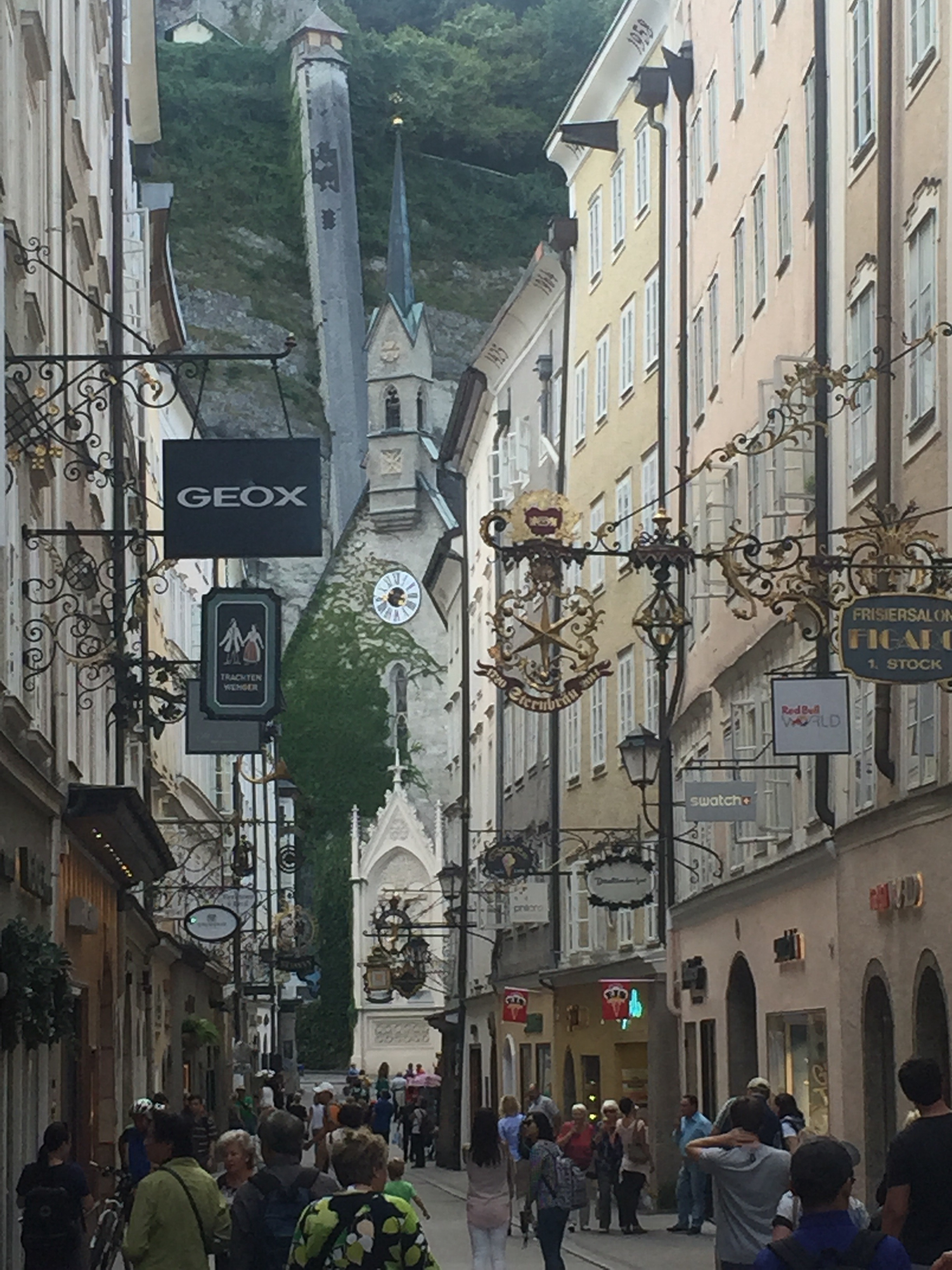
One of the beautiful street scenes in Salzburg
The Deep Blue Sea

Visiting the Cinque Terre, the 5 Lands that hover along the Mediterranean Sea
Taking the ferry out of Lerici along the Mediterranean coast to the Cinque Terra (five lands/cities that time forgot) we were immediately impressed with how clear and clean and blue the waters of the sea were. The five cities with their pastel buildings scrunched together along the crags of the cliffs above the water stood out like jewels above the deep blue. The water was calm and the ferry could dock at port–not always a possibility. We were blessed.
The day was one of relaxing. We took time to eat our wonderful breakfast at our hotel before heading out. It was a bountiful buffet, displayed with elegance. My favorites were the salamis and cheeses and the puff pastry filled with Nutella. I took time to use the unusual orange juice machine that was filled with fresh oranges that rolled down a shoot to be squeezed automatically–truly a work of mechanical expertise, and the fresh juice was fantastic. The tables were covered with linen and fine utensils and the balcony looked over the bay that was bobbing with sail boats. Lunch was taken at our favorite Cinque Terra restaurant, the Belvedere, in the village of Monterroso. Because we had eaten there previously on other visits, the waitress recognized me. That was cool! We ordered our favorite, pesto fettuccine–it is still fabulous!
One of the reasons we return here and to Italy, in fact, is that friends want to go, and they know we “know the ropes” and the sites. We enjoy seeing sites we love through the eyes of others. Today, the Berg’s and the Krahn’s declared it to be a grand day! WEG – September 7, 2015
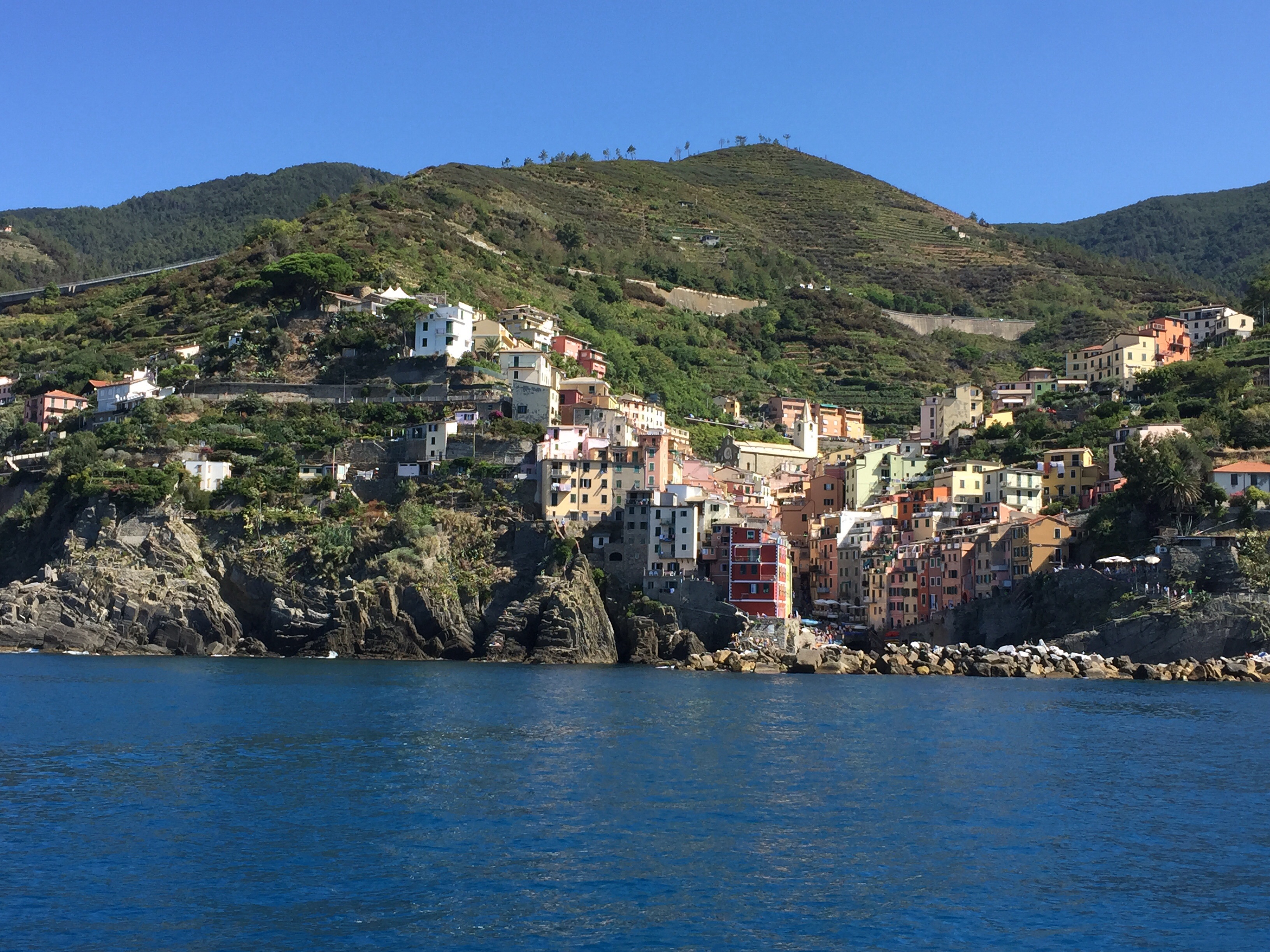
Viewing the Cinque Terre by boat
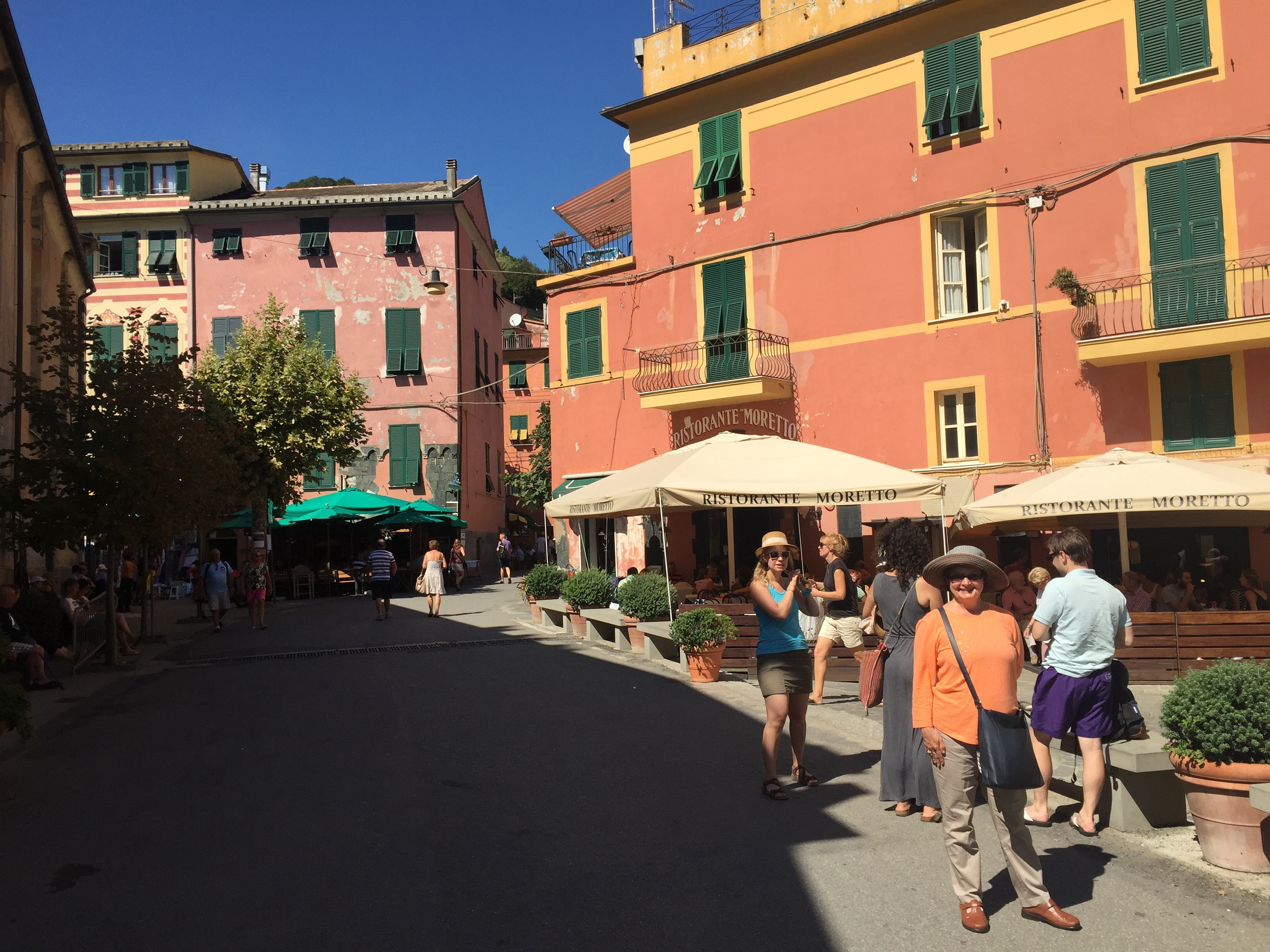
A visit to Monterrosa, one of the 5 Lands, or Cinque Terre
A Quilt of Grapes

The beautiful hill town of San Gimignano with its 14 towers
Tuscany is every picture of Italy, save the Roma (Rome) Coliseum, that you have seen, characterized by rising hills and verdant valleys, with narrow roads bounded by either tall sycamore with peeling bark or pencil thin cypress trees. Small villages with pastel or warm beige houses greet you around the turn, and then in the distance you see an ancient stone town on a hill with a castle and/or church in the center towering over the other buildings. Sometimes, the hill town has a medieval wall or stone towers. You think the scene is unique, and then soon again it is repeated a few kilometers down the narrow road. The hill town calls up to you to come and see; yet, you realize it would take many vacations to explore them all.
Along the way, the road turns upward toward a hill and switchbacks bring you higher and higher and then stretched out below are vineyards and sunflower fields and olive groves as far as the eye can see, a patchwork of beauty. Further in the distance, more hills rise up in undulating waves. And so the scene plays out over and over again. As we travel closer to vineyards, we see huge purple grape clusters hanging from the vines. Grape harvest and fresh wine production are soon to come.
We have chosen San Gimignano as our destination. An ancient hill town surrounded by a stone wall and beautiful church, it is noted for the 14 stone towers that dot the hill–emblems of wealthy medieval families who used them to showcase their wealth and remove them from the air below in the hope of keeping disease away, especially the plague. Narrow cobblestoned streets are lined with stone buildings, today housing businesses, especially colorful Italian pottery, and various eateries. Several piazzas beckon. It is a relaxing place, except in early afternoon when the tour buses arrive (they are gone by five). We are staying in a six-room agriturismo on an active farm/vineyard just outside the city walls, held by the family since the 1500s. An organic establishment, we have vegetarian breakfasts and the chatty owner regales us in story after story. An anthropologist who has come back home from work amongst unheard of tribes and research for National Geographic, she needed to rescue the family heritage after her grandfather’s stroke. She speaks five languages! We are thankful for this amazing experience. WEG – September 4 & 5, 2015
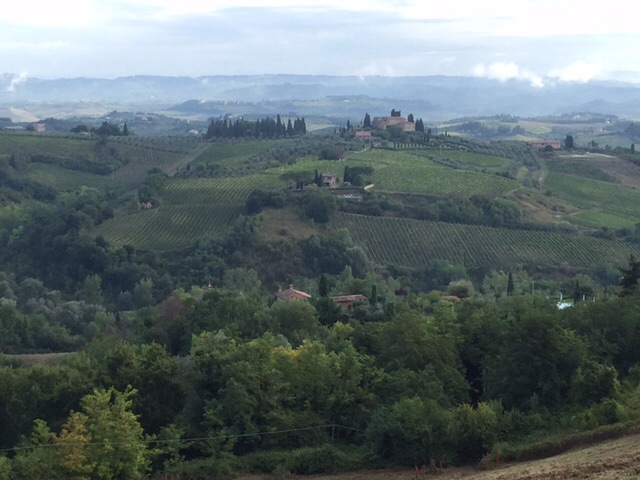
The Tuscan countryside with a view of San Gimignano

While lodging in San Gimignano, we took a side trip to the nearby hilltown of Sienna, entering by foot through one of its imposing gates
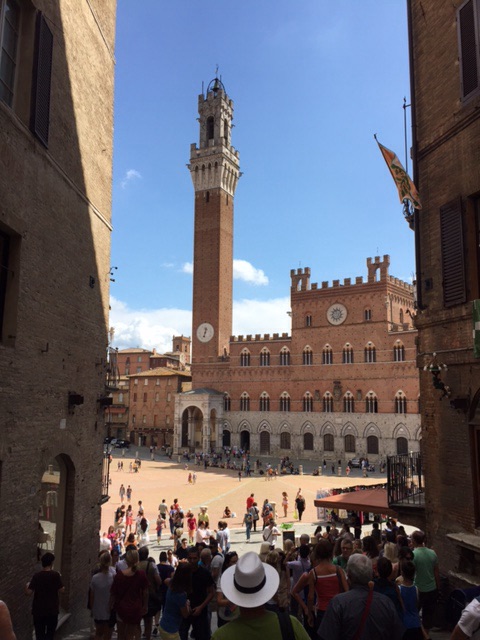
Sienna’s famous Piazza del Campo

Another view of Sienna’s breathtaking Duomo
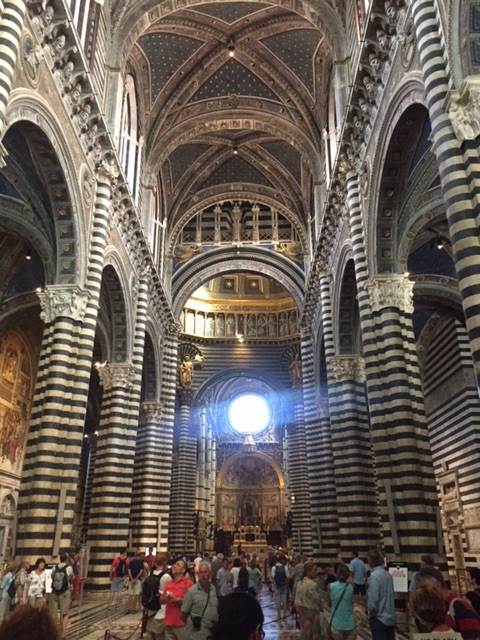
Inside Sienna’s Duomo

Inside Sienna’s Duomo

Insidee the library of Sienna’s Duomo

Money, Power, Art — Florence
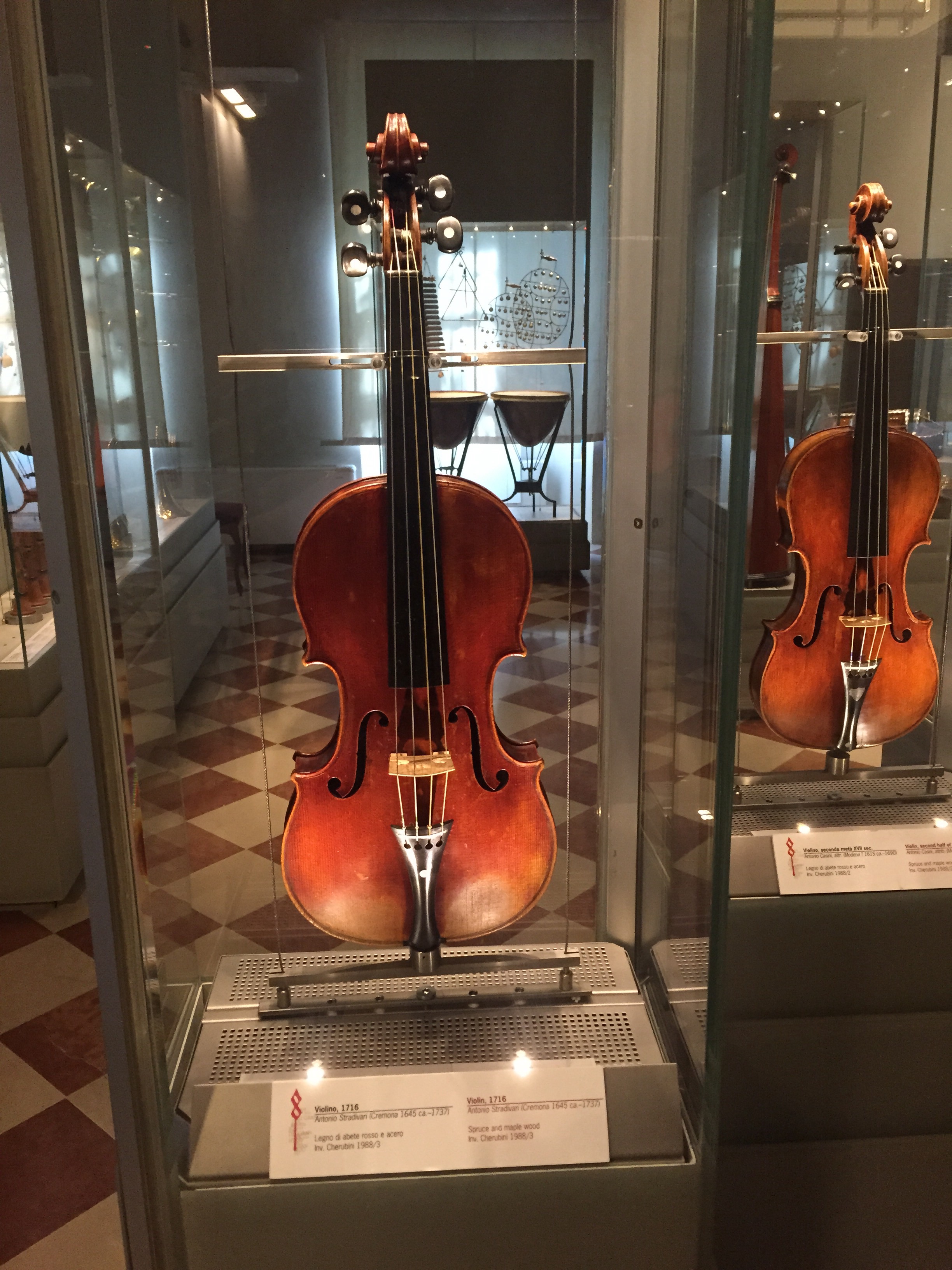
The Stradivarius Red Violin in the Accademia in Florence
And enjoy it we did! Dan Berg and I spent the afternoon at Santa Croce, a beautiful church that is the burial ground of Italy’s heroes and heroines over the centuries. We saw the graves (don’t think of an American cemetery, think huge sarcophagus of marble and marble floor markers) of such famous people as Galileo, Dante, Michelangelo, Leonardo da Vinci, Florence Nightingale, Marconi and the list goes on and on. We also saw the Donatello Christ and the Cimabue crucifix.
Our whole group took a tour to the Academia where the main attraction is Michelangelo’s 17 foot high sculpture of David envisioned as being just before David kills the giant Goliath. Chiseled from one piece of white marble, the artist’s realism is eye-catching. Bone structure and blood vessels are clearly visible. Michelangelo personally believed that sculpture was the highest art form, and David is his greatest achievement. Along the way, we saw a Stradivarius viola and the famed instrument maker’s “red” violin–both the most valuable instruments of their kind.
In the late afternoon, we attended a guided tour of the great Uffizzi Gallery. Here were many of the works of art that most people have seen in one way or another. Allen and Rhonda saw Boticelli’s “Venus” and immediately recognized that a copy of that famous piece hung in their bedroom at home. The great artists’ works hang throughout the 45 room museum. The halls are filled with ancient Greek and Roman statuary. It is simply mind-boggling.
The evening ended at an “Italy as Italy can be” trattoria (local family owned eateries where food is high quality, but priced reasonably–found across Italy) where the food and wine were excellent. Veal stew, roasted rabbit, ravioli with white truffle sauce, chef’s specialty meatballs and fried chicken were main courses. We strolled to our hotel near the cathedral in the cool relaxing evening air. And the day was done. WEG
Wednesday, September 2, 2015
The Stradivarius Red Violin in the Accademia in Florence

Rhonda & Allen Krahn in front of Botticelli’s famous “Birth of Venus” painting in Florence’s Uffizi Gallery

Ponte Vecchio Bridge as seen from a window in the Uffizi Gallery in Florence, Italy
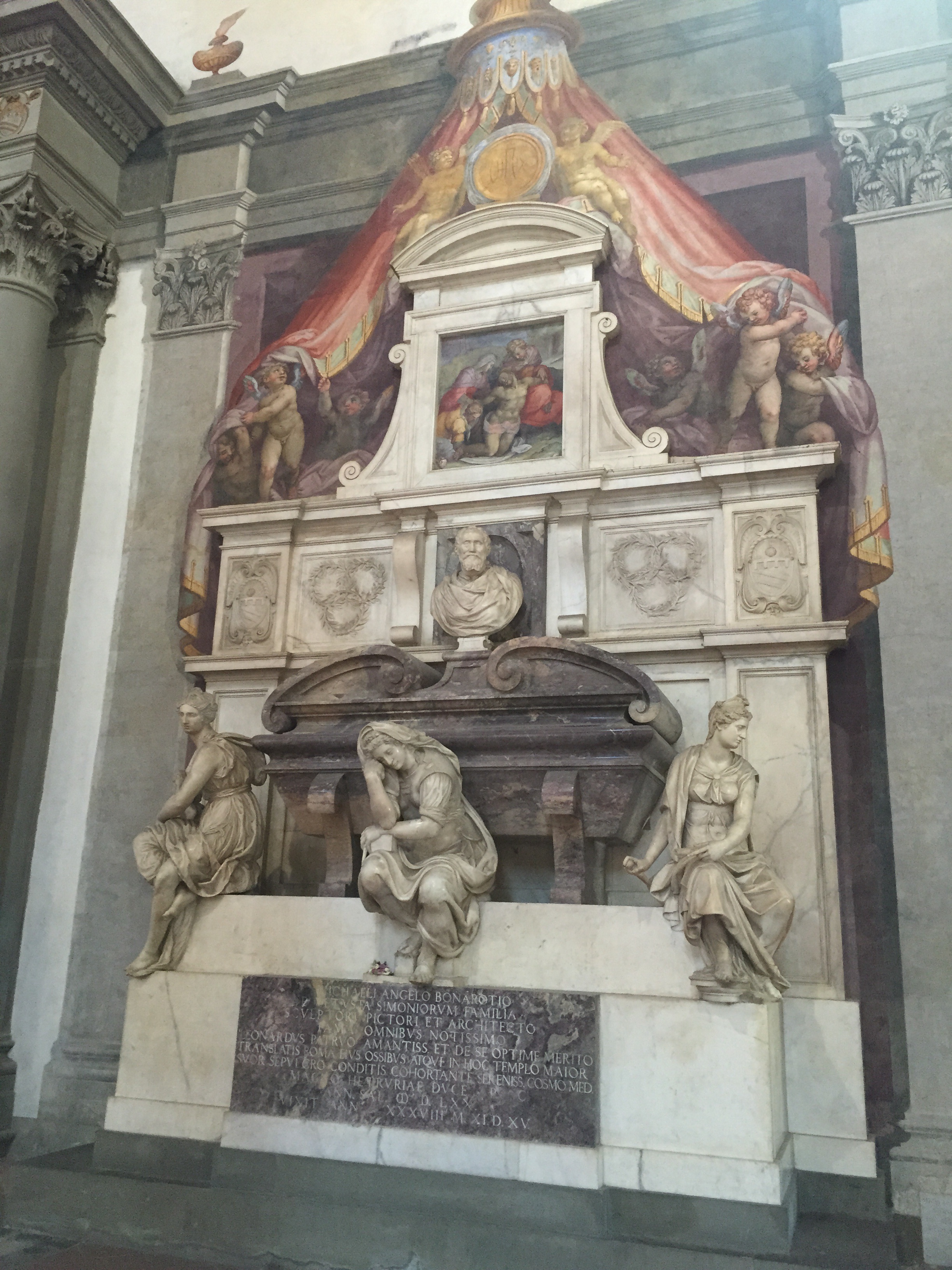
Michelangelo’s Sarcophagus in the Sante Croche, Florence, Italy
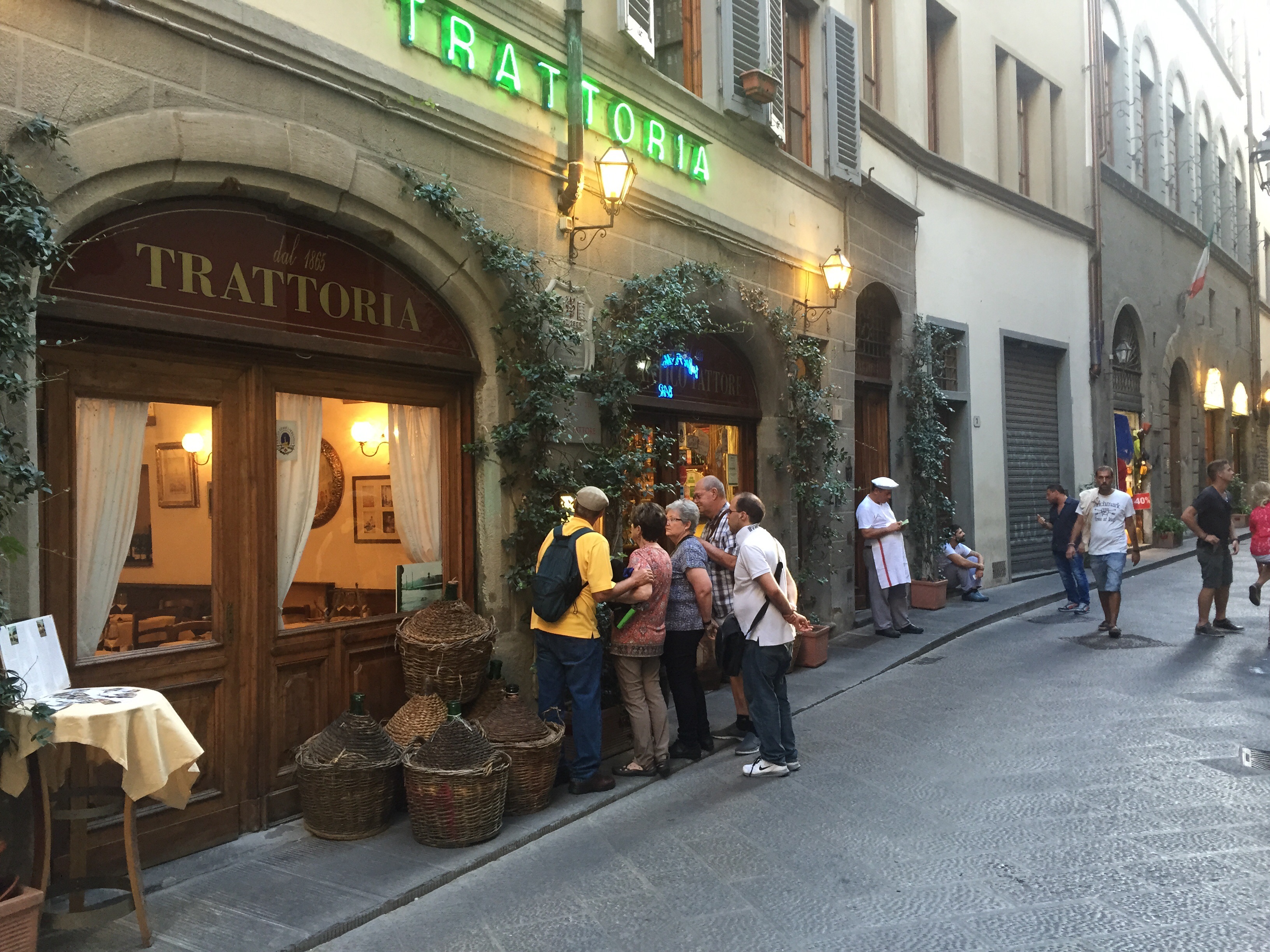
Studying the menu before selecting the trattoria in which we would eat our evening meal in Florence
More than Parma Ham
In our previous travels to Italy, Kathy and I had never been to central Italy above Florence. That is why we chose Bologna as a central location from which to take day trips to the surrounding Emilia-Romagna region of Italy. Many popular Italian foods originated from this region, such as Parmigiano-Reggiano, Parmesan cheese, balsamic vinegar, tortellini, tortelloni, tagliatelle, Ragu sauce, Parma ham, mortadella and prosciutto. The area is rich in farmland and old cities, including Bologna, Parma, and Modena. Today we spent a relaxing and enjoyable day in Parma.
The city of Parma is known for its university, one of the world’s oldest, for three beautiful churches in close proximity, and for its multi-storied baptistery. Inside the stunning Italian Romanesque Cathedral (Duomo) is the Assumption of Mary ceiling fresco. Painted by Correggio, the fresco is considered the world’s finest Renaissance fresco work and was radical in design. It changed the techniques used in painting and was studied by all the great painters who followed. It was one of my bucket list works of art. To stand in the stunning building and gaze upward at the swirl of three-dimensional movement as Christ descends, feet downward, to meet His mother as she ascends to heaven, surrounded by angels, was inspiring. I was transported into the scene, and that was Correggio’s intent. Outside the cathedral was the multi-storied baptistery, a building of great significance and architecturally one of Europe’s great monuments. Used for Christian baptisms, the building signified the architectural movement from Romanesque to Gothic design. We viewed the richly painted interior and stood before the ancient baptismal in the center of the octagonal structure with reverent awe.
Obviously, Parma is more than the ham for which it is also famous.
Thursday, August 27, 2015 – WEG
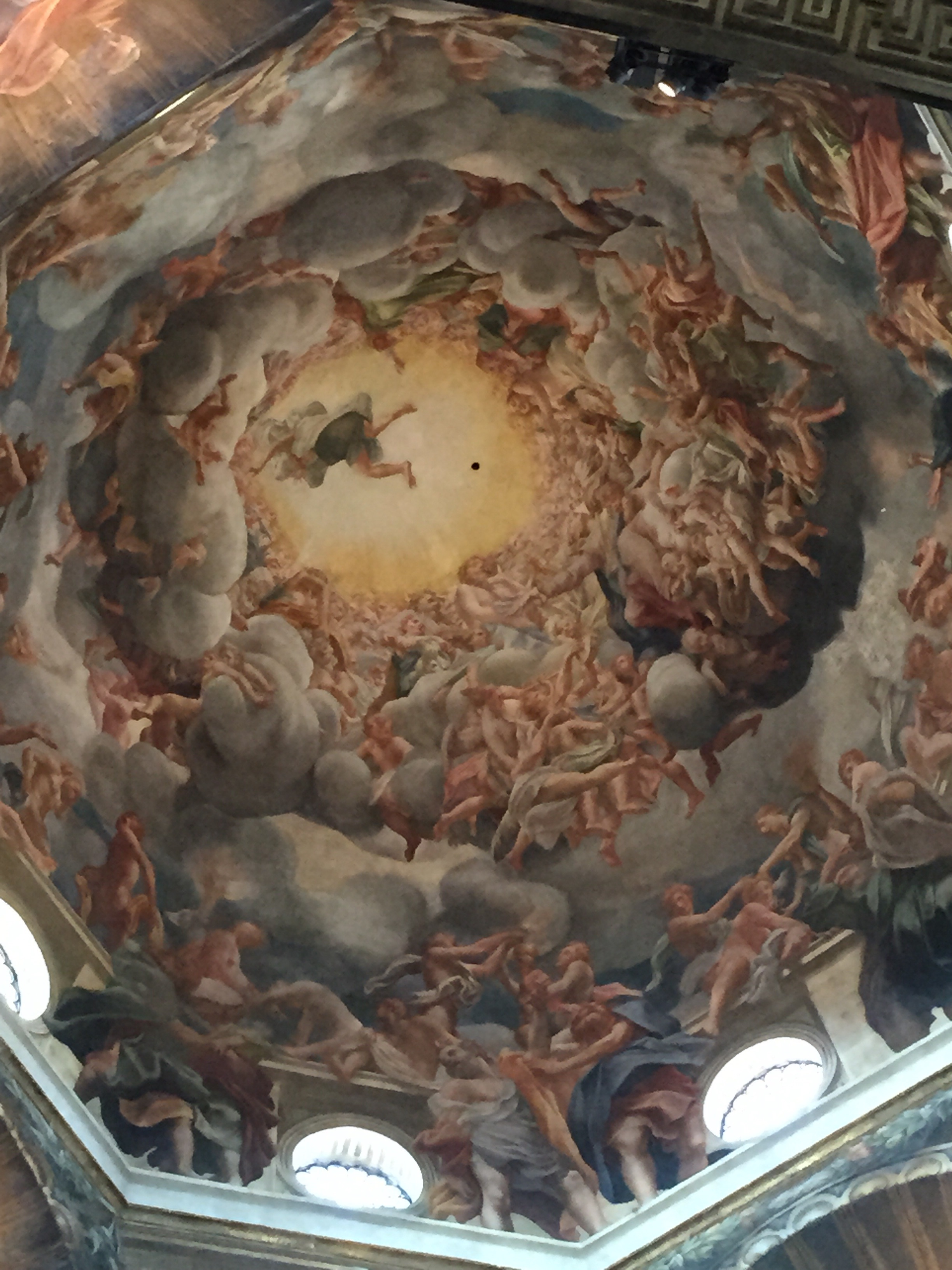
Correggio’s ceiling fresco, The Assumption of Mary, in duomo in Parma, Italy

Another view of Correggio’s fresco masterpiece in the dome ceiling of Parma’s cathedral
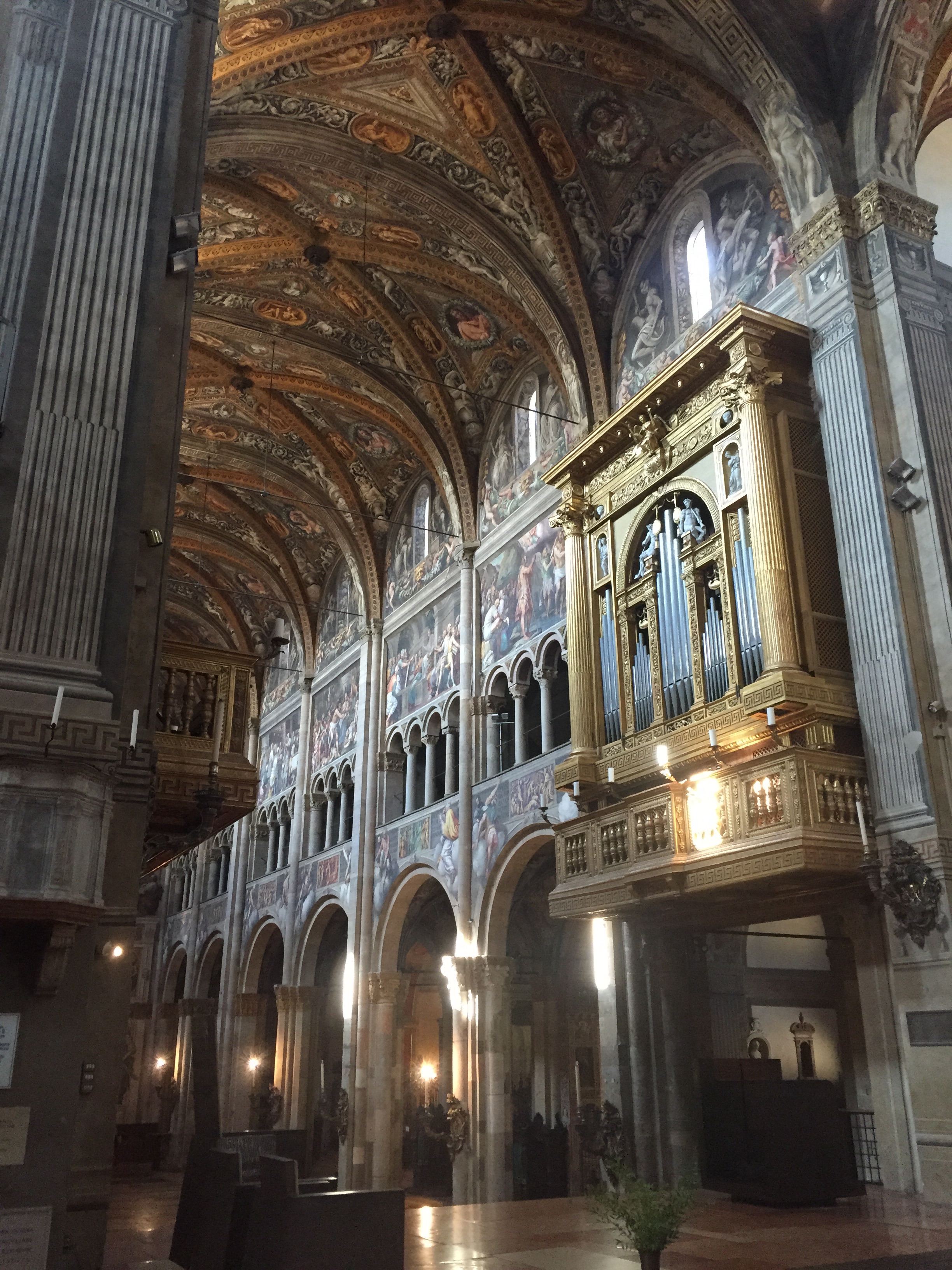
Interior of the cathedral
Venice the Menace

Rhonda & Allen Krahn and Kathy & Wayne Graumann at the Bridge of Sighs in Venice, Italy – 08/26/2015
Our day trip to Venice reminded us of the difficulties of navigating the city. Once off the train we were greeted by the beautiful sights of the city across from the train station, sights that are repeated in every view as you move about–churches with large domes and tall, sometimes pointed, bell towers, stately palaces along waterways in muted pastels, and windows with arched frames. First, the vaparetto–a large water bus–that circumvents the grand canal with stops along the way to the main city square–San Marco. You could take a water taxi–faster, but at 10 times the cost. The views are spectacular, especially as you glide past fabulous yachts anchored along the way.
Did I say Venice crawls with people? Huge cruise ships dock at port and disgorge thousands upon thousands of people. We had no problem getting into the Palazzo Ducal, the home of the ruling Doges (elected by the nobility) for centuries. The wealth of middle ages Venice is evident in the palace with rooms decorated with paintings of some of the great names in art history-Tintoretto and Titian being prominent. Mind you, it isn’t a simple painting hanging on the wall, but the entire room was used as the canvas.
Out in the square, the multi-domed San Marco, with its gold mosaic interior, loomed with mystic glory. We walked to the Rialto Bridge, one of the finest of the hundreds of bridges that traverse the canals that criss-cross the island city. Venice is a jigsaw puzzle with narrow major streets that dead-end into smaller streets off of which run very narrow alley ways. It is easy to get lost, but we did not. We did find an excellent trattoria in which to eat. We were hungry and thirsty and grateful to find such a wonderful place to rest our weary feet. My calzone oozed with buffalo mozzarella, parma ham and mushrooms–the air pocket-filled crust was charred from the oven and covered with a rich marinara sauce–every bite was wondrous. Allen, our friend along on the journey with his wife Rhonda, declared that his pizza was the best he had ever eaten–that is saying alot since Allen’s home office has a wall full of culinary trophies.
I commented that Venice can take the starch out of you physically–bridges everywhere, narrow dead-end streets filled with people–we realized we had walked several miles as the day came to an end, and we boarded the train back to Bologna. It was a good day. WEG
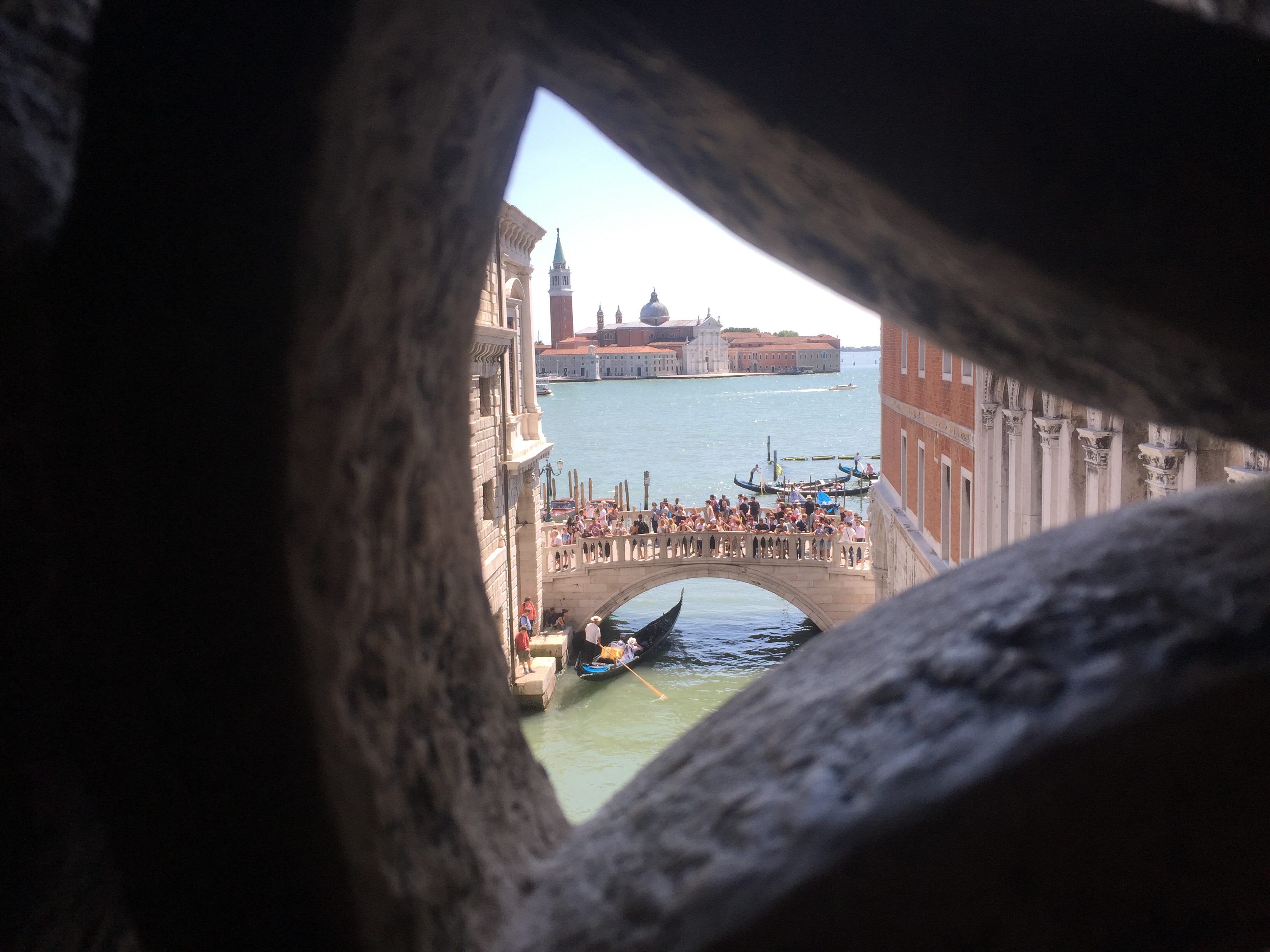
Overlooking the Grand Canal while on the Bridge of Sighs

Rhonda & Allen inside the Doges Palace

Wayne & Kathy inside the Doges Palace

Interior courtyard of the Doges Palace
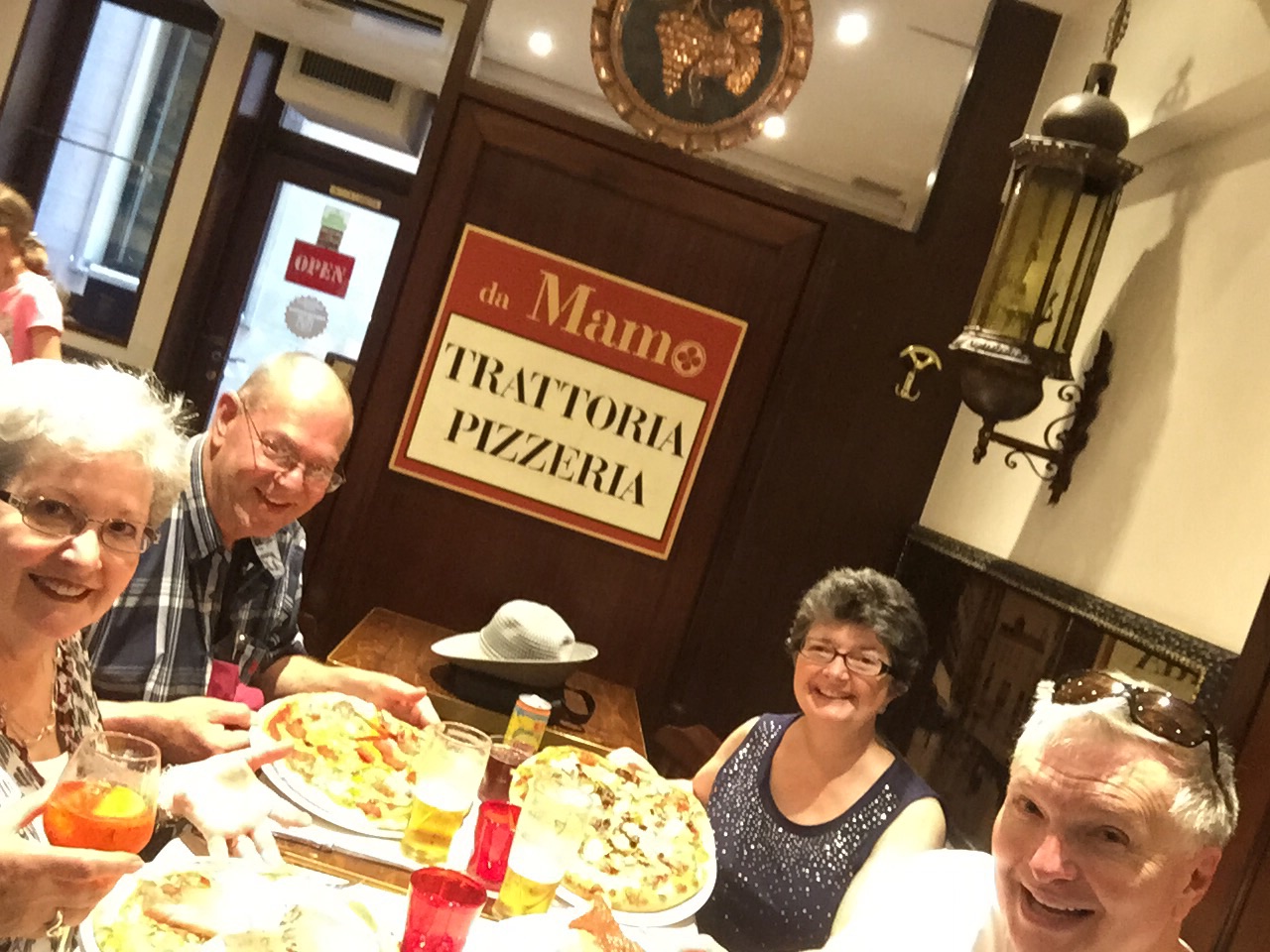
Tasty, plentiful afternoon lunch at a trattoria off the main traveled route – “and that made all the difference,” to which Robert Frost would smilingly attest
Can I Borrow that Egg?
Nothing better than a good Italian breakfast to get the day going–I enjoyed the mortadella (baloney with fat inclusions) and prosciutto(cured ham)– along with scrambled eggs (yellow gold to almost orange–farm yard fresh). The buffet was large and varied. Kathy’s selection of a boiled egg gave us the laughs of the day. Having not yet eaten the egg, she decided to take it with her; however, in moving the chair and with her hands occupied with purse and room key, the egg rolled out of her hand and lodged in a delicate place on the top portion of her body. Allen and Rhonda looked on helplessly as I gently removed the egg. Once things quieted down, Rhonda, looking at Allen said, “Can I borrow that egg?”
The highlight of the day was the Basilica of San Petronio, one of Italy’s largest churches, exceeded only by the cathedrals in Milan and Florence. Unfinished on the exterior, the basilica majestically anchors a fortresslike piazza. The interior nave, while plain by Italian standards, was solemn and reverent, yet, commanding in its simplicity. The side Chapel of the Magi, painter in dispute, is considered one of the great frescoes. While heaven beckons from above, one’s eye is drawn to Lucifer in the lower portion, gobbling up unrepentant sinners and excreting them into hell below.
We enjoyed the remainder of the day wandering the narrow streets and alleys, looking into markets with fresh produce, (especially interesting were the many varieties of figs) and into shops with giant wheels of parmesan or parmigiano-reggiano cheese and whole ham prosciutto hanging in rows from the ceilings. Salami in more varieties than I knew could exist beckoned from the butcher’s blocks.
It was a refreshing, unhurried day, made all the more pleasant with two stops at the gelateria just down the street from the hotel.
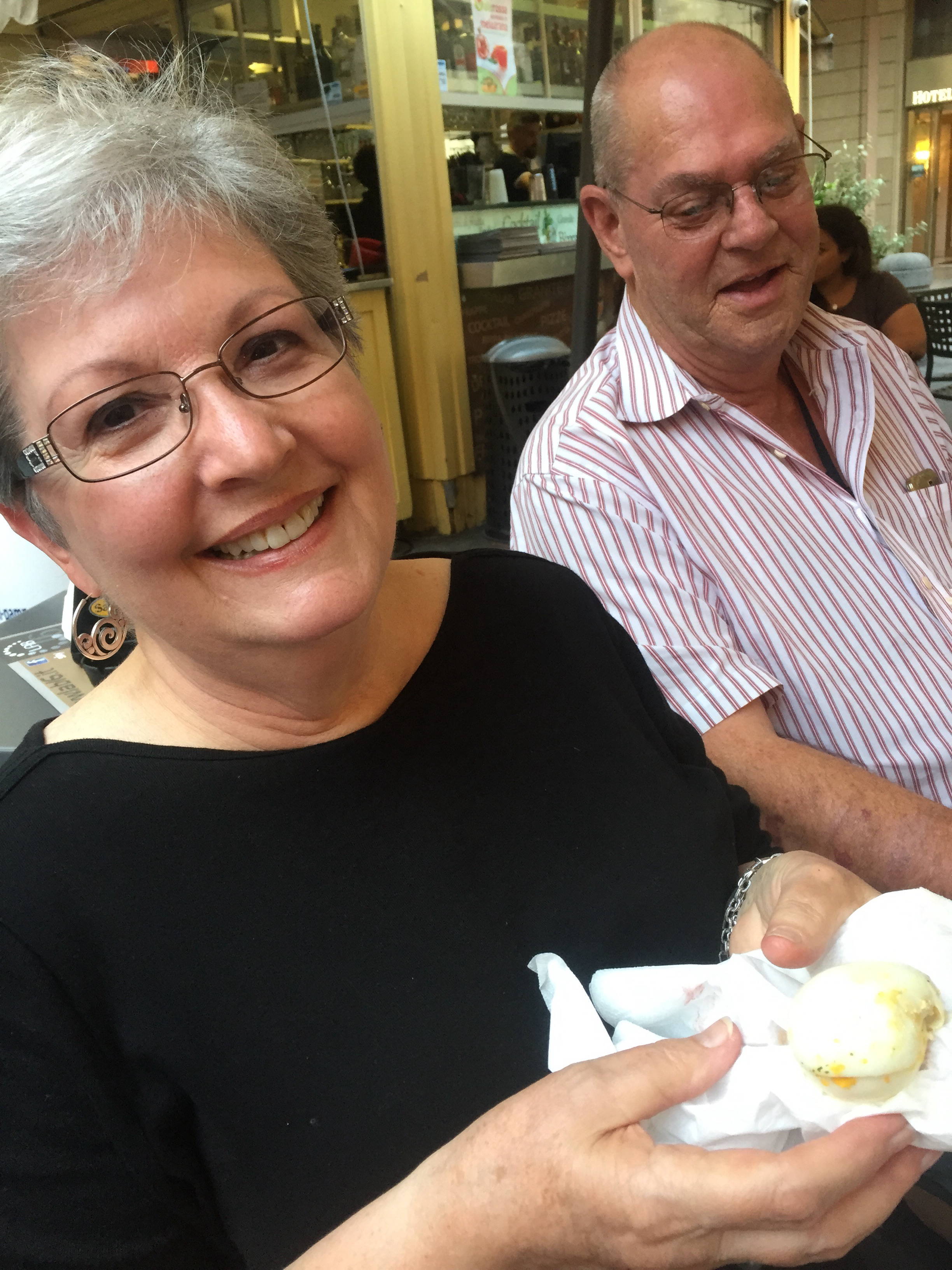
The Egg & I, Starring Rhonda Krahn – “Can Borrow that Egg?”
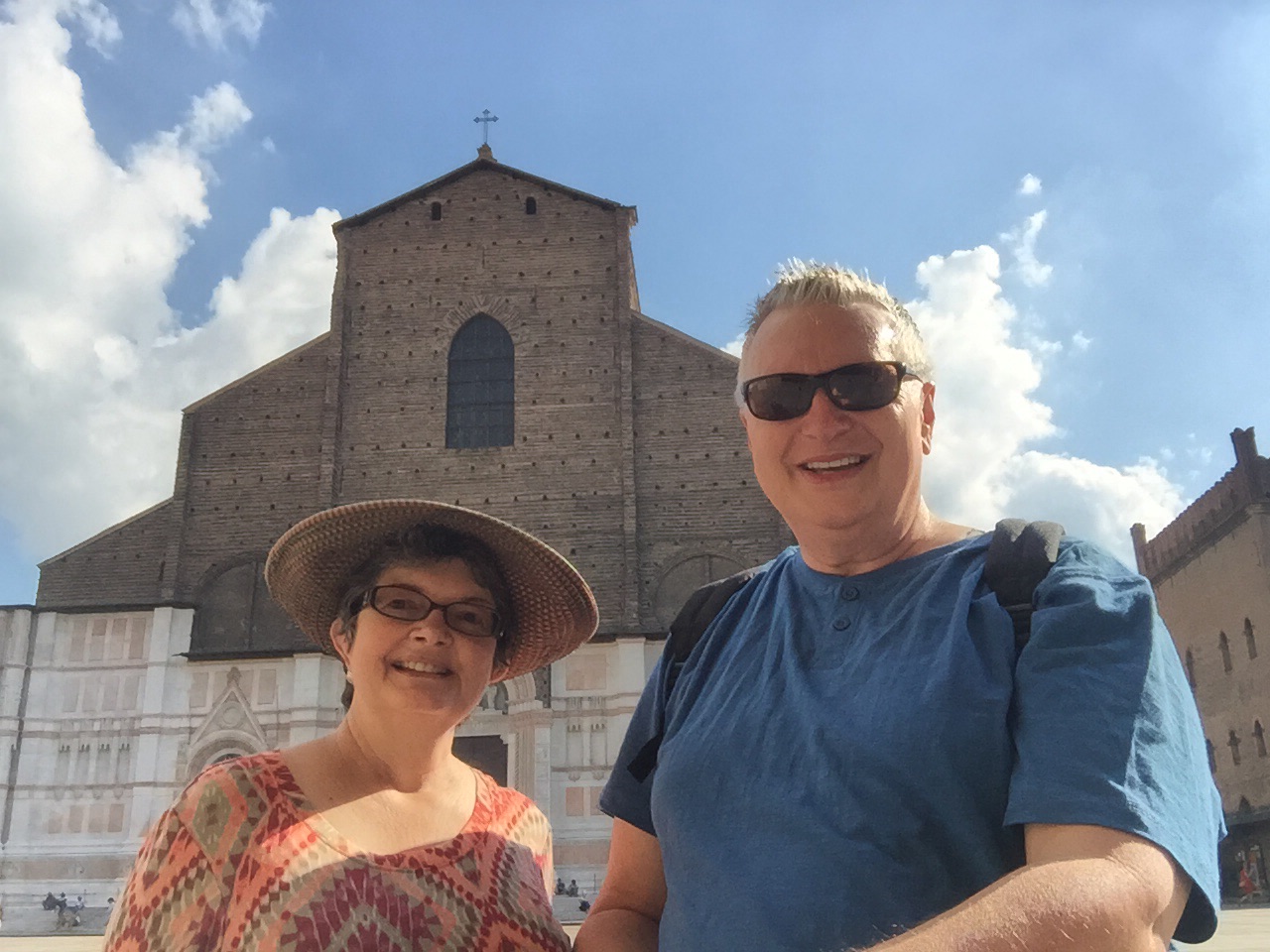
Wayne & Kathy, Bologna, Italy – August 25, 2015
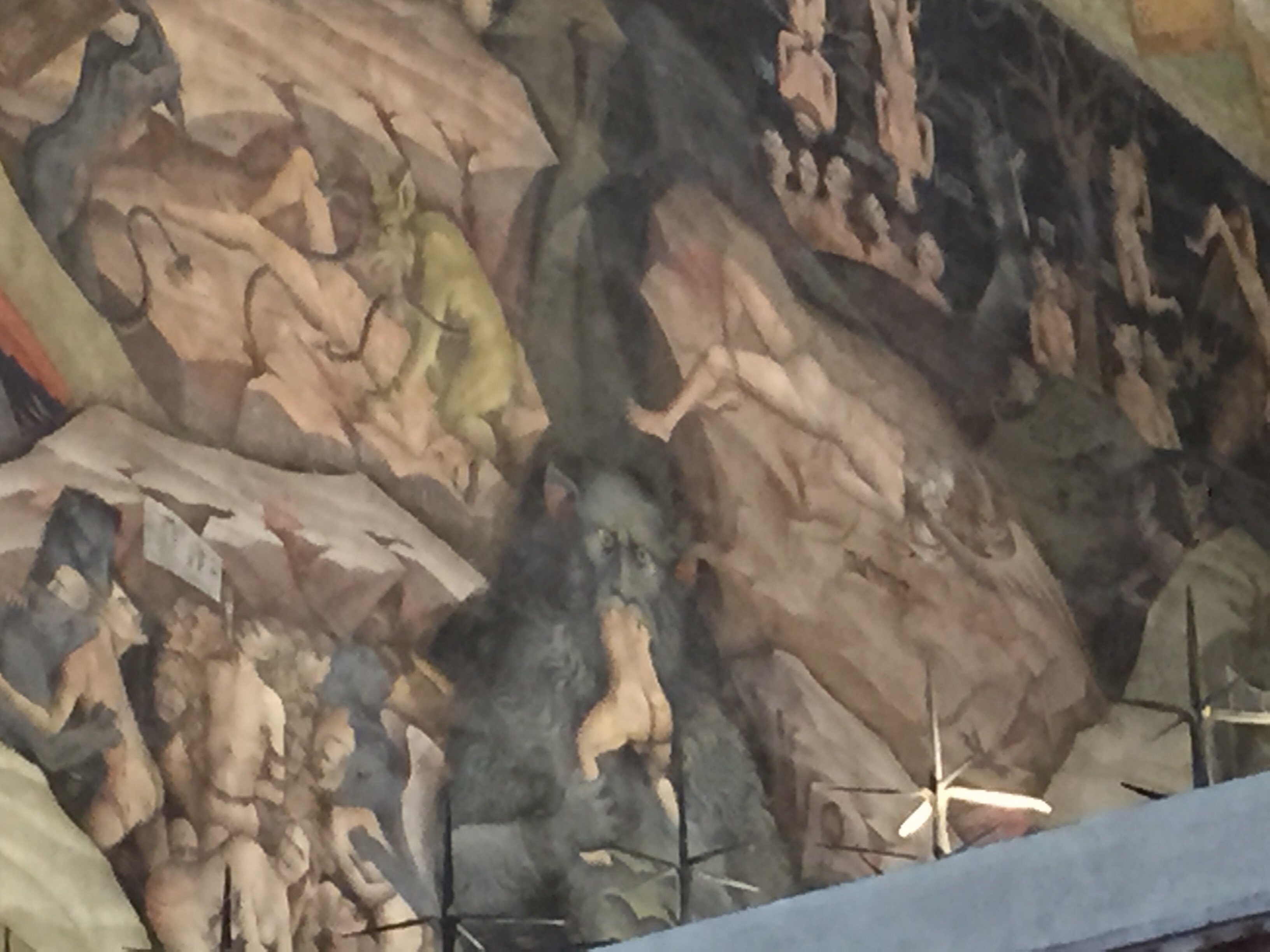
The famous painting following Dante”s imagery in the Chapel of the Magi at the Basilica of S. Petronio, Bologna’s largest church
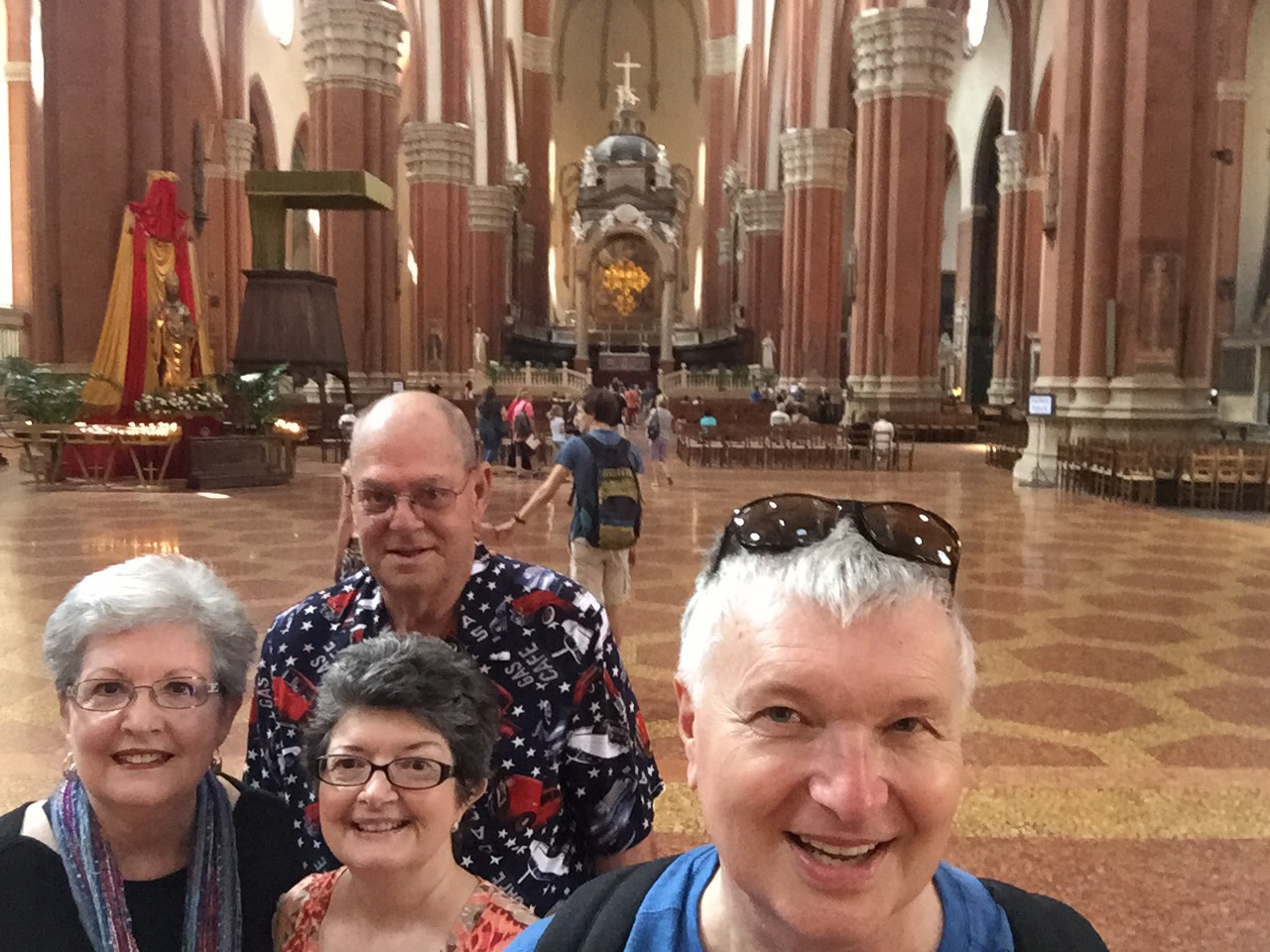
Rhonda & Allen Krahn, Wayne & Kathy Graumann – August 25, 2015
 kgraumann
 wgraumann
 gofarther.me