
Charlotte’s Shoes & the South Tyrolean Bands

Charlotte’s fashionable Italian shoes
Leaving the beautiful Italian lake country behind, we trained to “Fair Verona” for a stroll through the streets to see the Arena, the second largest Roman amphitheater after Rome’s Coliseum. I have seen the arena on television many times since it is featured in musical and theater productions frequently. It is not, therefore, a ruin, since it is in rather good shape after these thousands of years of use. Verona is a very nice city, clean, easy to navigate and with many historical sites. Of course, we had to go by Juliet’s balcony made famous by Shakespeare in his soliloquy for Juliet on that balcony–“Romeo, Romeo, wherefore art thou, Romeo.” Naturally, the tourist balcony is not the real one; however, thousands flock to it and leave love messages on the walls around it. While in the city, Charlotte could not pass up a pair of Italian shoes that she spotted in a shop window. Dan thought that she had brought along enough pairs of shoes–totally missing the point, that these were Italian shoes, and this was a special vacation purchase. Everyone cheered Charlotte on to buy the shoes, which she beautifully wore the rest of the day.
We then trained on to Bozen (German) / Bolzano (Italian) in Italy’s South Tyrol, formerly a part of Austria. Most people here still speak German, and the region has a unique atmosphere with distinctive foods and architecture–not Italian and yet, not quite Austrian either. We were surprised that, as we strolled the wonderful streets in the crisp air, we heard the strains of music. Happily, this evening a concert of several bands was playing in the Walther Platz (piazza/square). With South Tyrollean Alps looming overhead and the cathedral bells pealing, we sat to eat in an outdoor cafe where we could both see and hear the bands play. Dressed in native South Tyrollean dress as they marched and played, we experienced a true unexpected travel experience. I approached a band member who spoke English, and he explained that each valley in the region has similar unique traditional clothing with important distinctions that characterize each region; each region also supports a band. How blessed we were for this great evening of fine music! WEG – September 12, 2015

The Arena in Verona, Italy
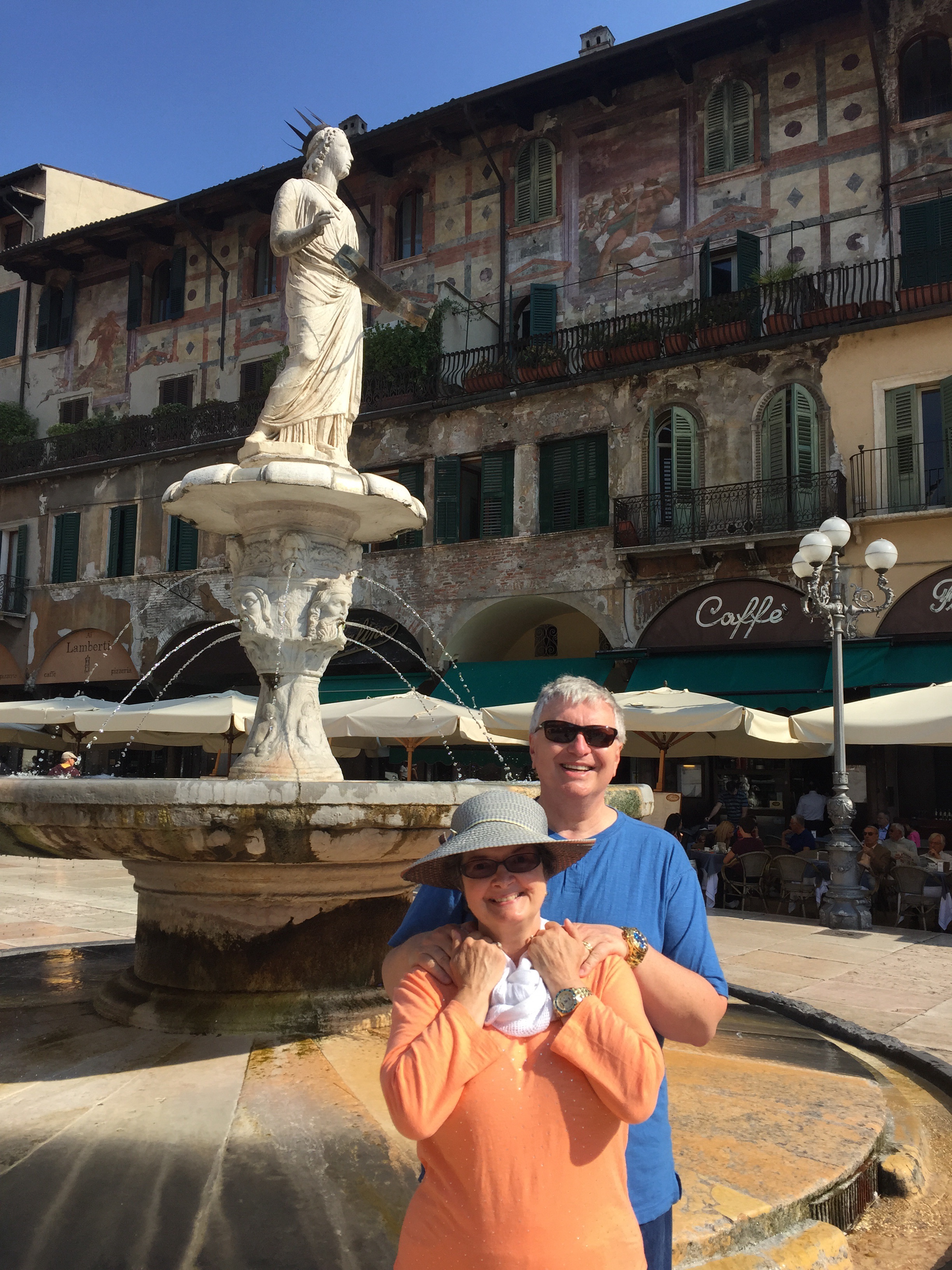
Wayne & Kathy in Shakespeare’s “fair Verona”
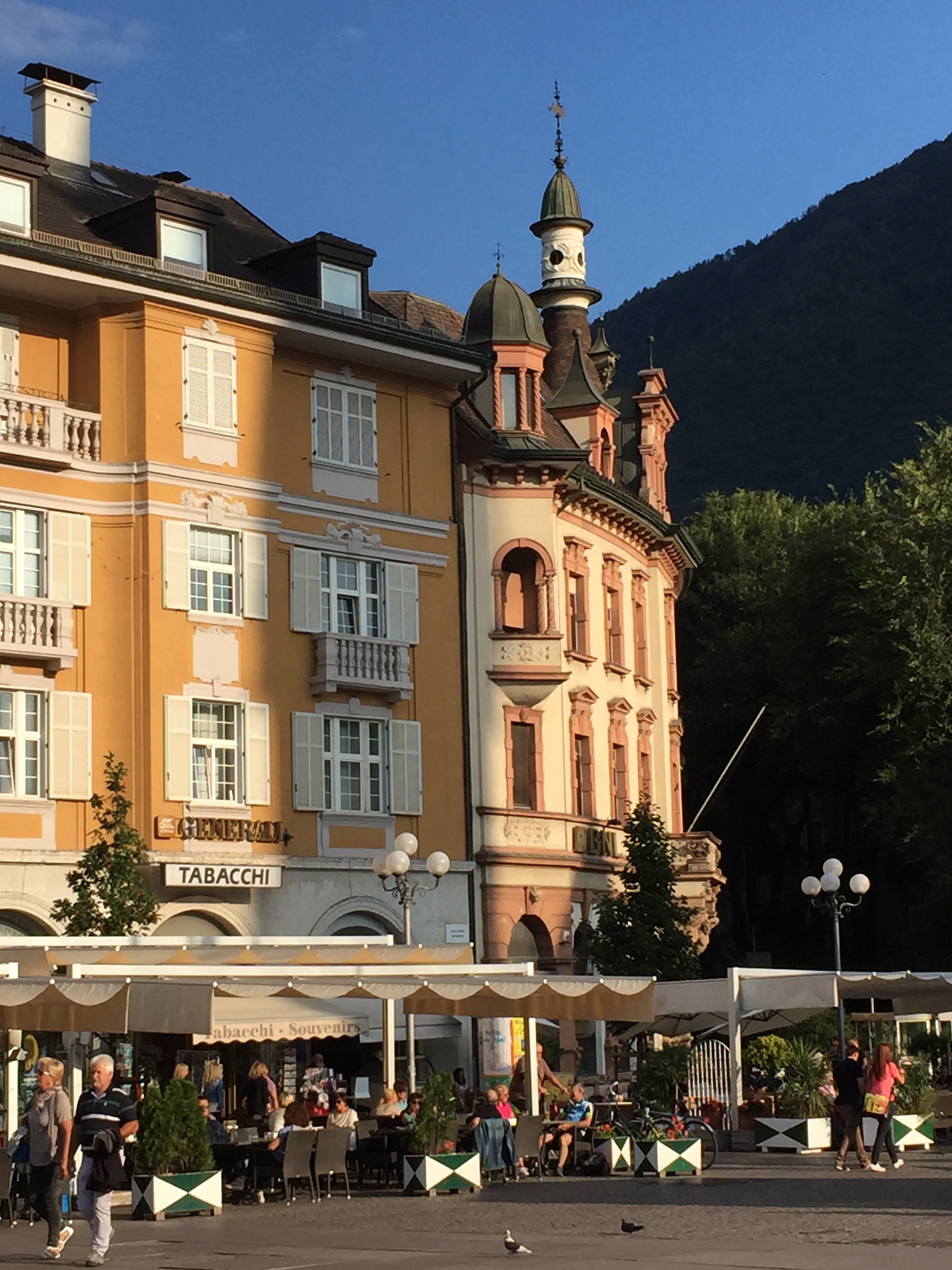
Balzano/Bozen, Italy
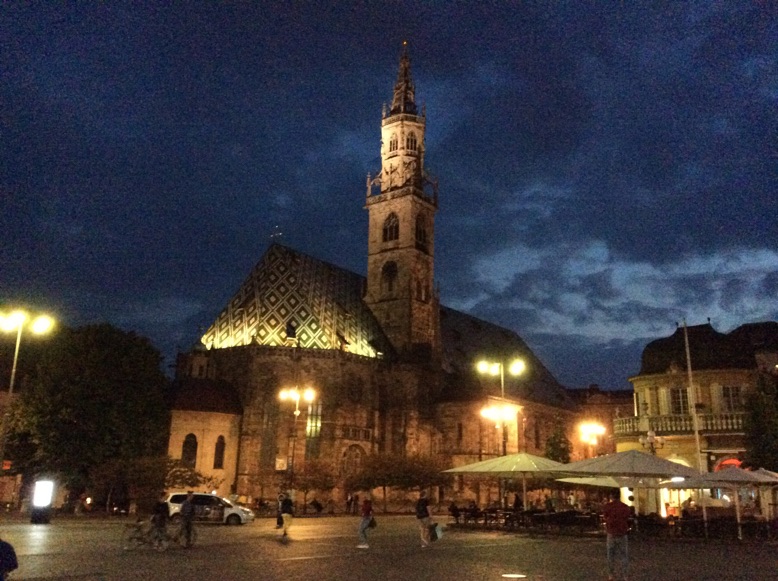
Bolzano/Bozen, Italy (photographed by Allen Krahn)
On Top of Old Baldo

Charlotte Berg at lunch in Limone overlooking Lake Garda
Allen and Rhonda hung back for a relaxing day in Sirmione. They explored the third century Roman villa ruins (built upon ruins from the BC period) that overlooked Lake Garda. The home of a very wealthy unknown family, the huge ruin is known for its grotto bathhouse that had heated water by running water over a marble floor with fires built underneath.
The rest of us headed out for a day on the lake. The waters were calm as our “fast” boats, one a hydrofoil, sailed from one beautiful lake town to another. Most had castles and tall steepled churches with wide walking promonades and sail or wooden boats bobbing in the harbors.
Dan and I debarked at Malcesine for our trek up Mt. Baldo. We rode the cable car up. It is the only cable car in the world that rotates as it ascends, giving everyone a wonderful view of the lake and mountains below and beyond. Once at the top, we did some hiking toward the hang-glide departure point. We watched as the riders ran forward until the wind caught their sails and up they swooped and then out over the edge of the mountain and over the lake about 10,000 feet below. Such a wondrous sight as one after another went over the edge sporting brightly colored sails.
While we did our mountain climb day, Charlotte and Kathy went on to Limone, a picturesque lake town that is narrow and long since the cliffs of the mountain behind it left no room but for several streets. Strewn with flowers and fountains, Limone is know for the enormous lemons that grow in orchards on the slopes of the mountains around it. It is especially known for its limoncello liqueur sold in bottles of every shape and size imaginable.
Allen and Rhonda met us at the Sirmione port, and we shared stories of the day over another wonderful meal. We all pronounced our various adventures “just right.” WEG – September 11, 2015
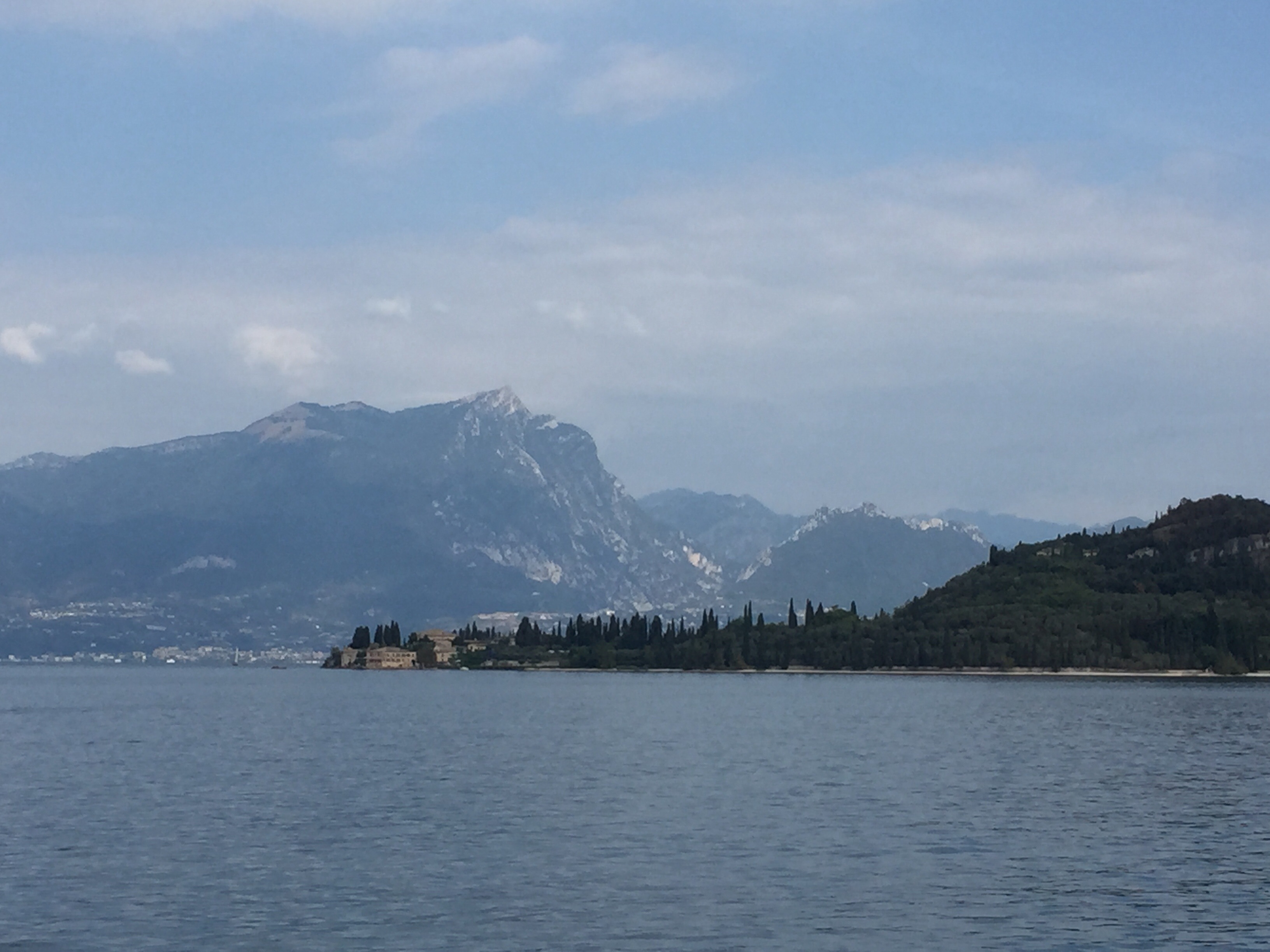
On Lake Garda

Scene on Lake Garda, Italy

From atop Mount Baldo overlooking Lake Garda in Italy
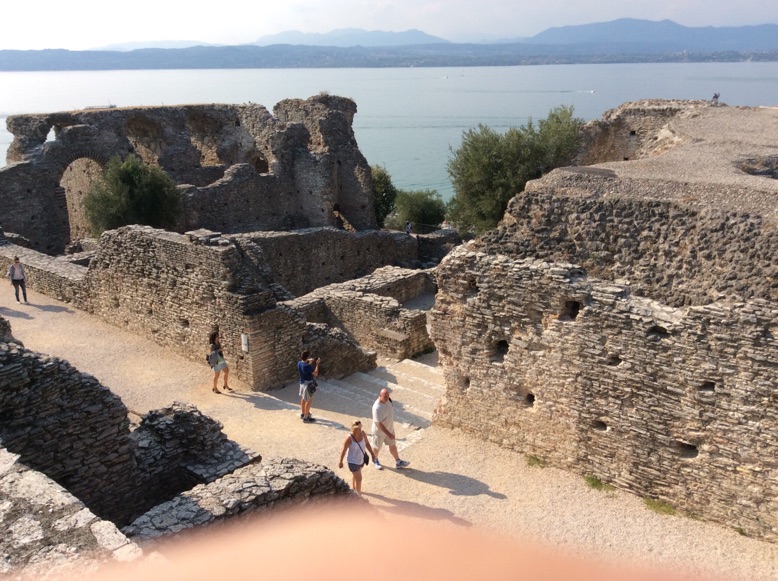
Third century Roman ruins found in Sirmione, Italy
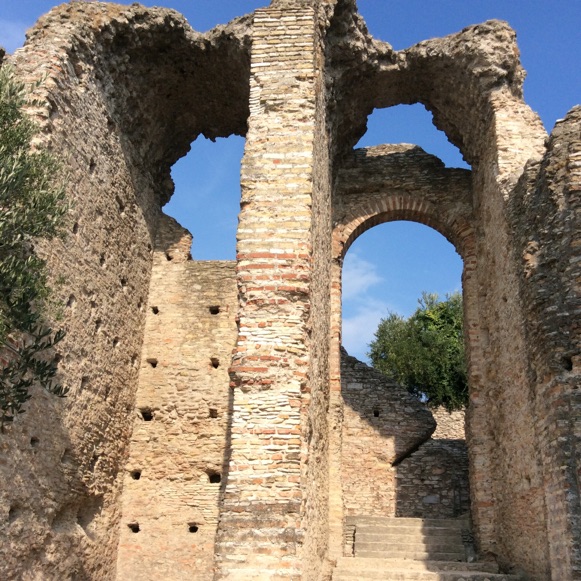
Third century Roman ruins in Sirmione, Italy
The Lake
I sit outside in 60 degree Fahrenheit temperature with a light breeze on a balcony outside our hotel room looking out over Lake Garda in Italy’s north lake district. This is Italy’s largest lake, and it stretches from a flat plain to the Italian Alps. The water is light blue and clear. We stayed the day in Sirmione, known as the Pearl of the Italian Lakes. It lies on a narrow peninsula on the southern part of the lake and is surrounded on three sides with water. Entry into the town is through the gates of a medieval castle.
Since Sirmione is a pedestrian zone, we walk the streets easily. They are cobblestoned and narrow. Lining the streets are blue, orange and yellow plaster-coated buildings interspersed with stone buildings. Archways and pergolas abound. Bouganvillas are in bloom and climb walls and arbors. Other flowers fill flower boxes. Marble piazzas break the pattern of the narrow streets and church bell peals bounce from wall to wall. The lake is easily in view from either direction and small boats and sail boats slowly ply the waters. Ducks meander in the streets near the water. It is a refreshing and relaxing day in this cozy beauty as we go from one unique shop to another. Organic and natural are key words here.
Once again, our evening ends with a meal–this time on the piazza looking out at the castle. Food choices include parma ham and melon, salmon and sautéed spinach, pumpkin and sage ravioli, grilled white fish with grilled vegetables and fried calamari, sardines and shrimp. A good red wine from the region added depth and richness. With the sun setting, we “moseyed” home, and I walked out onto the balcony to write this blog. WEG – Thursday, September 10, 2015

Sirmione, Italy
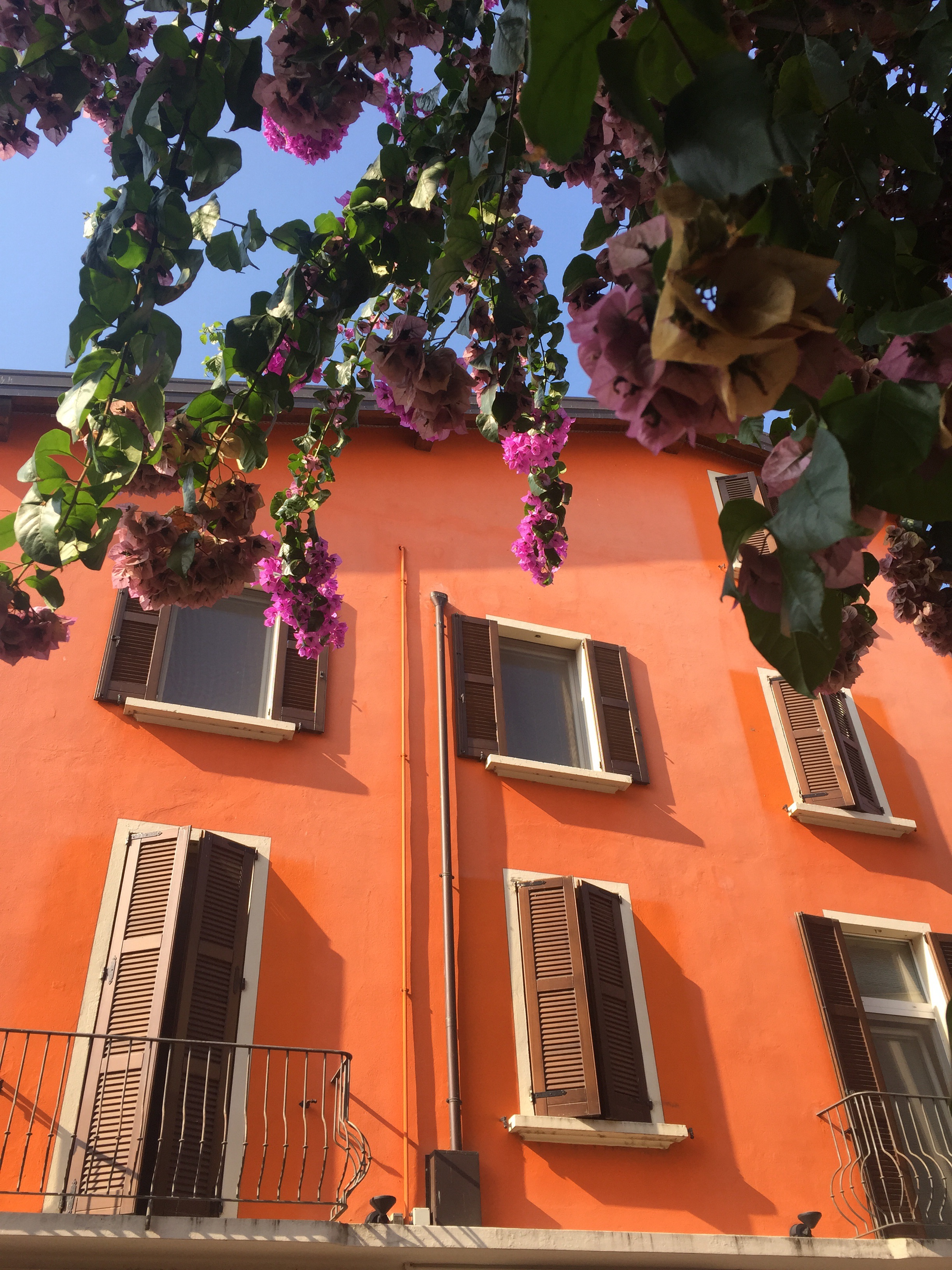
Sirmione, Italy

Sirmione, Italy – one of the many store windows
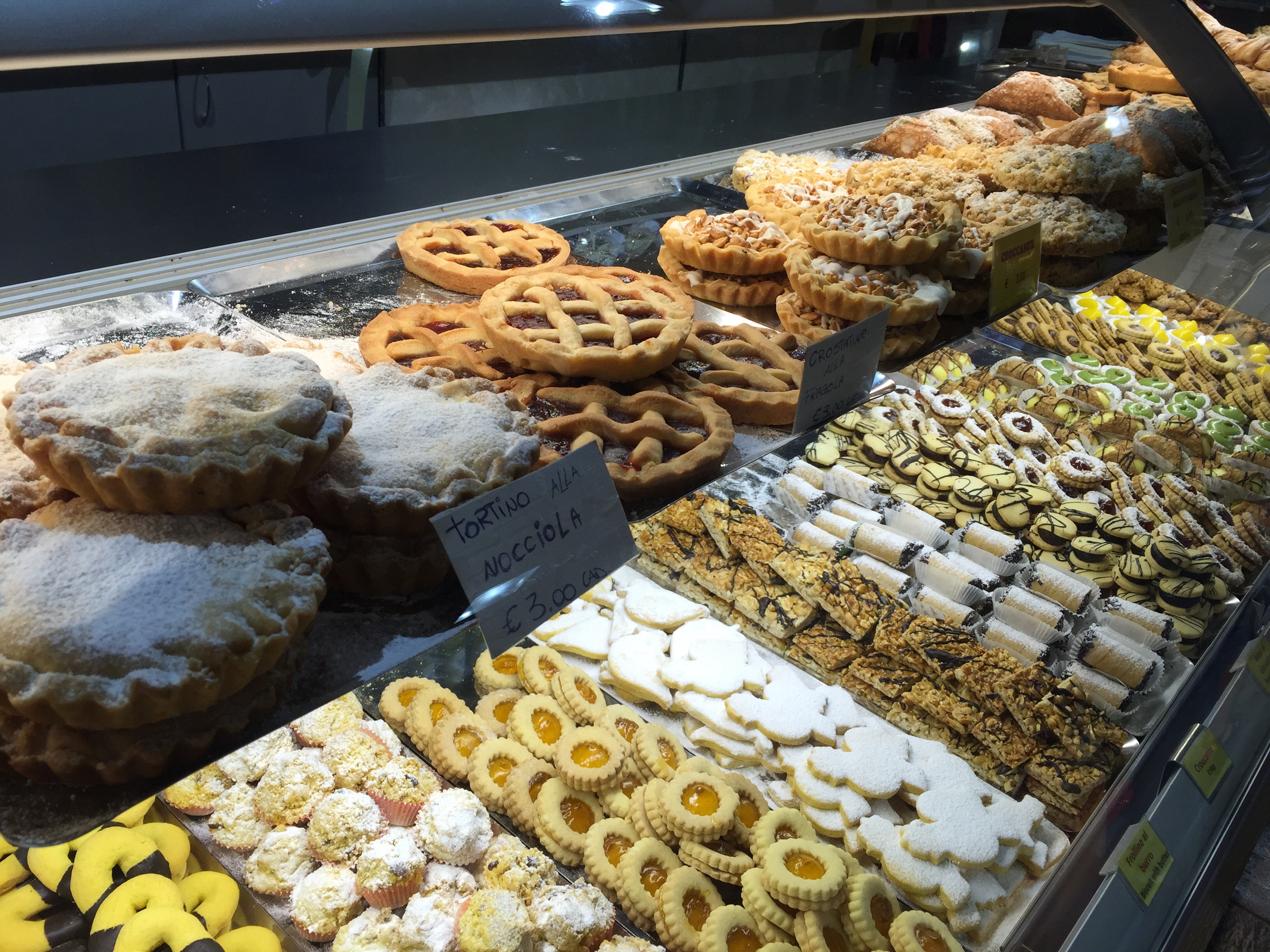
Some of the delectable pastries available in Sirmione, Italy
A Wild Goose Chase
Dan Berg has been looking forward to visiting the Beretta Gun Show Room in Milan for months. I took pains to make sure we could work it into our schedule. “Beretta is the oldest gun manufacturer,” said Dan. Since Dan hunts and has a gun collection, he knew that Italy contained some of the finest and most expensive weapons manufacturers in the world. Today, we set aside the morning for the guys to go to Beretta and the gals to go to the original, as in centuries old, galleria close by. Dan had made sure to have the directions, having looked on the internet prior to leaving Texas and reaffirming the location with our hotel clerks. We took the Metro from our hotel to the area close to the show room. Off we went since Allen had the location pinned on GPS–how could this be the wrong direction? The GPS signals were confused by the buildings. Back we went. Around we went. Down we went, and up we went. City map out–compare it to the GPS. Dan did not write down the address. Dan did not have the directions from the hotel clerk. Scratch heads–walk further. All of the sudden, Dan said the location looked like what he had seen on the internet. Yeah–a Beretta sign. At last! WHAT, where are the guns? This is a woman’s fashion center in a fashionable part of town. “Dan, did you verify on the internet that this was a gun show room?” “No, I saw Beretta Gallery and assumed it was guns.” “YOU WHAT!?” We had walked almost two miles searching for a Beretta gown not gun. We made Dan purchase some “fufu” for his guns. Later, we verified with the tourist center that there has never been a Beretta gun show room in the city in Milan’s 2400 year history.
The afternoon was spent in Milan’s majestic high Gothic Duomo (cathedral). Soaring and many spired, clad in marble, the Duomo is the fourth largest Christian church building in the world. The interior is breathtaking and can hold 60,000 people. The stained glass tell the Bible stories, both Old and New Testament. Since most people were illiterate during this time, the stained glass was their Bible. Over 50 massive and image-carved marble columns reach upward to a ceiling that is filigreed in an intricate design. A beautiful high altar and canopy point heavenward. Encased high above is one of the nails used at Christ’s crucifixion. Brought from Jerusalem in the 300s, it is one of the better authenticated relics found in churches throughout Europe. Only twice a year is the nail brought down to observe. Near the entrance of the Duomo, a thin gold line crosses the floor the width of the cathedral. From noon to 1pm each day, the sun light shines through a hole purposely built into the wall, and the rays fall on the day of the year on that gold line. Amazing.
The visit to the famous Teatro alla Scala (La Scala opera house) was a treat. The opera house has near perfect acoustics, and we stood in the highest level “pigeon” boxes (every seat and every box has an unobstructed view) and looked down on the golden room and upon the world’s largest production stage.
Later in the afternoon/early evening, we were privileged to view Leonardo da Vinci’s masterpiece, “The Lord’s Supper.” Painted on the wall of a Dominican monastery in the late 1490s and located just off the city’s old town, we first had to go through two decontamination rooms before entering to see the massive and fragile wall painting. The painting barely survived World War II, since a bomb blast shattered the entire building, but left the painting intact and in the open air until the building around it could be reconstructed. We learned some interesting facts–the painting was conceived to portray the moment Jesus said that one of the disciples would betray him, as, of course, Judas would do. Da Vinci painted Peter with a knife in his hand ready to kill anyone who would try to harm Jesus. Judas has a pouch in his hand that contained the 30 pieces of silver. The great artist used a girl’s face as a model for John because John was a teenaged disciple and not yet a man. What an inspirational joy those short 15 minutes were!
The evening found us at an outdoor restaurant enjoying some of the culinary specialties for which the city is known. My risotto with parmesan and white truffle sauce was very good! WEG – Wednesday, September 9, 2015
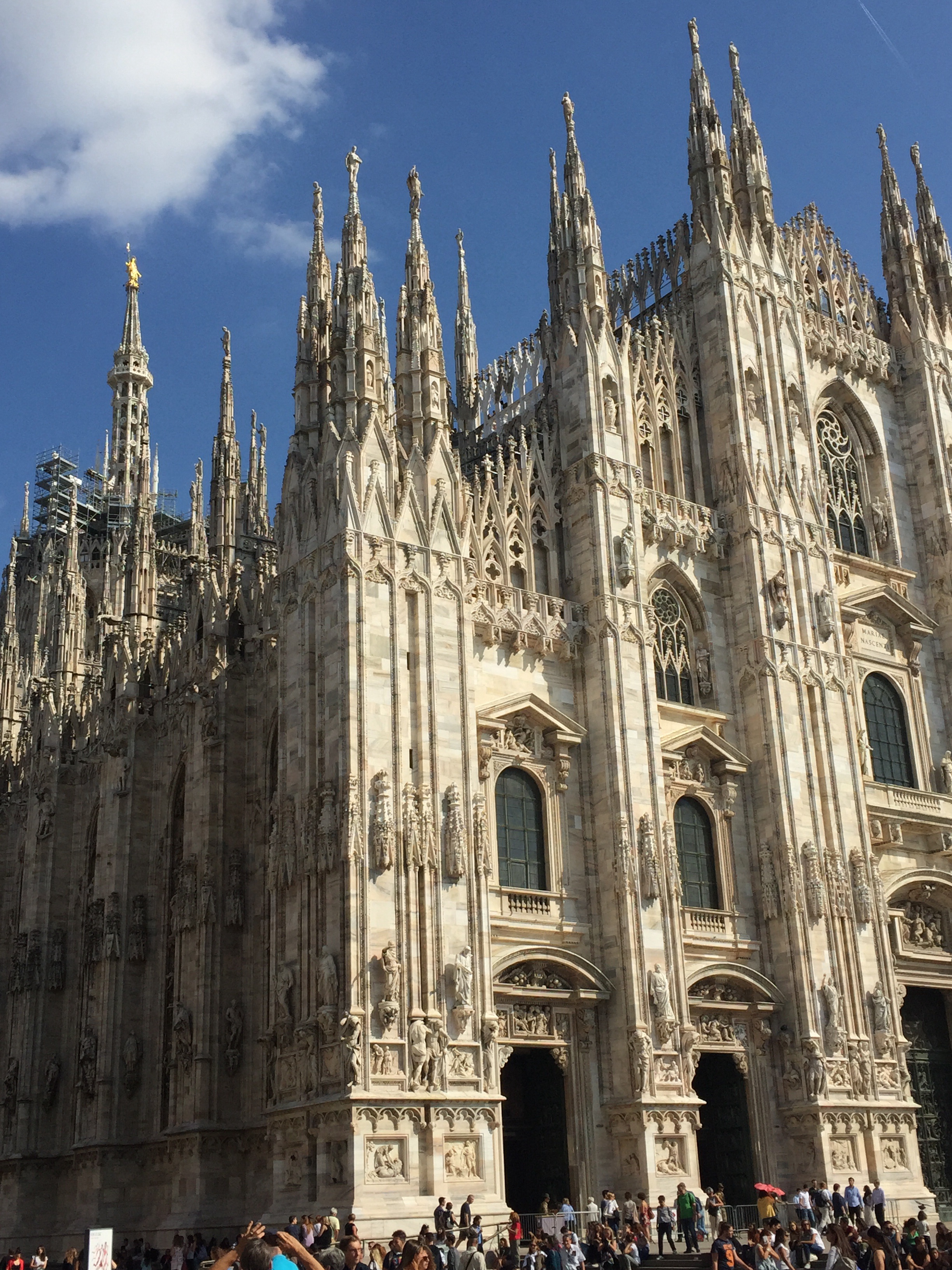
Milan’s Duomo

Milan’s renowned Galleria housing elaborate fashions of Prada, Versace, Louis Vuitton, Gucci, and others

One of the stained glass windows in Milan’s Duomo portraying in pictures the stories from the Bible intended to instruct those who were illiterate in the message of salvation through Christ
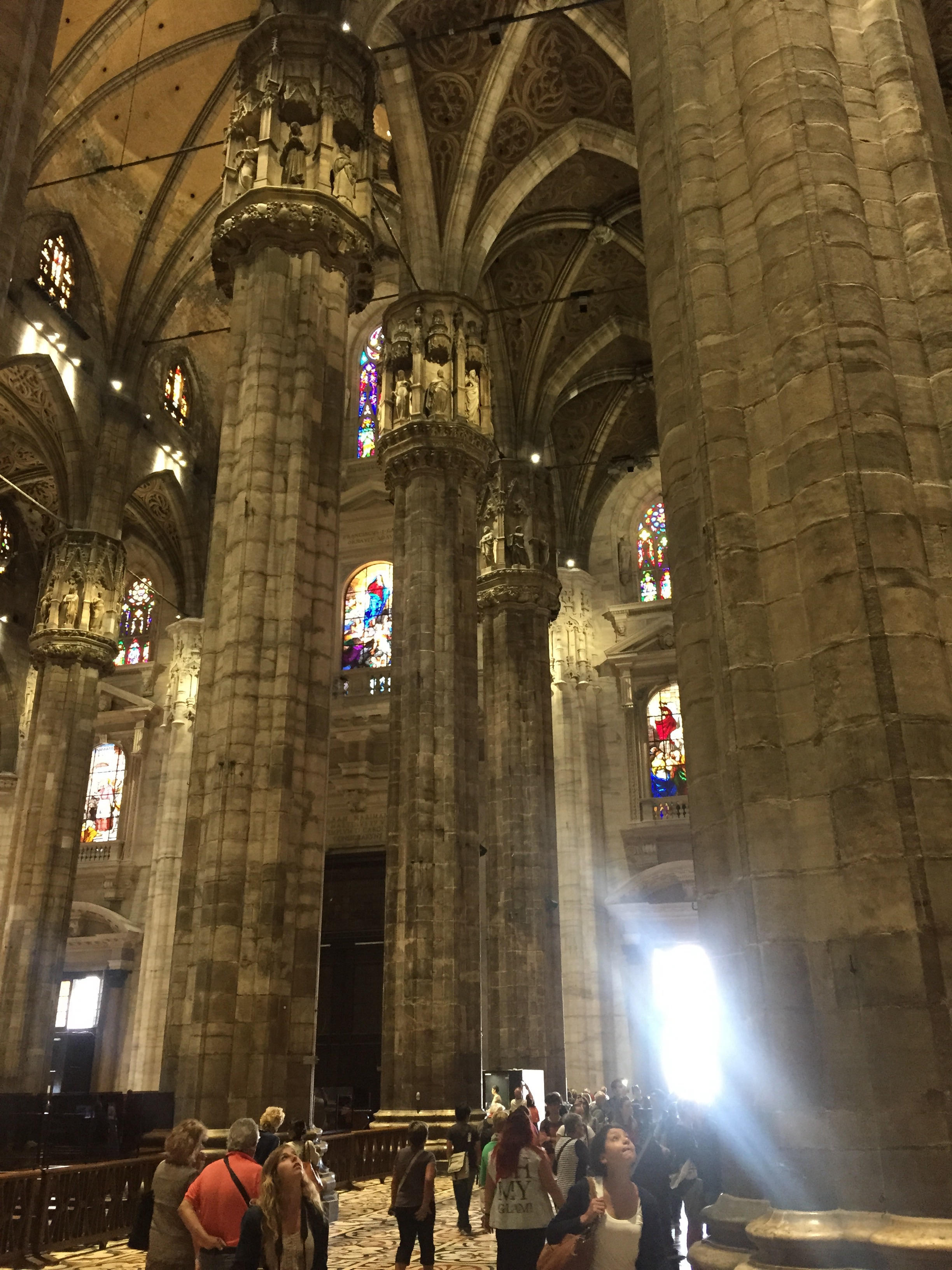
Marble columns in Milan’s Duomo
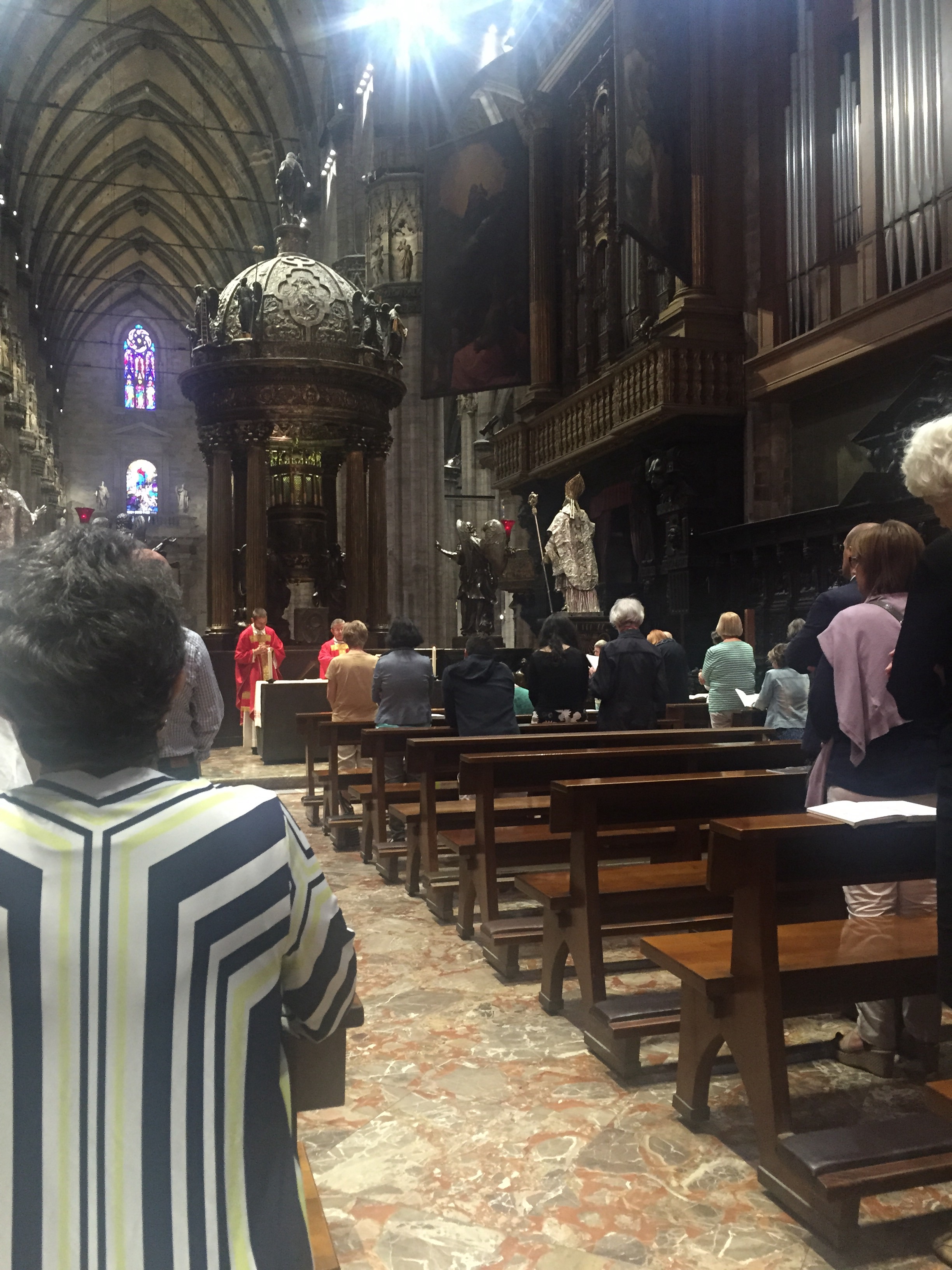
We had the opportunity to experience worship in the Milan cathedral.

Inside the Milan cathedral

Tuning the Steinway inside the museum of La Scala opera house, the very piano of Franz Listz

A visit to Milan’s Sforza Castle

Evening scene in Milan viewing the Sforza Castle from our outdoor restaurant
Expo 15 – Milan, Italy
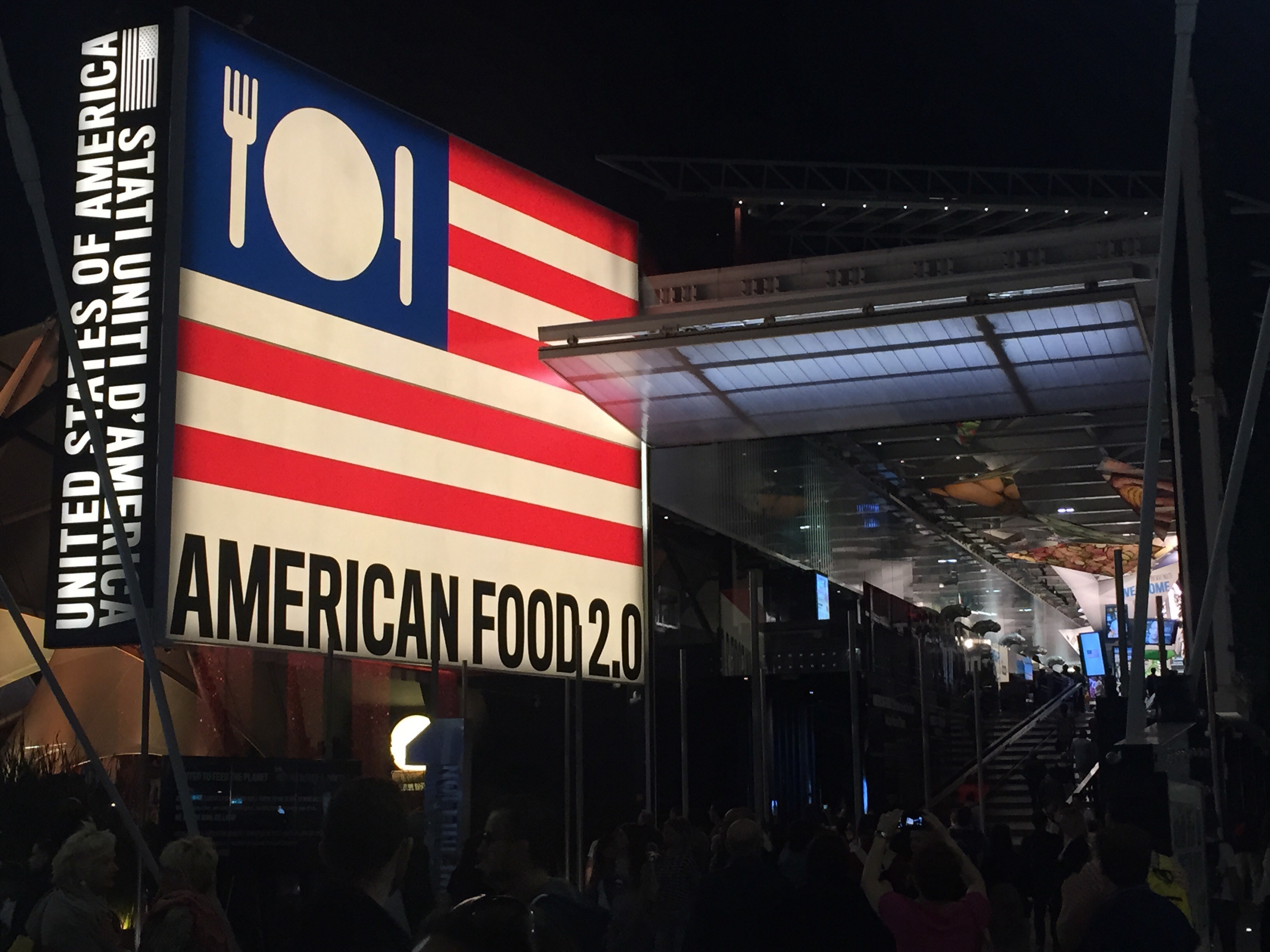
The United States exhibit at Expo 15 in Milan, Italy
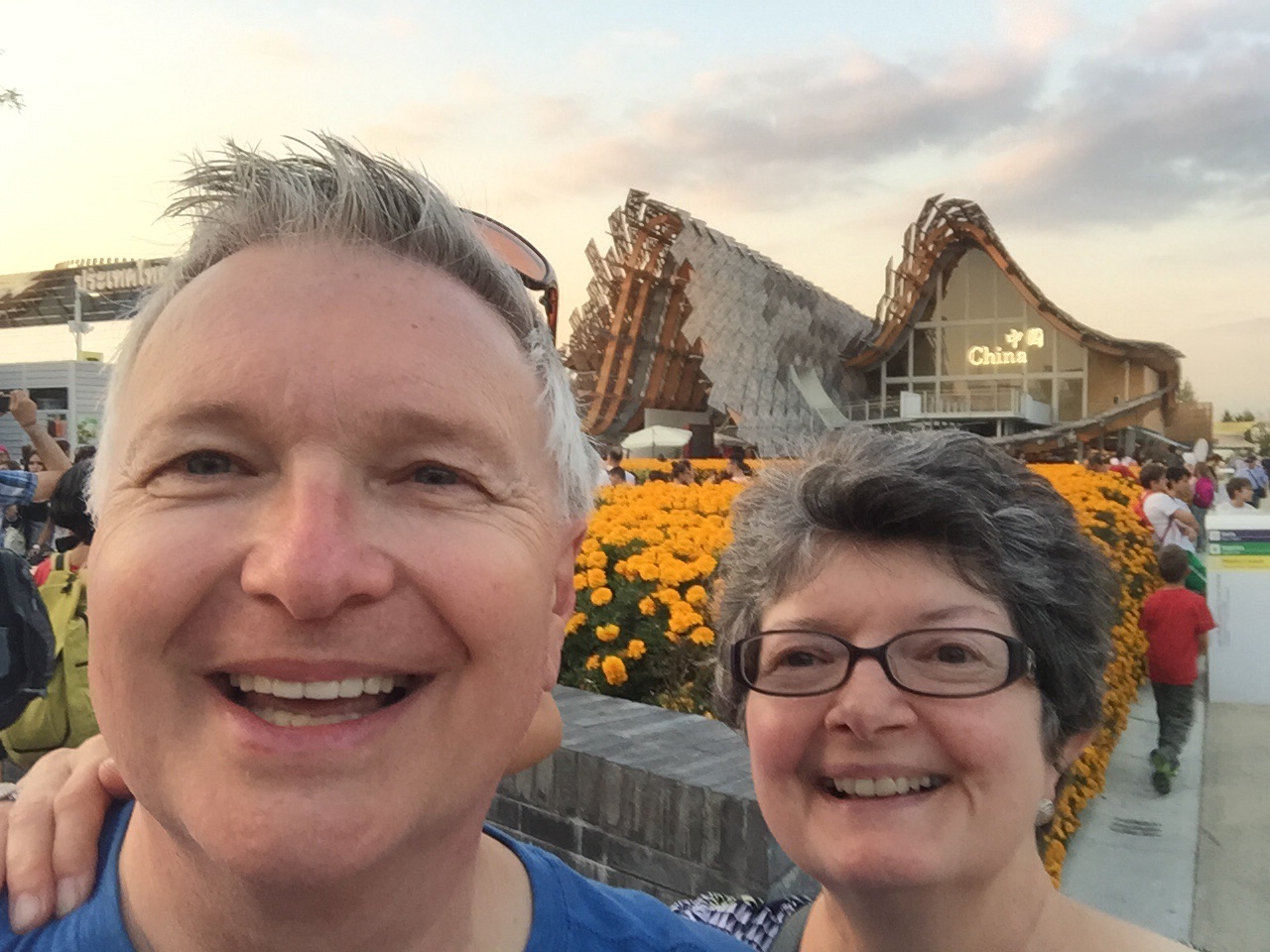
A selfie at Expo 15 in Milan, Italy – Wayne & Kathy were there!
Today was World’s Fair Day as we trained to Milan. Milan is noticeably upscale and fashionable. It is Italy’s banking and commercial heart, and it is known worldwide as a fashion and design center. Expo 15 is a huge attraction to the city with countries from Angola to Zaire participating by hosting beautiful and unique event buildings at the Expo site.
The theme of the Expo is food production and sustainability. Kathy and I are on stimulation overload. The site is quite well-organized, and the layout is simple and easy to navigate in spite of the large crowds of people from around the world. However, the lights, the sounds, the fountains, the sculptures and the buildings are amazing. Besides the nations that are participating, many corporations involved in food production, as well as Italian corporations, have inviting displays and buildings. Almost every country has food that is indicative of that country, as well as flowers and plants. Products, mainly related to food, are for sale.
Just a few random sites or observations: Ten high fashion models using the main concourse (that stretches about half a mile) as a runway; every state/region of Italy hosting a restaurant in the Italy section offering food for which they are known; Israel having a slanted roof on their building on which were planted the crops grown in that country; large screens, worthy of Times Square, featuring food from around the world; countries in which coffee is a major export grouped together and each offering it to drink; interesting and large light sculptures in the central site piazza; the magnitude and scope of the displays; the variety of building designs quilted together to make a whole; Vatican City’s “Give us our daily bread” quote on the entry and the huge plexiglas, “Rebuild Nepal,” offering box filled with generous monetary donations.
I have never been to a world’s fair and may never again, but I am glad Kathy and I were able to spend time at this one. WEG – Tuesday, September 8, 2015

Expo 15 – Milan, Italy
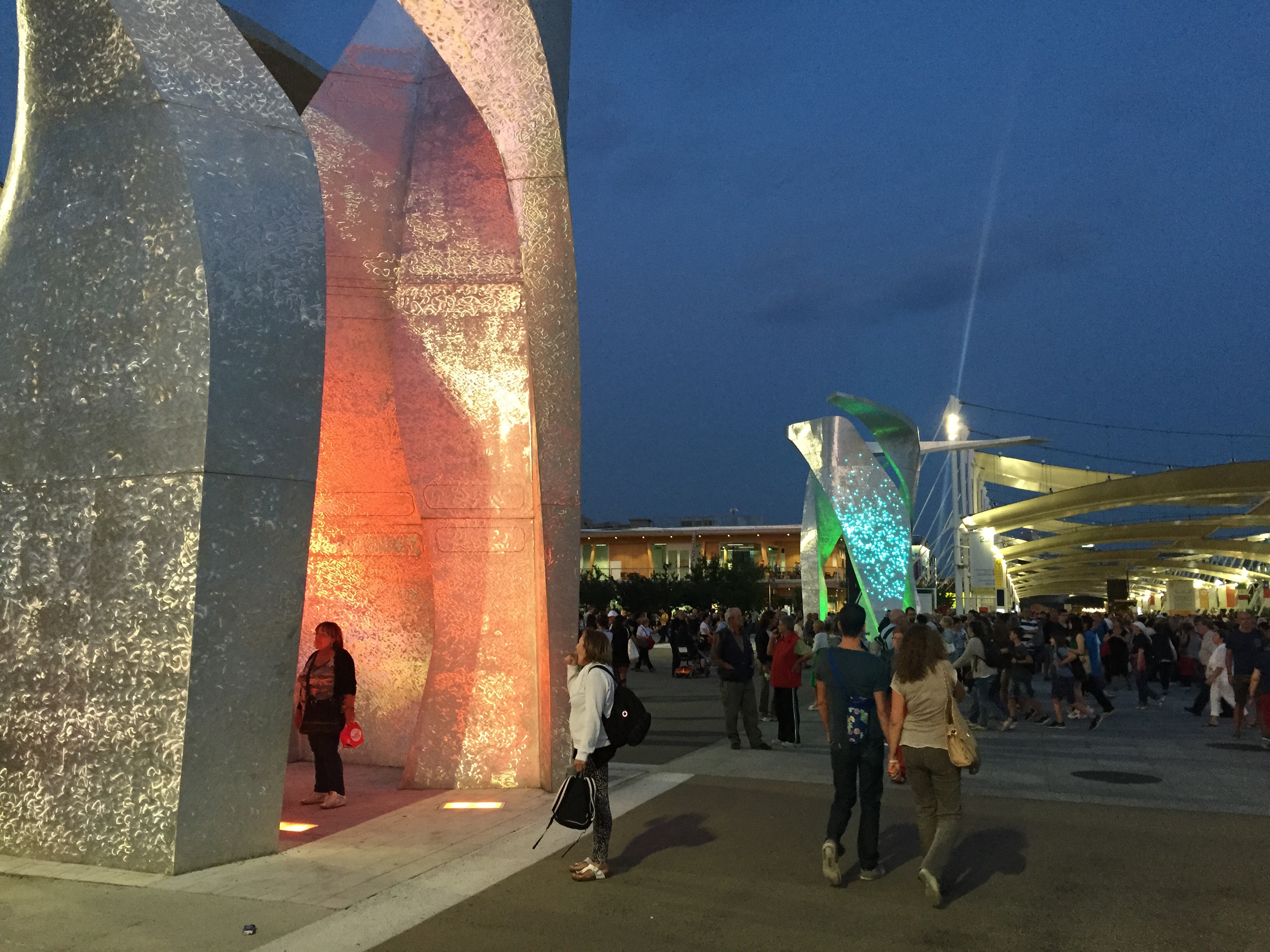
Expo 15 – Milan, Italy
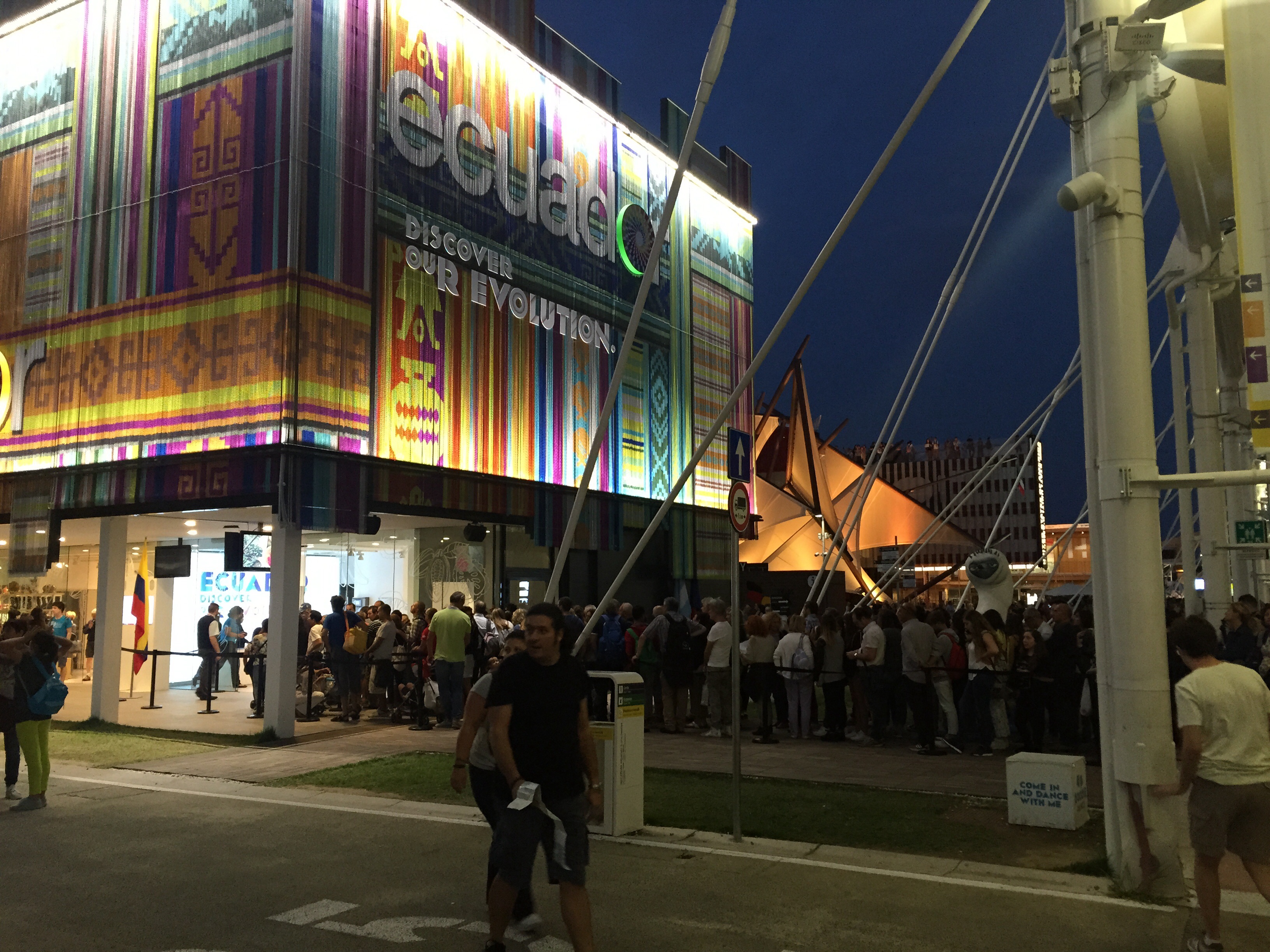
Expo 15 – Milan, Italy

Expo 15 – Milan, Italy
The Deep Blue Sea

Visiting the Cinque Terre, the 5 Lands that hover along the Mediterranean Sea
Taking the ferry out of Lerici along the Mediterranean coast to the Cinque Terra (five lands/cities that time forgot) we were immediately impressed with how clear and clean and blue the waters of the sea were. The five cities with their pastel buildings scrunched together along the crags of the cliffs above the water stood out like jewels above the deep blue. The water was calm and the ferry could dock at port–not always a possibility. We were blessed.
The day was one of relaxing. We took time to eat our wonderful breakfast at our hotel before heading out. It was a bountiful buffet, displayed with elegance. My favorites were the salamis and cheeses and the puff pastry filled with Nutella. I took time to use the unusual orange juice machine that was filled with fresh oranges that rolled down a shoot to be squeezed automatically–truly a work of mechanical expertise, and the fresh juice was fantastic. The tables were covered with linen and fine utensils and the balcony looked over the bay that was bobbing with sail boats. Lunch was taken at our favorite Cinque Terra restaurant, the Belvedere, in the village of Monterroso. Because we had eaten there previously on other visits, the waitress recognized me. That was cool! We ordered our favorite, pesto fettuccine–it is still fabulous!
One of the reasons we return here and to Italy, in fact, is that friends want to go, and they know we “know the ropes” and the sites. We enjoy seeing sites we love through the eyes of others. Today, the Berg’s and the Krahn’s declared it to be a grand day! WEG – September 7, 2015
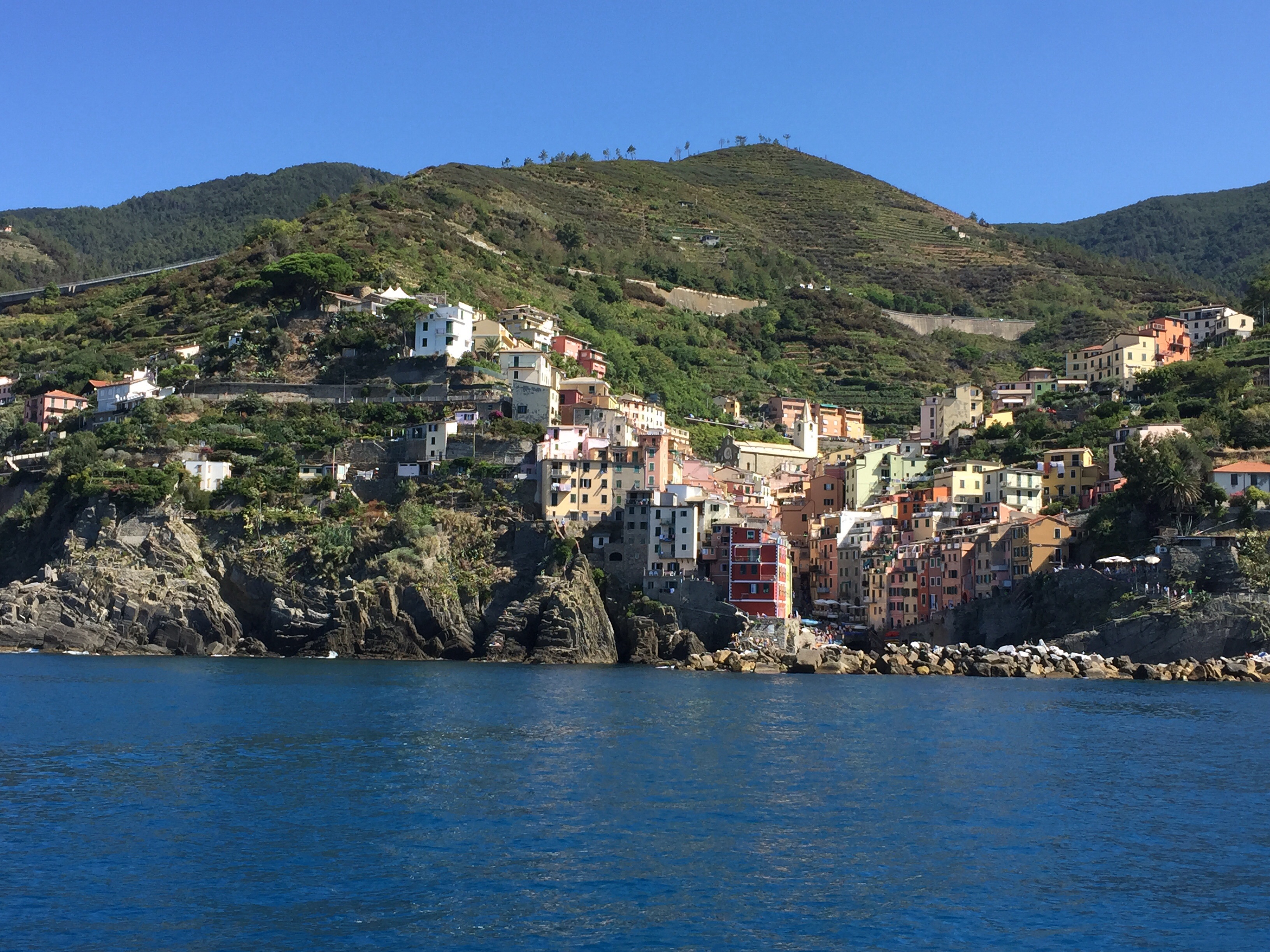
Viewing the Cinque Terre by boat
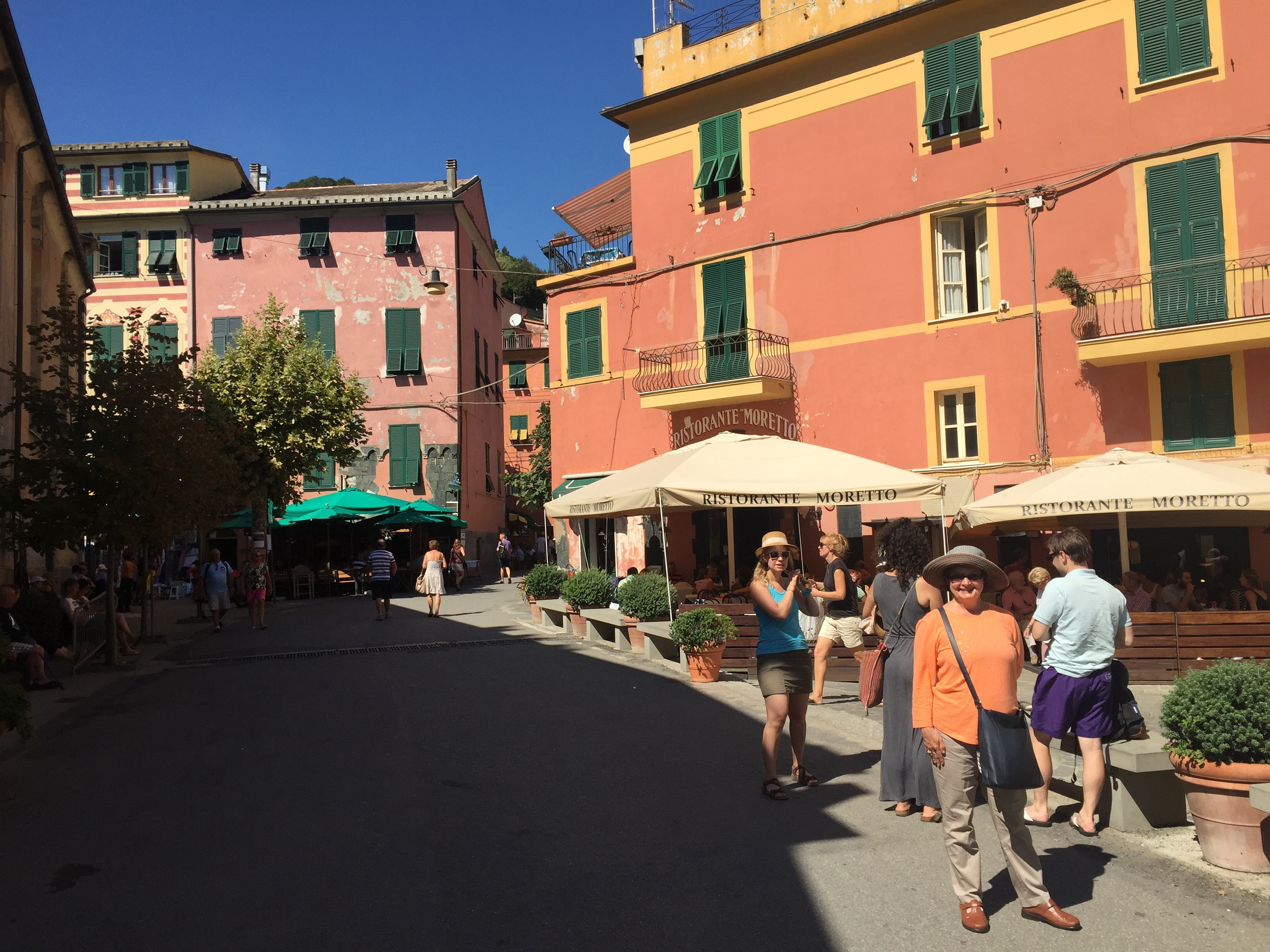
A visit to Monterrosa, one of the 5 Lands, or Cinque Terre
An Eventful Day
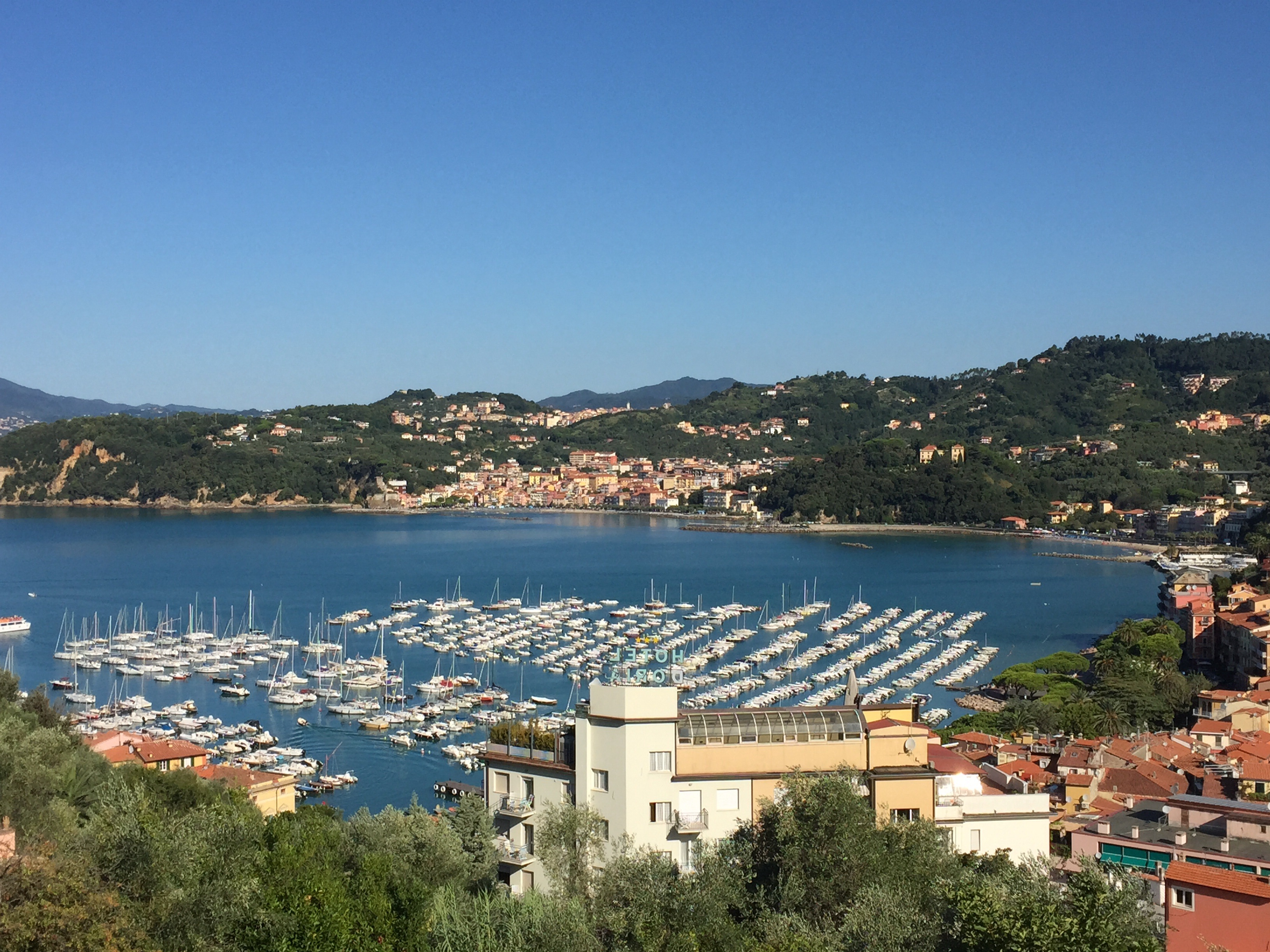
Lerici
Our rented vehicle, a Mercedes van that holds nine (we were upgraded) was a comfortable way for our six bodies (Berg’s, Krahn’s and Graumann’s) to travel Tuscany. It took us through hill and dale, and now we needed to return it to the Florence rental center near the train station. Dan drove and all of us navigated, except Charlotte who prayed. Roads are not well marked and, once in Florence, we needed to avoid the restricted zone, where non-authorized–we were not authorized–vehicles are forbidden and electronically ticketed with a hefty fine. The problem is that the train station borders the restricted zone. Having been in Florence before, I was well acquainted with the train station location, but getting there on authorized roads caused apoplexy. It may be possible we crossed one forbidden place. I will know in three months if a fine appears on my credit card, which is what happens in Italy. Thankfully, once we saw the stazione (train station) directional markers, we were able to navigate successfully to our destination. We had given ourselves plenty of time in case we got majorly lost, and we arrived over an hour early.
The trek to Pisa from Florence is via a crowded regional train. And crowded it was. Once there Dan headed out quickly to the leaning tower in order to take the climb. It is a memorable experience. The rest watched either Dan climb or the luggage. The Duomo (cathedral) and shopping rounded out the experience.
Back to the regional train we took the short hop to La Spezia where we will stay overlooking the Bay of Poets (Lord Byron wrote his poetry while he looked out upon the bay) and an ancient castle next to the Mediterranean in the small hamlet of Lerici. What a sight it is–outstanding!
PS. Dan had some unfortunate events during the day. First, he left his new and wonderful camera with precious memories captured on the chip on the train. It is gone, gone. Then, he was pick-pocketed of E200 (about $230) by gypsy women who entered the train behind him and exited the train after. An Italian man ran up hurriedly holding his own wallet and pointing and saying something we did not understand immediately. He was telling us the women pick-pocketed. Too late, Dan saw his empty wallet on the floor of the train car. Thankfully, his credit cards and passport were intact. Eventually, after the angst, Dan (and Charlotte) decided to let it go and enjoy the rest of the trip, which we shall.
WEG – September 6, 2015
A Quilt of Grapes

The beautiful hill town of San Gimignano with its 14 towers
Tuscany is every picture of Italy, save the Roma (Rome) Coliseum, that you have seen, characterized by rising hills and verdant valleys, with narrow roads bounded by either tall sycamore with peeling bark or pencil thin cypress trees. Small villages with pastel or warm beige houses greet you around the turn, and then in the distance you see an ancient stone town on a hill with a castle and/or church in the center towering over the other buildings. Sometimes, the hill town has a medieval wall or stone towers. You think the scene is unique, and then soon again it is repeated a few kilometers down the narrow road. The hill town calls up to you to come and see; yet, you realize it would take many vacations to explore them all.
Along the way, the road turns upward toward a hill and switchbacks bring you higher and higher and then stretched out below are vineyards and sunflower fields and olive groves as far as the eye can see, a patchwork of beauty. Further in the distance, more hills rise up in undulating waves. And so the scene plays out over and over again. As we travel closer to vineyards, we see huge purple grape clusters hanging from the vines. Grape harvest and fresh wine production are soon to come.
We have chosen San Gimignano as our destination. An ancient hill town surrounded by a stone wall and beautiful church, it is noted for the 14 stone towers that dot the hill–emblems of wealthy medieval families who used them to showcase their wealth and remove them from the air below in the hope of keeping disease away, especially the plague. Narrow cobblestoned streets are lined with stone buildings, today housing businesses, especially colorful Italian pottery, and various eateries. Several piazzas beckon. It is a relaxing place, except in early afternoon when the tour buses arrive (they are gone by five). We are staying in a six-room agriturismo on an active farm/vineyard just outside the city walls, held by the family since the 1500s. An organic establishment, we have vegetarian breakfasts and the chatty owner regales us in story after story. An anthropologist who has come back home from work amongst unheard of tribes and research for National Geographic, she needed to rescue the family heritage after her grandfather’s stroke. She speaks five languages! We are thankful for this amazing experience. WEG – September 4 & 5, 2015
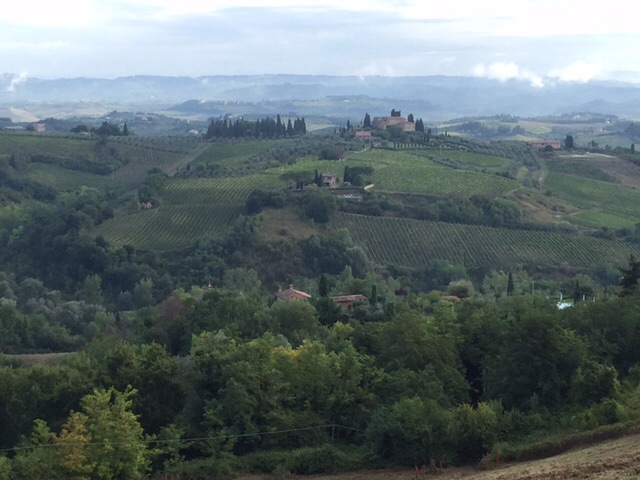
The Tuscan countryside with a view of San Gimignano

While lodging in San Gimignano, we took a side trip to the nearby hilltown of Sienna, entering by foot through one of its imposing gates
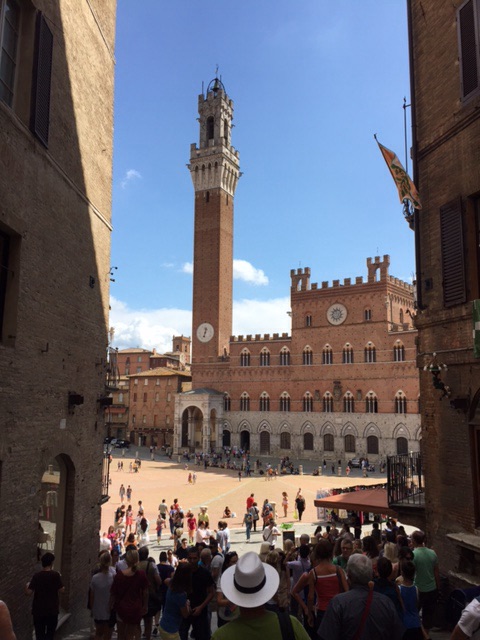
Sienna’s famous Piazza del Campo

Another view of Sienna’s breathtaking Duomo
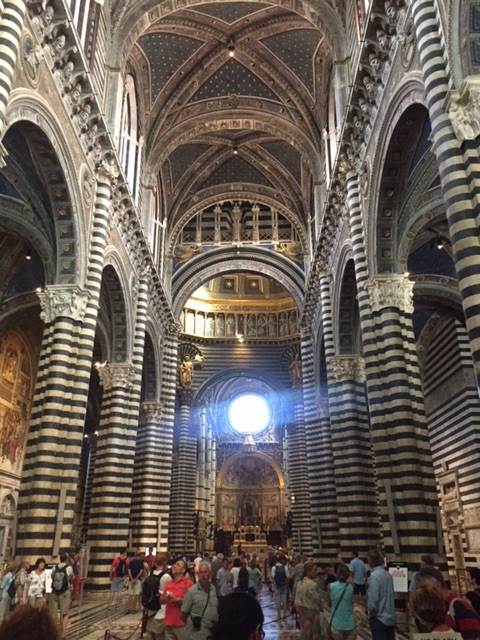
Inside Sienna’s Duomo

Inside Sienna’s Duomo

Insidee the library of Sienna’s Duomo

Eataly
This was cooking class day in Tuscany for the six travelers from Tomball, Texas. We took a morning stroll through Florence learning about the food history and food traditions in Tuscany. Our American stereotypes are so wrong. “Less is more” is the Italian thinking when it comes to food ingredients. Oregano is rarely used in Italian cuisine. Rosemary is more prevalent. Chicken is not used with pasta, ever. Coffee is not “to go” since you are served a small amount in a glass cup strongly brewed, and you drink it at the counter. Mozzarella that is sold in America grated in a bag is not Italian mozzarella and is a fake reproduction, since real mozzarella is fresh and too soft to be grated. Pumpkin and zucchini flowers are used in many Italian food preparations. We walked the central market and learned about Italian cuts of meat and why rabbit is preferred to chicken on menus.
Later, we took a bus to a beautiful Tuscan hillside and entered a wonderful professional kitchen–the entire cookstove had the burners over a well, in which hot water could flow to keep it clean while cooking and to prevent spills and burning that needed to be cleaned later–all the mess simply washed away down a drain in the rear. We all helped prepare our meal from the food purchased on our tour of the market–bruschetta (pronounced broo-skett-uh); pizza cooked in a large outdoor oven for 90 seconds at 800 degrees F; the correct dough for ovens that heat to 500 degrees; tagliatelle with ragu–no salt on the meat until the end and the holy trilogy of onion, celery and carrot sautéed in extra virgin olive oil as the foundation base; Tuscan potatoes and two desserts that we also made–tiramisu and gelato.
We ate our meal overlooking the Tuscan hills chatting with the new acquaintances we had made from Australia, Chicago, Los Angeles and Maryland. It was a great experience, and we have recipes. — September 3, 2015 — WEG
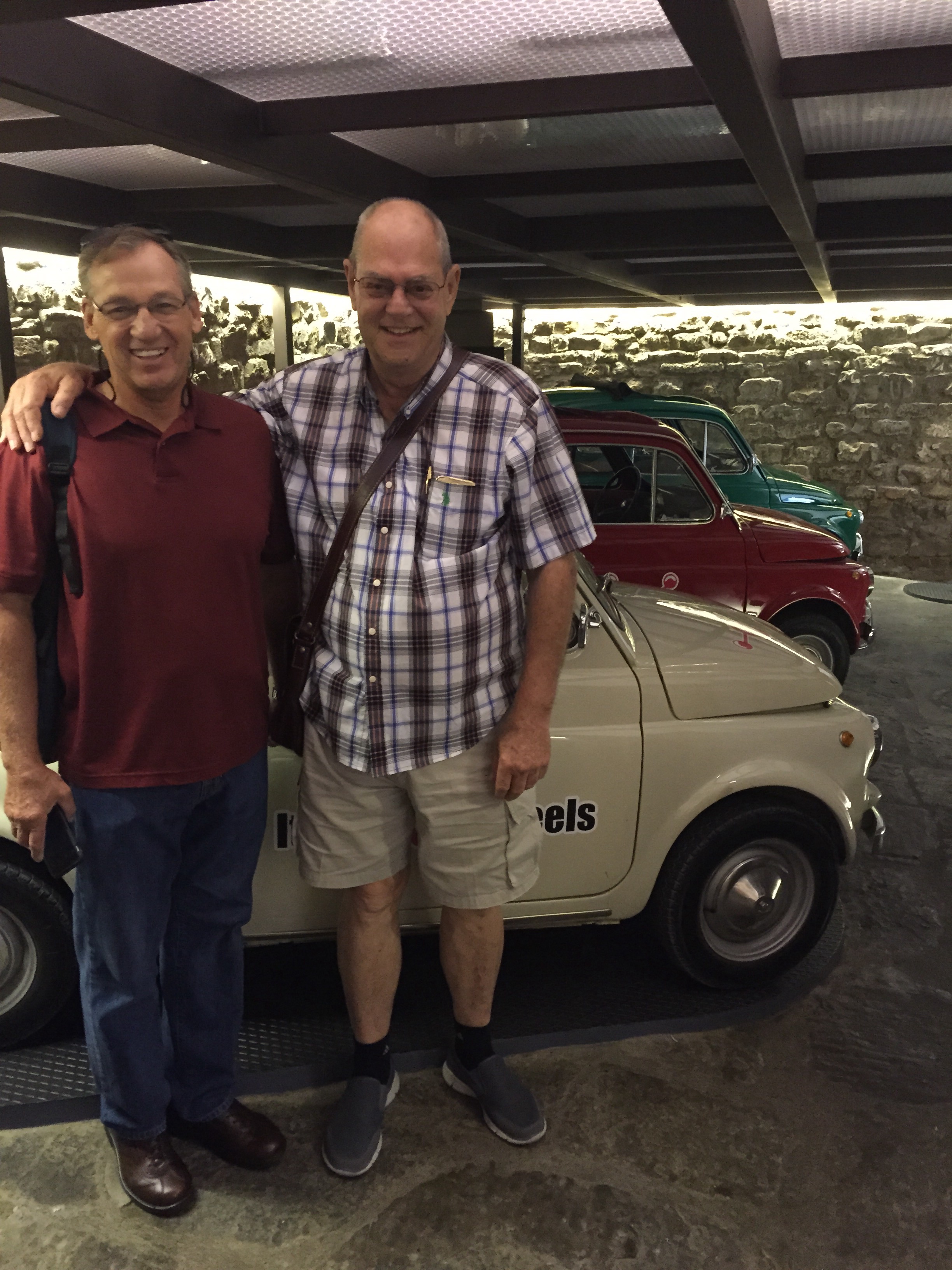
Dan Berg & Allen Krahn in front of an Italian car

Kathy in the garden of the Tuscan farmhouse where our cooking class was held

View of Florence, Italy, from the Tuscan farmhouse where our cooking class was held
Money, Power, Art — Florence
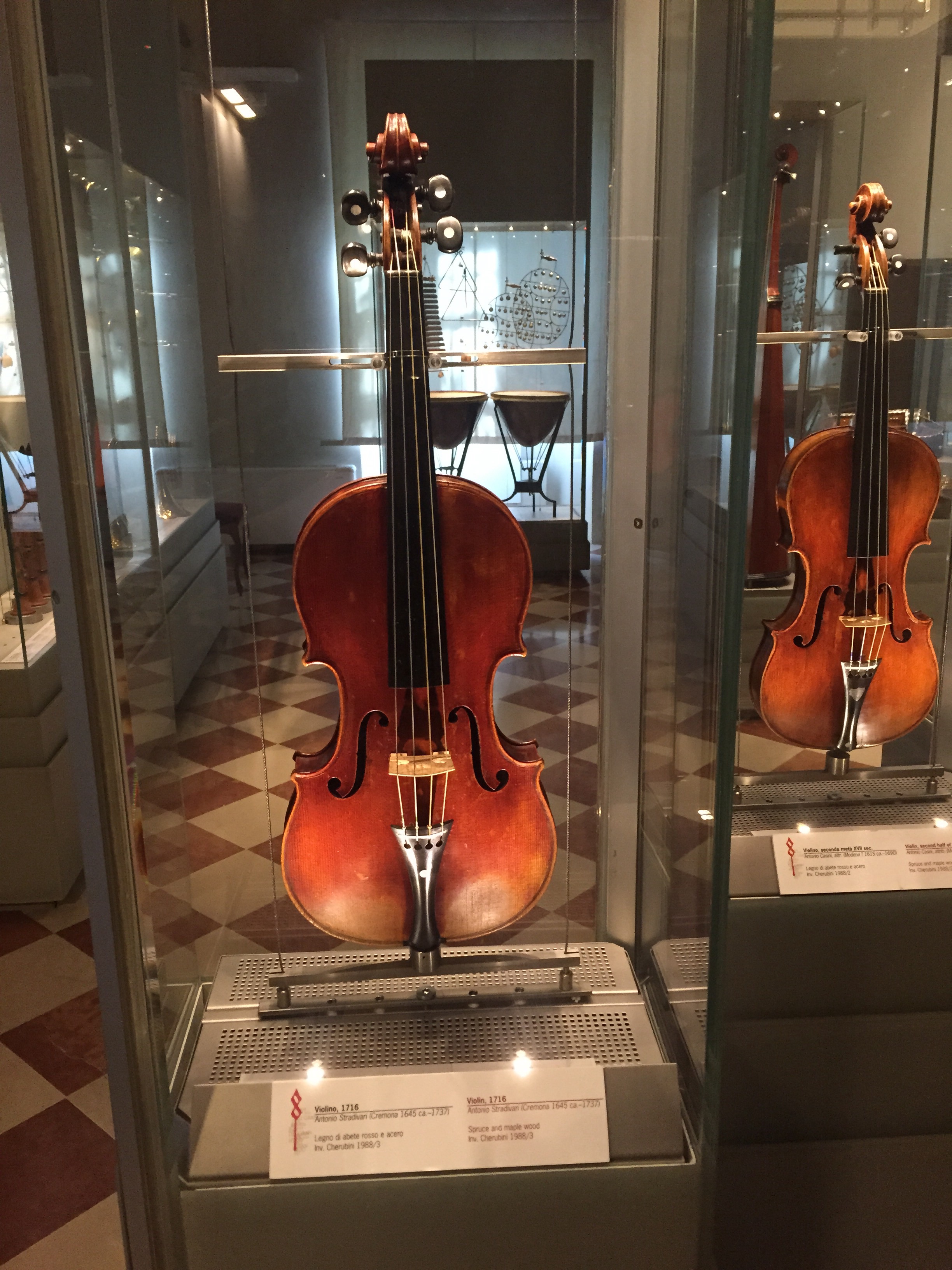
The Stradivarius Red Violin in the Accademia in Florence
And enjoy it we did! Dan Berg and I spent the afternoon at Santa Croce, a beautiful church that is the burial ground of Italy’s heroes and heroines over the centuries. We saw the graves (don’t think of an American cemetery, think huge sarcophagus of marble and marble floor markers) of such famous people as Galileo, Dante, Michelangelo, Leonardo da Vinci, Florence Nightingale, Marconi and the list goes on and on. We also saw the Donatello Christ and the Cimabue crucifix.
Our whole group took a tour to the Academia where the main attraction is Michelangelo’s 17 foot high sculpture of David envisioned as being just before David kills the giant Goliath. Chiseled from one piece of white marble, the artist’s realism is eye-catching. Bone structure and blood vessels are clearly visible. Michelangelo personally believed that sculpture was the highest art form, and David is his greatest achievement. Along the way, we saw a Stradivarius viola and the famed instrument maker’s “red” violin–both the most valuable instruments of their kind.
In the late afternoon, we attended a guided tour of the great Uffizzi Gallery. Here were many of the works of art that most people have seen in one way or another. Allen and Rhonda saw Boticelli’s “Venus” and immediately recognized that a copy of that famous piece hung in their bedroom at home. The great artists’ works hang throughout the 45 room museum. The halls are filled with ancient Greek and Roman statuary. It is simply mind-boggling.
The evening ended at an “Italy as Italy can be” trattoria (local family owned eateries where food is high quality, but priced reasonably–found across Italy) where the food and wine were excellent. Veal stew, roasted rabbit, ravioli with white truffle sauce, chef’s specialty meatballs and fried chicken were main courses. We strolled to our hotel near the cathedral in the cool relaxing evening air. And the day was done. WEG
Wednesday, September 2, 2015
The Stradivarius Red Violin in the Accademia in Florence

Rhonda & Allen Krahn in front of Botticelli’s famous “Birth of Venus” painting in Florence’s Uffizi Gallery

Ponte Vecchio Bridge as seen from a window in the Uffizi Gallery in Florence, Italy
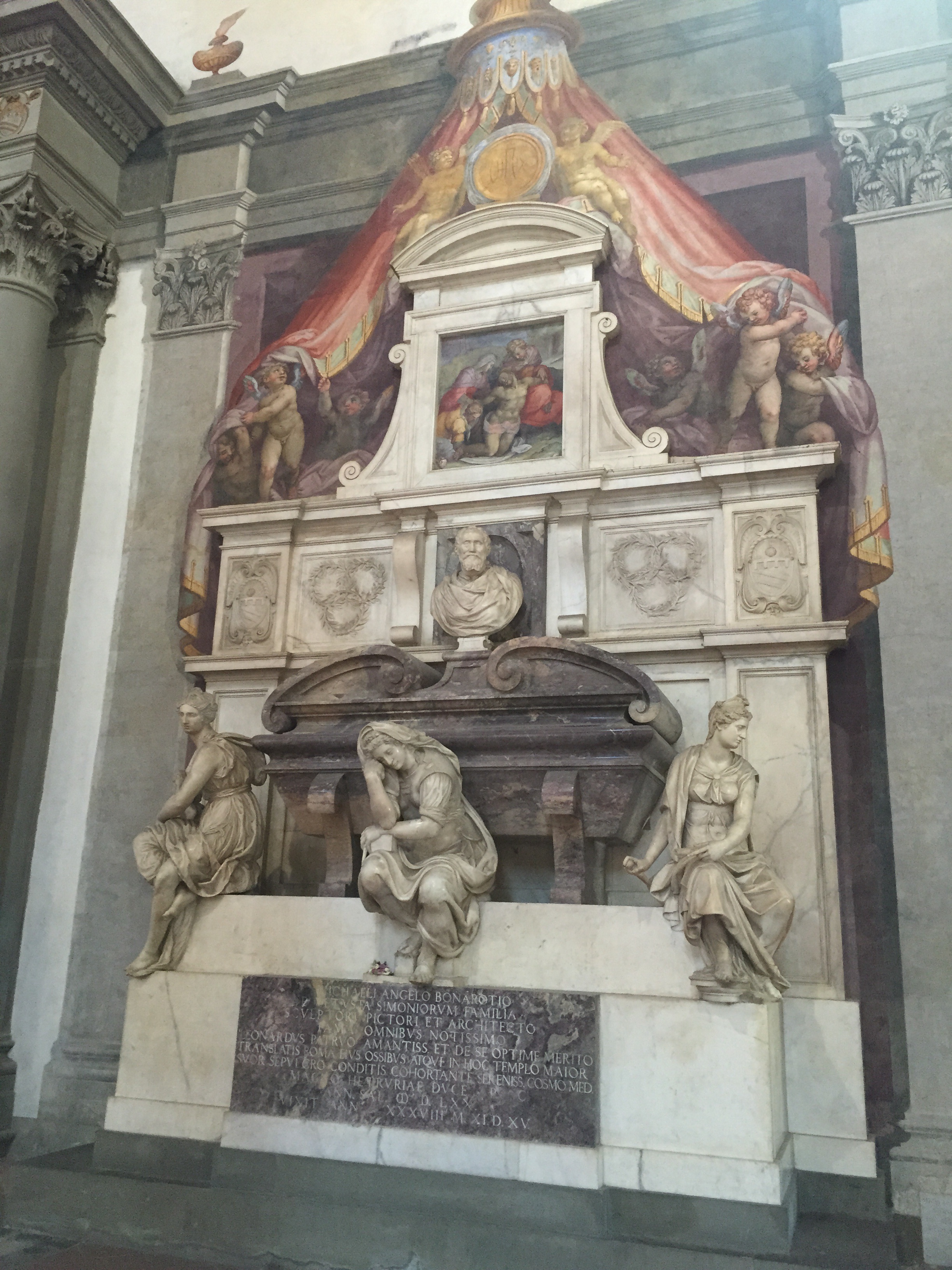
Michelangelo’s Sarcophagus in the Sante Croche, Florence, Italy
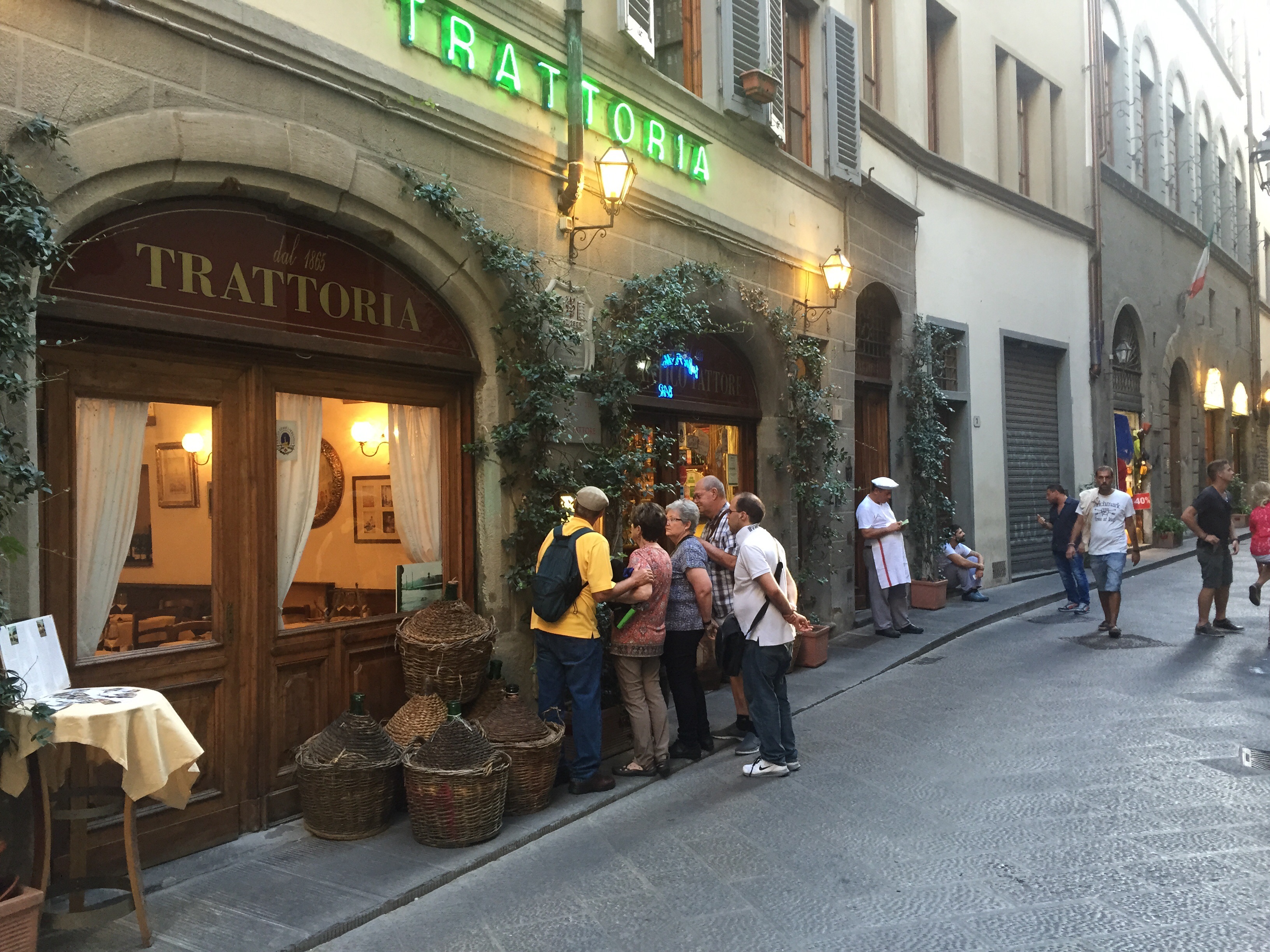
Studying the menu before selecting the trattoria in which we would eat our evening meal in Florence
 kgraumann
 wgraumann
 gofarther.me